Anti-Islanding Protection: Why Your Plug-In Solar System Shuts Off During Outages (And Why Unplugging Is Safe)
By PlugInSolarUS Editorial · Published 2026-05-24 · Updated August 26, 2026 · 12 min read
Anti-islanding is the safety feature that automatically shuts down your plug-in solar system when the grid goes down or when you unplug it. Here's how it works, why unplugging is safe, and what it means for your energy independence.
Safety in context
Connect Anti-Islanding to the Rest of Your Setup
Anti-islanding controls what a grid-interactive inverter does when utility power disappears. It is separate from placement, circuit, property, utility, and battery-backup questions that still need to be checked for the complete setup.
- Return to the system flow — See how panels, the microinverter, household loads, and optional storage work together.
- Understand the broader standard — Review touch safety, overcurrent protection, GFCI interaction, and complete-system requirements.
- Check your state — Confirm how equipment safety requirements fit into the current legal and utility framework.
- Plan backup power separately — Understand direct-device battery backup and the distinction between stored energy and grid backfeed.
Key Takeaway
Anti-islanding is a mandatory safety feature built into every certified plug-in solar inverter. It automatically disconnects your system from the grid within 0.2 seconds of a power outage — and shuts down even faster (under 50ms) when you physically unplug the system. This protects utility workers from electrocution and ensures the plug prongs are electrically dead the instant you pull them from the wall. This is not a flaw — it’s a feature that makes plug-in solar safe for everyone.
What Is Islanding?
Islanding occurs when a distributed energy source — such as a plug-in solar system — continues to energize a section of the electrical grid after the utility has disconnected it. The term comes from the idea of creating an electrical “island”: a section of wiring that remains live while the surrounding grid is dead.
This scenario is extremely dangerous. When a utility disconnects a section of the grid (whether for scheduled maintenance or in response to a storm, accident, or equipment failure), lineworkers assume the wires are de-energized. They follow lockout/tagout procedures and begin working on what they believe are dead lines. If a solar system continues feeding power into those lines, workers can be electrocuted by energy they have no reason to expect.
The risk extends beyond utility workers. Islanding can also damage sensitive equipment, interfere with automatic reclosing devices (which utilities use to restore power after brief faults), and create voltage and frequency conditions that are unsafe for appliances and electronics connected to the isolated section.
Why Anti-Islanding Matters for Plug-In Solar
Traditional rooftop solar systems have always been required to include anti-islanding protection under IEEE 1547 (the interconnection standard for distributed energy resources) and UL 1741 (the safety standard for inverters). Plug-in solar systems are no different — they feed power into your home’s electrical circuits, which are connected to the utility grid through your meter.
Even a small 800W plug-in solar system can produce enough current to be lethal. At 120V, an 800W system produces approximately 6.7 amps — well above the 0.1 amp threshold that can cause cardiac arrest. This is why every certified plug-in solar inverter includes anti-islanding protection, regardless of system size.
The new UL 3700 standard (released December 2025), which is specifically designed for plug-in solar systems, requires anti-islanding as one of its core safety provisions. This standard is referenced in every state plug-in solar bill currently moving through US legislatures.
How Anti-Islanding Detection Works
Modern plug-in solar inverters use a layered approach to detect grid loss, combining passive monitoring with active probing techniques. This dual-layer approach ensures that islanding is detected rapidly and reliably, even in edge cases where passive methods alone might fail.

Passive Detection Methods
Passive methods continuously monitor the electrical characteristics of the grid connection without injecting any signals. They are the first line of defense:
- Under/Over Voltage Protection (UVP/OVP): The inverter monitors the AC voltage at its output terminals. If voltage drops below approximately 88% of nominal (about 106V on a 120V circuit) or rises above 110% (about 132V), the inverter trips. When the grid disconnects, voltage typically changes rapidly because the solar output and local loads are unlikely to be perfectly balanced.
- Under/Over Frequency Protection (UFP/OFP): The inverter monitors the AC frequency. The US grid operates at 60.000 Hz (±0.05 Hz under normal conditions). If frequency drifts outside the window of approximately 59.3–60.5 Hz, the inverter trips. Without the massive inertia of the grid’s generators holding frequency stable, even small power imbalances cause rapid frequency drift.
- Rate of Change of Frequency (ROCOF): Some advanced inverters also monitor how quickly frequency is changing. A sudden acceleration in frequency drift (measured in Hz/second) can indicate grid loss even before the frequency leaves the normal window.
Active Detection Methods
Active methods deliberately introduce small perturbations to test whether the grid is still present. They are essential for detecting “perfect balance” islands — the rare scenario where local generation exactly matches local load, keeping voltage and frequency temporarily stable:
- Active Frequency Drift (AFD) / Sandia Frequency Shift (SFS): The inverter applies a small, deliberate bias to its output frequency — pushing it slightly higher or lower than 60 Hz. When the grid is present, its enormous inertia easily absorbs this bias and holds frequency at 60 Hz. When the grid is gone, there is no “stiffness” to resist the bias, and frequency drifts rapidly until it crosses the trip threshold. This is the most common active method in residential inverters.
- Impedance Measurement: The inverter injects a small test signal (typically at a frequency different from 60 Hz) and measures the impedance response. The grid presents a very low impedance (essentially a massive, low-resistance source). If impedance suddenly increases, it indicates the grid has disconnected and only local loads remain.
- Phase Shift Detection: The inverter slightly shifts the phase angle of its output current relative to voltage. When connected to the grid, the grid’s voltage waveform is unaffected. When islanded, the phase shift causes a measurable change in the voltage waveform, triggering a trip.
The Shutdown Sequence
When anti-islanding protection activates, the sequence happens faster than a human can blink:
- Grid outage occurs (t = 0): A utility circuit opens due to a fault, maintenance, or storm damage.
- Passive detection triggers (t ≈ 0.01s): Voltage and/or frequency begin deviating from normal bounds. The inverter’s passive monitoring flags an abnormal condition.
- Active detection confirms (t ≈ 0.05s): The frequency shift or impedance test confirms the grid is no longer present. This eliminates false positives from normal grid fluctuations.
- Inverter disconnects (t < 0.2s): The inverter ceases to energize. Output current drops to zero. No power flows from the solar system into the home circuits or the grid.
- Reconnection wait (t = 5 minutes): After the utility restores power and the grid is stable, the inverter waits a mandatory period (typically 5 minutes per IEEE 1547) before resynchronizing and ramping back up. This prevents the inverter from reconnecting during brief, unstable restoration attempts.
The entire detection-to-disconnect sequence takes less than 0.2 seconds — faster than the average human reaction time of 0.25 seconds. In practice, most modern inverters trip in under 0.1 seconds. Previous testing of plug-in solar inverters has shown anti-islanding disconnection times well below the 2-second maximum required by UL 1741.
What Happens When You Unplug the System?
One of the most common safety questions about plug-in solar is: “Is it safe to simply unplug my system from the wall outlet?” The answer is yes — and the reason is the same anti-islanding protection described above.
Safety Assurance
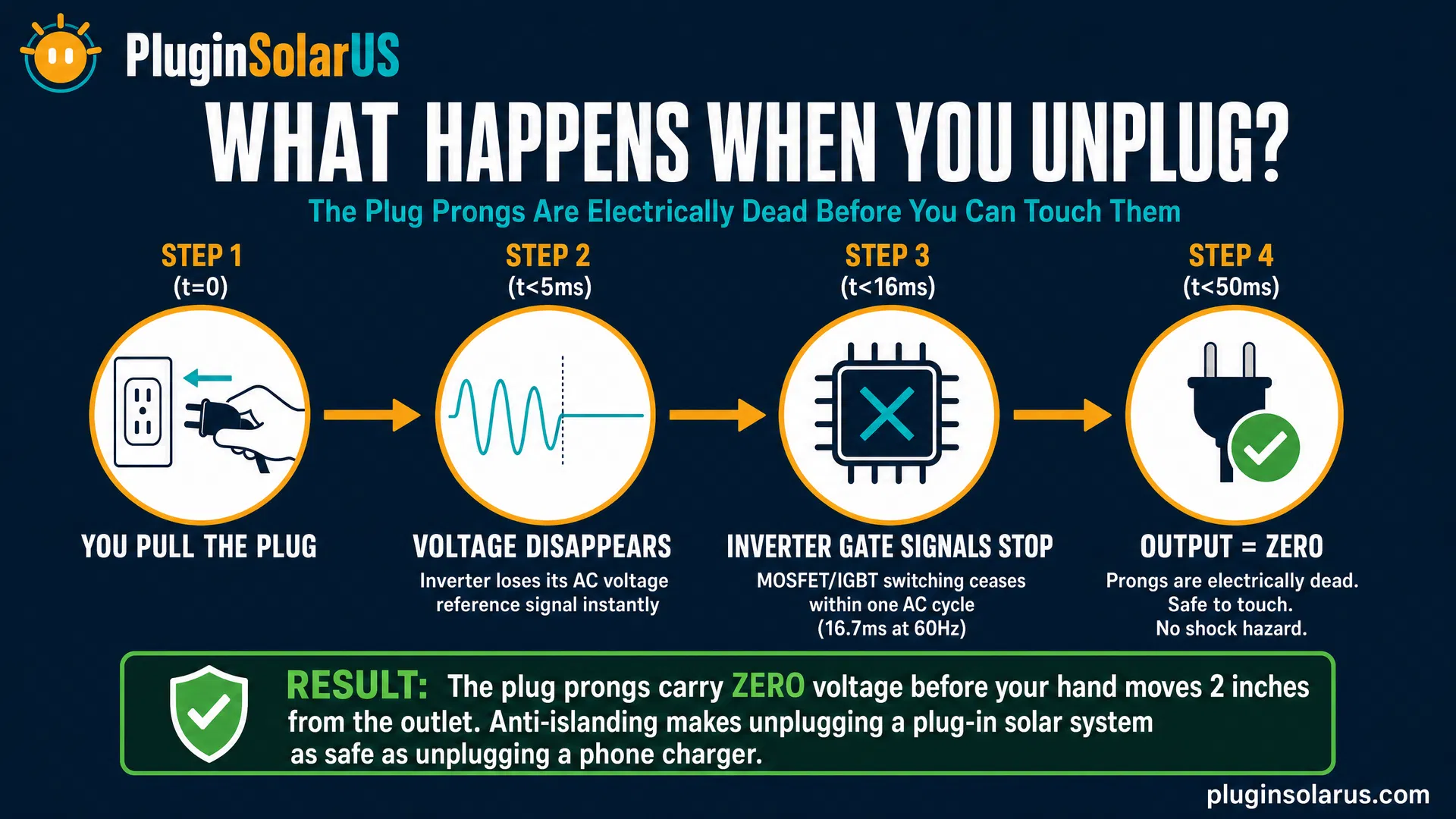
A UL-certified plug-in solar system cannot produce dangerous voltage at its plug when disconnected from the wall outlet. The microinverter ceases output within milliseconds of losing its grid reference signal.
Manufacturer-Supplied Discharge Test Examples
Manufacturer-supplied test data reviewed in August 2026 show that unplugged-output discharge profiles can vary by certified design and test method:
- Test example 1: One manufacturer reported that, when the system was disconnected during operation, AC power was removed from the equipment and cord and the exposed AC plug prongs were de-energized within 0.16 seconds.
- Test example 2: Another manufacturer reported that, with the plug exposed and no external resistors connected, voltage fell to about 34V within approximately 0.5 seconds under both full-load and half-load tests, and phase-to-phase voltage was near 0V within 1 second.
How to interpret these figures: These are product-specific test examples, not universal guarantees. Discharge time, measured voltage, test load, circuit design, and the definition of "de-energized" can differ. Follow the certification documents and manufacturer instructions for the exact system in use.
Why Unplugging Is Safe
A plug-in solar microinverter is a grid-following (also called “grid-tied”) device. It cannot generate AC power independently — it requires an external AC voltage waveform to synchronize with. When you pull the plug from the wall outlet:
- The grid reference disappears instantly. The inverter’s voltage and frequency monitoring circuits detect that the 120V/60Hz signal is gone.
- Anti-islanding triggers immediately. The same passive detection (under-voltage protection) that detects a utility outage also detects a disconnected plug. From the inverter’s perspective, both events look identical — the AC voltage at its output terminals has dropped to zero.
- The inverter ceases to energize within milliseconds. The internal power electronics (typically H-bridge MOSFETs) are gated off. No AC voltage appears at the plug prongs.
- DC voltage remains only inside the sealed unit. The solar panels still produce DC voltage in sunlight, but this energy stays within the sealed, insulated enclosure of the microinverter. It cannot reach the AC plug prongs because the inverter’s switching circuit is open.
The Physics: Why the Plug Prongs Are Safe to Touch
Even if you unplug the system in full sunlight while the panels are producing maximum power, the plug prongs are electrically dead. Here’s why:
- No grid reference = no AC output. The inverter’s control loop requires a stable 60Hz reference to operate its switching transistors. Without it, the transistors remain in their default “off” state.
- Galvanic isolation. Most plug-in solar microinverters include a high-frequency transformer that provides galvanic (electrical) isolation between the DC solar input and the AC output. Even in a fault condition, DC voltage from the panels cannot “leak” to the AC side.
- Bleed-down resistors. Any residual charge in the inverter’s output capacitors is discharged through internal bleed resistors within milliseconds of shutdown. UL 1741 requires that output voltage drops below 30V within 0.5 seconds of disconnection.
Comparison: Unplugging vs. Grid Outage
| Scenario | What Triggers Shutdown | Shutdown Time | Reconnection |
|---|---|---|---|
| Grid outage (utility disconnects) | Voltage/frequency drift detected at outlet | < 0.2 seconds | Automatic after 5-minute wait once grid is stable |
| Unplugged from outlet | Immediate loss of voltage reference (0V detected) | < 0.05 seconds (faster — voltage drops to zero instantly) | Automatic within seconds of being plugged back in |
| Breaker tripped | Same as unplug — immediate voltage loss | < 0.05 seconds | Automatic once breaker is reset and voltage returns |
Key insight: Unplugging is actually faster than a grid outage shutdown because the voltage drops to zero immediately (rather than drifting), so the under-voltage protection triggers on the very first half-cycle (within 8 milliseconds at 60Hz).
Safe Handling Practices
While the system is engineered to be safe when unplugged, following these best practices provides additional peace of mind:
- Unplug at the outlet, not by pulling the cord. This protects the plug and cord from physical damage and ensures a clean disconnection.
- Wait 2–3 seconds before touching the prongs. Although the inverter shuts down in milliseconds, waiting a moment allows any residual capacitor charge to fully bleed down. In practice, the prongs are safe almost instantly, but a brief pause costs nothing.
- Never modify the plug or bypass the GFCI. The GFCI outlet provides an additional layer of protection by detecting any ground fault current (as low as 5mA) and disconnecting the circuit in under 25 milliseconds.
- Inspect the plug periodically. Look for signs of heat damage, discoloration, or loose prongs. A damaged plug should be replaced before reconnecting the system.
What About DC Voltage on the Panels?
The solar panels themselves continue to produce DC voltage whenever exposed to light — this is unavoidable physics. However, this DC energy is contained within the sealed system:
- Panel-to-inverter connections use weatherproof MC4 connectors (not user-serviceable)
- Maximum DC voltage for a typical plug-in system is 30–60V (well below the 120V AC at the outlet)
- The DC wiring is fully insulated and enclosed within the panel frame and inverter housing
- UL 3700 requires that all DC connections be “tool-required” — meaning you cannot accidentally touch live DC conductors without using tools to disassemble the sealed enclosure
In short: the only user-accessible connection point is the AC plug, and that plug is electrically dead within milliseconds of being removed from the outlet.
The Standards Behind Anti-Islanding
| Standard | Scope | Anti-Islanding Requirement |
|---|---|---|
| IEEE 1547-2018 | Interconnection of all distributed energy resources with the grid | DERs must detect unintentional islanding and cease to energize within 2 seconds |
| UL 1741 | Safety of inverters, converters, and controllers for distributed generation | Requires anti-islanding testing per IEEE 1547.1; inverter must pass standardized island detection tests |
| UL 3700 (Dec 2025) | Plug-in solar systems specifically (system-level certification) | Requires anti-islanding as part of whole-system safety; referenced in all US state plug-in solar legislation |
| NEC 705 | National Electrical Code — Interconnected Electric Power Production Sources | Requires listed (UL-certified) equipment for all grid-interactive systems; anti-islanding is implicit through UL listing |
What This Means for You as a Plug-In Solar Owner
Your system WILL shut off during a power outage
If you have a standard grid-tied plug-in solar system (panels + microinverter, no battery), your system will stop producing power the moment the grid goes down. This is not a defect — it is the system working exactly as designed. You will not have solar power during a blackout with a grid-tied-only system.
Battery storage changes the equation
If your plug-in solar system includes battery storage with an inverter that supports intentional islanding (also called “backup mode” or “microgrid mode”), the system can safely disconnect from the grid and continue powering your home from stored energy and ongoing solar production. The key difference is that an intentional island:
- Opens a transfer switch at your meter, physically isolating your home from the grid
- Creates its own stable voltage and frequency reference using the battery inverter
- Ensures zero power flows back onto utility lines
- Complies with IEEE 1547.4 (microgrid interconnection guidelines)
This is how products like the Anker SOLIX and EcoFlow Delta Pro provide backup power during outages while remaining fully code-compliant.
Anti-islanding does NOT reduce your daily savings
During normal grid operation (which is 99.9%+ of the time), anti-islanding protection is completely invisible. It does not reduce your solar production, limit your savings, or affect system performance in any way. The detection circuits consume negligible power (less than 0.1W) and only activate their trip function when an actual grid anomaly is detected.
Common Misconceptions
| Myth | Reality |
|---|---|
| “Plug-in solar is dangerous because it can electrocute lineworkers” | False. Every certified inverter includes anti-islanding that disconnects in < 0.2 seconds. This is the same protection used in rooftop solar for decades. |
| “I can use my plug-in solar during a blackout” | Only if you have battery storage with intentional islanding capability. A panels-only system will shut off during outages. |
| “Anti-islanding wastes my solar energy” | No. During normal operation (99.9%+ of the time), anti-islanding is invisible and consumes essentially zero power. |
| “Cheap inverters skip anti-islanding to save costs” | Any inverter sold legally in the US must be UL-listed, which requires passing anti-islanding tests. Non-listed products cannot legally be connected to the grid. |
How US State Laws Address Anti-Islanding
Every enacted and pending US plug-in solar law addresses anti-islanding through equipment certification requirements:
- Utah HB 340: Requires UL-listed equipment, which inherently includes anti-islanding through UL 1741 certification
- Colorado HB 26-1007: Explicitly requires compliance with IEEE 1547 interconnection standards
- Maine LD 1730: Requires equipment certified to applicable UL standards (including UL 3700 when products become available)
- California SB 868: Requires UL certification and compliance with NEC Articles 690 and 705
The legislative approach is consistent: rather than specifying technical detection methods (which would become outdated as technology evolves), laws require compliance with industry standards that already mandate anti-islanding. This ensures safety while allowing manufacturers to innovate on detection techniques.
The Bottom Line
Anti-islanding protection is what makes plug-in solar safe for widespread residential adoption. It is not optional, not removable, and not something consumers need to configure or maintain. Every certified plug-in solar inverter sold in the United States includes this protection as a fundamental safety feature.
For the vast majority of the time, you will never know it’s there. Your system will produce power, reduce your electricity bill, and operate silently. The only time anti-islanding becomes visible is during a power outage — and in that moment, it’s protecting the lives of the workers restoring your power.
If backup power during outages is important to you, the solution is not to disable anti-islanding (which is illegal and dangerous) but to add battery storage with intentional islanding capability. See our How It Works guide for more on battery-backed systems.
Sources
- Anern: IEEE 1547 & Anti-Islanding: PV Shutdowns Explained (August 2025)
- Gerber et al.: Barriers to Balcony Solar and Plug-In DERs in the United States, Energies 18(8), 2132 (April 2025)
- UL Solutions: Testing and Certification Framework for Safer Plug-In Solar (January 2026)
- WIRED: Why Balcony Solar Panels Haven’t Taken Off in the US (May 2025)
- IEEE 1547 Standard Overview — IEEE Power & Energy Society
New: Find your plug-in solar fit
Our new Product Finder makes it easier to discover and compare plug-in solar kits and components across brands. See panel DC and inverter AC output alongside listed prices, known shipping, and required fees to find options worth exploring. A listing is not approval to install; these solar-only offers do not provide outage backup. Find and compare products.