Behind the Bill: How Colorado Built One of America’s Most Advanced Plug-In Solar Laws
By PlugInSolarUS Editorial · Published 2026-06-30 · 22 min read
Rep. Lesley Smith, Sen. Cathy Kipp, and Sen. Matt Ball’s office explain how Germany, Utah, renters, wildfire resilience, meter collars, and months of stakeholder work shaped HB26-1007.
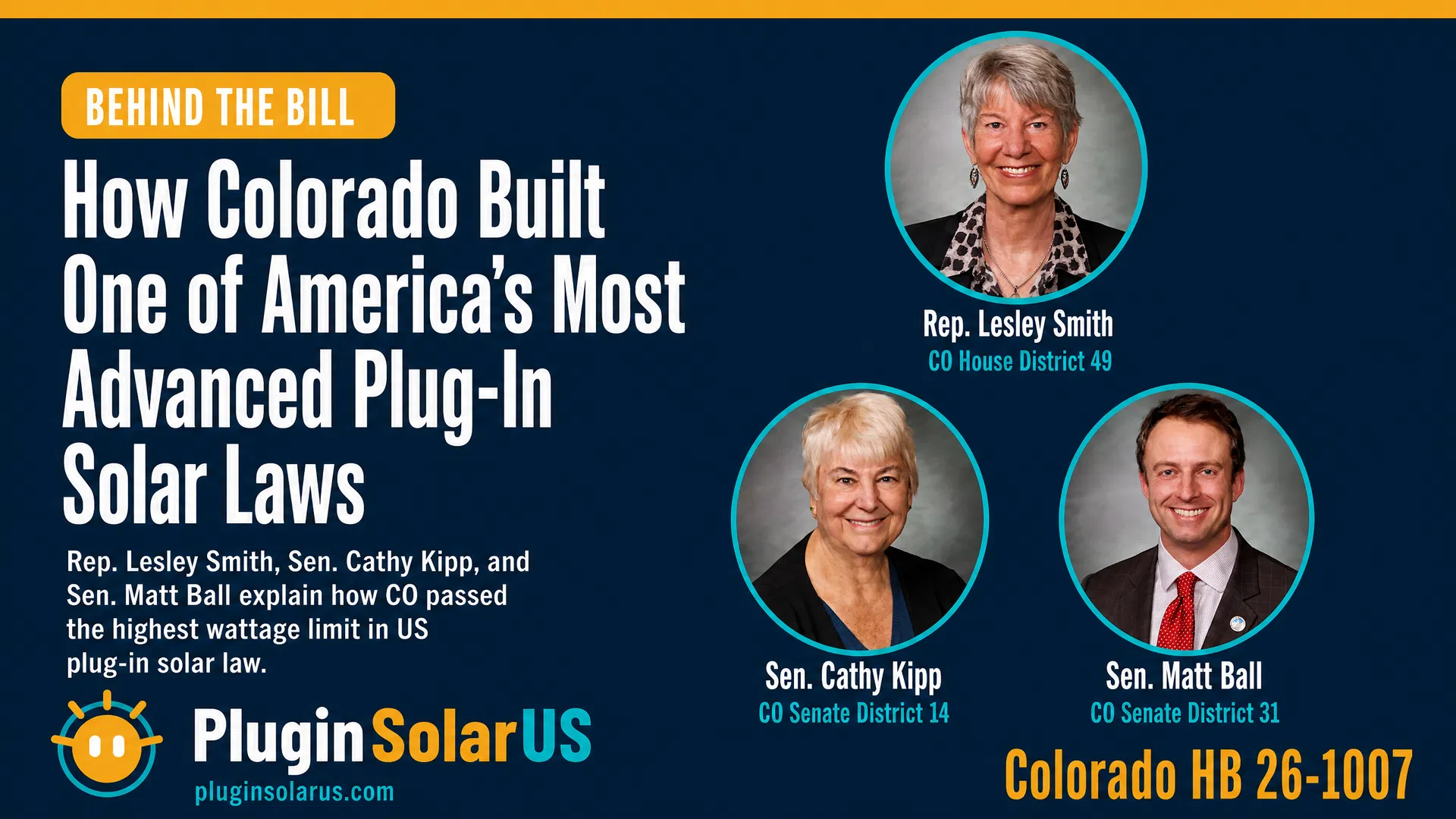
Editor’s Note: This article is part of PluginSolarUS.com’s “Behind the Bill” series, which explores how different states are approaching plug-in solar legislation, consumer access, safety, and implementation. The article is based on interviews with Colorado Rep. Lesley Smith, Sen. Cathy Kipp, and a representative of Sen. Matt Ball’s office, along with public legislative materials for Colorado HB26-1007 / Chapter 127, “Improve Customer Use Distributed Energy Resources.” The discussion reflects the status of Colorado’s plug-in solar law and related standards as of the publication date. Product certification, electrical code requirements, utility practices, building and fire code rules, and implementation details may continue to evolve. For a full overview of Colorado’s plug-in solar status, see our Colorado state page.
A German balcony, a Utah bill, and a Colorado opening
For Rep. Lesley Smith, Colorado’s plug-in solar story began thousands of miles away from Denver.
While visiting family in the Heidelberg area of Germany, Smith noticed something that has become increasingly common across Europe: small solar panels hanging from balconies and mounted in ordinary residential spaces. As she traveled, she kept seeing them. They were simple, visible, and consumer-facing in a way that most U.S. solar policy is not.
Then she returned to Colorado.
Almost immediately, a constituent emailed her about Utah’s new plug-in solar law and asked whether Colorado could do something similar. Around the same time, the Colorado Solar and Storage Association, or COSSA, encouraged her to run a bill. When Smith mentioned the idea at a town hall, the room applauded.
Smith later described the moment as a “perfect storm”: Germany showed the product category in real life, Utah showed that a state-law pathway was possible, COSSA brought industry momentum, and constituents were already asking for action.
Sen. Cathy Kipp saw the same surge of interest from another direction. After Utah passed its bill, Colorado legislators began receiving emails from residents asking why Colorado could not do the same. Kipp said the idea generated unusual excitement because people could immediately understand it: a small solar panel, a balcony or patio, and a more affordable way to produce some of your own power.
By the time HB26-1007 became law, Colorado had not merely copied Utah. It had built one of the most ambitious plug-in solar frameworks in the country, pairing a higher system-size limit with meter-collar provisions, property-rights language, and a detailed stakeholder compromise across utilities, solar advocates, electricians, HOAs, apartment interests, and state regulators.
What Colorado’s law does
Colorado’s HB26-1007, enacted as Chapter 127, is officially titled “Improve Customer Use Distributed Energy Resources.” The law creates a framework for “portable-scale solar generation devices,” while also addressing meter-collar adapters that can simplify interconnection for certain distributed-energy systems.
At a high level, the law does several important things:
- Defines and creates requirements for portable-scale solar generation devices.
- Prohibits retail electric or wholesale energy providers from requiring customer approval before installing or using a qualifying portable-scale solar generation device.
- Makes unreasonable prohibitions or restrictions on qualifying devices unenforceable, while still allowing reasonable restrictions related to safety, securing devices, and property concerns.
- Clarifies that installation must comply with fire code and applicable health-and-safety building code requirements.
- Specifies that utilities are not liable for damage caused by a portable-scale solar generation device.
- Requires the Colorado Public Utilities Commission to revise interconnection rules for commission-regulated utilities regarding meter-collar adapters, including public lists, approval processes, cost-estimate processes, and installation procedures.
Colorado’s statute also names the prime sponsors: Reps. Lesley Smith and Rebekah Stewart, and Sens. Cathy Kipp and Matt Ball. The bill became law after passing the House and Senate in spring 2026 and being signed by Gov. Jared Polis on May 7, 2026.
Some provisions and implementation details are staged. The official legislative summary notes an effective date of August 12, 2026, while also describing certain treatment of portable-scale solar generation devices as an energy-efficiency measure on and after January 1, 2027. For consumers, retailers, utilities, and HOAs, the practical timeline will also depend on product availability, standards, code interpretation, and regulator implementation.
Why Colorado went bigger
One of the most notable features of Colorado’s law is its higher upper limit. While several other state plug-in solar laws use a 1,200-watt framework, Colorado’s portable-scale solar provision reaches up to 1,920 watts, making it one of the most expansive explicit limits in the United States.
Kipp described the policy instinct simply: Colorado wanted to give people “as much as we can” within a framework that could still satisfy safety and stakeholder concerns.
Smith said the 1,920-watt limit emerged from coalition discussions. Utah was the main model available at the time, but the Colorado coalition believed the state could improve on the initial approach. Germany’s experience helped create confidence that smaller consumer-scale solar devices could become a mainstream category if the rules were clear and the products were safe.
Still, both Smith and Kipp emphasized that technical details should be handled carefully. Legislators were not trying to invent electrical standards on their own. They relied heavily on COSSA, technical experts, and stakeholder negotiations to translate policy goals into workable statutory language.
That is an important distinction. Colorado’s higher limit is a policy signal, but the market will still need compliant products, clear standards, safe installation practices, and practical education before consumers can use the law at scale.
Access: renters, apartments, condos, and mobile-home parks
For all three Colorado offices interviewed, access was the central story.
Traditional rooftop solar works well for some homeowners, but it leaves out large parts of the population. Renters usually cannot install panels on a roof they do not own. Condo owners and HOA residents may face restrictions or complicated approvals. Apartment residents may lack roof access entirely. Mobile-home residents may want solar but may not be able to mount panels on their homes. Even homeowners with suitable roofs may not be able to afford a full rooftop system.
Smith said renter portability is one of the most exciting parts of the category. A renter could potentially buy a panel, use it at one residence, and take it to the next. Kipp similarly highlighted apartment residents, condominium owners, and mobile-home residents as the kinds of Coloradans who have been locked out of rooftop solar but may want a smaller way to participate in the clean-energy economy.
Sen. Ball’s office added a dense-urban perspective. Ball represents Central and Eastern Denver, where many residents live in apartments, condos, and rental housing. From that district perspective, plug-in solar is not only a technology story. It is an affordability and access story for people who live in the kinds of homes that conventional rooftop solar does not reach.
That access story also explains the political appeal. Plug-in solar is easy to visualize. It is not an abstract grid rule or wholesale-market reform. It is a product a resident can imagine putting on a balcony, patio, porch, or yard.
Affordability: a lower-cost entry point
Colorado lawmakers repeatedly returned to affordability.
Rooftop solar can cost tens of thousands of dollars before incentives. A plug-in solar device is much smaller, but it is also much cheaper. For a resident who cannot spend the money for a full system, the ability to buy a smaller product could matter.
Ball’s office contrasted a traditional rooftop system that can cost up to around $30,000 with a plug-in solar option that might eventually fall into a much lower consumer price range. Kipp described the category as a way for people who “want to do something” but cannot afford rooftop solar to begin participating anyway.
That does not mean plug-in solar will eliminate a household electric bill. Colorado lawmakers were clear that consumer expectations must be realistic. A plug-in system will not run an entire house. It will not charge an electric vehicle the way a full rooftop array might. But it may offset small loads, reduce some consumption, and help residents feel a direct connection to producing their own electricity.
In a high-cost household environment, even small bill reductions can matter. The key is education: consumers need to know what the device can power, what it cannot power, and what kind of payback to expect based on price, location, usage pattern, and utility rates.
Resilience: a Colorado-specific driver
Colorado’s plug-in solar debate was also shaped by wildfire and high-wind conditions.
Kipp pointed to public-safety shutoffs as a growing concern. In Colorado, high winds and wildfire risk have led utilities to shut off power lines to reduce fire danger. Those outages can create real risks for residents who need to keep phones charged, computers running, or medication refrigerated.
Plug-in solar is not a whole-home backup system. But Kipp saw value in a small, affordable source of energy that could help keep essential items going during a temporary outage, especially if paired with a battery.
Smith’s safety concerns were shaped by the same outage context from another angle. She described major winter outages and emphasized that small solar systems must not energize utility lines while workers are repairing the grid. Anti-islanding and shutdown behavior are not technical footnotes; they are central safety requirements.
That duality is important. Plug-in solar can support resilience, but only if it is designed and installed safely. During an outage, a system that is not properly isolated can create hazards. Colorado’s law therefore points toward a future in which consumer-scale solar and storage may help with resilience, but certified equipment and safe grid behavior remain non-negotiable.
The hard part: utility and stakeholder negotiations
Colorado’s bill was popular with many residents, but it was not effortless.
Smith described extensive stakeholder work with Xcel Energy, rural electric cooperatives, municipal utilities, IBEW, apartment interests, HOA stakeholders, COSSA, and other advocates. By the time the bill reached the Senate, much of the groundwork had already been done by Smith and her team, but Kipp said there were still stakeholder concerns to work through before the bill could reach the finish line, particularly around safety language and utility comfort with implementation.
Xcel was generally more comfortable with the direction of the bill, according to the interviews, but some rural electric associations and municipal utilities were more cautious. That distinction matters in Colorado because the state has a mix of investor-owned utilities, municipal utilities, and cooperative electric associations. A rule that works smoothly for one category may raise different concerns for another.
Kipp described the core disagreement as a question of framing. Solar advocates worried that utilities wanted veto power over whether customers could use plug-in solar. Utilities said they were focused on safety and operational certainty. The final bill was a compromise: it protected the customer’s right to use qualifying portable-scale solar devices while giving utilities additional language and processes around safety, meter collars, and implementation.
That is one of Colorado’s biggest lessons. Passing plug-in solar legislation is not only about saying “yes” to a new product category. It is about writing language that homeowners, renters, utilities, electricians, property owners, regulators, and retailers can all live with.
Meter collars: the other major innovation
Although plug-in solar gets the headline, Colorado’s bill also includes important meter-collar provisions.
A meter collar adapter is installed between an electric meter socket and the utility billing meter. In some cases, it can provide a simpler way to interconnect customer-owned solar, storage, or other distributed-energy devices without requiring a major electrical panel upgrade.
For Smith, the meter-collar language was one of the most important innovations in the Colorado bill. She said the coalition knew there had to be a “line in the sand” on certain core provisions, and meter collars were one of them.
The enacted law requires the Public Utilities Commission to revise interconnection rules by December 31, 2026, for commission-regulated utilities. Those rules must address public lists of approved meter-collar adapters, approval processes for adapters not already listed, customer request processes, cost estimates when meter relocation or housing replacement is needed, and installation by qualified parties such as registered electrical contractors or master electricians where applicable.
The law also requires cooperative electric associations and municipally owned utilities to address meter-collar adapter processes. That broader coverage is part of what makes Colorado’s law more ambitious than a narrow plug-in solar bill.
Meter collars may not be as immediately intuitive to consumers as a balcony solar panel. Even Kipp said the public more readily understands plug-in solar than meter collars. But for the distributed-energy ecosystem, meter collars could be just as important because they may reduce interconnection cost and friction for larger solar, storage, and home-energy upgrades.
Safety: UL, codes, anti-islanding, wind, and property rules
Colorado’s law is built around the idea that access and safety have to advance together.
The official legislative summary states that portable-scale solar generation device installation must comply with fire code requirements and applicable health-and-safety building codes. The interviews also repeatedly referenced UL certification/listing and grid-safe behavior. Smith emphasized that systems must shut down during outages so they do not energize lines. Kipp described UL certification as the core safety baseline, while also acknowledging that utilities wanted additional language beyond UL alone.
Colorado also had safety concerns that are very local. Smith noted that the state can see very high winds, sometimes up to 100 miles per hour. That makes anchoring and mounting guidance more important than in some other places. Apartment and HOA stakeholders also worried about drilling into walls, damaging buildings, modifying wiring, or placing equipment in common areas.
The final law reflects that reality. It prevents unreasonable restrictions, but it does not erase reasonable safety and property rules. A real property owner may require reasonable restrictions. A homeowner in a common-interest community may be required to reasonably secure a device and may be responsible for costs or liability associated with installation, maintenance, or removal.
In plain English: Colorado is saying consumers should have a pathway, but not a free-for-all. Safe products, secure mounting, code compliance, property respect, and realistic use all matter.
A gateway into the broader solar and storage market
Kipp used a memorable phrase for plug-in solar: a gateway.
COSSA saw the same potential. A small plug-in solar device may be the first solar product a household ever buys. It may help residents understand how much power common devices use. It may make them more interested in rooftop solar, storage, EV charging, meter collars, virtual power plants, or home-energy management.
That gateway framing is especially important because plug-in solar by itself is small. The policy significance is not only the wattage of one device. The significance is the behavior it may unlock: more people paying attention to their energy use, more consumers participating in distributed energy, more demand for safe products, and more political support for grid modernization.
Smith also placed plug-in solar in Colorado’s broader clean-energy journey. She framed it as one of many tools needed to move toward 100% clean energy: rooftop solar, ground-mounted solar, storage, meter collars, electrification, and future distributed-energy business models.
In that sense, Colorado’s law is not only about balcony solar. It is about creating a more flexible architecture for customer-owned distributed energy.
Data centers and the larger energy-cost debate
Like other states, Colorado is also facing a larger debate over data centers, grid demand, and who pays for new infrastructure.
Kipp was careful not to overstate plug-in solar’s role. Data centers represent a massive load issue. Small consumer solar devices will not solve that problem. But they can help households reduce some consumption and build resilience at the edge of the grid.
Kipp also pointed to her separate work on data-center policy. Her view is that large new loads should pay their own way rather than shifting costs onto ordinary customers. She noted that Colorado’s Public Utilities Commission has moved in that direction for investor-owned utilities, but municipal utilities and rural electric associations are outside that same jurisdiction, making statewide solutions more complicated.
That distinction helps frame plug-in solar properly. It is not a substitute for serious data-center regulation, transmission planning, utility cost allocation, or resource adequacy. It is a household-scale tool that belongs in the same broader conversation about rising electricity costs and customer empowerment.
What still needs to happen
Colorado has created the legal pathway. The market still has to catch up.
Across the interviews, the next steps were clear:
- Compliant products need to become available. Consumers need devices that meet applicable safety standards and can be sold through trusted channels.
- Regulators and utilities need to implement the meter-collar provisions, including public lists, approval processes, and customer-request procedures.
- Retailers, manufacturers, electricians, installers, and utilities need clear guidance on what is allowed, what is required, and when professional installation is needed.
- Consumers need practical education about what these devices can power, how they interact with outages, what they cost, how much they save, and how to use them safely.
- Property owners, HOAs, apartment operators, and local officials need plain-English guidance on reasonable restrictions, secure mounting, common areas, wind, and building impacts.
Kipp said she had heard estimates that product readiness might take two to three years, but she was encouraged by the possibility that the standards and certification timeline could be shorter. If compliant products become available in six to twelve months, she said Colorado should know quickly so legislators and advocates can help inform the public.
Smith similarly cautioned that the U.S. market is not yet like Europe. Major retailers may eventually carry these products, but the category will need time, volume, standards, and trust.
Lessons for other states
Colorado’s experience offers several lessons for states considering plug-in solar legislation.
First, the idea is politically powerful because people understand it. Kipp said plug-in solar generated real excitement in Colorado because it was relatable. Residents could picture it. They could imagine using it.
Second, stakeholder work is not optional. Smith’s strongest advice to other lawmakers was to do the stakeholding. Utilities, co-ops, municipal utilities, electricians, apartment associations, HOAs, consumer groups, and solar advocates all see different risks. The bill improved through amendments because the sponsors kept working through those concerns.
Third, lawmakers need to know what can be compromised and what cannot. Smith said there has to be a line in the sand. If a stakeholder can simply block the category, the bill loses its purpose. But if lawmakers ignore real safety, property, and grid concerns, the bill may not be workable.
Fourth, consumer education should be built into the policy strategy from the beginning. Plug-in solar is easy to understand at the concept level, but the details are not always obvious. A device that offsets a refrigerator is different from a device that backs up a whole home. A panel on a patio is different from a rooftop system. A safe certified device is different from an unlisted online product.
Finally, states should think beyond the first product. Plug-in solar may be the consumer-facing tip of a larger shift toward storage, meter collars, home-energy management, VPPs, and better rate design.
A message to Colorado residents
Smith’s message to residents was simple: Colorado has 300 days of sunshine, and plug-in solar gives more people a way to capture some of it.
That does not mean every consumer should buy the first product they see online. The right message is more careful: Colorado is opening a pathway, but consumers should wait for compliant products, understand safety requirements, follow code and property rules, and keep expectations realistic.
Kipp’s message was similar. Plug-in solar can be safe and legal when it uses the appropriate certified equipment and follows the law. It will not run a whole house. But it can help with small useful loads, reduce bills, support resilience, and bring more people into the clean-energy economy.
For apartment residents, condo owners, mobile-home residents, and households priced out of rooftop solar, that matters.
Why Colorado matters nationally
Colorado’s HB26-1007 matters because it shows how quickly the plug-in solar policy conversation is evolving.
Utah proved that a narrow state-law fix could create a pathway. Colorado went further by pairing plug-in solar with meter collars, addressing multiple utility categories, protecting against unreasonable property restrictions, and pushing the system-size framework higher than most early state laws.
That does not mean Colorado’s law is the final model. The market is still early. Standards and products are still developing. Utilities and regulators still have implementation work to do. But Colorado has shown that a state can move beyond a simple permission bill and begin building a broader distributed-energy framework.
The next phase will determine how much of the promise becomes real: certified products, safe installation, retailer availability, consumer education, and utility implementation.
If those pieces come together, Colorado’s plug-in solar law may be remembered not only for its 1,920-watt limit, but for something larger: turning a simple consumer idea into a doorway for broader participation in the clean-energy system.
Source Notes: Primary sources for this article include interviews with Rep. Lesley Smith regarding Colorado HB26-1007 and the origin, stakeholder process, safety issues, and meter-collar provisions; an interview with Sen. Cathy Kipp regarding stakeholder negotiations, access, resilience, utility concerns, and consumer education; an interview with a representative of Sen. Matt Ball’s office regarding affordability, renter access, and district-level perspective; Colorado General Assembly materials for HB26-1007 / Chapter 127, “Improve Customer Use Distributed Energy Resources”; and public legislative and advocacy materials related to Colorado plug-in solar, meter-collar adapters, and distributed-energy implementation. Direct quotes from interviews have been lightly edited for clarity and readability without changing their intended meaning. Key quotes, technical references, wattage thresholds, and statutory interpretations should be verified with the relevant offices and technical stakeholders before publication.
Disclaimer: PluginSolarUS.com provides general educational information only. This article is not legal, electrical, engineering, product-safety, installation, or financial advice. Before purchasing or installing any plug-in solar, portable solar, solar-plus-storage, battery, inverter, meter-collar adapter, or related electrical product, consumers should confirm current requirements with applicable state law, local building and electrical authorities, fire officials where relevant, their utility, their landlord or HOA where applicable, and a qualified electrician if needed. Consumers should use only properly certified or listed products that comply with applicable safety standards, electrical codes, manufacturer instructions, and local requirements. Laws, standards, utility rules, product certifications, billing practices, metering requirements, and installation requirements may change over time. Estimated savings, payback periods, product availability, and eligibility vary by electricity rates, system size, location, product cost, installation requirements, metering configuration, tariffs, incentives, and local rules. Nothing in this article should be interpreted as a recommendation to install any electrical product in a way that violates applicable codes, utility rules, manufacturer instructions, lease terms, HOA rules, or safety requirements.
Sources
- Rep. Lesley Smith, sponsor of Colorado HB26-1007
- Sen. Cathy Kipp, sponsor of Colorado HB26-1007
- Colorado HB26-1007 / Chapter 127 — Colorado Legislature
- Colorado Sun: What’s plug-in solar? Colorado legislators promote a bill to help eager consumers find out
- Coloradoan: Colorado clears path for plug-in solar, a more affordable option