Behind the Bill: How Maine Built a Plug-In Solar Law — and Now Has to Make It Work
By PlugInSolarUS Editorial · Published 2026-07-13 · 20 min read
Rep. Gary Friedmann, Amy Eshoo, and Beth Woolfolk explain how LD 1730 grew from Germany, Utah, and grassroots climate organizing — and why the next phase is all about safety, electricians, bulk purchasing, batteries, and consumer education.
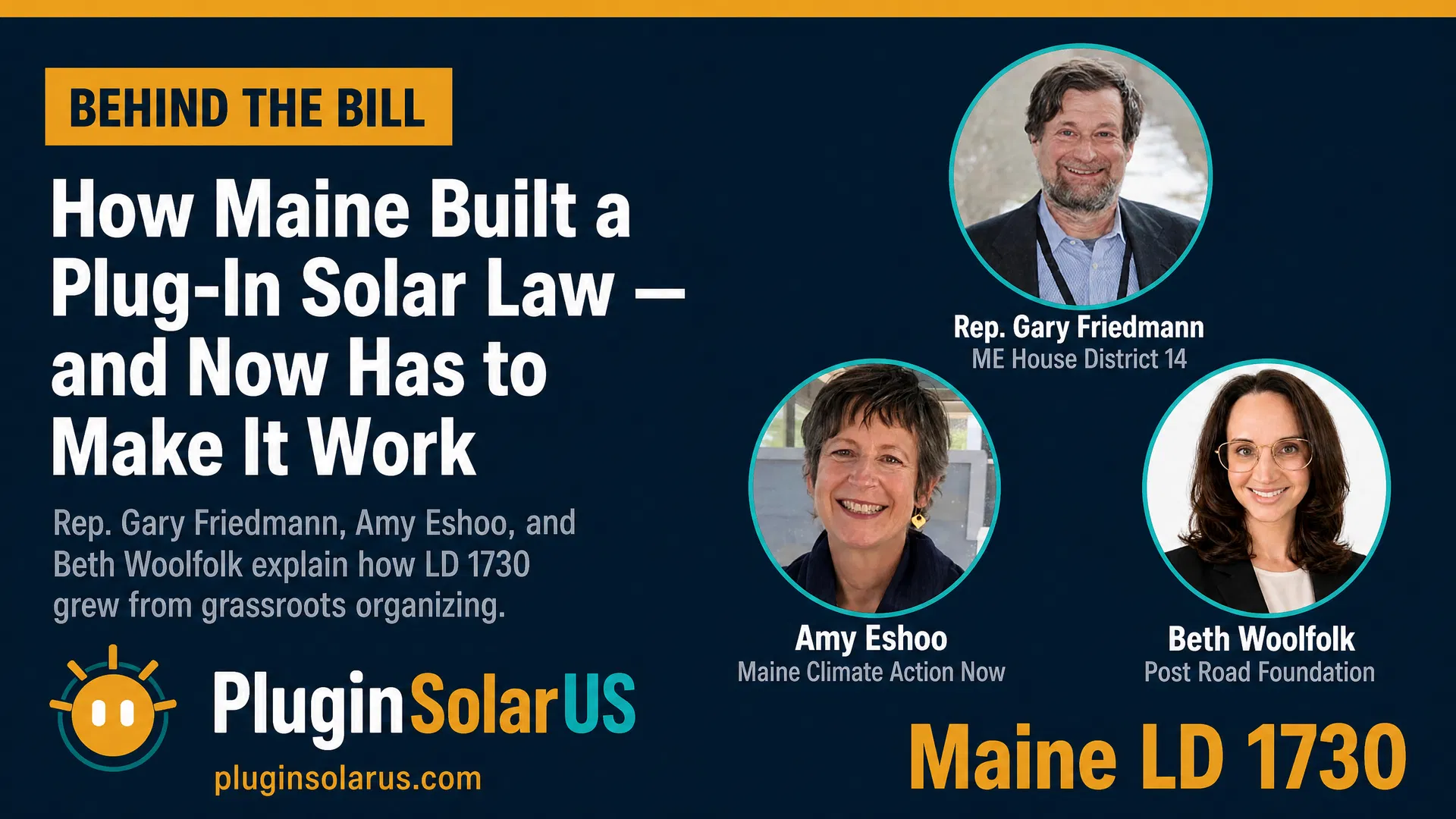
Editor’s Note: This article is part of PluginSolarUS.com’s “Behind the Bill” series, which explores how different states are approaching plug-in solar legislation, consumer access, safety, and implementation. This article is based on interviews with Maine State Rep. Gary Friedmann of District 14, Amy Eshoo of Maine Climate Action Now, and Beth Woolfolk, who worked on the bill as Manager of Community Energy Planning and Policy at A Climate to Thrive and later transitioned to the Post Road Foundation. For a full overview of Maine’s plug-in solar status, see our Maine state page.
A law is only the beginning
When Maine moved LD 1730 forward, the state did more than follow Utah into the emerging U.S. plug-in solar movement. It also created a test case for what happens after a law passes but before the market, safety standards, electricians, retailers, manufacturers, and consumers are fully ready.
That is the central lesson from Maine’s story. The bill opened a pathway. But the hard work now is implementation: finding compliant products, explaining the rules to residents, building electrician capacity, making utility notification simple, and turning a promising idea into something ordinary Mainers can safely use.
Rep. Gary Friedmann, who sponsored the bill alongside Sen. Nicole Grohoski of District 7, framed the idea around climate action and the rising cost of electricity. Amy Eshoo, Director of Maine Climate Action Now, framed it around energy democracy and energy justice. Beth Woolfolk, who worked on the bill as Manager of Community Energy Planning and Policy at A Climate to Thrive, traced the idea back to a simple question: if Germany could make small plug-in solar systems widely available, could Maine adapt the concept for its own residents?
From Germany to Utah to Maine
Beth Woolfolk’s path to plug-in solar began with research. As federal clean-energy incentives looked uncertain and funding opportunities became harder to rely on, A Climate to Thrive began looking at what other countries were doing to expand solar access. Germany stood out.
In Germany, small plug-in solar systems had already become part of the consumer-energy landscape. For Woolfolk, the idea immediately matched a gap she had seen in years of community energy work in Maine. Many people wanted solar, but could not afford a full rooftop system, did not own their roof, lacked a suitable roof or yard, or lived in rental housing.
When she searched for U.S. examples, she found Utah’s newly passed plug-in solar law. Utah became the first model. Woolfolk brought the idea to A Climate to Thrive’s Energy Committee, where it received strong support. She then approached Rep. Friedmann and Sen. Nicole Grohoski of District 7. Eshoo became involved through a Maine Climate Action Now roundtable. Together, the advocates, along with Rebecca Schultz, Senior Advocate for Climate & Clean Energy at the Natural Resources Council of Maine, began learning how to turn a European consumer-energy category into a Maine legislative proposal.
Eshoo described the process as a grassroots effort by people who had never written this kind of bill before, but who were willing to ask questions, seek technical help, and keep going. That became one of Maine’s defining features: advocates did not simply push for access; they also tried to understand the safety and implementation problems that access would create.
Why Maine cared: affordability, access, and energy democracy
For Rep. Friedmann, the bill was rooted in practical climate experience. He had helped form A Climate to Thrive, served on the Bar Harbor Town Council, and worked on community solar and municipal solar projects. His own home is powered through community solar, which supports his heat pump, hot water heater, and electric vehicle.
But in the Legislature, he said his testimony focused most directly on electricity affordability. Maine households, especially low- and middle-income households, were being hit hard by rising electricity costs. Plug-in solar offered a way for people to do something smaller, cheaper, and more immediate than a full rooftop system.
Eshoo and Woolfolk added another lens: energy democracy. Plug-in solar could help people who have been structurally left out of traditional solar markets. That includes renters, lower-income residents, people without suitable roofs, and homeowners who may not want to invest in a major rooftop system.
Maine’s demographics made the issue especially relevant. Eshoo noted that Maine has one of the oldest populations in the country and some of the oldest housing stock. A senior on a fixed income may not want to invest in rooftop solar if they expect to move. Another homeowner may not be able to afford roof repairs before installing solar. A portable, lower-cost system that can move with the resident could fit a different set of needs.
The safety compromise: not everything can be pure plug-and-play
The original appeal of plug-in solar is obvious: buy a small system, place it outside, and plug it in. But Maine’s process quickly showed that U.S. implementation would not be that simple.
Rep. Friedmann said the biggest challenge was satisfying the utilities’ and electricians’ concerns. Europe’s electrical systems are different from those in the United States. In Maine, advocates and lawmakers had to think about household circuits, outdoor outlets, backfeed risk, line-worker safety, and whether larger systems should require electrician involvement.
Maine’s approach distinguishes smaller systems from larger ones. Eshoo described the lower pathway as systems under roughly 420 watts, while larger systems require licensed electrician installation. Woolfolk and Eshoo said the advocates had hoped for a more plug-and-play model, but after talking with electricians and line workers, they decided to err on the side of safety.
That decision matters because it makes adoption more complicated. It may raise costs. It may make renter access harder if a landlord must approve electrical work or an outdoor outlet. But Eshoo said the safety issues were serious enough that they suggest other states should engage electricians and line workers early in the process. Woolfolk said the advocates also reviewed the potential hazards in detail, including the need for rapid shutoff and protection for line workers and people handling the equipment. Maine’s law and implementation discussions therefore became less about “can someone buy this online?” and more about “how do we make sure the product, the outlet, the circuit, the installer, and the consumer instructions all line up?”
Utilities raised concerns — but less opposition than expected
Compared with other new energy ideas, Rep. Friedmann described the opposition as relatively light. One of Maine’s major investor-owned utilities raised detailed concerns, while the other did not take a strong position. The main utility focus was safety and compliance rather than outright opposition.
Woolfolk said utilities were concerned that systems align with UL, the National Electrical Code, and related safety requirements. Maine’s policy also avoids turning small plug-in systems into full net-energy-billing projects, which helped reduce one potential political flashpoint.
The law includes utility notification rather than utility permission. That distinction is important. The utility is informed that systems are being used in a given area, but the concept is not supposed to become an interconnection-style approval gate that blocks ordinary consumer adoption.
Even notification, however, has become part of the implementation challenge. Eshoo said advocates reviewed a proposed notification form through the Public Utilities Commission and found it too technical for the average ratepayer. For advocates, that is now part of the work: a legal form is not enough if ordinary residents cannot understand it.
Implementation is the real test
Woolfolk said the idea of bulk purchasing was present from the beginning. Before the bill passed, she contacted manufacturers and learned that shipping could be a significant part of the cost. That made a community bulk-purchase model attractive: buy many units at once, reduce cost, and seed enough early systems that people can see them in their communities.
A Climate to Thrive, including current Manager of Community Energy Planning and Policy Naomi Albert, and Maine Climate Action Now and Natural Resources Council of Maine are now working on the practical rollout. The first issue is compliant product availability. Advocates are trying to understand the status of UL 3700, the timing for compliant products, and which manufacturers can meet Maine’s legal requirements. Some products may be available online today, but Eshoo emphasized that not every online product is legal, safe, or compliant under Maine law.
That creates an awkward but important public message: hurry up and wait. The law has passed, but consumers should not assume they can buy any device online and plug it into their home.
The second issue is electricians. For larger systems, electrician involvement may be required, but Maine is rural and geographically spread out. The people who could most benefit may be the same people who have the hardest time getting an electrician to travel for a small job.
Eshoo described a possible model: a town or nonprofit organizes a bulk purchase, then brings in a trained team of electricians to install multiple systems in one geographic area over several days. That could reduce travel costs, lower the installation barrier, and help electricians become familiar with the category.
The third issue is consumer-facing infrastructure. Advocates are exploring whether other partners, such as the Office of the Public Advocate, could help with education, compliant-product lists, electrician directories, and simple landing pages that tell residents what they can safely buy and how to proceed.
Renters, landlords, and old housing stock
Plug-in solar is often described as a solution for renters. In Maine, that is still true in principle, but the details are complicated.
If a renter already has the right outdoor outlet and a landlord is supportive, a small system could be a meaningful way to participate in solar. But many Maine rental properties do not have modern outdoor outlets. If a dedicated circuit or new outlet is required, landlord permission may be needed. That could limit the very group the bill was meant to help.
Woolfolk noted that NEC 210.52 requires balconies, decks, and porches attached to a dwelling unit and accessible from inside the dwelling unit to have at least one accessible receptacle outlet. But Maine’s older housing stock means many existing rentals may not have modern outdoor outlets. Eshoo said she hopes builders and developers will begin thinking about plug-in solar readiness in new construction, just as they might plan for EV charging or other electrification needs.
This is one of the most important policy lessons from Maine: legal access does not automatically equal practical access. A renter may be legally allowed to use a device but still face barriers from building wiring, landlord permission, product availability, or installation cost.
Why batteries may matter more in Maine than people expect
Maine advocates also see strong interest in batteries. That is not just because batteries improve solar economics by shifting power from one time of day to another. It is also because outages matter.
Eshoo said many Mainers would value even a small backup source during a power outage: enough to charge a phone, laptop, or other basic device. Woolfolk added another example: refrigerators. For households using SNAP benefits, losing a refrigerator full of food during an outage can be a major hardship.
That makes plug-in solar-plus-storage more than a clean-energy product. In Maine, it could become a modest resilience tool, especially for households that cannot afford a whole-home generator or full solar-plus-storage system.
This also increases the need for education. Consumers need to understand what a small battery can and cannot do. It may keep a refrigerator running for a period of time, charge communication devices, or support basic loads. It will not replace a full-home backup system.
A small system, a larger energy future
Rep. Friedmann is realistic about the scale. Plug-in solar will not solve Maine’s electricity affordability problem by itself. The systems are small. It would take thousands of them to matter at the grid level. But he sees them as an important step.
Woolfolk connected the issue to interconnection. One reason Maine advocates wanted a carve-out was that small systems should not be forced through the same extensive process as larger solar projects if the cost and administrative burden overwhelm the benefit.
Woolfolk also pointed to a broader Maine energy landscape that includes time-of-use rates, net energy billing, battery policy, and future demand-flexibility models. Her current work at the Post Road Foundation focuses on demand-flexibility technology, and she sees real-time data settlement and solar-plus-storage policy as part of the next layer of distributed energy.
In that sense, Maine’s plug-in solar law is not just about a small panel. It is about whether ordinary residents can become participants in a more flexible, distributed, consumer-facing energy system.
Lessons for other states
Maine’s experience offers several lessons for other states considering plug-in solar.
First, start with people who are excluded from traditional solar. Renters, seniors, lower-income households, people in older homes, and people without suitable roofs all have different barriers. The law should be designed with those differences in mind.
Second, talk to electricians and line workers early. Maine advocates began with a plug-and-play vision, but the safety discussion changed the final design. Early labor engagement helped make the bill more credible and safer.
Third, do not assume that passing a law creates a market. Advocates still need compliant products, retailer availability, electrician pathways, consumer education, simple forms, and trusted local partners.
Fourth, think about implementation before the bill passes. Woolfolk’s bulk-purchase idea was not an afterthought; it was part of the vision from the beginning. If shipping and installation are major costs, community-based programs can help make access real.
Finally, be honest with consumers. Plug-in solar is promising, but it is not magic. It will not power a whole house. It may require an electrician. Not every product online is compliant. The path to adoption must be safe, clear, and understandable.
A message to Maine residents
Asked what he would tell a Maine resident curious about plug-in solar, Rep. Friedmann said it is a way to “take power into your own hands,” save money with a quick payback, and take a small but significant step on climate change.
Eshoo’s near-term message is more cautious: wait until compliant products and installation pathways are ready. Maine has created a legal pathway, but the safe consumer market still needs to be built.
Woolfolk’s message is that the potential is real, especially for people who have wanted solar but have never had a practical way to own or use it. The next phase is not just about selling panels; it is about making sure the people who need the technology most can actually use it.
The Maine model
Maine’s plug-in solar story is not just a story about legislation. It is a story about grassroots advocates identifying a gap, borrowing from Germany and Utah, working with lawmakers, listening to electricians and utilities, and then staying involved after the bill passed.
That last part may be the most important. Many clean-energy policies stop at passage. Maine’s advocates are trying to make sure this one does not.
If Maine succeeds, its model may be less about being first and more about being practical. A plug-in solar law can open the door. But implementation is what lets people walk through it.
Source Notes: Primary sources for this article include interviews with Maine State Rep. Gary Friedmann of District 14, Amy Eshoo of Maine Climate Action Now, and Beth Woolfolk, who worked on the bill as Manager of Community Energy Planning and Policy at A Climate to Thrive and later transitioned to the Post Road Foundation. Direct quotes from interviews have been lightly edited for clarity and readability without changing their intended meaning. Key quotes, technical references, wattage thresholds, and statutory interpretations should be verified with the relevant offices and technical stakeholders before publication.
Disclaimer: PluginSolarUS.com provides general educational information only. This article is not legal, electrical, engineering, product-safety, installation, or financial advice. Before purchasing or installing any plug-in solar, portable solar, solar-plus-storage, battery, inverter, or related electrical product, consumers should confirm current requirements with applicable state law, local building and electrical authorities, fire officials where relevant, their utility, their landlord or HOA where applicable, and a qualified electrician if needed. Consumers should use only properly certified or listed products that comply with applicable safety standards, electrical codes, manufacturer instructions, and local requirements. Laws, standards, utility rules, product certifications, billing practices, metering requirements, and installation requirements may change over time.