New Jersey Garden State Balcony Solar Act Signed Into Law: What P.L.2026, c.82 Means
By PlugInSolarUS Editorial Team · Published 2026-07-01 · Updated September 1, 2026 · 8 min read
Governor Mikie Sherrill signed New Jersey's Garden State Balcony Solar Act (S2368/A4836) on September 1, 2026 as P.L.2026, c.82. The ninth enacted state framework takes effect March 1, 2027.
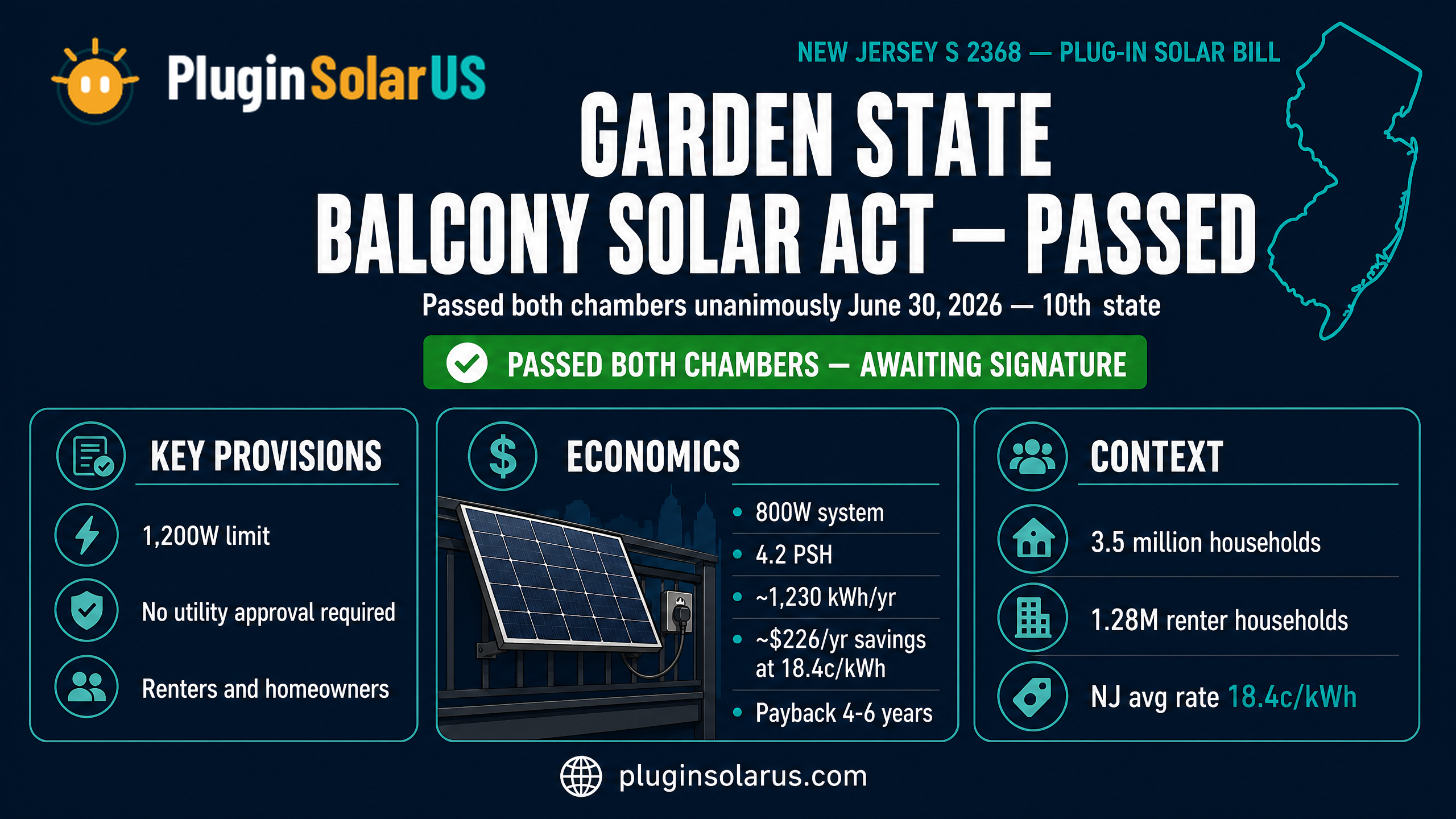
New Jersey Enacts the Garden State Balcony Solar Act
On September 1, 2026, Governor Mikie Sherrill signed the Garden State Balcony Solar Act (S2368/A4836) as P.L.2026, c.82. The unanimous legislation makes New Jersey the ninth US state to enact an explicit plug-in solar framework. Its operative provisions take effect on March 1, 2027.
The bill's passage caps a six-month legislative journey that began when S2368 passed the Senate 38-0 in March 2026. After extensive committee work in the Assembly — including referrals to the Telecommunications and Utilities Committee, Public Safety and Preparedness Committee, State and Local Government Committee, and Budget Committee — the bill was amended and passed the full Assembly on June 30. The Senate immediately concurred with the Assembly amendments, clearing the bill for the Governor's desk on the same day.
What the Garden State Balcony Solar Act Does
The law creates a legal framework for "portable solar generation devices" in New Jersey, exempting qualifying systems from Board of Public Utilities interconnection and net-metering program requirements. Its core provisions include:
- 1,200W AC output cap: Systems are limited to 1,200 watts of AC output — consistent with the emerging national standard across all 10 states that have passed plug-in solar legislation.
- No utility approval, fees, or notification: PSE&G, JCP&L, and Atlantic City Electric cannot require prior approval, charge additional fees, or even require notification before installation. This is one of the most permissive frameworks in the country.
- Product safety: Devices must be listed or certified under UL 3700, or a comparable standard or combination of standards addressing plug-in photovoltaic safety and grid-parallel operation, by a nationally recognized testing laboratory.
- Outage protection: Devices must include a feature that prevents export to the electrical distribution system during a power outage.
- Limited 400W alteration exemption: A qualifying device with no more than 400 watts of maximum output to the receptacle is exempt only from product-listing, National Electrical Code, or State Uniform Construction Code provisions that would otherwise require alterations to the building's premises, wiring, or electrical panels. Other applicable installation provisions still apply.
- Exempt from interconnection: Qualifying devices are fully exempt from BPU interconnection requirements, eliminating the regulatory barrier that has prevented plug-in solar adoption in New Jersey.
- Property and local rules: The law limits blanket landlord, association, and municipal prohibitions. Tenants must provide the landlord and applicable association written notice and compliance documentation at least 14 days before placement or use. Municipalities cannot require permits for device placement or use, but actual building modifications or electrical work remain subject to applicable code and permit requirements.
Why New Jersey Matters
New Jersey is a significant addition to the plug-in solar map for several reasons:
| Metric | Value |
|---|---|
| Total Households | 3.54 million |
| Renter-Occupied Units | 1.28 million (36%) |
| Apartment Units (5+ buildings) | 847,911 |
| Average Electricity Rate | 18.4¢/kWh |
| TOU Peak-Off-Peak Spread | ~8¢/kWh |
| Estimated Annual Savings (800W system) | ~$225/year |
| Peak Sun Hours/Day | 4.76 hours |
| Public Support (FDU Poll, April 2026) | Nearly 80% |
With 1.28 million renter households and nearly 850,000 apartment units, New Jersey has one of the largest potential plug-in solar markets on the East Coast. The state's electricity rates — 18.4¢/kWh on average, with TOU spreads reaching 8¢ between peak and off-peak — make the economics compelling. An 800W system on a south-facing balcony can generate approximately 1,094 kWh per year, saving residents roughly $225 annually.
The Legislative Journey
S2368 is the successor to S4982 from the 221st Legislature, which did not receive a floor vote before the session ended. Senator Bob Smith (D-Middlesex), chair of the Senate Environment and Energy Committee, reintroduced the bill in January 2026 with strengthened provisions.
Key milestones:
- January 13, 2026: S2368 introduced in Senate, referred to Environment and Energy Committee
- March 16, 2026: Reported from Senate Committee with amendments
- March 23, 2026: Passed Senate 38-0
- June 4–28, 2026: Assembly committee review and amendments (Telecom, Public Safety, State & Local Gov, Budget)
- June 30, 2026: Assembly passed 79-0-1; Senate concurred 40-0
The bill's title was changed during the Assembly process from "Plug-In Solar Device Consumer Access Act" to the "Garden State Balcony Solar Act" — a rebranding that emphasizes the practical, consumer-friendly nature of the technology.
What Makes NJ's Law Unique
New Jersey's law stands out among enacted plug-in solar frameworks for one key reason: it prohibits utilities from requiring even notification. Most other states — including Maine, Colorado, and Connecticut — allow utilities to require a simple registration or notification form. New Jersey joins Utah as one of only two states where the utility has zero involvement in the process.
Additionally, New Jersey is a fully deregulated electricity market, meaning residents can choose their electricity supplier. This creates an interesting dynamic where plug-in solar competes directly with third-party suppliers — and often wins on cost for peak-hour consumption when paired with battery storage.
Nine States Have Enacted Plug-In Solar Legislation
| # | State | Bill | Status | Date Passed |
|---|---|---|---|---|
| 1 | Utah | HB 340 | ✅ Enacted | March 2025 |
| 2 | Maine | LD 1730 | ✅ Enacted | April 2026 |
| 3 | Virginia | HB 395 | ✅ Enacted | April 2026 |
| 4 | Colorado | HB 26-1007 | ✅ Enacted | May 2026 |
| 5 | Maryland | HB 1532 | ✅ Enacted | May 2026 |
| 6 | Connecticut | HB 5340 | ✅ Enacted | May 2026 |
| 7 | New Hampshire | SB 540 | ✅ Enacted | June 2026 |
| 8 | Vermont | S.202 | ✅ Enacted | June 2026 |
| 9 | New Jersey | S2368/A4836 | ✅ Enacted | September 2026 |
| — | New York | A9111C/S8512C | ⏳ Awaiting Governor | Passed May 2026 |
When the Law Takes Effect
P.L.2026, c.82 takes effect on March 1, 2027. The Board of Public Utilities may take anticipatory implementation action before that date, but the September 1 signature does not make the new framework immediately operative.
Once the law is effective, qualifying New Jersey residents will be able to:
- Use a qualifying listed or certified plug-in solar system up to 1,200W per service address or dwelling unit
- Connect through a standard 120V outlet without utility approval, device-related fees, or notification
- Rely on statutory protections against blanket landlord, association, and municipal prohibitions, subject to placement, documentation, notice, and liability conditions
- Use the limited 400W alteration exemption where its exact statutory conditions apply
Until March 1, 2027, residents should continue to follow existing utility, property, code, and permit requirements. After that date, the product listing, installation instructions, local code provisions, property conditions, and tenant-notice requirements still need to be checked for the actual setup.
Key Quotes
"New Jersey has been a national leader on solar for more than 20 years — this is a big victory for solar. Plug-in solar is a simple concept — solar small enough to plug in but big enough to provide real environmental and bill benefits."
"Plug-in solar has rapidly expanded across Europe and it's time to make it as easy as possible for all residents — renters, apartment dwellers and homeowners — to go green by literally plugging into clean energy."
New Jersey's Existing Solar Incentives
New Jersey already has one of the strongest solar incentive ecosystems in the country. While plug-in solar systems may not qualify for all programs (many require utility interconnection), residents benefit from:
- SuSI SREC-II Program: Fixed incentive payments per MWh of solar generation over 15 years (eligibility for plug-in solar remains to be confirmed during implementation)
- Sales Tax Exemption: 6.625% sales tax exemption on solar energy systems
- Property Tax Exemption: Solar system value excluded from property tax assessment
- Net Metering: Available through PSE&G, JCP&L, and Atlantic City Electric for registered systems
What This Means for New Jersey Residents
For New Jersey's 1.28 million renter households and 847,000+ apartment dwellers, the Garden State Balcony Solar Act represents a breakthrough. Traditional rooftop solar has been available in New Jersey for decades, but it requires home ownership, a suitable roof, and a significant upfront investment. Plug-in solar changes the equation entirely — a $300–$1,500 system on a balcony or patio can start generating savings from day one.
At 18.4¢/kWh — and with TOU rates reaching 26¢ during peak hours — the payback period for a typical 800W plug-in solar system with battery storage is approximately 4–6 years. After that, the savings are pure return on investment for the 25+ year lifespan of the panels.
References
- NJ Legislature — S2368 Bill Status
- NJ Legislature — S2368 Third Reprint (Final Legislative Text)
- Governor Sherrill Signs the Garden State Balcony Solar Act (September 1, 2026)
- Environment New Jersey: Legislature Passes Bill To Expand Clean Energy with Plug-In Solar (June 30, 2026)
- FDU Poll: Nearly 80% of New Jerseyans Support Plug-In Solar (April 2026)
- EIA Electric Power Monthly — New Jersey residential electricity rates
Sources
- NJ Legislature — S2368 Bill Status
- NJ Legislature — S2368 Third Reprint (Final Legislative Text)
- Governor Sherrill Signs the Garden State Balcony Solar Act (September 1, 2026)
- Environment New Jersey: Legislature Passes Bill To Expand Clean Energy with Plug-In Solar (June 30, 2026)
- FDU Poll: Nearly 80% of New Jerseyans Support Plug-In Solar (April 2026)
- EIA New Jersey Electricity Data