New Jersey Just Proposed a $68M Virtual Power Plant. Here’s Why Plug-In Solar Owners Should Pay Attention.
By PlugInSolarUS Editorial · Published 2026-08-02 · 9 min read
The NJ Board of Public Utilities wants to turn home batteries, smart thermostats, and EV chargers into grid assets—and plug-in solar with storage could be the perfect entry point.
Listen: Why New Jersey’s proposed VPP matters for smaller energy systems
Hear the companion episode of Plug-In Solar, Explained from PlugInSolarUS.
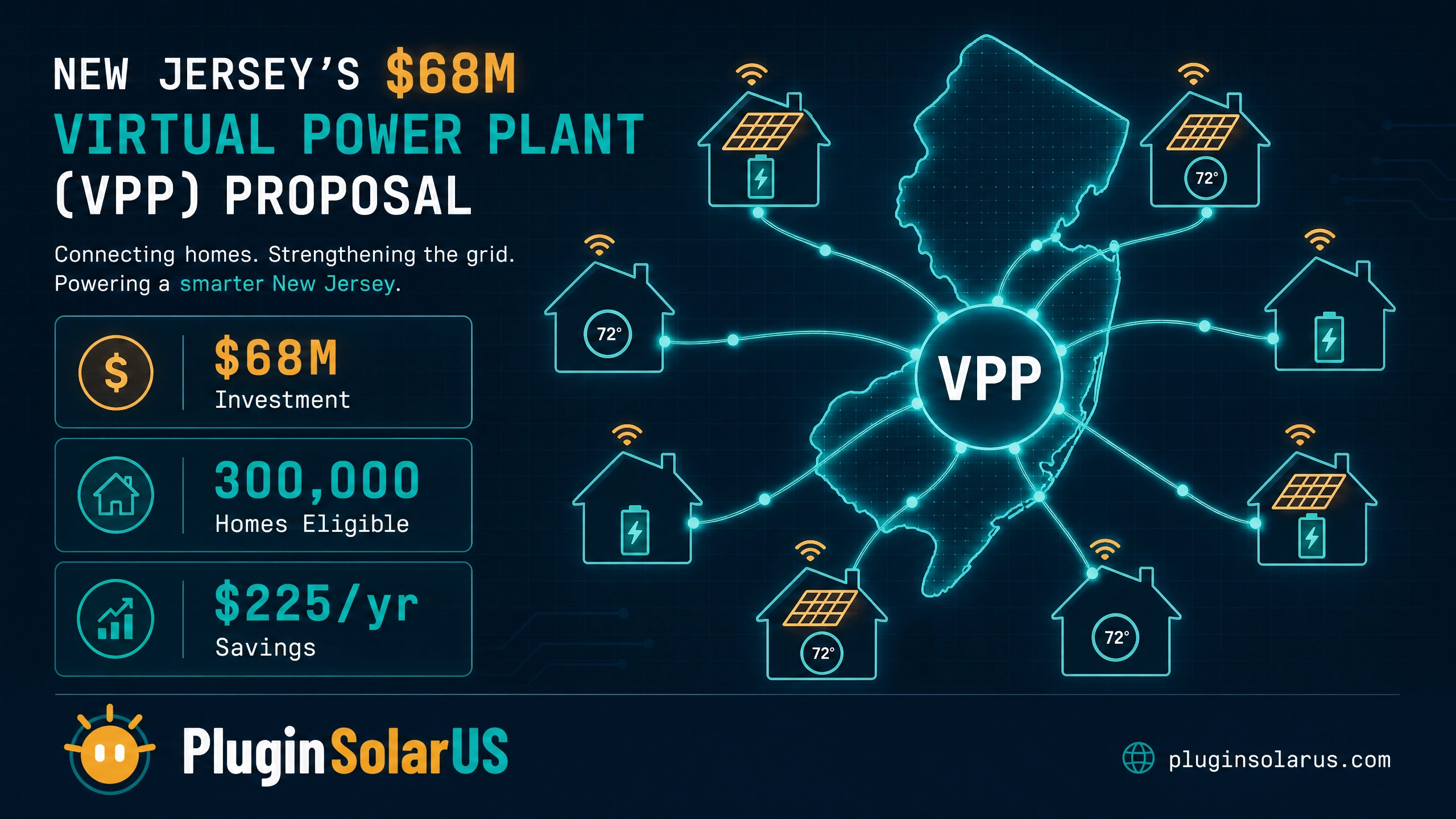
On July 27, 2026, the New Jersey Board of Public Utilities (NJBPU) unveiled a plan that could fundamentally change how the state manages electricity demand—and create a new revenue stream for homeowners with batteries, smart devices, and plug-in solar systems. The $68 million Virtual Power Plant (VPP) Straw Proposal aims to aggregate thousands of distributed energy resources into a coordinated grid asset, with Phase 1 operational by mid-2027.
What Triggered This?
Governor Mikie Sherrill’s Executive Order No. 2, issued January 20, 2026, declared a statewide energy emergency and directed the BPU to develop a VPP program. The order came after a summer of record-breaking grid stress, rolling conservation alerts, and growing recognition that New Jersey’s aging infrastructure cannot keep pace with rising demand—particularly from AI data centers and electrification.
NJBPU President Ben Hertz-Shargel framed the initiative in practical terms: “Every New Jersey family deserves a grid that works smarter and costs less. Virtual power plants let us tap into technology that’s already sitting in driveways and living rooms across the state—batteries, thermostats, EV chargers—and turn them into grid assets that reduce utilities’ cost to serve customers.”
How the NJ VPP Would Work
A Virtual Power Plant uses digital technology to link thousands of everyday devices—home batteries, smart thermostats, EV chargers—into one coordinated system. When demand spikes, the VPP operator sends a signal and each enrolled device makes a small adjustment: batteries discharge stored energy, thermostats reduce cooling by a degree or two, EV chargers pause temporarily. The combined effect replaces the need for a new gas peaker plant—without any single household noticing a difference.
How Participants Get Paid
The Straw Proposal discussed potential compensation mechanisms including bill credits, discounted electricity rates, and direct payments for dispatch events. The public comment period closed August 17, 2026; final program design, eligibility, and compensation remain subject to NJBPU action.
The Numbers
| Metric | Detail |
|---|---|
| Phase 1 Budget | $68 million |
| Target Launch | Mid-2027 |
| Peak Demand Reduction Goal | 3% of state peak load |
| Participating Utilities | PSE&G, JCP&L, Atlantic City Electric, Rockland Electric |
| Eligible Devices | Home batteries, smart thermostats, EV chargers, distributed solar |
| Regulatory Docket | QO26030099 |
| Comment Deadline | Closed August 17, 2026; final program details pending |
Why This Matters for Plug-In Solar
The Straw Proposal discusses distributed energy resources such as batteries, smart thermostats, and EV chargers. It does not establish final customer eligibility for plug-in solar equipment. Small solar-and-storage systems may be relevant to the program's eventual design, but eligibility, technical standards, and compensation have not yet been set.
A potential future scenario is a qualifying customer battery reducing a household's grid draw during a dispatch event. Whether any particular plug-in solar or storage configuration can participate will depend on the final NJBPU program rules, relevant utility requirements, and the equipment's capabilities.
The Plug-In Solar + VPP Value Stack
LAYER 1
Direct bill savings from solar self-consumption
LAYER 2
TOU arbitrage: charge battery off-peak, discharge during peak rates
LAYER 3
VPP compensation: bill credits or payments for grid dispatch events
Where NJ Stands vs. Other States
New Jersey is not the first state to pursue VPPs, but its $68 million commitment makes it one of the most ambitious early-stage programs. The national VPP market reached nearly 40 GW of capacity by mid-2025, with a Sunrun-Tesla-Renew Home partnership alone aggregating 9 million homes and 16.8 GW of flexible capacity. Here’s how NJ compares to its neighbors:
| State | VPP Status | Key Programs |
|---|---|---|
| New York | Active pilots | Con Edison REV framework, battery aggregation |
| Connecticut | Operational | ConnectedSolutions demand response |
| New Jersey | Proposal stage | $68M VPP Straw Proposal (mid-2027 target) |
| Pennsylvania | Exploring | PJM DER aggregation rules |
| Maryland | Early pilots | Community solar + battery filings |
| Virginia | Directed | HB1467 directs Appalachian Power VPP pilot by July 2027 |
Open Questions for Plug-In Solar
While the proposal is encouraging, several details remain unresolved that will determine whether plug-in solar systems can actually participate:
Key Unanswered Questions
- Minimum system size: Will there be a minimum kW threshold that excludes smaller plug-in systems (typically 600–2,000W)?
- UL certification requirements: Will only UL 3700-certified systems qualify, or will any UL 1741-listed microinverter be eligible?
- Battery requirement: Can solar-only systems participate, or is storage mandatory for VPP enrollment?
- Aggregator access: Will third-party aggregators (like Tigo Energy, which already operates in DE/MD/VA) be allowed to enroll plug-in solar customers?
- Interconnection status: Do plug-in solar systems need a formal interconnection agreement, or is the simplified plug-in pathway sufficient?
These questions were raised during the public-comment period, which closed August 17, 2026. They remain central to the final program design; PlugInSolarUS will monitor NJBPU action and update this article when official eligibility criteria are published.
The Bigger Picture: AI Is Driving This
The urgency behind NJ’s VPP push isn’t just about summer heat waves. Hyperscale AI data centers are adding tens of gigawatts of new load to the grid—more than 24 GW of demand from data-center announcements tracked in just the first half of 2025, triple the volume from the previous year. Utilities cannot build new transmission or generation fast enough. VPPs offer a faster, cheaper alternative: instead of spending billions on new power plants that take 5–10 years to build, aggregate existing distributed resources that are already installed.
This is where plug-in solar’s simplicity becomes a strategic advantage. Traditional rooftop solar requires permits, inspections, and utility interconnection agreements that can take months. Plug-in solar systems can be deployed in hours. If VPP eligibility criteria are designed inclusively, plug-in solar could become the fastest pathway for NJ households to become grid assets—earning money while helping stabilize the grid.
What NJ Residents Should Do Now
- Monitor the docket for NJBPU orders and final-program materials under Docket No. QO26030099.
- Do not assume eligibility for any particular plug-in solar, battery, or smart-device configuration before final program rules are published.
- Review utility requirements before connecting equipment to home wiring or pursuing a future VPP enrollment.
- Track the timeline through official NJBPU announcements; the straw proposal's mid-2027 target is not a guaranteed enrollment date.
The Bottom Line
New Jersey’s $68 million VPP straw proposal could shape how distributed devices support the grid. It does not yet guarantee that plug-in solar equipment will be eligible or compensated. Final details—including minimum size thresholds, technical standards, aggregation rules, and consumer compensation—will determine whether and how smaller systems participate.
Last updated: August 21, 2026. The public-comment period for the NJ VPP Straw Proposal closed August 17, 2026. This article will be updated when NJBPU releases final program materials.