New York's SUNNY Act: What the Legislature's Passage Means for 5 Million Renters
By PlugInSolarUS Editorial · Published 2026-04-27 · Updated June 2026 · 9 min read
The New York State Legislature passed the SUNNY Act (A9111C / S8512C) on May 28, 2026 — both chambers. With electricity rates at 28.4¢/kWh and over 60% of NYC households renting, here's what the bill means, what it allows, and what comes next as it awaits Governor Hochul's signature.
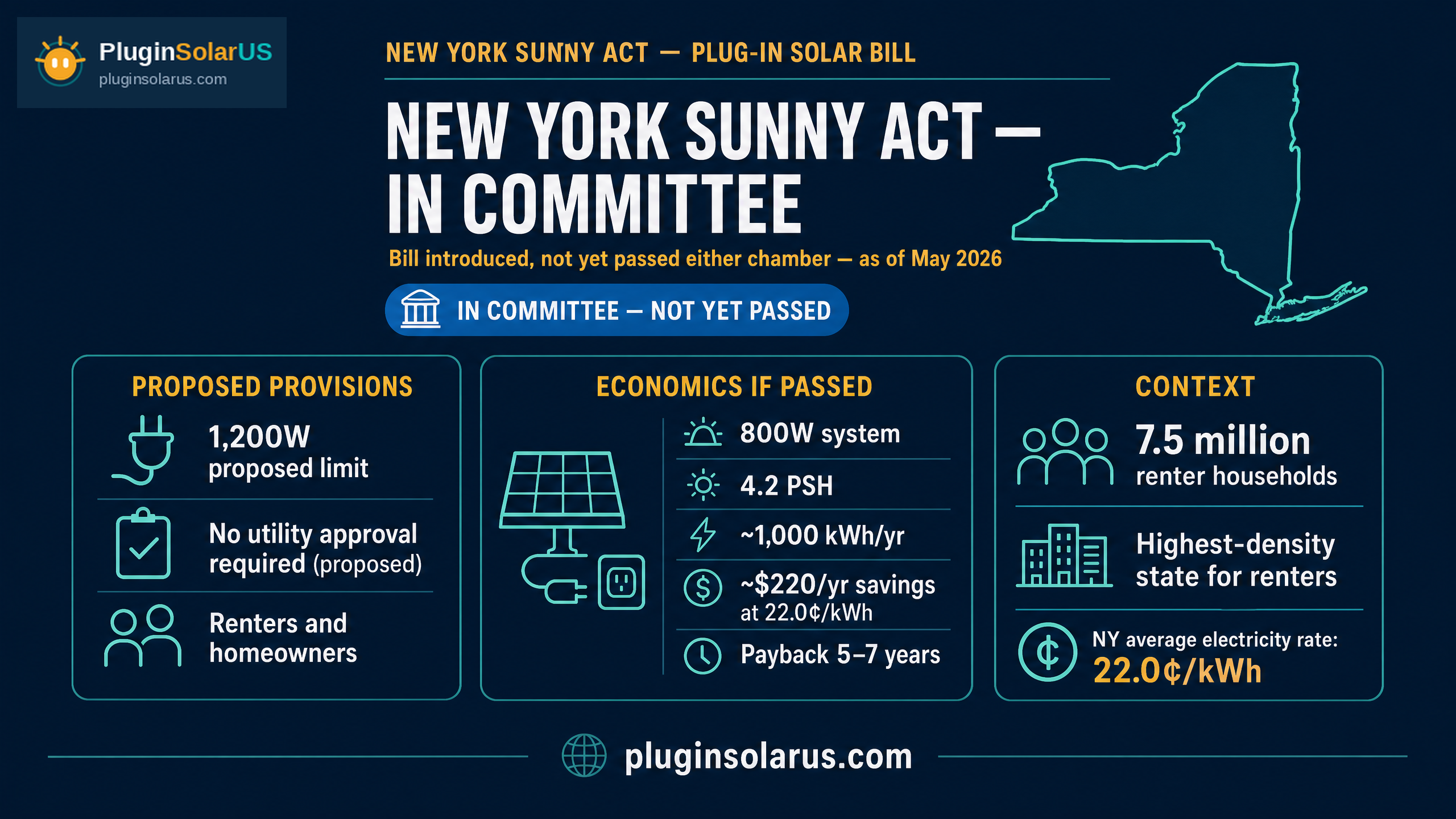
On April 22, 2026 — Earth Day — the New York State Senate voted 62–0 to pass the Solar Up Now New York Act, better known as the SUNNY Act. The Assembly passed the amended bill on May 28, and the Senate concurred the same day. The measure now awaits Governor Hochul and is not law unless and until it is enacted.
For the broader legal status, practical tools, and statewide updates beyond this bill, visit the New York plug-in solar state page.
For New York's roughly 5 million renter households — more than 60% of all NYC households, according to Brickwise — the SUNNY Act represents the first realistic path to solar energy ownership.[8] Traditional rooftop solar requires landlord approval, a south-facing roof, and a $20,000+ installation. A plug-in solar panel requires a balcony, a wall outlet, and about $300.
What the SUNNY Act Actually Does
The bill, S.8512B, amends New York's Public Service Law to create a new legal category: the portable solar generation device. Under current law, any device that generates electricity and connects to the grid is treated as "solar electric generating equipment" — subject to full utility interconnection agreements, net metering applications, and professional installation requirements. The SUNNY Act carves out plug-in solar from those rules entirely.[1]
The four core provisions are:
| Section | What It Does |
|---|---|
| Section 2 | Defines “portable solar generation device” and exempts it from the definition of “solar electric generating equipment.” Sets a maximum power output of 1,200W back to the grid. Requires UL certification or equivalent. Requires installation per NYS Fire Prevention and Building Code. |
| Section 3 | Exempts portable solar devices from utility interconnection requirements and net metering requirements. Protects utilities from liability for device-caused damage. Requires a simple online notification to the utility — not a full interconnection application. |
| Section 4 | Requires the State Fire Prevention and Building Code Council to update the building code within one year to optimize for portable solar. For devices smaller than 391W, no changes to building wiring are required. |
| Section 5 | Sets the effective date (to be determined upon Governor Hochul's signature). |
Notably, the bill does not include explicit landlord or HOA protections — it focuses on the utility and building code side of the equation. This distinguishes it from Virginia's HB 395 (which explicitly prohibits landlords from banning qualifying systems) and Colorado's HB 26-1007 (which bans HOA restrictions). Advocates may push for tenant protections in a future amendment or companion bill.
Why New York's Electricity Prices Make This Urgent
New York's average residential electricity rate hit 28.4¢/kWh in January 2026 — the sixth highest in the nation, according to the Empire Center for Public Policy.[5] That rate is nearly double the national average of approximately 16¢/kWh. And it is rising fast: Con Edison approved a 3.5% electric rate increase for 2026, with additional increases of 3.2% in 2027 and 3.1% in 2028 — a cumulative 9.8% hike over three years.[6] For customers served by NYSEG (upstate New York), the situation is even more acute: a 23.6% total bill increase takes effect in May 2026.[7]
At 28.4¢/kWh, a plug-in solar system generates meaningful savings relatively quickly. Senator Krueger's office estimates that an 800W system paired with battery storage could save approximately $279 per year.[3] Bright Saver, the plug-in solar advocacy group running pilots in New York City, estimates that panels can offset 10% to 25% of a household's electricity consumption depending on capacity and sun exposure.
What This Looks Like in Practice
Lauren Phillips, a Bronx resident profiled by Gothamist in April 2026, installed a 220W panel on her balcony in January using zip ties — a process that took minutes.[3] The panel shaved about $30 from her utility bills in the first few months. “It’s generating power that goes right into my apartment, and that’s money that I’m not spending,” she told Gothamist. “As a mom who has two kids and a big day care bill, that makes a big difference.”
Phillips’s setup is currently operating in a legal gray zone — her panel is not technically street-legal under existing New York law, which was written for large grid-connected systems. The SUNNY Act would formalize exactly what she is doing and give millions of other New Yorkers the same option without legal ambiguity.
Savings Estimates at New York Rates
The following table shows estimated annual savings for common plug-in solar configurations at New York’s current average rate of 28.4¢/kWh, assuming 4.5 peak sun hours per day (NYC average) and a 20% system efficiency loss factor.
| System Size | Est. Daily Generation | Est. Annual Savings | Approx. Payback Period |
|---|---|---|---|
| 220W (entry-level) | 0.79 kWh | ~$82/yr | ~3.7 years ($300 system) |
| 400W (mid-range) | 1.44 kWh | ~$149/yr | ~2.7 years ($400 system) |
| 800W (with battery) | 2.88 kWh | ~$279/yr | ~3.6 years ($1,000 system) |
| 1,200W (maximum) | 4.32 kWh | ~$419/yr | ~3.6 years ($1,500 system) |
These are conservative estimates based on direct-consumption offset (no net metering). With Con Edison’s Time-of-Use rates, peak-hour generation can be worth significantly more — reducing payback periods further.
The Path to Passage: Assembly and Governor
The Senate’s 62–0 vote is a strong signal, but the SUNNY Act still needs two more steps to become law. The Assembly companion bill, A9111B, is sponsored by Assemblymember Emily Gallagher (Brooklyn) and is currently in the Assembly Energy Committee.[1] Advocates are calling on Assembly Speaker Carl Heastie to bring the bill to the floor before the session ends.
If the Assembly passes A9111B, the bill goes to Governor Kathy Hochul. Hochul has not publicly commented on the SUNNY Act, but she has been a vocal supporter of New York’s Climate Leadership and Community Protection Act (CLCPA) and has signed multiple clean energy bills. The bill’s justification section explicitly references the CLCPA and the “abrupt repeal of the federal solar tax credits” as reasons for urgency — framing that aligns with Hochul’s stated energy priorities.[1]
Con Edison, New York City’s largest utility, has already signed on in support of the bill — a notable development given that utilities in other states have sometimes opposed plug-in solar legislation over grid stability concerns.[3]
New York in the National Context
The SUNNY Act arrives as plug-in solar legislation is advancing across the country at an unprecedented pace. Utah signed the first US plug-in solar law in March 2025. Maine followed in April 2026. Virginia became the third state on April 22, 2026 — the same day the New York Senate voted. Colorado signed on May 7, 2026 (4th state). Maryland signed on May 12, 2026 (5th state). Connecticut, New Hampshire, and Vermont followed. Governor Mikie Sherrill signed New Jersey's Garden State Balcony Solar Act on September 1, 2026 as P.L.2026, c.82, making New Jersey the ninth enacted state; its law takes effect March 1, 2027.
New York’s scale makes it uniquely consequential. If the SUNNY Act passes, it would bring plug-in solar access to the largest renter population of any state — and at 28.4¢/kWh, the economics are among the strongest in the country. Senator Krueger captured the moment plainly: “Once the market for plug-in solar fully matures, like it already has in Germany, New Yorkers will be able to simply walk into a store, pay a few hundred bucks for a system, take it home and plug it in like any other appliance and start saving hundreds of dollars every year.”[2]
What New Yorkers Can Do Right Now
The SUNNY Act has passed both chambers and is awaiting Governor Hochul’s signature. Plug-in solar in New York is not yet legal — but it is closer than ever. Here is what residents can do now:
- Contact Governor Hochul. The bill is on her desk. A constituent message urging her to sign takes minutes. Use the Governor's contact form to make your voice heard.
- Research your options now. A 400W balcony solar kit costs $300–$500 and is available from multiple US retailers. If you have a south-facing balcony, terrace, or yard, you can assess your sun exposure today.
- Check your lease. Many New York leases do not explicitly prohibit plug-in solar. If your lease is silent on the issue, you may have more flexibility than you think — though consulting your landlord is advisable before installation.
- Plan the property conversation. Review the plug-in solar renter pathway, then use the Landlord & HOA Letter Generator when a written request is appropriate.
- Track the bill. Follow the official bill page at the NY Senate bill page (S8512C) for updates on the Governor's action.
Sources
- NY Senate Bill S.8512C — Official Text and Status (2025–2026 Session)
- Gothamist: New Yorkers can soon hang solar panels from their windows, if Gov. Hochul approves (June 1, 2026)
- River Reporter: SUNNY Act passes NYS Legislature, bringing plug-in solar one step closer to becoming law (May 28, 2026)
- Yahoo News / Press Republican: State Senate Passes SUNNY Act Unanimously (April 23, 2026)
- Gothamist: Here Comes the Sun — New Bill Would Let New Yorkers Hang Solar Panels from Windows (April 14, 2026)
- Talk of the Sound: New York Electricity Prices Rank Sixth Highest in the U.S. (April 19, 2026)
- Empire Center for Public Policy: Energy Data Bulletin — January 2026 Electricity Prices
- Empire Solar NY: Con Edison Announces New Electric Rate Increases for 2026
- Solar.com: NYSEG Electric Rate Increase in 2026 — What Customers Need to Know (February 2026)
- Brickwise: NYC Rental Population Statistics 2026
- NY Senate Press Release: Senate Advances Earth Day Legislation (April 21, 2026)
Related Articles
- Behind the Bill: How New York Is Trying to Bring Plug-In Solar to the Country’s Largest Urban Market — Assemblymember Emily Gallagher and Sen. Liz Krueger’s policy advisor Justin Flagg explain why New York’s SUNNY Act targets interconnection as the first barrier to unlocking plug-in solar for millions of urban renters and homeowners.
- New York Solar Energy System Equipment Credit: A 2026 Guide — Understand New York’s 25% Solar Energy System Equipment Credit, the $5,000 cap, principal-residence rules, utility checks, and Form IT-255.
- Renter Solar Rights: What You Can and Can't Do in All 50 States — A state-by-state guide to your legal rights as a renter who wants to install plug-in solar. What's permitted, what's pending, and how to negotiate with your landlord.
New: Find your plug-in solar fit
Our new Product Finder makes it easier to discover and compare plug-in solar kits and components across brands. See panel DC and inverter AC output alongside listed prices, known shipping, and required fees to find options worth exploring. Find and compare products.
Sources
- NY Senate Bill S.8512B — Official Text
- Yahoo News / Press Republican: State Senate Passes SUNNY Act Unanimously (April 23, 2026)
- Gothamist: Here Comes the Sun — New Bill Would Let New Yorkers Hang Solar Panels from Windows (April 14, 2026)
- Talk of the Sound: New York Electricity Prices Rank Sixth Highest in the U.S. (April 19, 2026)
- Empire Center for Public Policy: Energy Data Bulletin
- Empire Solar NY: Con Edison Announces New Electric Rate Increases for 2026
- Solar.com: NYSEG Electric Rate Increase in 2026 (February 2026)
- Brickwise: NYC Rental Population Statistics 2026
- NY Senate Earth Day Press Release (April 21, 2026)
- Gothamist: New Yorkers can soon hang solar panels from their windows, if Gov. Hochul approves (June 1, 2026)
- River Reporter: SUNNY Act passes NYS Legislature (May 28, 2026)