Plug-In Solar 101: What It Is, How It Works, and Whether It's Right for You
By PlugInSolarUS Editorial Team · Published 2026-01-15 · Updated August 26, 2026 · 12 min read
Everything you need to know about plug-in solar — from how the technology works to realistic savings estimates and who it makes sense for.
Quick decision guide
Is Plug-In Solar a Good Fit for You?
Plug-in solar—also called balcony solar or apartment solar—can be worth considering when you have useful sun exposure, a suitable placement and outlet, and a state, utility, property, and equipment path that supports the proposed setup.
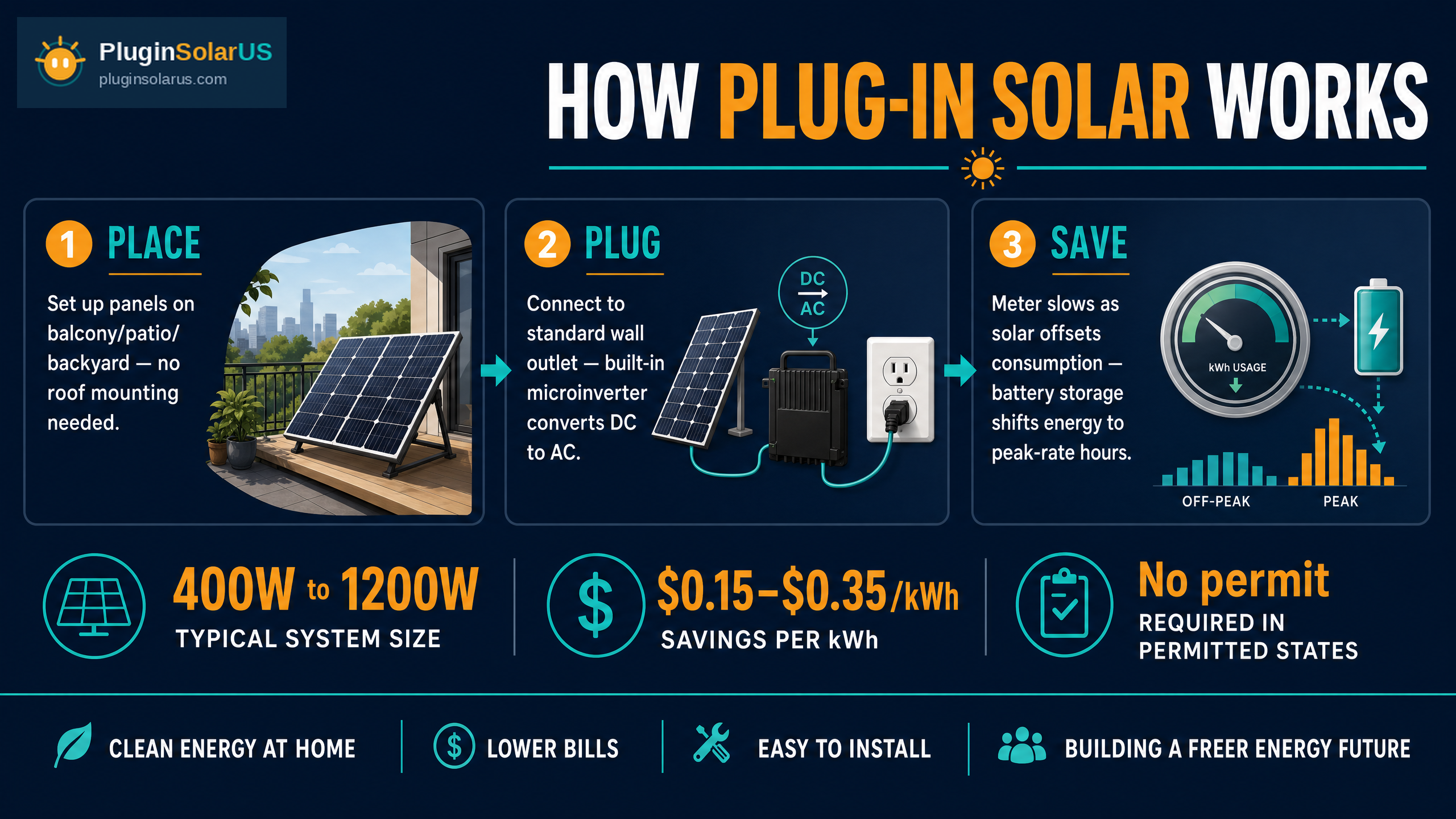
- See how plug-in solar works — Follow the Place → Plug → Save flow and compare plug-in, portable, and rooftop solar.
- Plan a balcony solar setup — Separate grid-connected, battery, zero-export, and off-grid paths before choosing equipment.
- Follow the renter pathway — Review lease, property, placement, permission, and portability considerations.
- Check your state — Find the current law, bill, or regulatory status for your location.
- Check your setup readiness — Turn the key space, outlet, property, and state questions into one practical next step.
Plug-In Solar 101: What It Is, How It Works, and Whether It's Right for You
Plug-in solar, often referred to as balcony solar or apartment solar, represents a revolutionary approach to personal energy generation. It empowers individuals, particularly those in apartments or rental properties, to harness solar power without the complexities and costs associated with traditional rooftop installations. This guide will demystify plug-in solar, explaining its core principles, how it operates, and whether it's the right energy solution for your home.
Unlike large-scale solar arrays, plug-in solar systems are designed for simplicity and portability. They typically consist of a few solar panels, an inverter, and often a battery, all configured to plug directly into a standard electrical outlet. This "plug and play" functionality significantly lowers the barrier to entry for solar energy, making it accessible to a broader demographic. As energy costs continue to fluctuate and environmental consciousness grows, understanding plug-in solar becomes increasingly relevant for anyone looking to take control of their electricity consumption.
What is Plug-In Solar?
At its heart, plug-in solar is a decentralized, small-scale solar energy system that allows you to generate your own electricity and feed it directly into your home's electrical system by plugging into an outlet. It's a modular and scalable solution, meaning you can start with a basic setup and expand it as your needs or budget allow. The primary goal is to offset a portion of your household's electricity consumption, leading to lower utility bills and a reduced carbon footprint.
These systems are particularly appealing to renters, apartment dwellers, and homeowners who might not have suitable roof space or the capital for a full-sized solar installation. They offer a tangible way to participate in the renewable energy movement, providing a sense of energy independence and contributing to a more sustainable future. The ease of installation and removal also makes them ideal for those who anticipate moving, as the system can often be taken with you.
How Plug-In Solar Works
The operation of a plug-in solar system is elegantly simple, relying on a few key components working in harmony:
- Solar Panels: These are the heart of the system, capturing sunlight and converting it into direct current (DC) electricity. Modern plug-in systems typically use high-efficiency monocrystalline panels, designed to maximize energy capture even in limited spaces like balconies or patios.
- Microinverter: Attached to each solar panel, the microinverter converts the DC electricity generated by the panel into alternating current (AC) electricity, which is the type of electricity used by your home appliances and the grid. This individual conversion maximizes efficiency and allows for modular expansion.
- Cabling and Plug: The AC electricity from the microinverter is then routed through a cable that terminates in a standard electrical plug. This plug is inserted into a dedicated GFCI-protected outlet in your home.
- Home Electrical System: Once plugged in, the generated electricity flows into your home's electrical system. Your appliances will first draw power from the solar panels. If the solar panels produce more electricity than your home is currently consuming, the excess power can flow back into the grid, potentially earning you credits depending on your utility's net metering policies. If your home needs more power than the panels are generating, the remaining electricity is drawn from the grid as usual.
- Optional Battery Storage: Many plug-in solar systems now include battery storage. This allows you to store excess solar energy generated during the day for use during the evening or on cloudy days, further maximizing your self-consumption and reducing reliance on the grid. For more details, see our Battery Guide.
It's crucial to understand that plug-in solar systems are designed to supplement, not entirely replace, your grid connection. They are most effective at offsetting baseline electricity loads, such as refrigerators, lights, and charging devices, during daylight hours.
System Sizing Tiers for Plug-In Solar
Plug-in solar systems come in various sizes, tailored to different energy needs and available space. The sizing is primarily determined by the total wattage of the solar panels and the capacity of the accompanying battery storage. Here's a breakdown of common tiers:
| Tier | Panel Wattage (W) | Battery Capacity (kWh) | Typical Use Case |
|---|---|---|---|
| Starter | 400–1,200W | 1–2 kWh | Ideal for offsetting small loads, apartment dwellers, or those new to solar. Focuses on basic energy independence. |
| Mid-Range | 800–1,600W | 2–3 kWh | Suitable for small homes, larger apartments, or users with moderate energy consumption. Offers greater energy offset and storage. |
| High Output | 1,600–2,400W | 3–5 kWh+ | Designed for larger homes or users with higher energy demands. Maximizes self-consumption and provides significant backup capabilities. |
Choosing the right tier depends on factors like your average electricity consumption, available space for panels, and your budget. Our Savings Calculator can help you determine the optimal system size for your specific situation.
Battery Capacity Tiers
Integrating battery storage significantly enhances the value proposition of a plug-in solar system, allowing you to store surplus energy for later use. This is particularly beneficial for optimizing Time-of-Use (TOU) electricity rates, where electricity is more expensive during peak demand hours.
| Tier | Battery Capacity (kWh) | Description |
|---|---|---|
| Entry | 1–2 kWh | Provides basic evening power for essential devices, extending solar self-consumption beyond daylight hours. |
| Standard | 2–3 kWh | Offers more substantial storage for moderate evening use, capable of powering several appliances during peak rate periods. |
| Extended | 3–5 kWh+ | Maximizes energy independence, providing significant backup power and allowing for extensive off-peak usage. |
The choice of battery capacity should align with your daily energy consumption patterns and your desire for energy resilience. A larger battery can mean less reliance on the grid, especially during periods of high electricity prices or outages.
Safety and Regulations: What You Need to Know
While plug-in solar systems are designed for ease of use, safety and compliance with electrical codes are paramount. Understanding the regulatory landscape is crucial for a safe and effective installation.
Critical Safety Requirement
Plug-in solar MUST connect to a GFCI-protected outlet on a dedicated circuit; not just any standard outlet. This ensures critical safety against electrical shocks and prevents overloading shared circuits. Consult with an electrician if you are unsure about your outlet configuration.
GFCI Outlets and Dedicated Circuits
The requirement for a Ground Fault Circuit Interrupter (GFCI) protected outlet on a dedicated circuit is non-negotiable for plug-in solar. A GFCI outlet provides enhanced safety by quickly cutting off power if it detects a ground fault, preventing electric shock. A dedicated circuit ensures that the solar system has its own circuit breaker and wiring, preventing overloads that could occur if it were sharing a circuit with other high-draw appliances. This is a critical safety measure that protects both your home's electrical system and anyone interacting with the solar setup.
National Electrical Code (NEC)
The National Electrical Code (NEC) provides the foundational safety standards for electrical installations in the United States. For plug-in solar systems, NEC Articles 690 (Solar Photovoltaic Systems) and 705 (Interconnected Electric Power Production Sources) are directly applicable. These articles outline requirements for wiring, overcurrent protection, disconnecting means, and labeling to ensure the safe integration of solar power with the existing electrical grid. It's important to note that NEC Article 625, which pertains to Electric Vehicle (EV) charging, does not apply to plug-in solar installations.
UL 3700 Standard
UL 3700 is a crucial safety standard specifically for "Plug-in Grid-Interactive Power Conversion Equipment." This standard ensures that plug-in solar inverters and related equipment meet rigorous safety and performance criteria for connecting to the grid. Compliance with UL 3700 is a strong indicator of a product's reliability and safety, and it is increasingly being referenced in state-level legislation, such as Utah HB 340, as a requirement for legal plug-in solar installations.
State-Specific Legislation
- Utah HB 340 (2025): This landmark legislation was the first enacted US law explicitly legalizing plug-in solar (eight states have now enacted such laws as of June 2026: Utah, Maine, Virginia, Colorado, Maryland, Connecticut, New Hampshire, and Vermont). It exempts systems under 1,200W from interconnection permits, significantly streamlining the process for smaller installations. This bill serves as a model for other states looking to encourage distributed solar generation.
- California SB 868 (Plug and Play Solar Act, 2026): Governor Newsom signed California SB 868 on September 30, 2026. Its new utility-side framework is expected January 1, 2027; current utility, electrical, landlord and property rules still apply until then. The signed text calls for qualifying equipment certification (UL or equivalent NRTL) but does not name UL 3700; AB-2316 was a separate community-solar bill.
For more information on regulations in your state, visit our States page.
Financial Considerations and Incentives
Understanding the financial aspects of plug-in solar is key to evaluating its return on investment. While the initial cost is a factor, the long-term savings and potential incentives can make it a very attractive option.
Federal Investment Tax Credit (ITC)
Important Update: Federal ITC Expired
The Federal Investment Tax Credit (ITC) of 30% for solar installations expired on December 31, 2025. It is no longer available for new purchases made in 2026 or beyond. However, if you purchased and installed a system in 2025, you can still claim the 30% credit on your 2025 tax returns.
The expiration of the federal ITC means that new plug-in solar purchases will not qualify for this significant tax incentive. This highlights the importance of evaluating current state and local incentives, as well as the direct savings from reduced electricity bills.
Payback Periods
The payback period for a plug-in solar system is the time it takes for the energy savings to offset the initial investment. This period can vary significantly based on several factors:
- National Average: The national average payback period for plug-in solar systems is typically 5–7 years.
- High-Rate States: In states with high electricity rates, such as California (CA), Massachusetts (MA), and Connecticut (CT), the payback period can be as short as 3–5 years, especially when combined with Time-of-Use (TOU) optimization strategies.
TOU optimization involves using battery storage to draw power from your solar panels or battery during peak electricity rate hours, and charging your battery during off-peak hours when electricity is cheaper. This strategy maximizes your savings and accelerates the payback period.
Electricity Rates
The cost of electricity is a major driver of savings from plug-in solar. The higher your electricity rates, the more you save by generating your own power. Here are some average electricity rates (as of April 2026):
- National Average: Approximately $0.18/kWh
- California (CA): Approximately $0.34/kWh
- Massachusetts (MA): Approximately $0.32/kWh
- Connecticut (CT): Approximately $0.28/kWh
These figures underscore why plug-in solar is particularly attractive in states with higher electricity costs, where the financial benefits are realized more quickly.
Is Plug-In Solar Right for You?
Deciding if plug-in solar is the right choice involves weighing its advantages against your specific circumstances. It's an excellent option for many, but not a universal solution.
Advantages:
- Accessibility: Ideal for renters, apartment dwellers, and homeowners with limited roof access.
- Cost-Effective: Lower upfront costs compared to traditional solar installations.
- Easy Installation: "Plug and play" design simplifies setup.
- Portability: Can often be moved if you relocate.
- Reduced Electricity Bills: Directly offsets a portion of your energy consumption.
- Environmental Impact: Reduces your carbon footprint.
- Energy Independence: Greater control over your energy supply.
Considerations:
- Limited Output: Smaller systems may not cover all your energy needs.
- Space Requirements: Still requires some outdoor space (balcony, patio, yard).
- GFCI Outlet: Requires a dedicated GFCI-protected outlet.
- Regulatory Landscape: State and local regulations can vary.
- Net Metering: Availability and terms of net metering vary by utility.
If you're looking for a flexible, affordable, and environmentally friendly way to reduce your electricity bills, plug-in solar is definitely worth exploring. Our Readiness Guide can help you assess your suitability.
Frequently Asked Questions (FAQ) About Plug-In Solar
Q: Can I really just plug solar panels into any outlet?
A: No, this is a common misconception and a critical safety point. Plug-in solar systems MUST be connected to a GFCI-protected outlet on a dedicated circuit. Plugging into a standard, non-GFCI outlet or a shared circuit can create serious safety hazards, including electrical fires or shocks. Always ensure your outlet meets these specifications, and if in doubt, consult a qualified electrician.
Q: Do I need permission from my landlord or HOA to install plug-in solar?
A: It depends. While plug-in solar is less intrusive than rooftop solar, it's always best to check your lease agreement or HOA bylaws. Many jurisdictions are enacting "right to dry" or "right to solar" laws that may protect your right to install small-scale solar. However, open communication with your property manager or HOA is recommended. You can use our Letter Generator to help draft a request.
Q: What happens if my plug-in solar system produces more electricity than I'm using?
A: If your system is connected to the grid and your utility offers net metering, the excess electricity will flow back into the grid, and you may receive credits on your electricity bill. Without net metering, the excess energy might simply be unused unless you have battery storage to capture it. It's important to understand your utility's policies before installation.
Q: Is plug-in solar safe?
A: Yes, when installed correctly and using UL 3700 certified equipment, plug-in solar is very safe. The key is adherence to electrical codes (NEC Articles 690 and 705), proper GFCI protection, and ensuring the system is within the wattage limits for plug-in devices. Always follow manufacturer instructions and local regulations.
Q: How much money can I save with plug-in solar?
A: Savings vary widely based on your electricity rates, system size, and energy consumption habits. In high-rate states like California, Massachusetts, and Connecticut, savings can be substantial, leading to payback periods of 3–5 years. Even in states with average rates, you can expect to save money over the long term, typically with a 5–7 year payback. Our Savings Calculator can provide a personalized estimate.
Q: Can I use plug-in solar during a power outage?
A: Most grid-tied plug-in solar systems are designed to shut down during a power outage for safety reasons (to prevent backfeeding the grid and endangering utility workers). However, if your system includes battery storage with an appropriate inverter that supports "islanding" or "backup mode," it can provide power to essential loads during an outage. Always check the specifications of your system and battery.
Q: What's the difference between plug-in solar and traditional rooftop solar?
A: The main differences lie in scale, complexity, and installation. Plug-in solar is smaller, simpler, and designed for DIY or minimal professional installation, plugging into an outlet. Traditional rooftop solar is a larger, more complex, and permanently installed system that requires professional installation and often extensive permitting. Plug-in solar is about offsetting a portion of your energy, while rooftop solar often aims for near-total energy independence.
Energy Resilience: The Non-Financial Case for Plug-In Solar
Saving money is the headline benefit of plug-in solar, but for a growing number of Americans, energy resilience — the ability to keep essential devices running when the grid goes down — is equally compelling. The US grid experiences more weather-related outages than any other developed nation, and that trend is worsening. Wildfires, hurricanes, ice storms, and heat waves are all driving longer, more frequent blackouts.
A plug-in solar system with battery storage changes this equation. A 2 kWh battery can keep a refrigerator running for 24–30 hours, charge phones and laptops through a multi-day outage, and power LED lighting and a Wi-Fi router indefinitely during daylight hours. Unlike a whole-home generator, it requires no fuel, no maintenance, and no noise — and it pays for itself through daily bill savings even when the grid is perfectly reliable.
This resilience angle is especially relevant in:
- Hurricane and coastal zones — Florida, Texas, Louisiana, the Carolinas
- Wildfire-prone regions — California, Oregon, Colorado, Nevada
- Rural communities where grid repair times are longer
- Renters and apartment dwellers who cannot install a whole-home generator or rooftop solar
If energy resilience is a priority for you, look for systems with at least 2 kWh of battery storage and a UPS (uninterruptible power supply) output mode, which keeps connected devices live during a grid switch. See our Buyer's Guide for spec-by-spec guidance on resilience-focused systems.
Next Steps on Your Solar Journey
Ready to explore if plug-in solar is right for you? We've outlined a clear path to help you make an informed decision and take action:
- Assess Your Readiness: Start by understanding the basic requirements and considerations for plug-in solar. Visit our Readiness Guide to see if your home is a good candidate.
- Calculate Your Potential Savings: Use our interactive Savings Calculator to estimate how much electricity you can generate and how much you can save on your utility bills based on your location and energy usage.
- Explore Your Options: Dive deeper into the types of systems available, including panels, inverters, and battery solutions. Our comprehensive Buyer's Guide will walk you through everything you need to know to choose the right system.