Virtual Power Plants, Explained: How Your Plug-In Solar System Could Earn You Money
By PlugInSolarUS Editorial · Published August 2, 2026 · Updated August 26, 2026 · 10 min read
NJ just proposed a $68M VPP program. Maryland issued its framework order. Here's what virtual power plants are, why they're growing, and how plug-in solar fits in.
Listen to the companion episode
Virtual Power Plants, Explained: How Your Plug-In Solar System Could Earn You Money
TL;DR
A virtual power plant (VPP) aggregates thousands of small energy devices—batteries, smart thermostats, EV chargers, and solar systems—into one coordinated system that can respond to grid stress like a traditional power plant. New Jersey just proposed a $68 million program. Maryland issued its regulatory framework. And plug-in solar + battery systems are perfectly positioned to participate.
What Is a Virtual Power Plant?
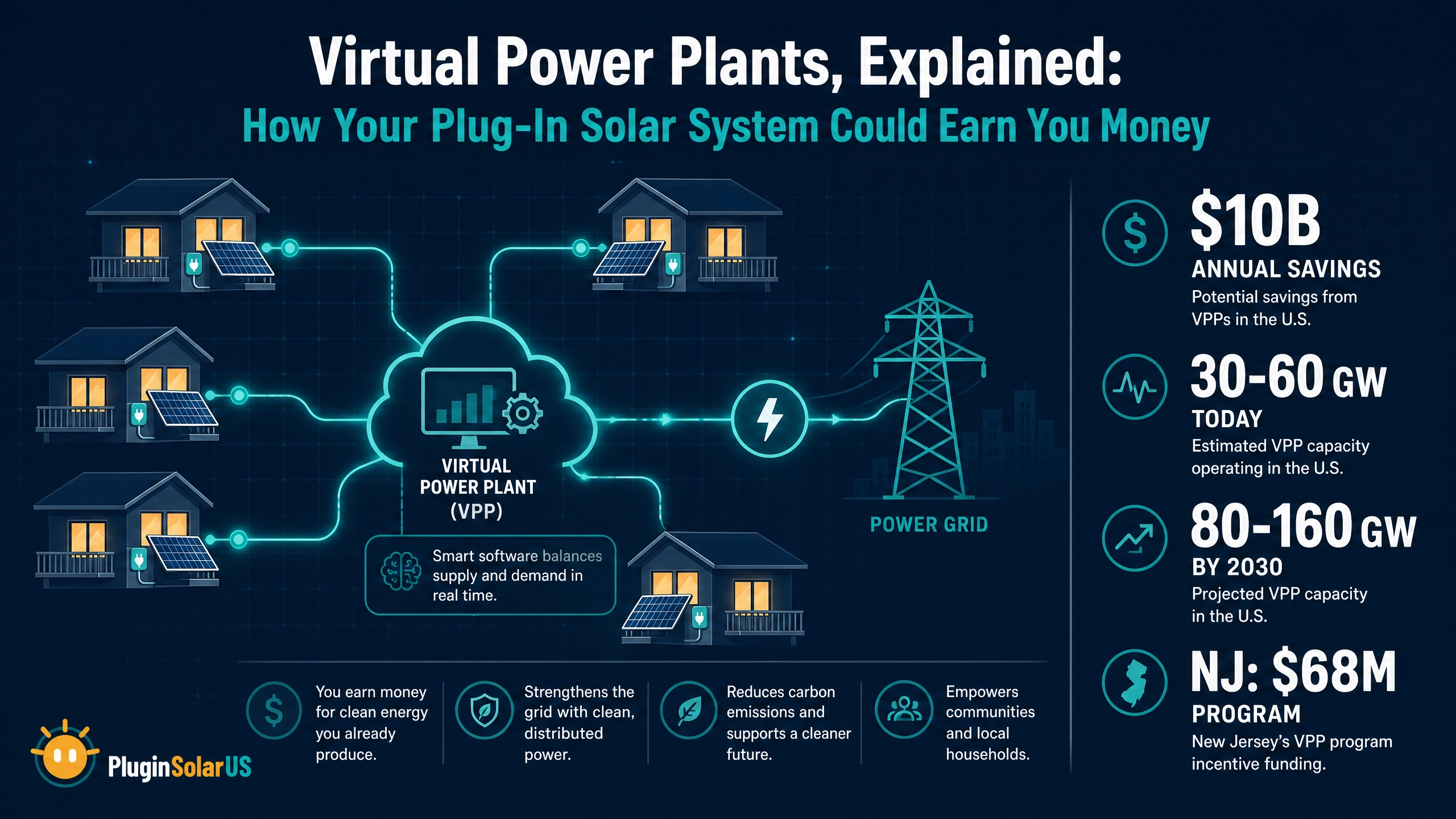
A virtual power plant is not a physical building with turbines and smokestacks. It’s a software platform that coordinates thousands—sometimes millions—of distributed energy resources (DERs) so they behave like a single, dispatchable power plant. When the grid needs more power or less demand, the VPP sends signals to enrolled devices: discharge your battery, delay your EV charging, nudge your thermostat up two degrees.
The result? Small adjustments across many homes add up to power-plant-scale impact. The Department of Energy estimates that 30–60 GW of VPP capacity already exists on the US grid today, and tripling that to 80–160 GW by 2030 could address 10–20% of peak load and save approximately $10 billion in annual grid costs.
How VPPs Work: The Three Layers
For participants, the experience is simple: you enroll your device, set your comfort preferences (e.g., “don’t let my house go above 78°F”), and the VPP handles the rest. In exchange, you receive compensation—typically bill credits, direct payments, or reduced rates.
Why VPPs Are Exploding Right Now
Three regulatory and market forces are converging to make 2026 the breakout year for virtual power plants:
Three Catalysts
- FERC Order 2222 (2020, compliance deadlines hitting now) — Requires all regional grid operators to let DER aggregations participate in wholesale electricity markets. Minimum aggregation: 100 kW.
- Grid stress is real — PJM hit 168 GW estimated peak on July 2. ERCOT broke its record at 91.3 GW. Utilities need demand-side solutions now.
- State programs are launching — NJ ($68M program, mid-2027), Maryland (regulatory framework issued May 2026), California (already operational), and more.
New Jersey’s $68 Million VPP Proposal
On July 27, 2026, the New Jersey Board of Public Utilities released its VPP Straw Proposal—a detailed plan to aggregate home batteries, smart thermostats, and EV chargers into a coordinated grid resource. The proposal responds to Governor Mikie Sherrill’s Executive Order No. 2 (January 20, 2026), which declared a statewide energy emergency.
Key details:
“Virtual power plants let us tap into technology that’s already sitting in driveways and living rooms across the state – batteries, thermostats, EV chargers – and turn them into grid assets that reduce utilities cost to serve customers.”
— Ben Hertz-Shargel, NJBPU President
Maryland’s Regulatory Framework
On May 6, 2026, the Maryland Public Service Commission issued Order No. 92398, establishing the state’s VPP regulatory framework. The order directs utilities to enable aggregator access to PJM-required data by January 1, 2028, creates a Data Exchange Work Group for a statewide Green Button Connect platform, and requires annual DERMS (Distributed Energy Resource Management System) status updates starting October 2026.
For plug-in solar owners in Maryland—where the technology is already legal under HB 1532—this means the regulatory infrastructure for earning money from your system is being built right now.
Where Plug-In Solar Fits In
Here’s where it gets interesting for plug-in solar owners. A plug-in solar system paired with a battery is, from a VPP’s perspective, a perfect node:
Under FERC Order 2222, the minimum aggregation size for wholesale market participation is 100 kW. That’s approximately 250 plug-in solar + battery systems (at 400W each). In a dense urban area—exactly where plug-in solar thrives—reaching that threshold is entirely feasible within a single neighborhood.
The Economics: What Could You Earn?
VPP compensation varies by program, but here’s a realistic range based on existing programs:
For a plug-in solar + battery system costing $800–$1,200, VPP participation could add $100–$300 in annual value on top of the direct electricity savings. That could cut payback periods from 3–4 years down to 2–3 years—making the economics even more compelling.
The Cost Advantage
The DOE’s analysis is striking: a VPP composed of residential thermostats, water heaters, EV chargers, and behind-the-meter batteries can provide peaking capacity at roughly half the net cost of traditional alternatives (a utility-scale battery plus a natural gas peaker plant). This cost advantage is what’s driving state regulators to act.
The market reflects this potential. The global VPP market was valued at $7.4 billion in 2026 and is projected to reach $30.9 billion by 2033—a compound annual growth rate of 22.6%.
States Where This Matters Most
The intersection of plug-in solar legalization and VPP program development creates a unique opportunity in several states:
What Needs to Happen Next
For plug-in solar to fully participate in VPPs, several pieces need to come together:
Requirements for Plug-In Solar VPP Participation
- Battery integration — Solar-only systems can reduce demand but can’t dispatch stored energy. Battery-equipped systems are the real VPP asset.
- API-enabled microinverters — Manufacturers like Hoymiles and APsystems already have cloud-connected inverters. The next step is opening APIs to VPP aggregators.
- Aggregator enrollment — Companies need to build enrollment pathways specifically for plug-in solar owners (most current VPP programs target full rooftop solar + Powerwall systems).
- Regulatory clarity — States need to explicitly include plug-in solar in their VPP program definitions. NJ’s A6159 bill already defines VPPs to include “residential solar systems.”
- Metering standards — Maryland’s order addresses device-level metering, which would allow plug-in solar to be compensated without a separate utility meter.
The Bottom Line
Virtual power plants represent the next evolution of distributed energy—and plug-in solar is positioned to be a foundational building block. The technology is cheap, the regulatory frameworks are being built, and the grid desperately needs the capacity.
If you’re buying a plug-in solar system today, consider one with battery storage and a Wi-Fi-connected microinverter. You’re not just buying a way to reduce your electricity bill—you’re buying a future revenue-generating asset that could earn you money every time the grid needs help.
Key Dates to Watch
- August 17, 2026 — NJ VPP public comment deadline
- October 10, 2026 — Maryland utilities DERMS status reports due
- January 1, 2028 — Maryland aggregator access to utility DER data
- Mid-2027 — NJ VPP Phase 1 target launch
- 2030 — DOE target: 80–160 GW of VPP capacity nationwide