Behind the Bill: How Connecticut Brought Plug-In Solar Into a Broader Renewable-Energy Package
By PlugInSolarUS Editorial · Published 2026-06-24 · 18 min read
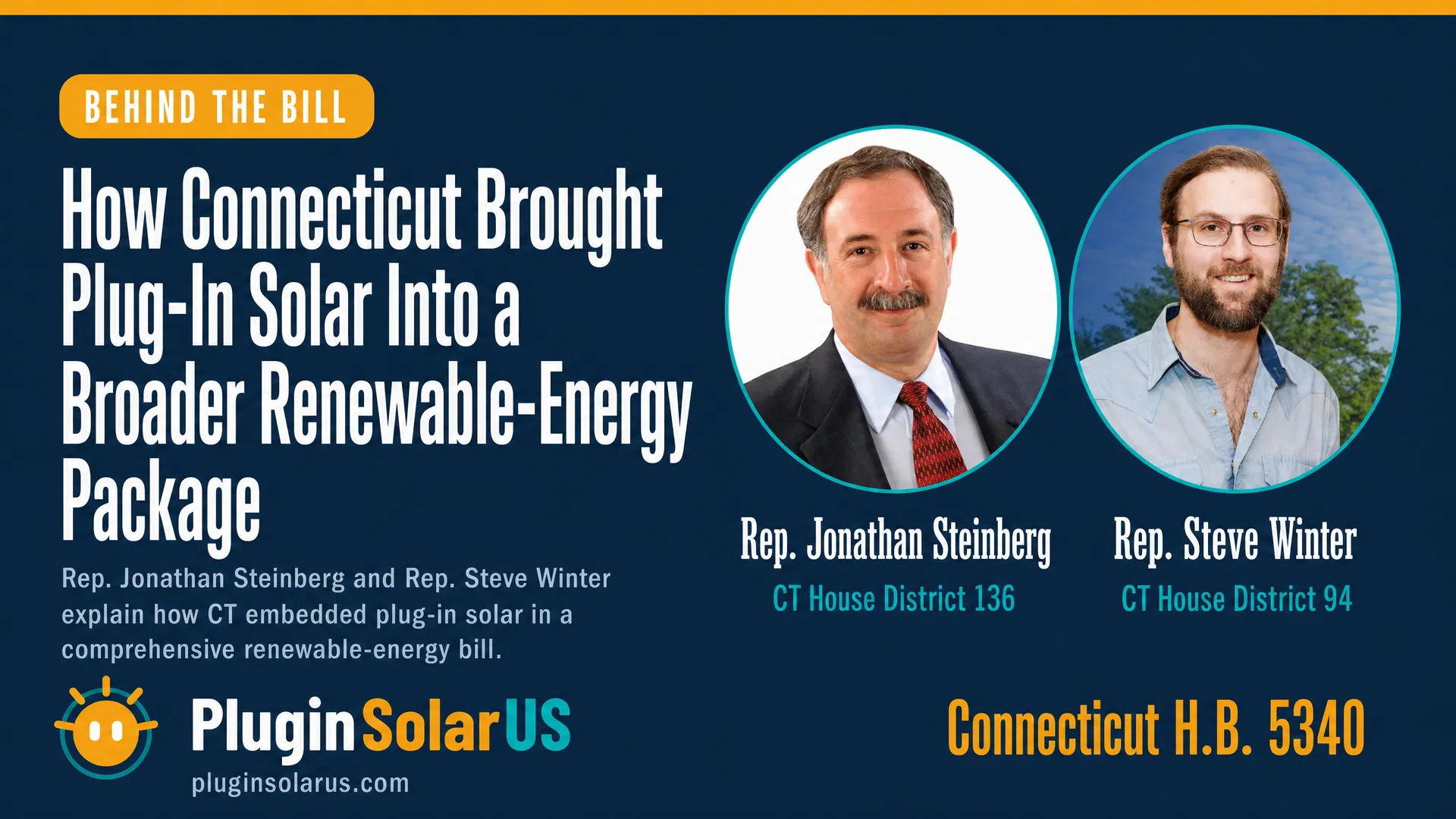
Rep. Jonathan Steinberg and Rep. Steve Winter explain why Connecticut treated plug-in solar as a safety-first affordability and clean-energy access tool.
Editor’s Note: This article is part of PluginSolarUS.com’s “Behind the Bill” series, which explores how different states are approaching plug-in solar legislation, consumer access, safety, and implementation. The article is based on interviews with Connecticut Rep. Jonathan Steinberg and Rep. Steve Winter, public legislative materials for H.B. 5340 / Public Act No. 26-127, and additional background research. The discussion reflects the status of Connecticut’s plug-in solar law and related standards as of the publication date. Product certification, electrical code requirements, utility practices, building and fire code rules, and implementation details may continue to evolve. For a full overview of Connecticut’s plug-in solar status, see our Connecticut state page.
When Connecticut passed H.B. 5340, later enacted as Public Act No. 26-127, plug-in solar was only one piece of a much larger renewable-energy package.
The bill addressed multiple energy priorities, including solar programs, consumer protections, storage, agrivoltaics, environmental justice solar, permitting, and portable solar photovoltaic systems. Rep. Jonathan Steinberg described this type of large legislative package as an “aircraft carrier” — a broad bill carrying many separate policy sections at once.
He said that was not his preferred approach, but Connecticut’s legislative calendar made it practical. In a short session, with many energy priorities competing for attention, lawmakers recognized that they might only be able to move one major energy bill. As a result, many renewable-energy issues were consolidated into a single package.
Plug-in solar was not the largest part of the bill. But it quickly became one of the most interesting.
“It was remarkable how many people really from both sides of the aisle were excited by the prospect,” Steinberg said.
Rep. Steve Winter saw that same appeal from another angle. For Winter, plug-in solar was not only a technical fix or a small consumer product. It was part of a broader effort to reduce clean-energy soft costs, expand access for people left out of traditional rooftop solar, and test new models for bringing clean energy into everyday life.
Together, the two interviews show Connecticut’s distinctive approach: the state treated plug-in solar as a promising affordability and access tool, but embedded it inside a safety-first framework that recognizes the category is still early in the United States.
How plug-in solar entered the conversation
Steinberg said plug-in solar had become a popular discussion point, partly because of media coverage and examples from Germany, where small balcony and portable solar systems have become more common.
Winter first encountered the issue at a statewide clean-energy event in Hartford. Bill McKibben joined the event by Zoom and highlighted plug-in solar and automated permitting as technologies worth fast-tracking. Both ideas eventually became part of Connecticut’s broader H.B. 5340 package.
That pairing is important. Automated permitting reduces friction for conventional solar projects. Plug-in solar points toward an even lower-friction category: a small, behind-the-meter product designed to offset part of a customer’s electricity use without the same interconnection burden as a full rooftop system.
Winter said he had long been interested in how to increase access to clean energy, especially for less wealthy households, and why U.S. solar costs have not fallen as dramatically as in some other jurisdictions. Plug-in solar and automated permitting both spoke to that concern.
Brightsaver and local environmental and grassroots clean-energy groups also helped make plug-in solar a priority. As a newer legislator, Winter said he knew the idea needed buy-in from Steinberg, so he raised it with him before session. By the time the session began, multiple advocacy groups were elevating plug-in solar as a priority.
A small part of a big bill, but a powerful idea
Connecticut’s plug-in solar provisions are part of a broader law called “An Act Concerning Renewable Power Generation.”
Under the law, a portable solar generation device is generally defined as a solar photovoltaic device that is not permanently affixed to a structure, has a maximum output of 1,200 watts, connects behind the customer’s meter through a standard 120V outlet, and is primarily intended to offset part of the customer’s electricity consumption.
The law also includes important conditions. The device must meet state building code requirements, the National Electrical Code, IEEE 1547, and certification requirements from Underwriters Laboratories or an equivalent nationally recognized testing laboratory. It must include a feature that prevents the system from energizing the building’s electrical system during a power outage.
If those conditions are met, the device is exempt from certain interconnection-agreement requirements imposed by the Public Utilities Regulatory Authority, with a limit of one device behind a customer’s meter.
In plain English, Connecticut created a legal pathway for small plug-in solar devices — but only under defined safety, code, grid-reliability, and consumer-protection conditions.
That balance reflects the core message from both Steinberg and Winter: Connecticut wants plug-in solar to become accessible, but not at the expense of safety, transparency, or grid reliability.
Why plug-in solar resonated in Connecticut
For Steinberg, the excitement around plug-in solar came from the broader energy affordability crisis.
New England electricity costs are high, and many residents feel they have little control over their bills. Traditional rooftop solar can help some households, but it is expensive, requires the right roof, and is often unavailable to renters, apartment residents, and many lower-income households.
Plug-in solar offered a different promise. It would not eliminate a household’s electricity bill. It would not replace a full rooftop solar system. But it could let people take a small, visible step toward producing some of their own electricity.
Steinberg said the appeal came from the idea that people could “reassert control” and not feel powerless in the face of rising energy costs. He described plug-in solar as a “populist” answer to that frustration.
Winter framed the same idea as clean-energy democratization. He said plug-in solar has the potential to provide a small but meaningful amount of clean energy, but that its symbolic value may be just as important: it can help more people access clean energy and present new models for bringing clean energy into people’s lives.
With plug-in solar and plug-in storage, Winter said, Connecticut is looking for creative tools that can help people lower both energy bills and emissions.
Renters, homeowners, and the access question
One of the most compelling arguments for plug-in solar is that it could help people who are left out of traditional rooftop solar.
That includes renters, apartment residents, condo owners, homeowners with unsuitable roofs, and households that cannot afford a full solar installation.
Steinberg said the original concept was to make plug-in solar as broadly available as possible. That broad access is what made the idea feel populist. A renter may not control the roof. A condo resident may need board approval. A homeowner may not want to spend tens of thousands of dollars on a full system. Plug-in solar could offer a smaller, more affordable entry point.
Winter was careful to distinguish between near-term and long-term beneficiaries. In the near term, he expects homeowners and other property owners may be best positioned to benefit because current UL-related pathways may still require a specialized plug or installation component. For now, he said, the category may not be a true plug-and-play product for every resident.
Longer term, Winter sees major promise for renters and urban residents if standards and certifications evolve toward ordinary-outlet use. A renter with a balcony, backyard, or other suitable space could eventually have a practical way to participate in clean energy without owning a roof.
That makes Connecticut’s access story realistic rather than simplistic. The law opens a pathway, but renter and multifamily access will depend on products, standards, building rules, landlords, wiring, consumer education, and possibly future policy work.
Safety first: older homes, UL standards, and building codes
Steinberg repeatedly emphasized that Connecticut intentionally erred on the side of safety.
That posture was shaped by several factors. First, plug-in solar is still a new category in the United States. While Germany has seen broad adoption, the U.S. electrical system, building stock, codes, utility practices, and consumer expectations are different.
Second, Connecticut has many older homes and buildings. Steinberg noted that the state has aging infrastructure across transportation, energy, housing, and other systems. That includes older homes and improvised wiring that may not be ideal for a new electrical product category.
Winter echoed this concern. He said Connecticut has many older homes with older wiring, which creates real safety considerations.
Third, UL standards and code treatment are still evolving. Steinberg said Connecticut did not expect widespread adoption immediately. Instead, the state wanted to create a supportive legal pathway while waiting for safety standards, compliant products, and implementation practices to mature.
Steinberg said UL appeared to be moving toward recommending involvement from an electrician or appropriate installer, along with a separate circuit and breaker, to avoid problems with existing wiring. Winter similarly noted that current UL-related requirements may still involve a specialized plug or installation component.
Connecticut’s message was not “buy anything and plug it in anywhere.” It was: the state supports the category, but consumers should be informed, careful, and guided by certified products, applicable codes, and proper installation.
Grid reliability and inverter certification
Winter added another important implementation detail: grid reliability.
He said Connecticut met with ISO New England, the regional grid operator, and received input about including language specific to inverter standards already used for conventional residential solar systems. The goal was to make sure plug-in solar systems would have the same grid-reliability characteristics expected of other residential solar equipment.
That detail matters because plug-in solar is not just a consumer appliance. It is a device that can generate electricity and interact with a home electrical system and, under certain conditions, with the grid.
The bill’s safety framework therefore addresses more than household wiring. It also attempts to ensure that devices are certified, outage-safe, and compatible with broader grid-reliability expectations.
Winter said these changes were not the result of outright opposition. Rather, ISO New England wanted explicit certainty that systems would align with existing grid-reliability standards.
The metering problem
One of the most important technical issues raised by both Steinberg and Winter was metering.
If a plug-in solar device produces more electricity than the customer is using at that moment, excess electricity may flow back through the meter. If the customer does not have the right kind of meter, that exported generation could be measured as usage — meaning the customer might be charged for electricity they produced.
That is the opposite of what lawmakers want.
Steinberg said Connecticut discussed the issue but did not simply require every customer to install a new meter. Requiring a new meter could add hundreds of dollars in cost, undermining the affordability promise that makes plug-in solar attractive.
Winter described this as a Connecticut-specific wrinkle because only some customers currently have smart meters. In most cases, he expects small systems will generate power that is consumed on site, especially if paired with a battery. But in edge cases, a customer with an older meter could see exported power treated as consumption.
Instead of blocking access because of those edge cases, Connecticut added consumer disclosure language. The goal is to make sure customers understand the issue before buying or using a system.
This is a critical point for consumer education. Plug-in solar savings depend not only on the product, but also on electricity consumption patterns, meter type, system size, storage, installation, and utility rules.
Concerns, not outright opposition
Both interviews suggest that Connecticut’s plug-in solar provisions faced concerns, but not major organized opposition.
Steinberg said utilities grumbled and worried they would be blamed if customers had bad experiences, especially if costs, meters, or product issues created confusion. But he also said the plug-in solar portion spoke directly to affordability and had bipartisan appeal, even though other parts of the broader renewable-energy package remained partisan.
Winter described the process similarly. Utilities wanted language warning residents that older meters could result in charges for exports. ISO New England wanted explicit inverter-certification language. Those concerns led to more precise bill language, not a campaign to stop the idea.
“Nobody at any point was saying, don’t do this,” Winter said. The message was more: this is interesting, but the bill needs to address certain technical concerns.
That distinction is important for other states. Plug-in solar bills may not fail because people oppose consumer solar access. They may struggle because technical stakeholders are not comfortable that the bill addresses safety, metering, grid reliability, building codes, or consumer disclosures. Connecticut’s approach was to capture those nuances while preserving the core legal pathway.
Why Connecticut did not wait for everything to be perfect
Some states may choose to wait until standards are fully developed before acting. Connecticut chose a different path.
Steinberg described the law as an enabling step rather than a full market launch. The state is not expecting instant mass adoption. Instead, it is creating a policy foundation so that when products, standards, and consumer education catch up, Connecticut residents can participate.
“We have no expectation of any sort of widespread adoption in the near term until that’s all been promulgated by UL,” Steinberg said.
But lawmakers did not want to wait until every detail was finished. Connecticut was responding to sincere demand from residents who want more control over energy costs. The state wanted to recognize that demand while still being careful about safety.
The result is a law that says, in effect: plug-in solar is coming, Connecticut is supportive, but implementation must be safe, certified, grid-compatible, and informed.
Soft costs, interconnection, and the broader solar strategy
Winter’s interview adds an important theme to Connecticut’s story: soft-cost reduction.
In solar, soft costs include permitting, interconnection, customer acquisition, financing, inspection, and other non-hardware costs. Even as hardware prices fall, these costs can keep U.S. solar expensive.
Winter connected plug-in solar to automated permitting and interconnection reform. Automated permitting can reduce friction for conventional solar. Plug-in solar is compelling because it can eliminate or greatly reduce the interconnection burden for small systems.
“The beauty of plug-in systems is there is no interconnection,” Winter said.
Even if a specialized plug or small building permit is needed in the near term, Winter said the soft costs are dramatically lower than conventional solar. If the same concept can eventually expand into larger systems, plug-in battery storage, or combined PV-and-battery systems, it could become even more interesting.
This positions plug-in solar not as a replacement for rooftop solar, but as part of a broader strategy to make distributed energy easier, cheaper, and more accessible.
Part of a broader solar future
Steinberg sees plug-in solar as one part of a much larger transformation in solar and distributed energy.
He pointed to rooftop solar, ground-mounted solar, solar canopies, solar shingles, solar window films, storage, peak shaving, and virtual power plants as part of the future energy system.
Plug-in solar may start small — perhaps two or three panels — but it could become an entry point into broader energy participation. A consumer who begins with a small portable system may later consider a larger ground-mounted system, rooftop solar, storage, or other home electrification upgrades.
Winter also sees plug-in solar’s grid value as modest but real. Its main value is lowering household bills, he said, but at scale it could add a small but meaningful amount of behind-the-meter solar to the regional grid during sunny midday hours in spring, summer, and fall.
Germany is the example many policymakers point to: a single small device is modest, but millions of small systems can add up.
That does not make plug-in solar a solution to every energy challenge, including data centers or large-scale demand growth. But it does make the category part of a broader distributed-energy story: more generation closer to where electricity is used, more customer participation, and more tools for reducing bills and emissions.
Jobs, manufacturing, and the emerging ecosystem
Plug-in solar could also create new opportunities for workers and small businesses.
Steinberg said he hopes the broader solar and storage transition will create green jobs and new career pathways. That may include electricians, installers, contractors, energy-service providers, and possibly manufacturers.
He noted that Connecticut has a strong base of precision manufacturing. If the plug-in solar market grows, there may be opportunities for companies to help produce or support UL-approved products.
Winter’s soft-cost framing points to another possible ecosystem effect. If plug-in systems, plug-in storage, or smaller PV-and-battery products become viable categories, they could create a new layer of consumer energy work: product distribution, qualified installation, outlet upgrades, consumer education, monitoring, storage integration, and local service.
But both interviews also reflect realism. The market is early. Products are not yet broadly available in certified, retail-ready form. Standards are evolving. Consumer education and installer guidance will be essential.
Education may be the most important next step
If there was one issue Steinberg returned to again and again, it was education.
Consumers need to understand what plug-in solar can and cannot do. It is not a whole-home power system. It may not work during an outage unless properly designed with appropriate equipment. It may require professional installation, a specialized plug, or a dedicated circuit. It may interact with a utility meter in ways consumers do not expect. It may not produce savings if installed incorrectly or used in the wrong setting.
Steinberg said people are paying more attention to energy because their bills are high, but that does not mean they fully understand how the grid, meters, circuits, batteries, or solar generation work.
That gap creates risk. Without education, consumers could be disappointed, overcharged, sold poor-quality products, or exposed to unsafe installations.
“The last thing we want is to set expectations and then not be able to deliver on them,” Steinberg said.
Winter agreed that market readiness is essential. He said the biggest next step is a mass-produced product that meets the relevant UL pathway and is available online or in stores. Connecticut and other states have sent a market signal; now lawmakers are waiting to see what manufacturers and retailers produce.
The next phase is therefore not only about passing laws. It is about standards, compliant products, consumer disclosures, installer guidance, utility communication, and plain-English education.
Lessons for other states
Connecticut offers several lessons for other states considering plug-in solar legislation.
First, plug-in solar can fit inside a broader energy package. Connecticut did not treat it as an isolated idea; it placed the category alongside solar programs, storage, environmental justice, permitting, and other renewable-energy policies.
Second, affordability matters. In a high-electricity-cost region like New England, plug-in solar resonated because people want some control over rising bills.
Third, safety cannot be an afterthought. Older homes, wiring, specialized plugs, dedicated circuits, UL standards, building codes, inverter certification, and outage safety all matter.
Fourth, consumer disclosure is essential. Metering issues may not affect every customer, but they can create bad experiences if people do not understand them.
Fifth, opposition may be manageable if concerns are addressed early. In Connecticut, the major issues were technical nuance rather than a fundamental rejection of plug-in solar.
Finally, laws can open the door, but standards and products determine how widely consumers can walk through it. Connecticut’s law creates a framework. The market, standards bodies, utilities, code officials, and educators now have to make that framework practical.
A message to Connecticut residents
Asked what he would tell Connecticut residents interested in plug-in solar, Steinberg’s answer was supportive but cautious.
“It’s coming,” he said. “The state is supportive. People need to be patient and they need to be well informed.”
He emphasized that plug-in solar should not be treated as a trivial gadget. It generates electricity, and if used incorrectly, it can create real issues. His advice was straightforward: do your homework, hire a professional when needed, and buy the best certified product available once the market is ready.
Winter’s message was similar but focused on the promise once certified products are available. If products meet UL certification, he said, consumers can have a high degree of confidence that they will be safe and grid-compatible. Because Connecticut electricity rates are high, he suggested a three- to four-year payback could be reasonable if U.S. product costs approach European levels.
After payback, Winter described the product as a small appliance that produces essentially free clean power.
The combined message is clear: plug-in solar holds real promise for savings, access, and clean-energy participation, but consumers should wait for certified products, understand their meter and installation situation, and follow applicable safety and code requirements.
Connecticut’s role in the national movement
Connecticut’s plug-in solar law is important because it shows how the idea can fit into a broader state energy strategy.
Unlike Utah, where the first bill focused narrowly on removing a utility-contract barrier, Connecticut placed plug-in solar inside a larger renewable-energy package. That reflects the state’s broader energy priorities: affordability, solar deployment, storage, consumer protection, safety, environmental justice, permitting, grid reliability, and modernization.
The plug-in solar provisions are not the whole story. But they represent a meaningful shift.
Connecticut is saying that small consumer-owned solar devices should have a legal pathway, as long as safety, codes, certification, grid reliability, and consumer disclosures are respected.
That may be the defining feature of Connecticut’s approach: enthusiasm, but not haste; access, but not at the expense of safety; consumer choice, but with education and guardrails.
Plug-in solar is still early in the United States. The market is not fully developed. Standards are still evolving. Products are still emerging. Consumers still need clear guidance.
But Connecticut has taken an important step. It has recognized that people want more control over their electricity bills, more access to solar, and more ways to participate in the clean-energy transition.
Now the next phase begins: standards, products, education, implementation, and the practical work of turning a new legal pathway into a safe and useful consumer market.
Source Notes: Primary sources for this article include interviews with Rep. Jonathan Steinberg and Rep. Steve Winter regarding Connecticut H.B. 5340 / Public Act No. 26-127; Connecticut General Assembly materials for H.B. 5340 / Public Act No. 26-127, “An Act Concerning Renewable Power Generation”; public information on portable solar generation devices, UL standards, National Electrical Code considerations, inverter certification, and plug-in photovoltaic safety; and background research on emerging U.S. plug-in solar legislation and European plug-in solar adoption. Direct quotes from interviews have been lightly edited for clarity and readability without changing their intended meaning. Key quotes should be verified with the speakers before publication.
Disclaimer: PluginSolarUS.com provides general educational information only. This article is not legal, electrical, engineering, product-safety, installation, or financial advice. Before purchasing or installing any plug-in solar, portable solar, solar-plus-storage, battery, inverter, or related electrical product, consumers should confirm current requirements with applicable state law, local building and electrical authorities, fire officials where relevant, their utility, their landlord or HOA where applicable, and a qualified electrician if needed. Consumers should use only properly certified or listed products that comply with applicable safety standards, electrical codes, manufacturer instructions, and local requirements. Laws, standards, utility rules, product certifications, billing practices, metering requirements, and installation requirements may change over time. Estimated savings, payback periods, and product availability vary by electricity rates, system size, location, usage patterns, product cost, installation requirements, metering configuration, tariffs, incentives, and local rules. Nothing in this article should be interpreted as a recommendation to install any electrical product in a way that violates applicable codes, utility rules, manufacturer instructions, lease terms, HOA rules, or safety requirements.
Sources
- Rep. Jonathan Steinberg, sponsor of Connecticut H.B. 5340
- Rep. Steve Winter, Connecticut House District 94
- Connecticut H.B. 5340 / Public Act No. 26-127 — CT General Assembly
- UL 3700: Standard for Plug-In Photovoltaic Products
- CT Mirror: Plug-in solar can help reduce electric bills. Will CT make it legal?