Behind the Bill: How New York Is Trying to Bring Plug-In Solar to the Country’s Largest Urban Market
By PlugInSolarUS Editorial · Published 2026-07-27 · 22 min read
Assemblymember Emily Gallagher and Sen. Liz Krueger’s policy advisor Justin Flagg explain why New York’s SUNNY Act targets interconnection as the first barrier to unlocking plug-in solar for millions of urban renters and homeowners.
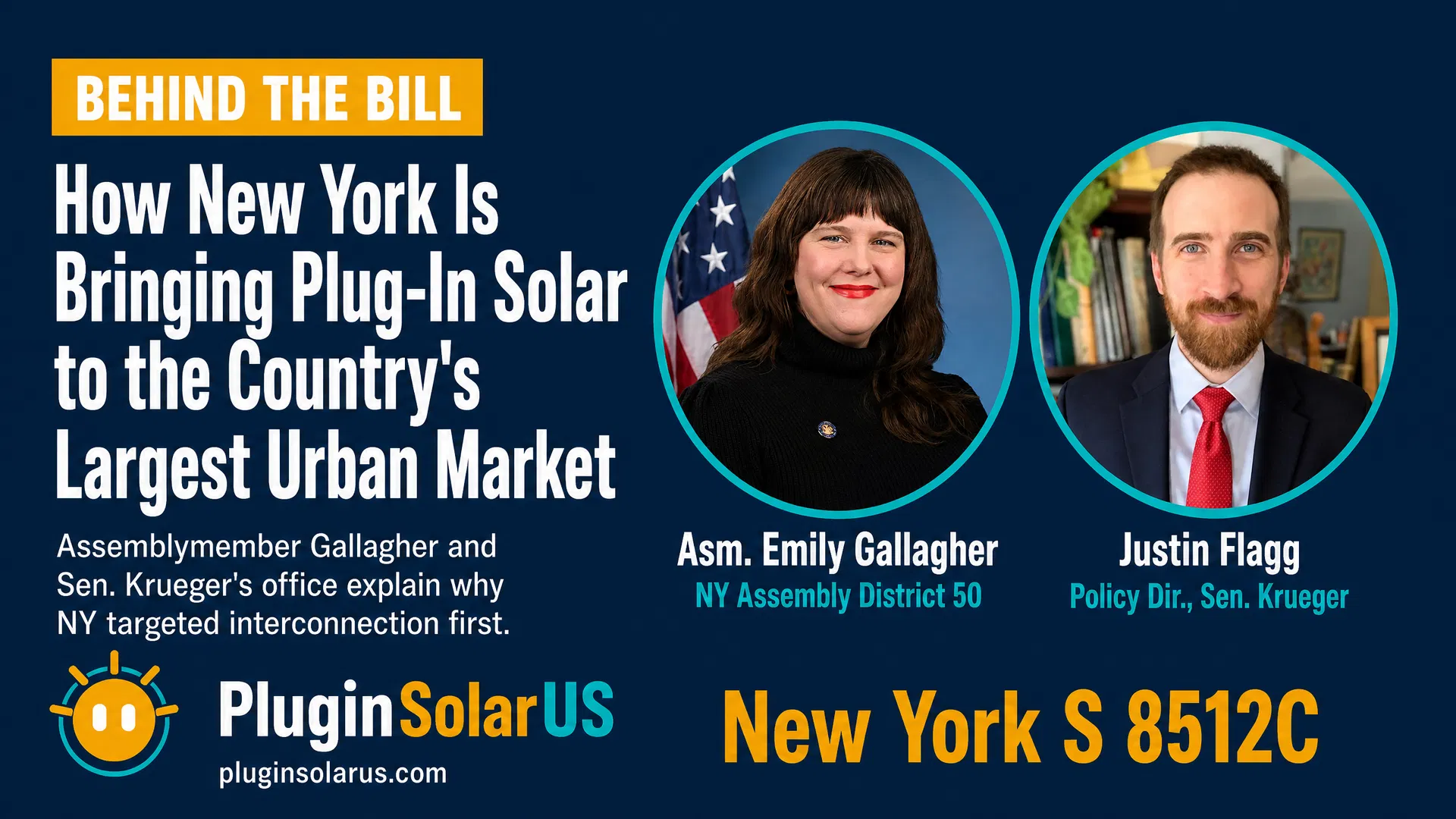
Editor’s Note: This article is part of PluginSolarUS.com’s “Behind the Bill” series, which explores how different states are approaching plug-in solar legislation, consumer access, safety, and implementation. This article is based on interviews with Assemblymember Emily Gallagher and Justin Flagg, Director of Environmental Policy for Sen. Liz Krueger. For a full overview of New York’s plug-in solar status, see our New York state page.
A positive climate idea for a renter-heavy state
New York’s plug-in solar story is different from the stories in many other states because it begins in one of the most urban, renter-heavy energy markets in the country.
Assemblymember Emily Gallagher framed the bill as part of her office’s broader decarbonization work, but also as something rarer in climate policy: an affirmative, consumer-facing idea. Instead of only banning harmful practices, regulating pollution, or stopping fossil-fuel expansion, plug-in solar offers people a way to participate in a technology they can see and own.
For Gallagher, that mattered. Plug-in solar is not only a kilowatt-hour story. It is a visibility story. A small solar device on a balcony, deck, yard, or multifamily building can give a resident a direct connection to clean energy that feels very different from a subscription, a utility program, or an abstract renewable-energy credit.
Justin Flagg, Director of Environmental Policy for Sen. Liz Krueger, described the same idea from the policy side. New York’s bill was narrowed around one barrier that mattered most: the interconnection agreement requirement. If that barrier stayed in place, small plug-in solar devices would remain trapped in a regulatory gray area, treated more like a large rooftop solar system than a small consumer product.
New York’s bill tried to change that. It did not attempt to solve every future landlord, co-op board, building-code, product-design, or retail question at once. It focused first on clearing the path so a market could begin to develop.
From Germany and Utah to Albany
Like many U.S. plug-in solar bills, New York’s effort was shaped by two outside examples: Germany and Utah.
Flagg said Sen. Krueger had been interested in the concept for roughly two years after reading about Germany’s balcony-solar market. He and Krueger traded articles about the German model and discussed whether something similar could eventually work in New York.
At first, however, it was not obvious what the state-policy lever should be. A tax credit or traditional incentive did not make much sense if the products were not yet being sold at scale in the United States. There needed to be a legal and regulatory path before there could be a real consumer market.
Utah helped clarify that path. When Utah passed an early plug-in solar law, it showed that one of the most important barriers was not only cost or consumer awareness. It was the way small plug-in systems could be pulled into conventional utility interconnection requirements that were designed for larger rooftop systems.
Gallagher came to the issue after a friend shared information about Utah’s law. She saw it as a strong fit for New York’s climate goals and especially relevant to a state where so many people live in rentals, apartments, co-ops, condos, duplexes, and multifamily buildings.
The barrier New York chose to remove first
New York’s strategy was intentionally narrow.
Gallagher’s office had considered a broader bill. Krueger’s office and Gallagher’s office ultimately focused on the one issue they believed had to be solved first: the interconnection agreement requirement.
Without the bill, a small plug-in solar device could fall into a legal gray area. A consumer might be technically expected to go through a utility interconnection process similar to the process used for a large rooftop solar project. That does not make sense for a small product someone might eventually buy from a retailer and use to offset part of a household’s load.
Flagg said the goal was to move quickly on the biggest barrier and let the market begin to develop. Later issues, such as landlord approval, co-op board rules, local codes, public-housing requirements, or building-specific restrictions, may need future fixes. But without solving interconnection first, those later questions would remain theoretical because the market itself would have little room to grow.
That is why New York’s approach can be understood as a first-step bill. It does not answer every question. It clears the first regulatory obstacle so the next set of questions can become real.
Why the legal gray area mattered
A gray market is not the same as a safe, accessible market.
Flagg’s concern was that people might buy plug-in solar systems anyway, even without clear rules. If the law is unclear, early adopters may turn to online products, informal installation practices, or products not designed around local safety expectations. Retailers may be reluctant to stock the category. Manufacturers may not see enough certainty to invest in New York-specific distribution. Consumers may not know what is legal, safe, or worth buying.
A clearer legal pathway can change that. It gives manufacturers, retailers, utilities, advocates, and consumers a common starting point. It also tells the market that New York is open to the category, which matters because New York City alone can send a major signal to product makers and national retailers.
That market signal was part of the strategy. If New York, with its dense urban housing stock and large customer base, enters the plug-in solar movement, manufacturers have more reason to build compliant products, refine designs, and serve U.S. consumers.
Who benefits: renters, urban homes, and high-cost households
Renters were top of mind for both Gallagher’s and Krueger’s offices.
That is not surprising. Gallagher and Krueger represent New York City districts where many constituents live in rental housing, apartment buildings, co-ops, condos, or multifamily structures. Traditional rooftop solar does not easily reach those residents. Even when solar exists somewhere in the system, residents may experience it through a subscription, a utility program, or a bill credit rather than through something they own directly.
Gallagher described the primary beneficiaries broadly: people who are curious about solar but lack the money, space, ownership rights, or building conditions needed for a full rooftop system. That includes renters, condo owners, duplex owners, and people looking for a lower-cost supplement to existing energy options.
Flagg also emphasized that New York’s early adopters may not all be renters. Single-family homeowners in places like Long Island could benefit earlier because electricity is expensive and many homes have decks, yards, or porches where small systems may be easier to place. A renter in a dense apartment building may face landlord, wiring, balcony, or building-code issues first. A homeowner with a deck may have a simpler path.
That does not weaken the renter-access case. It simply means rollout may happen in stages. The first wave may include homeowners, DIY-oriented consumers, and people with easier physical installation conditions. Later waves may require clearer rules for landlords, co-ops, public housing, multifamily buildings, and local codes.
The direct-ownership appeal
Gallagher emphasized a point that is easy to miss in energy policy: people want to feel connected to their energy choices.
New York already has community solar, clean-energy programs, utility offerings, and subscription-style options. Some of these can save customers money or support renewable energy. But they do not always feel direct. Residents may wait on lists, deal with confusing offers, or worry about scam-prone renewable-energy marketing.
Plug-in solar offers a different emotional experience. A resident can see the panel, know where the power came from, and feel that some part of the household’s electricity was produced by the sun hitting a device they own.
That directness matters in a state where many residents feel removed from energy infrastructure. A small system will not power an entire apartment. But it can make decarbonization feel less abstract and more participatory.
Urban solar: turning heat and sunlight into power
Gallagher’s district is urban, and she sees plug-in solar as part of a broader question: how can cities use sunlight rather than only experience it as heat?
Solar debates often focus on rural land use, farmland, utility-scale development, or conflicts with landowners. New York’s plug-in solar debate points in a different direction. It asks whether balconies, facades, decks, yards, and multifamily buildings can become part of the solar landscape.
That makes New York especially important. If plug-in solar can work in an urban environment, it expands the imagination of where distributed energy belongs. Solar does not have to be only on suburban roofs, rural fields, or large commercial buildings. It can also begin with small consumer devices in dense neighborhoods.
Con Edison support and stakeholder dynamics
One of the most notable parts of the New York story is that Con Edison, New York City’s major utility, supported the bill and provided a letter of support.
That utility posture distinguishes New York from some states where utility concerns have been a major obstacle. Flagg said Krueger’s office engaged Con Edison proactively. The utility had concerns, but the office worked through them. Gallagher also described little feasibility pushback, with opposition coming more from political skepticism toward renewable energy than from practical objections to the concept.
Flagg said other utilities, landlord groups, and real estate interests did not appear to mount organized opposition during the legislative process, though he cautioned that the bill still awaited the Governor’s signature at the time of the interview.
The bill passed unanimously in the Senate, according to Flagg, with more debate in the Assembly. That legislative path suggests the bill succeeded in part because it was focused. By narrowing the problem to interconnection, the sponsors avoided turning the first bill into a fight over every future building, landlord, or code question.
Safety education after battery-fire concerns
Safety questions were real in New York, but they took on a particular local shape.
Flagg said some legislators associated the concept with New York City’s e-bike battery-fire problem. Those fires have involved unsafe, refurbished, damaged, or uncertified battery products. Plug-in solar is a different category, but the association meant the sponsors had to explain the difference clearly.
That education included inverters, touch-safe plugs, anti-islanding behavior, UL standards, and other safeguards designed to prevent small solar systems from creating hazards for users, buildings, or utility workers.
Gallagher said her office worked with industry experts in appliance regulation and solar to create standards that were safe and achievable across building types, including older and newer buildings. Her broader point was that renewable energy is often portrayed as uniquely dangerous, while the daily risks and harms of fossil fuel use are normalized. The goal was not to ignore safety, but to create a realistic and balanced safety framework.
The 391-watt tradeoff
New York’s draft originally included a 391-watt exemption from certain rewiring requirements. That provision was removed before final passage.
Flagg said the concern appeared to come from legislative leadership discomfort with the Legislature making technical decisions that might more properly belong to UL, the code council, or another expert body. Rather than risk losing the entire bill, the sponsors chose to drop the 391-watt carve-out and keep the focus on removing the interconnection barrier.
That decision may slow some early adoption. Smaller systems that could have had a more straightforward plug-and-play path may now face more code or wiring uncertainty. But Flagg described interconnection as the North Star. If New York had not removed that barrier first, the market would have had a much harder time developing at all.
In other words, New York traded a broader first bill for a cleaner first step. The next phase can address rewiring, product design, building codes, and no-wiring systems once the market begins to show where the real problems are.
Implementation will move outside the Legislature
Once the Legislature clears the first barrier, the next phase shifts to a much wider ecosystem.
Flagg identified UL, the National Electrical Code, manufacturers, product designers, local governments, New York City building and fire officials, landlords, co-op boards, and consumer educators as the next set of actors. Gallagher also pointed to the Codes Council and building-code regulators as key to working through how standards, dedicated circuits, and older building stock will interact.
Product availability will matter. So will retail confidence. State or city support for the solar supply chain could help. Gallagher mentioned the possibility of bulk-buy programs or partnerships with solar developers and manufacturers to reduce costs, stimulate adoption, and make the category more visible.
New construction may be another opportunity. Developers and builders could design multifamily buildings with plug-in solar readiness in mind, just as some buildings are beginning to think more intentionally about EV charging, electrification, and distributed energy.
Affordability, peak demand, and the future grid
Plug-in solar is small, but Flagg connected it to large energy-system questions.
For households, even modest savings can matter. A 10–20% bill reduction may not eliminate a utility bill, but $30–$50 a month can be meaningful for constituents facing high energy costs.
At system scale, small devices could also matter if they reduce peak demand in constrained areas. In New York City, even small reductions during peak periods can save the system significant money because infrastructure upgrades are expensive.
Flagg also linked plug-in solar to the future of distributed energy: demand response, virtual power plants, small batteries, household-scale generation, and a changing relationship between consumers and the grid. The long-term question is not only whether a device can offset a small load. It is whether households can become active participants in generation, storage, and flexible demand.
Data centers and energy affordability
The conversation also connects to the broader pressure that data centers and new electric loads are placing on grids across the country.
Flagg mentioned New York’s separate data-center debate and a bill involving a one-year moratorium. Plug-in solar will not solve the data-center load problem. But it is part of the same affordability conversation: when demand rises, infrastructure costs rise, and households look for tools to protect themselves from higher bills.
A small plug-in system cannot replace serious planning around large loads, transmission, resource adequacy, or utility cost allocation. But it can give some residents a way to reduce part of their own consumption and participate in a more distributed energy system.
Lessons for other states
New York’s lesson is not that every state should write the same bill. It is that states should identify the barrier that matters most in their market and solve that first.
For New York, that barrier was interconnection. Landlord rules, co-op boards, public housing, local codes, and product readiness all matter. But those issues become easier to address once a legal consumer market exists.
The second lesson is that utility engagement can change the tone of the debate. Con Edison support gave New York’s bill credibility and helped distinguish practical concerns from political objections.
The third lesson is that safety education must be specific to local context. In New York, that meant explaining how certified plug-in solar differs from unsafe battery products and how standards, inverters, plugs, and anti-islanding features reduce risk.
Finally, New York shows why urban states matter. Bringing New York City into the plug-in solar movement sends a signal that this category is not only for suburban decks or rural yards. It may also belong in dense, renter-heavy cities.
A message to New Yorkers
Gallagher’s message is that plug-in solar can make climate action feel more positive, personal, and accessible. It gives people a way to move a desirable clean-energy technology into their own lives rather than waiting for the energy system to change around them.
Flagg’s message is that plug-in solar can help residents save money, gain a measure of energy independence, and take part in the grid of the future. It will not solve every energy problem. It will not remove every building or landlord barrier on day one. But it can move New York out of the gray area and into a more practical conversation about safe, affordable, household-scale distributed energy.
That is the significance of New York’s bill. It is not the final word on plug-in solar. It is the first step toward making small consumer solar real in one of the country’s most important urban energy markets.
Source Notes: Primary sources for this article include interviews with Assemblymember Emily Gallagher and Justin Flagg, Director of Environmental Policy for Sen. Liz Krueger, regarding New York’s plug-in solar bill, interconnection, renters, urban housing, safety, utility coordination, implementation, and energy affordability. Direct quotes have been lightly edited for clarity.
Disclaimer: PluginSolarUS.com provides general educational information only. This article is not legal, electrical, engineering, product-safety, installation, or financial advice. Before purchasing or installing any plug-in solar, portable solar, solar-plus-storage, battery, inverter, or related electrical product, consumers should confirm current requirements with applicable state law, local building and electrical authorities, fire officials where relevant, their utility where applicable, their landlord or HOA where applicable, and qualified professionals. Consumers should use only properly certified or listed products that comply with applicable safety standards, electrical codes, manufacturer instructions, and local requirements. Laws, standards, utility rules, product certifications, billing practices, metering requirements, and installation requirements may change over time. Nothing in this article should be interpreted as a recommendation to install any electrical product in a way that violates applicable codes, utility rules, manufacturer instructions, lease terms, HOA rules, or safety requirements.
Related Articles
- New York's SUNNY Act: What the Legislature's Passage Means for 5 Million Renters — The New York State Legislature passed the SUNNY Act (A9111C / S8512C) on May 28, 2026 — both chambers. With electricity rates at 28.4¢/kWh and over 60% of NYC households renting, here's what the bill means, what it allows, and what comes next as it awaits Governor Hochul's signature.
- Behind the Bill: How Maryland Put Plug-In Solar Inside a Utility Relief and Climate Justice Agenda — Del. Lorig Charkoudian and CCAN AF Maryland Director Brittany Baker explain how Maryland combined consumer access, energy affordability, climate justice, and practical implementation.
- Behind the Bill: How Vermont Made Plug-In Solar Simple for Consumers — Sen. Anne Watson and VPIRG’s Ben Edgerly Walsh explain why Vermont removed utility notification, anchored safety in national standards, and created a future pathway for renters and everyday consumers.
New: Find your plug-in solar fit
Our new Product Finder makes it easier to discover and compare plug-in solar kits and components across brands. See panel DC and inverter AC output alongside listed prices, known shipping, and required fees to find options worth exploring. Find and compare products.