Deregulated Market Solar Bundling: A Practical Guide for Energy Executives
By PlugInSolarUS Research · Published 2026-03-01 · Updated October 1, 2026 · 30 min read
A step-by-step implementation guide for Retail Energy Providers looking to launch plug-in solar bundle products. Covers product selection, pricing strategy, regulatory compliance, customer education, and performance metrics.
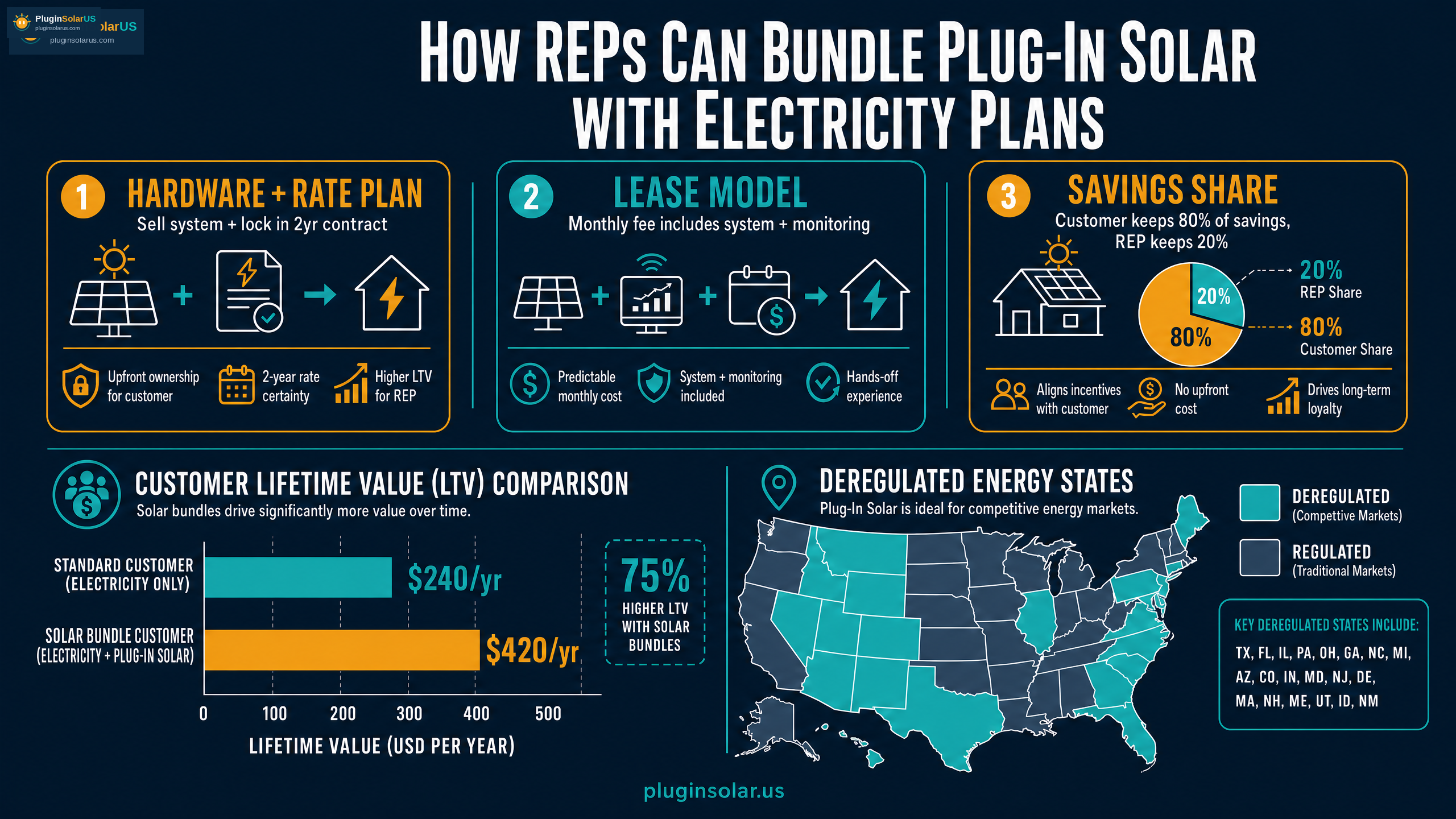
This guide presents a conceptual planning framework, not a proven playbook. No US REP has yet launched a commercial plug-in solar bundle product.
1. Executive Summary
The energy landscape in deregulated markets presents both significant challenges and unparalleled opportunities for Retail Electricity Providers (REPs). With increasing customer acquisition costs (CAC) and high churn rates, REPs are constantly seeking innovative strategies to enhance customer lifetime value (LTV) and foster loyalty. This whitepaper explores the strategic imperative for REPs to integrate plug-in solar solutions into their product offerings, positioning it as a compelling customer acquisition and retention tool. Focusing on the unique regulatory environment, particularly the groundbreaking Utah HB 340 (2025) and California SB 868, signed September 30, 2026, we outline a practical implementation framework. This includes a comprehensive market assessment, product selection criteria based on UL 3700 safety standards and tiered system outputs, innovative pricing and financing models, and a robust customer education strategy. Furthermore, we delve into regulatory compliance by state, present a pilot design and measurement framework, and draw critical insights from European market analogues such as Germany's Balkonkraftwerk and the UK's Smart Export Guarantee. Through detailed ROI modeling and a strategic go-to-market timeline, this guide provides energy executives with a roadmap to navigate the complexities and capitalize on the burgeoning plug-in solar market, transforming it into a sustainable competitive advantage.
2. Market Analysis: The Strategic Imperative for Plug-in Solar
Deregulated electricity markets, characterized by customer choice and competitive pricing, offer fertile ground for innovation but also pose significant challenges for REPs. The imperative to differentiate and capture market share drives the need for value-added services beyond commodity electricity supply. Plug-in solar, or micro-inverter-based grid-tied solar systems designed for easy installation by consumers, represents a nascent yet powerful opportunity.
2.1. The Deregulated Market Landscape
Key deregulated electricity markets in the US include Texas (ERCOT), Pennsylvania, Ohio, Illinois, New York, New Jersey, Maryland, Connecticut, Massachusetts, Maine, and New Hampshire. These markets are defined by:
- Customer Choice: Consumers can select their electricity supplier, leading to intense competition among REPs. This competition often drives down margins on electricity supply alone, necessitating value-added services to maintain profitability.
- Price Volatility: Wholesale electricity prices can fluctuate significantly due to factors like fuel costs, weather events, and grid congestion. This volatility impacts REP margins and can lead to unpredictable consumer bills, increasing the appeal of solutions that offer bill stability.
- High Customer Acquisition Costs (CAC): REPs face substantial costs, typically ranging from $80 to $200 per residential customer, to acquire new accounts. These costs are driven by extensive marketing, sales commissions, and administrative overhead in a highly competitive environment.
- Significant Churn Rates: The commodity nature of electricity often leads to annual churn rates of 25–40% as customers frequently switch providers based on price promotions or perceived better deals. This constant churn erodes customer loyalty and increases the ongoing need for costly acquisition efforts.
- Customer Lifetime Value (LTV) Pressure: Despite LTV ranging from $800 to $2,400 over three years, high churn significantly erodes profitability and necessitates continuous acquisition efforts. Products that increase customer stickiness directly contribute to higher LTV.
2.2. The Value Proposition of Plug-in Solar for REPs and Consumers
Plug-in solar systems offer a unique value proposition that addresses several pain points for REPs in deregulated markets, while also providing tangible benefits to consumers:
- Customer Stickiness: Offering a tangible asset that reduces electricity bills creates a stronger bond with customers, potentially lowering churn. Unlike a simple electricity contract, a physical solar system represents a long-term investment and a commitment, making customers less likely to switch providers.
- Differentiation: A plug-in solar bundle can distinguish a REP from competitors offering only commodity electricity. In a crowded market, offering innovative, sustainable solutions can attract a new segment of environmentally conscious consumers and those seeking greater energy independence.
- New Revenue Streams: Beyond electricity supply, REPs can generate revenue from equipment sales, installation services (if offered), and potentially financing. This diversifies the REP's income portfolio and reduces reliance on volatile electricity margins.
- Brand Enhancement: Aligning with renewable energy solutions enhances a REP's brand image and appeals to environmentally conscious consumers. It positions the REP as a forward-thinking, sustainable energy provider, which can be a powerful marketing tool.
- Reduced Bill Shock: For customers in high-rate areas like California ($0.34/kWh average), plug-in solar can significantly offset consumption, leading to more predictable bills and higher satisfaction. Even in lower-rate markets like Texas ($0.14/kWh), the savings are meaningful. The average US electricity rate is $0.18/kWh. This predictability and savings directly translate to higher customer satisfaction and retention.
- Empowerment and Control: Plug-in solar empowers consumers to take an active role in their energy consumption and production. This sense of control over their energy bills and environmental footprint is a significant psychological benefit.
2.3. Market Data Overview and Trends
The following tables provide a snapshot of critical market dynamics and trends influencing the adoption of plug-in solar:
Table 1: Key Deregulated Market Metrics and Strategic Implications
| Metric | Range/Average | Strategic Implication for REPs |
|---|---|---|
| Customer Acquisition Cost (CAC) | $80–$200 per residential customer | High cost necessitates products with strong retention capabilities to maximize ROI. Plug-in solar can act as a powerful retention tool, amortizing CAC over a longer customer relationship. |
| Average Residential Customer LTV (3 years) | $800–$2,400 | Value can be significantly increased by reducing churn and cross-selling. A plug-in solar bundle enhances LTV through direct product revenue and improved customer loyalty. |
| Annual Churn Rate | 25–40% | Indicates a critical need for sticky, value-added products to retain customers. Plug-in solar offers a tangible, long-term asset that reduces the likelihood of customers switching providers. |
| Average US Electricity Rate | $0.18/kWh | Provides a baseline for potential savings. Higher rates in specific markets amplify the economic benefits of self-generation. |
Table 2: Average Electricity Rates (Selected Regions) and Solar Savings Potential
| Region | Average Rate ($/kWh) | Potential for Solar Savings | Strategic Market Focus |
|---|---|---|---|
| United States (Average) | $0.18 | Moderate | Broad appeal, focus on environmental benefits and energy independence. |
| California (CA) | $0.34 | High | Primary target market due to significant economic incentives for consumers. |
| Texas (TX) Residential | $0.14 | Moderate | Focus on competitive pricing and differentiation in a highly deregulated market. |
| New York (NY) | ~$0.22 (variable) | High-Moderate | Strong state-level renewable energy mandates and consumer interest. |
| New England States (e.g., MA, CT) | ~$0.25–$0.30 (variable) | High | High electricity costs and progressive energy policies make these attractive markets. |
3. Detailed Implementation Framework: A Step-by-Step Approach
Launching a plug-in solar bundle requires a structured, multi-faceted approach, encompassing product development, regulatory navigation, customer engagement, and operational readiness. This section details the key phases and considerations for REPs.
3.1. Product Selection Criteria and System Tiers
Product selection must balance cost, performance, safety, and ease of installation. Adherence to UL 3700, the safety standard for plug-in grid-interactive power conversion equipment, is paramount. Systems can be categorized into tiers to cater to diverse customer needs and budgets, ensuring broad market appeal:
- Starter Tier: Typically 400–1,200W of solar panel capacity coupled with 1–2 kWh of battery storage. Wholesale cost: ~$400–$900. This tier is ideal for renters, apartment dwellers, or those seeking minimal energy offset and a low entry barrier. It offers basic bill reduction and a tangible step into renewable energy. These systems are often compact, easily portable, and require minimal technical expertise for setup, making them highly attractive to a broad consumer base.
- Mid-Range Tier: Offering 800–1,600W of solar capacity with 2–3 kWh of battery storage. Wholesale cost: ~$900–$1,600. This tier is suitable for average residential customers looking for significant bill reduction and increased energy independence. It balances cost-effectiveness with substantial energy generation, often providing a noticeable impact on monthly electricity bills. These systems might involve slightly more complex installation but are still designed for consumer-friendly deployment.
- High Output Tier: Designed for 1,600–2,400W of solar capacity and 3–5 kWh+ of battery storage. Wholesale cost: ~$1,600–$2,500. This tier is designed for larger homes or those with higher energy consumption, maximizing self-consumption and providing a more robust backup solution. It caters to customers seeking maximum energy savings and resilience, potentially offering near-complete offset of daytime electricity usage.
Each tier should be designed as a complete, easy-to-install kit, minimizing the need for professional electrical work and simplifying the customer journey. This approach reduces friction for consumers and lowers the operational burden for REPs. Furthermore, offering clear product differentiation based on power output and storage capacity allows REPs to target specific customer segments effectively.
3.2. Pricing and Financing Structures: Enhancing Accessibility and Adoption
Innovative pricing and financing models are crucial for overcoming upfront cost barriers and accelerating market penetration. REPs are uniquely positioned to offer flexible solutions due to their existing customer relationships and billing infrastructure:
- Outright Purchase: Customers buy the system upfront. REPs can leverage their purchasing power to offer competitive pricing due to bulk procurement from manufacturers. This option appeals to customers who prefer full ownership and have the capital available.
- Lease/Power Purchase Agreement (PPA) Models: Similar to traditional solar, but adapted for smaller systems. REPs retain ownership of the system, and customers pay a monthly fee for the energy produced or for the equipment itself. This eliminates the upfront cost for the customer and provides a predictable monthly expense, making solar accessible to a wider demographic.
- On-Bill Financing: This highly attractive model integrates the system cost into the customer's monthly electricity bill, spreading payments over several years. It reduces upfront barriers, simplifies billing, and leverages the existing trusted relationship between the REP and the customer. This can significantly boost adoption rates, especially for mid-range and high-output systems.
- Subscription Model: A monthly fee covers the system, maintenance, and potentially a guaranteed energy offset. This simplifies the value proposition for customers, offering a hassle-free experience akin to a utility service. It can include performance guarantees and maintenance, further reducing customer concerns.
- Performance-Based Incentives: REPs could also explore offering performance-based incentives or rebates that reward customers for achieving certain energy production targets, further aligning customer and REP interests.
3.3. Regulatory Compliance by State: Navigating a Complex Landscape
Navigating the complex patchwork of state and local regulations is critical. The absence of a uniform federal plug-in solar standard means REPs must conduct thorough due diligence in each target market. Key considerations include:
- Interconnection Rules: Many states require formal interconnection agreements for any grid-tied system, regardless of size. These processes can be cumbersome, costly, and time-consuming. However, Utah HB 340 (2025) is a landmark exception, legalizing plug-in solar under 1,200W without interconnection permits. This model could serve as a blueprint for other states, demonstrating the benefits of simplified regulatory pathways. REPs should actively identify and prioritize states with similar streamlined processes or advocate for their adoption.
- Net Metering/Smart Export Guarantees: Policies for compensating distributed generation vary widely. Some states offer robust net metering, crediting customers at retail rates for excess generation, while others may have less favorable export compensation mechanisms or none at all. Understanding these policies is crucial for accurately modeling customer savings and REP profitability. In markets without strong net metering, REPs might consider offering their own virtual net metering or export credit programs.
- Permitting Requirements: Local building codes and electrical permits can add significant complexity and cost, even for small systems. Systems designed for true plug-and-play functionality aim to minimize these requirements, but local jurisdictions often have their own interpretations. REPs should engage with local authorities to clarify requirements and advocate for simplified permitting for UL 3700 compliant plug-in systems.
- Consumer Protection Laws: Ensure all marketing, sales practices, and contractual agreements comply with state-specific consumer protection regulations. Transparency in pricing, performance expectations, and terms of service is paramount to building trust and avoiding legal challenges.
- Grid Modernization Initiatives: Stay abreast of state-level grid modernization efforts that may introduce new opportunities or requirements for distributed energy resources.
California SB 868 was signed September 30, 2026. When its qualifying-device framework is expected to take effect January 1, 2027, it may simplify specified utility approval steps in California. REPs should prepare compliant offerings while following current utility, product-certification, electrical and property requirements until then.
3.4. Customer Education Strategy: Building Trust and Driving Adoption
Given the relative novelty of plug-in solar for many consumers, a robust and accessible education strategy is essential to build trust, manage expectations, and drive adoption:
- Clear Value Proposition: Articulate the benefits in simple, compelling terms, focusing on bill savings, environmental impact, energy independence, and ease of use. Avoid overly technical jargon.
- Installation Guides: Provide simple, step-by-step instructions and video tutorials that demonstrate the ease of installation. These should be accessible online and potentially included with the product.
- Safety Information: Emphasize UL 3700 compliance and safe operating procedures. Reassure customers about the safety and reliability of the systems.
- Online Resources: Develop comprehensive FAQs, knowledge bases, and a dedicated section on the REP's website (e.g., Buyer's Guide, Readiness Checker). These resources should address common questions and concerns.
- Customer Support: Train customer service teams to handle inquiries related to plug-in solar, from pre-sales questions to post-installation support. Provide multiple channels for support (phone, email, chat).
- Interactive Tools: Implement online calculators (Savings Calculator) that allow customers to estimate their potential savings based on their location and electricity usage.
3.5. Pilot Design and Measurement Framework: Learning and Iterating
A phased rollout, starting with a well-designed pilot program, allows REPs to test assumptions, refine product offerings, and optimize go-to-market strategies before a full-scale launch. Key elements of a successful pilot include:
- Target Market Selection: Choose a specific deregulated market or a segment within it (e.g., high-bill customers in California, or environmentally conscious customers in New York). The chosen market should ideally have favorable regulatory conditions or a strong appetite for renewable energy.
- Key Performance Indicators (KPIs): Define clear, measurable KPIs to track the success of the pilot. These should include: customer acquisition rate for the solar bundle, churn reduction among solar customers vs. non-solar customers, system performance (actual vs. expected energy generation), customer satisfaction scores, and overall ROI for the REP.
- Feedback Mechanisms: Implement robust mechanisms for gathering both quantitative and qualitative insights. This includes customer surveys, focus groups, direct customer interviews, and analysis of customer support interactions.
- Iterative Improvement: Use pilot data and feedback to make continuous adjustments to product features, pricing models, marketing messages, and operational processes. The pilot should be viewed as a learning phase, not just a sales exercise.
- Scalability Assessment: Evaluate the operational challenges and resource requirements for scaling the program to a broader market.
3.6. Go-to-Market Timeline: A Strategic Roadmap
A typical go-to-market timeline for a plug-in solar bundle might span 6–12 months, depending on the complexity of the offering and the REP's internal capabilities:
- Month 1-2: Strategy & Product Definition: Conduct in-depth market research, finalize product tiering, select vendors offering equipment certified to UL 3700, and complete initial regulatory review for target markets. Develop detailed business cases and financial projections.
- Month 3-4: Pilot Program Design & Development: Define pilot KPIs, segment target customers, develop marketing collateral, and establish operational workflows for sales, installation support, and customer service. Secure initial inventory.
- Month 5-6: Pilot Launch & Execution: Onboard initial pilot customers, begin data collection on system performance and customer feedback. Monitor sales funnel and operational efficiency.
- Month 7-9: Analysis & Refinement: Conduct a thorough review of pilot results. Analyze KPIs, customer feedback, and operational challenges. Implement product adjustments, refine pricing strategies, and develop a detailed plan for operational scaling.
- Month 10-12: Full Market Launch: Execute expanded marketing campaigns, provide comprehensive sales force training, and initiate broader customer acquisition efforts across selected deregulated markets. Continuously monitor performance and adapt strategies as needed.
4. Regulatory Compliance and Policy Landscape: Navigating the Future of Distributed Energy
The regulatory environment for distributed energy resources, particularly small-scale plug-in systems, is evolving rapidly. Understanding and proactively engaging with this landscape is crucial for successful market entry and sustained growth. REPs must be adept at navigating state-specific regulations and advocating for policies that support widespread adoption.
4.1. Landmark Legislation: Utah HB 340 (2025) - A Blueprint for Simplification
Utah House Bill 340, enacted in 2025, stands as a pivotal piece of legislation in the US. It was the first enacted US law legalizing plug-in solar systems under 1,200W without requiring interconnection permits (eight states have now enacted such laws as of June 2026: Utah, Maine, Virginia, Colorado, Maryland, Connecticut, New Hampshire, and Vermont). This significantly reduces the administrative burden and cost for both consumers and providers, making plug-in solar truly "plug-and-play." The success of Utah HB 340 provides a powerful precedent and a model for other states to emulate, demonstrating that simplified regulatory pathways can unlock significant market potential. This legislation removes a major barrier to entry for consumers, who often find the interconnection process daunting and complex. For REPs, it means a faster, more efficient deployment process and reduced operational overhead. REPs operating in or considering Utah should prioritize developing offerings that leverage this unique regulatory advantage, potentially positioning Utah as a testbed for broader market expansion.
4.2. Emerging Policy: California SB 868 - High Stakes in a High-Value Market
California Senate Bill 868 was signed by Governor Newsom on September 30, 2026. Its new utility-side framework is expected January 1, 2027, and applies only to qualifying certified devices. California's high electricity rates make household savings attractive, but REPs must assess customer eligibility, current interconnection rules and property requirements rather than presenting the law as an immediate blanket installation exemption.
4.3. Safety Certification: UL 3700 for Plug-In Solar
UL 3700 is the U.S. safety certification standard developed specifically for plug-in photovoltaic equipment and systems. It addresses the submitted plug-in configuration, including the safety challenges created by a plug-and-receptacle connection. A REP should select equipment certified to UL 3700 while also applying any broader NRTL, comparable-standard, state, utility, code, and installation requirements for the target market. The standard addresses critical areas such as:
- Inverter Safety and Performance: Ensuring that the power conversion equipment operates reliably and safely, preventing electrical hazards.
- Grid Interaction and Anti-Islanding Protection: Critical features that ensure the system safely disconnects from the grid during power outages, protecting utility workers and preventing damage to the grid.
- Electrical Safety and Fire Prevention: Rigorous testing to minimize risks of electrical shock and fire.
- Durability and Environmental Testing: Ensuring the equipment can withstand various environmental conditions and operate effectively over its lifespan.
Accurately stating that equipment is certified to UL 3700 can help consumers understand the plug-in solar safety baseline. Marketing should avoid treating related component certifications as substitutes for UL 3700 or implying that certification alone resolves every jurisdictional and installation requirement.
4.4. Federal Incentives (Expired) and Future Outlook
It is important to note that the Federal Investment Tax Credit (ITC) for residential solar expired on December 31, 2025. While this removes a significant federal incentive that historically drove solar adoption, the inherent value proposition of plug-in solar (bill savings, ease of installation) combined with state-level policies and REP-specific financing can still drive adoption. The expiration of the ITC underscores the need for REPs to develop compelling, self-sustaining business models that do not rely solely on federal subsidies. Future federal or state incentives may emerge, and REPs should remain vigilant for such opportunities, as they can significantly enhance the economic attractiveness of plug-in solar. Advocacy efforts should also focus on reintroducing or creating new incentives tailored to small-scale distributed generation.
5. Financial Modeling and ROI: Quantifying the Opportunity
A robust financial model is essential to demonstrate the profitability of a plug-in solar bundle for both the REP and the customer. This section outlines key components and provides worked examples to illustrate the economic benefits.
5.1. Key Financial Metrics for REPs
REPs must analyze several financial metrics to assess the viability and profitability of a plug-in solar offering:
- Customer Acquisition Cost (CAC): As noted, this ranges from $80–$200 per residential customer. The goal is to reduce the effective CAC by leveraging the solar bundle as a differentiator.
- Customer Lifetime Value (LTV): $800–$2,400 over 3 years. A primary objective of the solar bundle is to increase LTV by extending customer tenure and cross-selling.
- Churn Rate: 25–40% annually. Reducing churn is a direct driver of increased LTV and profitability.
- Gross Margin on Equipment: Varies by tier, but REPs can achieve 20-40% by leveraging bulk purchasing and efficient supply chain management.
- Recurring Revenue: This includes revenue from electricity supply, and potentially from lease/subscription models for the solar system, as well as maintenance contracts.
- Cost of Capital: For financing customer systems, if the REP chooses to offer lease or on-bill financing options. Lower cost of capital translates to more attractive financing terms for customers and higher margins for the REP.
- Operational Costs: Including customer support, logistics, marketing, and any potential installation or maintenance services.
5.2. Customer Savings and Payback Period: Driving Consumer Adoption
Customer savings are primarily driven by reduced electricity consumption from the grid. The payback period, or the time it takes for savings to offset the initial investment, is a critical factor in consumer adoption. Clear communication of these savings is paramount.
Worked Example: Customer Savings (California) - High Rate Market
Consider a Mid-Range Tier system (1,200W average output) in California, a state with high electricity rates:
- Average daily generation: Assuming 4 peak sun hours/day, 1,200W * 4 hours = 4.8 kWh/day
- Monthly generation: 4.8 kWh/day * 30 days = 144 kWh/month
- California average electricity rate: $0.34/kWh
- Monthly savings: 144 kWh * $0.34/kWh = $48.96
- Annual savings: $48.96 * 12 = $587.52
If the retail price of a Mid-Range system is $2,000 (including installation support), the simple payback period for the customer would be approximately $2,000 / $587.52 = 3.4 years. This is a highly attractive payback, especially for a product with a 20+ year lifespan, making it a compelling offer for California residents.
Worked Example: Customer Savings (Texas) - Moderate Rate Market
Consider a Mid-Range Tier system (1,200W average output) in Texas, a state with moderate residential electricity rates:
- Average daily generation: Assuming 4 peak sun hours/day, 1,200W * 4 hours = 4.8 kWh/day
- Monthly generation: 4.8 kWh/day * 30 days = 144 kWh/month
- Texas residential average electricity rate: $0.14/kWh
- Monthly savings: 144 kWh * $0.14/kWh = $20.16
- Annual savings: $20.16 * 12 = $241.92
If the retail price of a Mid-Range system is $1,800, the simple payback period for the customer would be approximately $1,800 / $241.92 = 7.4 years. While longer than California, this is still a reasonable payback for a long-term asset, particularly if financed through the REP. The lower upfront cost in Texas also contributes to its attractiveness.
5.3. REP ROI Modeling: Beyond Equipment Sales
REPs can model ROI by considering the multifaceted benefits of offering plug-in solar:
- Reduced Effective CAC: By bundling solar, the overall cost to acquire a customer for both electricity and solar services can be lower than acquiring them separately.
- Increased LTV: Lower churn rates directly increase LTV. A customer who invests in a solar system through their REP is less likely to switch providers.
- Equipment Sales Margin: Direct profit from selling the plug-in solar systems.
- Financing Revenue: Interest or fees generated from lease/on-bill financing options.
- Cross-Selling Opportunities: Solar customers are often more engaged and receptive to other value-added services like smart home devices, energy efficiency upgrades, or specialized electricity plans.
- Brand Equity: While harder to quantify, enhanced brand image and customer loyalty contribute to long-term business value.
Callout Box: Key Insight - The Synergistic Value
Synergistic Value: The true ROI for REPs lies not just in the direct margins from equipment sales, but in the profound synergistic effect of reduced churn, increased customer loyalty, and expanded cross-selling opportunities, which collectively enhance the profitability and sustainability of their core electricity supply business. Plug-in solar acts as a powerful anchor product.
6. Risk Analysis: Mitigating Challenges for Sustainable Growth
While the opportunities presented by plug-in solar are substantial, REPs must also carefully assess and proactively mitigate potential risks to ensure sustainable growth and market success.
6.1. Regulatory Uncertainty and Evolution
The primary risk is the fragmented and evolving regulatory landscape. While Utah HB 340 provides a clear pathway in one state, other states may impose stringent interconnection requirements, limiting market potential. Implementation delays or varied utility and property requirements, even after California SB 868 was signed, could hinder growth in key markets. This regulatory variability creates uncertainty and can complicate multi-state expansion. Mitigation strategies include:
- Proactive Lobbying and Advocacy: Engage actively with state legislatures, public utility commissions, and industry associations to advocate for simplified plug-in solar policies, drawing on successful models like Utah HB 340.
- Phased Rollout and Market Prioritization: Prioritize market entry into states with favorable or clear regulatory frameworks. Conduct thorough regulatory assessments before expanding into new jurisdictions.
- Expert Legal Counsel: Maintain expert legal and regulatory counsel to navigate state-specific requirements, interpret evolving policies, and ensure continuous compliance.
- Scenario Planning: Develop contingency plans for different regulatory outcomes, including delays or unfavorable policy changes.
6.2. Supply Chain and Logistics Complexities
Sourcing reliable equipment certified to UL 3700 at competitive prices, managing inventory efficiently, and establishing robust logistics for delivery, installation support, and potential returns pose significant operational challenges. Disruptions in global supply chains can impact product availability and cost. Mitigation strategies:
- Diversified Supplier Base: Establish relationships with multiple reputable manufacturers of equipment certified to UL 3700 to reduce reliance on a single source and mitigate supply chain risks.
- Robust Inventory Management Systems: Implement advanced inventory management and forecasting tools to optimize stock levels, minimize holding costs, and ensure timely product availability.
- Strategic Partnerships: Collaborate with experienced third-party logistics (3PL) providers for efficient warehousing, distribution, and last-mile delivery. Consider partnerships for installation support and reverse logistics.
- Quality Control: Implement stringent quality control measures for all sourced equipment to ensure product reliability and customer satisfaction.
6.3. Customer Adoption and Education Challenges
Despite the ease of installation, customer awareness and understanding of plug-in solar may be low. Misinformation, perceived complexity, or skepticism about the technology could hinder adoption rates. Effective education is key. Mitigation strategies:
- Clear and Consistent Messaging: Develop compelling marketing and educational campaigns that clearly articulate the benefits, simplicity, and safety of plug-in solar. Focus on tangible savings and environmental impact.
- Comprehensive Educational Resources: Provide user-friendly guides, video tutorials, FAQs, and interactive tools (e.g., savings calculators) to demystify the technology and empower customers.
- Dedicated and Trained Support: Ensure customer service teams are thoroughly trained on plug-in solar products, installation, and troubleshooting to provide accurate and timely support.
- Community Engagement: Partner with local community organizations or environmental groups to raise awareness and build trust.
6.4. Competitive Landscape and Market Saturation
As the market for plug-in solar matures, competition from other REPs, traditional solar installers, big-box retailers, and even direct-to-consumer DIY providers will intensify. This could lead to price compression and increased marketing costs. Mitigation strategies:
- First-Mover Advantage: Early entry into favorable markets can establish brand leadership and secure market share before competition intensifies.
- Value-Added Services and Bundling: Differentiate offerings by bundling plug-in solar with other energy management services (e.g., smart thermostats, EV charging solutions, demand response programs) or specialized electricity plans.
- Superior Customer Experience: Focus on delivering a seamless customer journey from initial inquiry to post-installation support, building strong customer loyalty that transcends price competition.
- Continuous Innovation: Invest in R&D or partner with innovators to offer next-generation plug-in solar solutions, suchs as enhanced battery integration or smart home connectivity.
7. European Market Case Studies: Lessons for US REPs
Europe has a more mature and diverse market for small-scale, plug-in solar systems, offering valuable insights and transferable lessons for US REPs looking to enter or expand in this sector.
7.1. Germany's Balkonkraftwerk Market: The Power of Regulatory Simplification
Germany's "Balkonkraftwerk" (balcony power plant) market is a prime example of successful plug-in solar adoption driven by supportive regulations and a strong public interest in renewable energy. These small systems, typically limited to 600W output, have seen rapid growth, with hundreds of thousands now installed across the country. Key success factors include:
- Simplified Interconnection: Germany has significantly streamlined the registration process for Balkonkraftwerke, often requiring only a simple notification to the grid operator, rather than complex and costly permits or inspections. This ease of connection has been a major catalyst for adoption.
- High Electricity Prices: Germany's relatively high retail electricity prices make the economic case for self-consumption compelling. Every kilowatt-hour generated and consumed at home directly offsets a more expensive unit from the grid.
- Strong Consumer Awareness and Environmental Ethos: Extensive public information campaigns, coupled with a deep-seated environmental consciousness among German consumers, have fostered high adoption rates. The concept of energy independence and contributing to the energy transition resonates strongly.
- Standardized and Certified Products: A wide range of certified, easy-to-install systems are available from various manufacturers, often sold through mainstream retailers and online platforms. Adherence to safety standards (though not identical to UL 3700, similar principles apply) builds consumer confidence.
- Supportive Policy Framework: While not direct subsidies for Balkonkraftwerke, the broader German energy policy (Energiewende) creates a favorable environment for distributed generation.
Lesson for US REPs: The German experience unequivocally demonstrates that regulatory simplification is a powerful catalyst for mass adoption. Advocating for "Balkonkraftwerk-style" legislation in the US, similar to Utah HB 340, can unlock significant market potential. Furthermore, clear, accessible product offerings, strong consumer education, and leveraging existing retail channels are vital for market penetration.
7.2. UK's Smart Export Guarantee (SEG): Valuing Distributed Generation
The UK's Smart Export Guarantee (SEG), introduced in 2020, mandates larger energy suppliers to pay small-scale generators for the electricity they export to the grid. While the SEG is not exclusively for plug-in solar (it applies to various small-scale renewables), it creates a robust framework for valuing distributed generation and offers valuable insights for US markets. Key aspects of the SEG include:
- Guaranteed Payments: Licensed electricity suppliers with over 150,000 customers are required to offer a tariff for exported electricity. This provides an additional, predictable revenue stream for solar owners, enhancing the economic attractiveness of their systems.
- Market-Driven Rates: Export rates are set by individual suppliers, encouraging competition among them to offer the most attractive tariffs to generators. This market-based approach can lead to higher payments for consumers compared to fixed, regulated rates.
- Smart Meter Integration: The SEG relies on smart meters to accurately measure exported electricity, ensuring fair and transparent compensation. This highlights the importance of advanced metering infrastructure for effective distributed energy management.
- Consumer Choice: Generators can choose their SEG licensee, allowing them to shop around for the best export tariff.
Lesson for US REPs: While the US lacks a direct equivalent for small plug-in systems, the SEG highlights the importance of fair and transparent compensation mechanisms for exported energy. In states without robust net metering policies, REPs can explore offering their own "smart export" tariffs or credits for plug-in solar customers, even in the absence of state mandates, to enhance the value proposition and differentiate their offerings. This could be particularly impactful in states without robust net metering policies. The development of such REP-specific programs could bridge the gap until broader regulatory frameworks are established, providing immediate value to customers and fostering goodwill.
8. Strategic Recommendations: Charting a Course for Success
To successfully launch and scale a plug-in solar bundle, REPs should consider the following strategic recommendations, integrating them into their long-term business planning:
8.1. Prioritize Regulatory Advocacy and Engagement
Actively engage with state legislative bodies, public utility commissions, and industry associations to advocate for policies that simplify plug-in solar deployment, drawing inspiration from successful models like Utah HB 340. Support accurate implementation of signed measures such as California SB 868. A unified industry voice can accelerate regulatory clarity and market expansion. This could involve forming industry alliances, participating in existing energy policy groups, or commissioning research to demonstrate the economic and environmental benefits of simplified plug-in solar regulations. Lobbying efforts should emphasize consumer empowerment, grid resilience, and the economic benefits of distributed generation.
8.2. Develop Comprehensive Tiered Product Offerings
Design and market plug-in solar systems across Starter, Mid-Range, and High Output tiers to cater to a broad spectrum of customer needs and budgets. Specify equipment certified to UL 3700 and emphasize ease of installation, while preserving any broader NRTL or comparable-standard pathways allowed by the applicable jurisdiction. Consider offering modular systems that allow customers to expand their capacity over time, providing flexibility and future-proofing their investment. Product development should also consider aesthetic appeal and integration with smart home ecosystems to enhance overall customer experience.
8.3. Innovate with Financing and Bundling Strategies
Leverage the REP's existing customer relationships and billing infrastructure to offer attractive financing options, such as on-bill financing or subscription models. These models significantly reduce upfront barriers and make plug-in solar accessible to a wider demographic. Bundle plug-in solar with other energy services (e.g., smart thermostats, EV charging solutions, energy efficiency audits, demand response programs) to create a holistic value proposition and increase customer stickiness. Explore strategic partnerships with financial institutions to offer competitive loan products, further expanding financing options for customers.
8.4. Invest Heavily in Customer Education and Support
Develop comprehensive, easy-to-understand educational materials that demystify plug-in solar. This includes online resources (Buyer's Guide, Readiness Checker), video tutorials, webinars, and dedicated customer support channels. A well-informed customer is a satisfied and loyal customer. Consider interactive tools like a savings calculator to help customers visualize their potential benefits and make informed decisions. Proactive communication about system performance and maintenance can also enhance customer satisfaction.
8.5. Execute Strategic Pilot Programs with Rigorous Measurement
Before a full-scale launch, conduct targeted pilot programs in favorable deregulated markets. Use these pilots to gather data, refine product offerings, optimize marketing messages, and test operational workflows. Focus on measurable KPIs such as customer acquisition cost for the bundle, churn reduction, system performance, and customer satisfaction. Iterate rapidly based on feedback and data analysis, treating the pilot as a crucial learning phase to de-risk broader market entry.
8.6. Leverage Digital Marketing and Strategic Partnerships
Utilize digital channels to reach potential customers, highlighting the benefits of plug-in solar. Develop compelling content for social media, email campaigns (e.g., promoting a newsletter), and online advertising. Implement targeted campaigns based on customer demographics and energy consumption patterns. Explore strategic partnerships with home improvement retailers, community organizations, real estate agents, and local solar advocacy groups to expand reach and credibility (see our Partner Program). Co-marketing initiatives can significantly amplify outreach efforts.
8.7. Continuously Monitor and Adapt to Market Dynamics
The energy market is dynamic and subject to rapid changes in technology, regulation, and consumer preferences. Continuously monitor regulatory changes, technological advancements in solar and battery storage, and competitive actions. Be prepared to adapt product offerings, pricing strategies, and marketing approaches to maintain a competitive edge. Regularly review market assessment data and customer feedback to inform strategic adjustments, ensuring the plug-in solar bundle remains relevant and attractive. Agility and responsiveness will be key to long-term success.
9. Conclusion
The convergence of deregulated energy markets, evolving renewable energy technologies, and increasing consumer demand for sustainable solutions presents a unique window of opportunity for Retail Electricity Providers. By strategically embracing plug-in solar bundles, REPs can transform their business models, moving beyond commodity electricity supply to become comprehensive energy solution providers. This approach not only addresses the critical challenges of high CAC and churn but also unlocks new revenue streams and significantly enhances customer lifetime value. While the path requires careful navigation of regulatory complexities and a commitment to customer education, the lessons from European markets and the pioneering efforts in states like Utah demonstrate a clear and viable future. For energy executives ready to innovate, plug-in solar is not just a product; it is a strategic imperative for long-term growth and market leadership.
References
- [1] Utah State Legislature. (2025). HB 340: Plug-in Solar System Amendments.
- [2] California State Legislature. (2026). SB 868: Distributed Energy Resources Interconnection. (signed September 30, 2026; new framework expected January 1, 2027)
- [3] UL Standards. (n.d.). UL 3700: Standard for Safety for Grid-Interactive Inverters, Converters, Controllers and Interconnection System Equipment for Use With Distributed Energy Resources.
- [4] Energy Information Administration (EIA). (2024). Electric Power Monthly. (Average US electricity rates)
- [5] ERCOT. (2024). Market Information. (Texas electricity rates)
- [6] California Public Utilities Commission (CPUC). (2024). Electricity Rates & Billing. (California electricity rates)
- [7] Bundesverband Solarwirtschaft e.V. (BSW-Solar). (2023). German Solar Market Statistics. (Balkonkraftwerk market data)
- [8] Ofgem. (2020). Smart Export Guarantee (SEG). (UK regulatory framework)
Related Articles
- The Plug-In Solar Opportunity for Retail Energy Providers: A 2026 Market Analysis — Plug-in solar is one of the fastest-growing segments of residential solar in the US. This whitepaper analyzes the market opportunity for Retail Energy Providers in deregulated states, including addressable market sizing, bundling strategies, and competitive positioning.
- Plug-In Solar in Texas: How the Deregulated Market Changes Everything — Texas has the highest electricity price volatility in the US. Here's how plug-in solar with battery storage can protect you from rate spikes — and why the deregulated market makes it easier.
- Why Existing Solar Installers Should Add Plug-In Solar to Their Offerings — Plug-in solar is not a competitor to rooftop solar — it is a complementary product line that expands your addressable market by 44 million renters. Here is the strategic case.