The Federal Solar Tax Credit Is Gone. Plug-In Solar Doesn't Care.
By PlugInSolarUS Editorial · Published 2026-08-02 · 8 min read
The One Big Beautiful Bill Act killed the 30% residential solar tax credit a decade early. For rooftop solar, it's a $9,000 loss per household. For plug-in solar, it barely matters — and here's why that changes the competitive landscape.
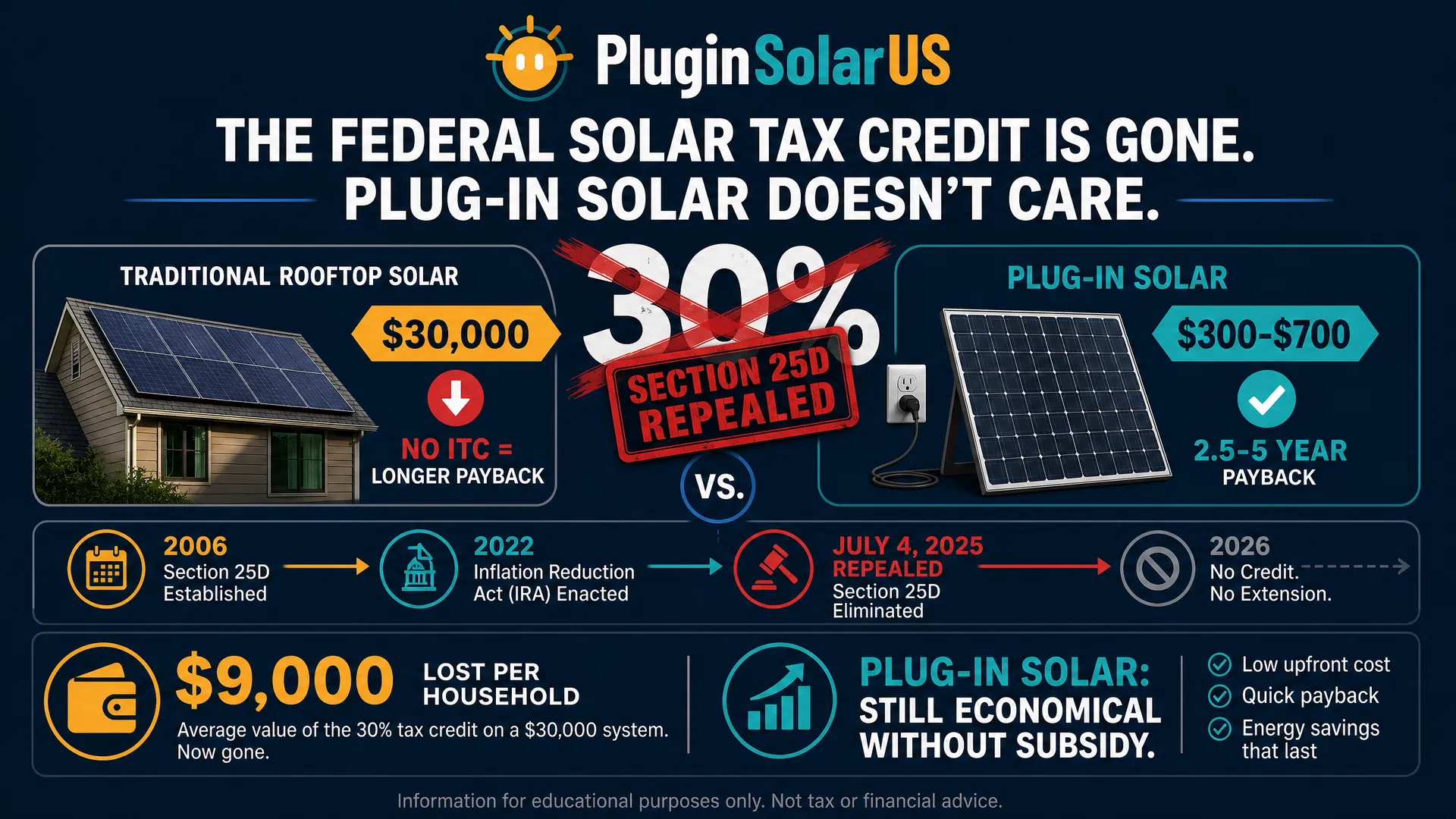
On July 4, 2025, President Trump signed the One Big Beautiful Bill Act into law. Among its many provisions, the bill repealed Section 25D of the Internal Revenue Code — the Residential Clean Energy Credit that gave homeowners a 30% tax credit on solar installations. The credit, which was originally extended through 2032 under the Inflation Reduction Act, ended nearly a decade ahead of schedule.
For the traditional rooftop solar industry, this is seismic. On a typical $30,000 residential system, the credit was worth $9,000 back in the homeowner’s pocket. Without it, payback periods stretch from 5–8 years to 8–12 years, and the economics of solar become far more dependent on system design, battery storage, and rate optimization.
For plug-in solar? The impact is negligible. And that’s exactly why this policy shift makes plug-in solar the most compelling entry point into solar energy for American households in 2026.
What Happened: The Tax Credit Timeline
| Year | Event | Credit Rate |
|---|---|---|
| 2006 | Section 25D created (Energy Policy Act) | 30% |
| 2022 | Inflation Reduction Act extends through 2032 | 30% |
| July 4, 2025 | One Big Beautiful Bill Act signed | Repealed |
| Dec 31, 2025 | Last day to qualify for Section 25D | 30% (final) |
| 2026+ | No residential credit available | 0% |
The IRS confirms on its Residential Clean Energy Credit page that the credit is not available for property placed in service after December 31, 2025. The commercial Investment Tax Credit (Section 48E) remains available through December 31, 2027, but only for third-party owned systems — not homeowner-purchased installations.
The $9,000 Question: Why Rooftop Solar Just Got Harder
The math for traditional rooftop solar has fundamentally changed. Consider a typical residential installation in 2026:
| Metric | With 30% ITC (2025) | Without ITC (2026) |
|---|---|---|
| Gross system cost (7.2 kW avg) | $30,000 | $30,000 |
| Federal tax credit | -$9,000 | $0 |
| Net cost to homeowner | $21,000 | $30,000 |
| Payback period | 5–8 years | 8–12 years |
| Requires permits | Yes | Yes |
| Requires electrician | Yes | Yes |
| Available to renters | No | No |
That additional $9,000 in upfront cost, combined with longer payback timelines, means many households that were on the fence about solar will now delay or abandon the decision entirely. The solar industry is already reporting a slowdown in residential installations.
Why Plug-In Solar Is Immune to This Change
Here’s the fundamental insight: plug-in solar never needed the tax credit to be economical.
A 360-watt Bright Saver kit costs $414 at member pricing. The 30% tax credit on that purchase would have been $124 — meaningful, but not make-or-break. The payback period for plug-in solar was already 2.5–5 years without any federal incentive, because the total cost is so low that even modest electricity savings compound quickly.
| Comparison | Rooftop Solar (2026) | Plug-In Solar (2026) |
|---|---|---|
| Upfront cost | $30,000 | $285–$700 |
| Tax credit impact | Lost $9,000 incentive | Lost $85–$210 incentive |
| Payback period | 8–12 years | 2.5–5 years |
| Permits required | Yes (weeks–months) | No (in permitted states) |
| Professional installation | Required ($5,000–$10,000 in labor) | DIY (15 minutes) |
| Available to renters | No | Yes |
| Portable when you move | No | Yes |
The competitive gap between plug-in solar and rooftop solar just widened dramatically. Before the repeal, rooftop solar’s effective cost was $21,000 after the credit. Now it’s $30,000. Plug-in solar’s cost hasn’t changed at all.
The New Math: Cost Per Watt Comparison
One of the most revealing metrics in solar economics is cost per watt — how much you pay for each watt of generating capacity. Here’s how the landscape looks in 2026:
| Option | Cost/Watt | Notes |
|---|---|---|
| Rooftop solar (with ITC, 2025) | $2.92/W net | After 30% credit on $4.17/W gross |
| Rooftop solar (no ITC, 2026) | $4.17/W | Full cost, no federal offset |
| Plug-in solar (Bright Saver 360W) | $1.15/W | Member price, DIY install |
| Plug-in solar (retail 360W kit) | $1.50–$2.50/W | CraftStrom, APsystems, EcoFlow |
| Germany (IKEA balcony solar) | $0.35/W | Mature market pricing |
Even at US retail pricing, plug-in solar delivers generating capacity at 40–70% less per watt than rooftop solar in 2026. And unlike rooftop, there are no soft costs (permitting, engineering, interconnection) adding to the price.
Who Benefits Most from This Shift
Renters were never eligible for the residential solar tax credit because they don’t own the property. The ITC’s repeal doesn’t affect them at all — but plug-in solar gives them access to solar savings for the first time. With 44 million renter households in the US, this is the largest untapped market in residential energy.
Budget-conscious homeowners who can’t justify a $30,000 investment without the tax credit now have an alternative. A $300–$700 plug-in system won’t eliminate their bill, but it will reduce it meaningfully — and the payback is measured in years, not decades.
Homeowners in high-rate states (California, Connecticut, Massachusetts, New York) see the fastest payback on plug-in solar because their baseline electricity costs are highest. In California at 32¢/kWh, a 360W system saves approximately $150/year — paying for itself in under 3 years.
What About State Incentives?
The federal credit is gone, but state and local programs remain. Several states offer incentives that can apply to plug-in solar systems:
- State tax credits — Some states offer their own residential solar credits (check the DSIRE database)
- Sales tax exemptions — Many states exempt solar equipment from sales tax
- Property tax exemptions — Solar installations won’t increase your assessed property value
- Utility rebates — Some utilities offer rebates for distributed generation
- Net metering — In states with favorable net metering, excess generation earns bill credits
However, most of these programs were designed for traditional rooftop systems. As plug-in solar adoption grows, we expect to see state-level incentives specifically tailored to the technology — particularly in states that have already legalized it.
The Bigger Picture: Energy Democracy
The federal solar tax credit was always a tool for homeowners with sufficient tax liability and capital to invest $20,000–$40,000 upfront. It was never accessible to renters, low-income households, or anyone without a suitable roof. In that sense, its repeal exposes a truth that was always there: the traditional solar model has an accessibility problem.
Plug-in solar solves that problem not through policy incentives, but through fundamental economics. When the total cost of entry is under $500, you don’t need a tax credit to make the math work. You don’t need to own a home. You don’t need a credit score. You just need a sunny spot and a wall outlet.
"Only a nonprofit like ours will ever give up our margins completely to pass along to consumers the savings from clean energy. Someone’s got to do it, or we are up the creek in terms of energy affordability and climate."
— Cora Stryker, Co-founder, Bright Saver
What You Should Do Now
Your Next Steps
- If you installed rooftop solar in 2025: File Form 5695 with your 2025 tax return to claim the credit. Unused amounts carry forward.
- If you’re considering rooftop solar in 2026: The economics still work long-term, but payback is longer. Consider a prepaid lease to access the commercial ITC through a third-party owner.
- If you want solar but can’t afford $30,000: Plug-in solar delivers real savings for under $500. Check our State Tracker to see if it’s legal in your state.
- If you rent: Plug-in solar is your best (and often only) path to solar savings. No landlord permission needed in most states.
- Calculate your savings: Use our Savings Calculator for a location-specific estimate based on your utility rates.
The federal solar tax credit served its purpose — it helped build the rooftop solar industry from nothing to a $30 billion market. But its repeal doesn’t mean the end of residential solar. It means the beginning of a new chapter where the economics of solar stand on their own, without government subsidy. And in that chapter, plug-in solar — affordable, accessible, and available to everyone — is the protagonist.