Your First Four Hours Without Power: Build a Critical-Load Plan Before You Buy
By PlugInSolarUS Editorial Team · Published 2026-10-30 · Updated October 30, 2026 · 8 min read
Plan essential household loads for a short outage with a practical energy worksheet, documented battery limits and safe preparation steps.
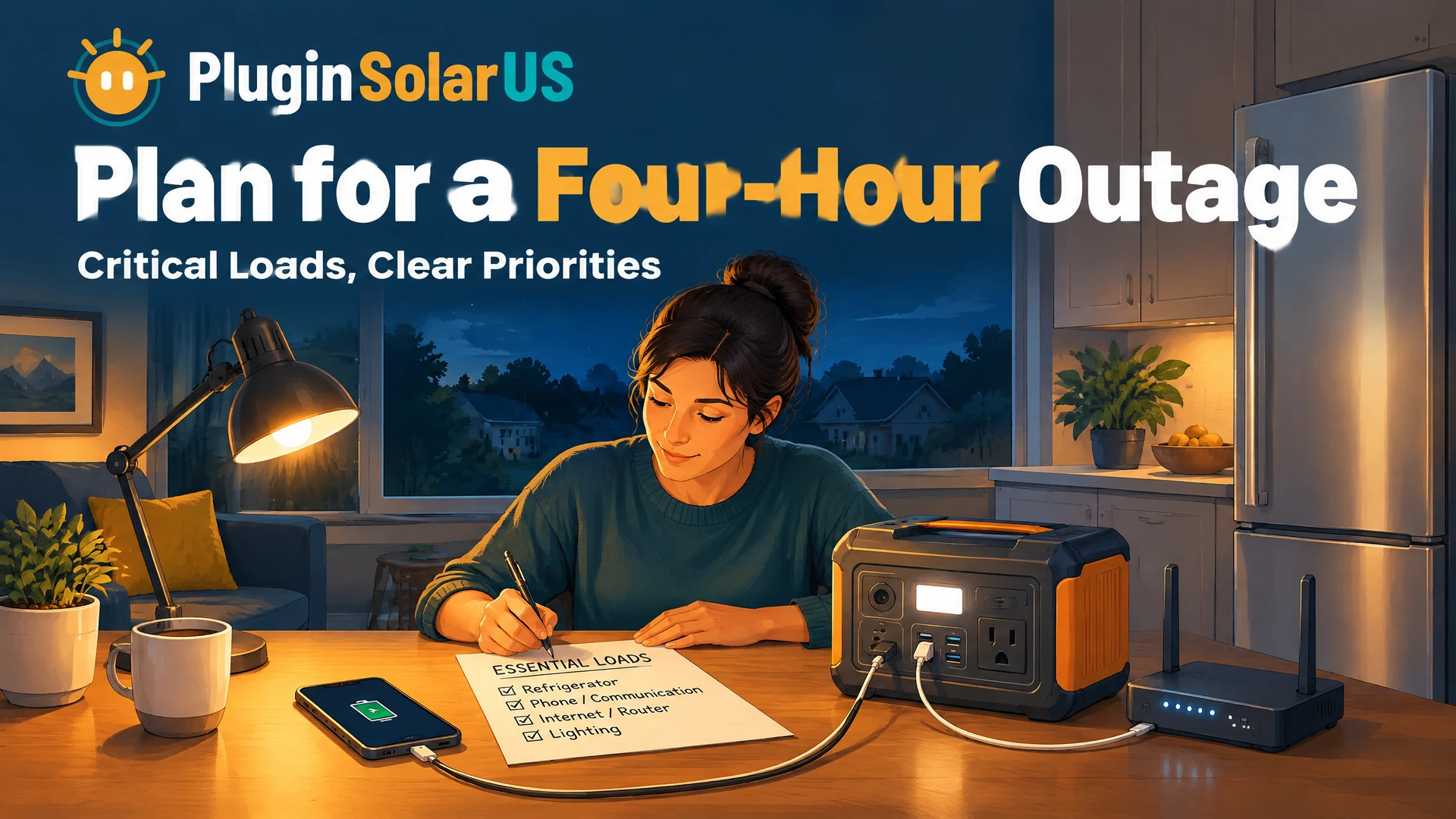
A four-hour outage plan is a small, practical resilience win. It gives your household a clear answer to an important question before a battery, generator, or solar product enters the picture: what actually needs power first?
Start with the things that protect communication, food, health, and safety. Ready.gov advises households to inventory items that rely on electricity and plan alternative power sources. It also advises keeping refrigerators and freezers closed; an unopened refrigerator generally keeps food cold for about four hours. That is food-safety guidance, not a promise that a refrigerator needs to run from your backup equipment for four hours.[1]
A good plan does not try to run the whole house. It identifies a few selected devices, the time they matter, and the limits a power source must meet. That can make a modest, well-matched solution useful while helping a household avoid buying capacity it cannot use.
Start with the first four hours, not a product listing
In the first few minutes, locate flashlights, check local alerts, preserve phone charge, and keep refrigerator and freezer doors closed. Decide which rooms need light and how household members will communicate. If heat or cold is dangerous, identify a nearby location with power rather than assuming a small battery can safely handle heating or cooling.[1]
Next, sort needs into three short lists. Write the actual devices in your home rather than copying a generic checklist.
Must keep running
- Communication: phone charging, a modem or router if service is available, and a weather radio if you use one.
- Basic lighting: the smallest number of efficient lights that lets people move safely.
- Time-sensitive needs: only those devices whose power plan has been confirmed for the person who relies on them.
Helpful but optional
- Laptop charging, a television or other information device, and a fan where conditions and equipment allow.
- A small comfort item that does not displace a more important load.
Do not put on a short-outage power list unless your system was designed for it
- Central air conditioning, electric space heat, electric water heating, clothes dryers, ovens, and other large home loads.
- A refrigerator compressor as a casual battery-runtime assumption. Keep the door closed first; determine any appliance-power plan from its manual and the specific backup system, not from a generic watt estimate.
Medical equipment and refrigerated medicines need their own plan. Ready.gov says to talk with the medical provider about a power-outage plan for electricity-dependent devices and to get specific advice on critical medicines. The equipment provider can help identify the device’s operating and startup requirements. This article does not provide a medical-device runtime estimate.[1]
Use the worksheet before comparing capacity labels
A battery’s capacity is energy, usually stated in watt-hours (Wh) or kilowatt-hours (kWh). Its output rating is power, stated in watts (W). Both matter. A battery might hold enough energy on paper but still be unable to start or continuously run a particular device if the device’s operating or startup demand exceeds the battery’s output limits.
Fill out the following worksheet with product manuals and device labels beside you. A blank or an unverified value is a reason to pause, not a value to guess.
Critical-load and runtime worksheet
1. Define the four-hour job
- Outage window to plan for: ____ hours.
- People at home and communication needs: ____.
- Weather or location-with-power plan: ____.
- Refrigerator/freezer action: keep doors closed; thermometer/cooler plan if needed: ____.
- Medical-device or refrigerated-medicine plan confirmed with clinician and equipment provider: yes / no / not applicable.
2. List only selected electrical loads
For each device, record: device name _; label/manual operating watts W; hours needed _; energy need = watts × hours = Wh; source of the watt figure ____.
Add each device’s energy need: four-hour energy subtotal = ____ Wh. Keep an appliance with a motor, compressor, or heating element separate until you have its manufacturer-stated operating and startup information.
3. Document the power source, not just the headline capacity
- Battery rated capacity: ____ Wh.
- Manufacturer-published usable capacity: ____ Wh. If a usable figure is published, use it rather than applying a second, invented loss percentage.
- If only rated capacity is available, planning allowance for conversion, operating conditions, and other documented limits: _ Wh or _%. Write why this allowance was chosen: ____.
- Battery continuous AC output limit: ____ W.
- Battery peak or surge output limit and stated duration: _ W for _ seconds.
- Largest selected device’s manual-stated startup or surge requirement: _ W for _ seconds.
- Output check: the total simultaneous operating load and the applicable startup requirement must both fit within the published limits: pass / needs review.
- Reserve held back for uncertainty, communications, or a later need: _ Wh or _%.
4. Make the decision
Required usable energy = four-hour energy subtotal + reserve = ____ Wh. Compare that with the documented usable capacity, after any clearly stated planning allowance. Then confirm that the simultaneous load and startup demand fit the source’s output specifications. A result that fails either check is not a safe match merely because its capacity number looks large.
A transparent example: communication and light, not a whole home
Consider an illustrative four-hour plan with three selected loads: a 12 W router, 16 W of LED lighting, and 10 W of phone charging. The energy arithmetic is simple:
- Router: 12 W × 4 hours = 48 Wh.
- LED lights: 16 W × 4 hours = 64 Wh.
- Phone charging: 10 W × 4 hours = 40 Wh.
The subtotal is 152 Wh. If the household chooses a 20% reserve, the reserve is 30.4 Wh, for a required usable-energy target of 182.4 Wh. The simultaneous operating load is 38 W.
Now suppose a hypothetical power station is labeled 500 Wh rated capacity and its documentation states 425 Wh of usable output capacity. The worksheet uses 425 Wh directly, with no additional conversion-loss deduction because the usable figure already defines the example’s available energy. Assume its continuous AC output limit is 100 W. The 38 W selected load is below that continuous limit, and 425 Wh is greater than the 182.4 Wh target, leaving 242.6 Wh in this example.
This is not a product recommendation or a promise of runtime. It deliberately excludes a refrigerator, medical device, compressor, heating load, and any device with an unconfirmed startup requirement. Add any one of those only after replacing the example assumptions with the exact device and power-source documentation.
Choose the right lane for the goal
A portable power station can be useful for selected, directly connected devices. It is not automatically whole-home backup, and it does not make a home’s wiring safe to energize. A home-backup system is a different project: it needs appropriately designed equipment, selected loads, and a safe way to separate from the grid. For the equipment distinctions, see how portable power stations and home batteries connect and the guide to what energy independence means at home.
Solar belongs in its own lane. DOE explains that residential solar panels alone generally depend on the grid and are designed to switch off during an outage; independent operation requires a properly configured inverter and storage system.[2] That is why a solar panel watt rating is not an outage-runtime plan.
Rowkin belongs on the daytime bill-offset side of that distinction. Its cataloged Solo and Dual kits are solar-only, grid-tied offerings with no battery included and no verified outage output.[3] They are not a critical-load backup recommendation and should not be casually paired with a battery to imply blackout operation. Readers exploring a separate daytime solar project can use the Product Finder and Readiness Checker, then verify applicable property, utility, electrical, and exact-equipment requirements before purchase or connection. For the outage behavior behind this boundary, read why grid-tied plug-in solar switches off.
Keep generator safety outside the worksheet
A generator may be part of a household’s longer-outage plan, but it is not an indoor or improvised-wiring solution. Ready.gov says generators and fuel should be used outdoors at least 20 feet from windows, doors, and attached garages, and recommends working carbon-monoxide detectors on every level of the home.[1] Never try to power house wiring by plugging a generator into a wall outlet. The Consumer Product Safety Commission identifies that practice as backfeeding and warns that it can electrocute utility workers and others and bypass household circuit protection.[4]
The useful outcome of this worksheet is not a bigger shopping cart. It is a short list of documented needs, a realistic four-hour energy target, and a clear signal about whether non-electric preparedness, selected-device portable power, or a professionally designed backup system is the next conversation.
Related Articles
- What “Energy Independence” Means at Home: Lower Bills, Backup Power, and Grid Flexibility Are Different Things — A practical guide to separating bill offset, load shifting, backup power, and electrically isolated off-grid use—so households can choose the energy outcome they actually need.
- How Solar Batteries Connect: AC vs. DC Coupling and Portable Power Stations — AC and DC coupling describe how solar and batteries share power, but they do not by themselves create backup. Learn how portable power stations, home batteries, inverters, and transfer equipment differ.
- Home Solar Batteries, Explained: LFP vs. NMC, Usable kWh, and What Makes a Battery Last — A practical guide to comparing LFP and NMC batteries without reducing durability to a cycle-count claim. Learn what usable kWh, temperature, warranty terms, and system design mean for a battery’s real-world life.