The New York Times Just Covered Plug-In Solar. Here's What It Means.
By PlugInSolarUS Editorial · Published 2026-08-02 · 9 min read
On July 31, the NYT published two front-page articles on plug-in solar — a watershed moment for a technology that was virtually unknown in the US a year ago. We break down what they got right, what they missed, and why this changes everything.
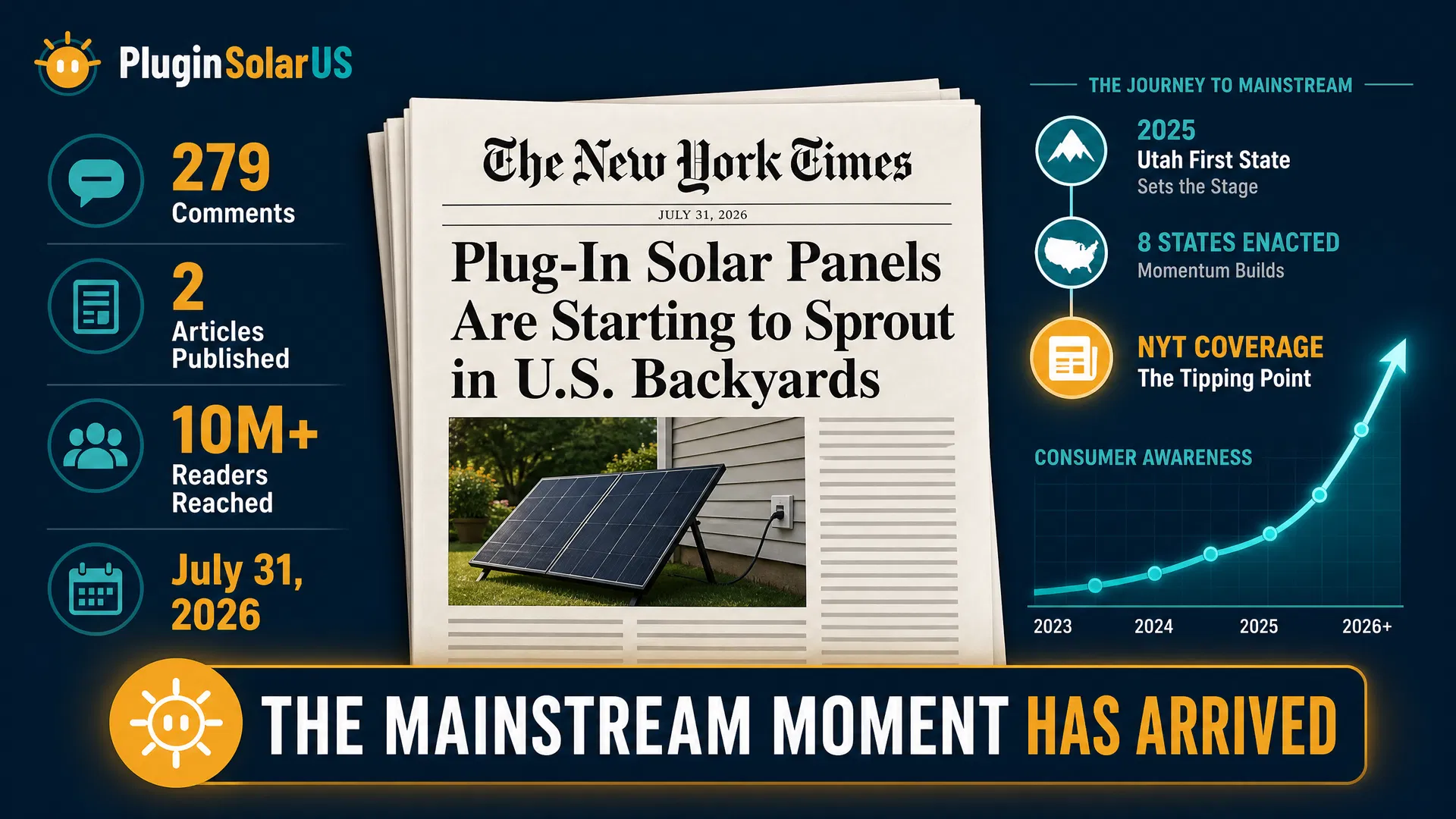
On July 31, 2026, the New York Times published not one but two front-page articles on plug-in solar energy — a main feature titled "Plug-In Solar Panels Are Starting to Sprout in U.S. Backyards" and a companion consumer guide, "What You Need to Know About Installing Plug-In Solar Panels." Written by energy reporters Ivan Penn and Claire Brown, the pieces represent the single largest mainstream media moment for plug-in solar in the United States to date.
For a technology that was virtually unknown to most Americans twelve months ago, this is a watershed. The Times coverage reached millions of readers, generated 279 comments on the main article alone, and was shared widely across Reddit, LinkedIn, and Instagram. It signals that plug-in solar has crossed the threshold from niche energy-policy curiosity to mainstream consumer technology.
Here at PlugInSolarUS, we've been covering this space since before the first state legalized plug-in solar. Below, we break down what the Times got right, what they missed, and what this mainstream moment means for you.
What the NYT Covered
The main article tells the story through real people: Melani Jackson in Salt Lake City, who saved $77 in six months with four panels in her backyard, and Alex Ottoboni in the San Francisco Bay Area, who hangs two panels from his condo balcony to save $5–7 per month. These personal narratives ground the technology in everyday life — not as a futuristic concept, but as something your neighbor might already be doing.
The Times correctly identified several critical dynamics:
- Ten states have legalized plug-in solar systems (including those awaiting gubernatorial signature)
- No permits required in states that allow their use
- Cost advantage: A few hundred dollars vs. up to $36,000 for conventional rooftop systems
- Rising electricity costs are the primary driver — rates up 7% year-over-year, 1 in 6 households behind on bills
- Germany's success: 800,000 registrations in the first three months after legalization
- Safety certification gap: No system has yet received full UL 3700 certification
- Utility opposition: Edison International's CEO supports the concept but opposes California legislation
The companion guide focused on practical consumer advice, emphasizing the importance of UL 3700 certification and warning readers to wait for certified products. It's a responsible approach, even if it may overstate the risk for smaller systems.
What the NYT Got Right
Credit where it's due — the Times nailed several important points that other outlets have gotten wrong:
1. This is not "portable solar." The article correctly distinguishes plug-in solar from portable panels or solar generators. These are grid-interactive systems that feed power directly into home circuits through a wall outlet.
2. The economic case is real but modest. By quoting actual savings figures ($77 over six months, $5–7/month), the Times avoids the hype that plagues some coverage. Plug-in solar won't eliminate your electricity bill, but it will meaningfully reduce it — and the savings compound over 25+ years of panel life.
3. Utility resistance is about economics, not safety. The article quotes Edison International's CEO saying he supports the technology but opposes legislation — revealing the tension between stated safety concerns and the economic threat that distributed generation poses to utility business models.
4. Germany is the proof of concept. The reference to 800,000 German registrations in three months provides the strongest possible evidence that this technology works at scale when policy enables it.
What the NYT Missed
No single article can cover everything, but there are several important dimensions the Times didn't address:
| Topic | What They Missed | Why It Matters |
|---|---|---|
| State Wattage Limits | Each state sets different caps (600W–2,400W) | Determines how much you can actually save |
| TOU Rate Optimization | Battery storage shifts solar to peak-rate hours | Can double effective savings in TOU states |
| UL 3700 Progress | Hoymiles launched UL 3700-compliant microinverter July 15 | Certification gap is closing faster than implied |
| FCC Inverter Ban | July 28 ban on new foreign inverter models | Could constrain future product availability |
| Federal Tax Credit Loss | Section 25D repealed in One Big Beautiful Bill | Makes plug-in solar's low price even more advantageous vs. rooftop |
| Renter-Specific Benefits | Portability, no landlord permission in most states | 44M+ US renters are the primary addressable market |
The Certification Narrative Needs Nuance
The Times frames the safety certification gap as a significant consumer warning. While responsible, this framing deserves context. On July 15 — just 16 days before the NYT articles published — Hoymiles announced the HiFlow Pro, described as the first UL 3700-compliant plug-in microinverter for the US market. The certification landscape is moving fast.
Moreover, the safety risk profile of a 360-watt system (like Bright Saver's) is fundamentally different from a 1,200-watt or 2,400-watt system. As the proposed NEC amendment notes, plugging 360 watts into a standard 15-amp circuit "can never damage" the 14-gauge copper wires commonly used in US homes. The Times doesn't make this distinction, potentially discouraging consumers from systems that pose minimal risk.
Utah has had systems up to 1,200 watts in the field for over a year with zero reported safety incidents. That's real-world data, not theoretical risk modeling.
The "10 States" Question
The Times reports that "ten U.S. states have legalized" plug-in solar. Our state tracker currently shows 8 states with enacted legislation (Utah, Colorado, New Jersey, New Hampshire, Vermont, Maine, Virginia, and Maryland) plus New York's SUNNY Act which has passed both chambers but awaits the governor's signature, and Connecticut's HB 5340 in a similar position. The discrepancy likely reflects different counting methodologies — whether you include bills that have passed legislatures but haven't been signed into law.
Why This Matters: The Mainstream Tipping Point
The significance of NYT coverage cannot be overstated. Consider the trajectory:
| Date | Milestone | Significance |
|---|---|---|
| March 2025 | Utah becomes first state to legalize | Proof that US legislation is possible |
| 2025–2026 | 7 more states enact laws | Bipartisan momentum builds |
| March 2026 | Canary Media covers plug-in solar | Clean energy media validates the category |
| July 10, 2026 | Bill McKibben mentions on Ezra Klein podcast | Climate thought leadership endorsement |
| July 12, 2026 | Boston Globe op-ed on Massachusetts | Regional newspaper coverage begins |
| July 13, 2026 | Bright Saver launches at-cost kits | Sub-$300 price point makes national news |
| July 31, 2026 | New York Times publishes two articles | Mainstream tipping point reached |
When the New York Times covers a consumer technology, it typically signals that the early-adopter phase is ending and mass-market adoption is beginning. The 279 comments on the article — overwhelmingly positive and curious — confirm that demand exists far beyond the energy-policy community.
What Happens Next
The NYT coverage will likely accelerate several trends already in motion:
Consumer demand will spike. Every major media moment in the solar industry has been followed by a measurable increase in consumer inquiries. Craftstrom's CEO told the Times that sales were already up 50% year-over-year before this coverage. Expect that to accelerate.
Legislative pressure will intensify. Lawmakers in California, Massachusetts, Pennsylvania, and other states now have a New York Times article to cite when making the case for plug-in solar legislation. The political calculus just shifted.
Certification will accelerate. UL Solutions knows that millions of consumers are now aware of the technology and waiting for certified products. The commercial incentive to move quickly just increased dramatically.
Utility opposition will intensify — then soften. In the short term, utilities will fight harder against state legislation. But as consumer awareness grows and the political cost of opposition rises, the smarter utilities will pivot to accommodation, as they did with rooftop solar a decade ago.
The Bottom Line
"Politicians all over the country are wringing their hands, wanting to do something about energy affordability. Here is an immediate answer."
— Bernadette Del Chiaro, Environmental Working Group, quoted in the NYT
The New York Times didn't discover plug-in solar. Millions of Europeans have been using it for years, and thousands of Americans were already plugging in before July 31. But the Times did something equally important: it told 10 million subscribers that this technology exists, it works, and it's coming to their state.
For the plug-in solar movement, this is the moment the conversation shifts from "What is plug-in solar?" to "When can I get one?" And that's a question we're here to help answer.
What To Do Next
- Check your state: Use our State Tracker to see if plug-in solar is legal where you live
- Calculate savings: Try our Savings Calculator for a location-specific estimate
- Understand the tech: Read our How It Works guide for a deeper dive
- Stay informed: The FCC just banned new foreign inverter models — read our analysis of what that means
Sources
- NYT: Plug-In Solar Panels Are Starting to Sprout in U.S. Backyards (July 31, 2026)
- NYT: What You Need to Know About Installing Plug-In Solar Panels (July 31, 2026)
- Canary Media: A New Deal on Balcony Solar (July 13, 2026)
- PV Magazine: Bright Saver Begins Offering Kits at Wholesale (July 14, 2026)
- PV Magazine: Hoymiles UL 3700 Compliant Microinverter (July 15, 2026)