Plug-In Solar Off-Grid: How to Use Solar Without Waiting for Your State
By PlugInSolarUS Editorial · Published August 20, 2026 · 14 min read
Live in a state without plug-in solar legislation? Truly off-grid and portable solar configurations let you generate your own power today. But the legal picture depends on how your system connects — or doesn’t connect — to the grid.
Listen to the companion episode
Plug-In Solar Off-Grid: How to Use Solar Without Waiting for Your State
You live in Texas, Florida, Georgia, or one of the 40+ states that haven’t passed a plug-in solar law. Does that mean you can’t use solar at all? Not necessarily. But the answer depends on how your system is set up — specifically, whether it connects to your home’s electrical grid or operates independently.
This guide breaks down three distinct approaches to using solar without state plug-in solar legislation, explains what’s clearly legal, what’s a gray area, and what requires caution.
Three Types of “Off-Grid” Solar — and Why the Distinction Matters
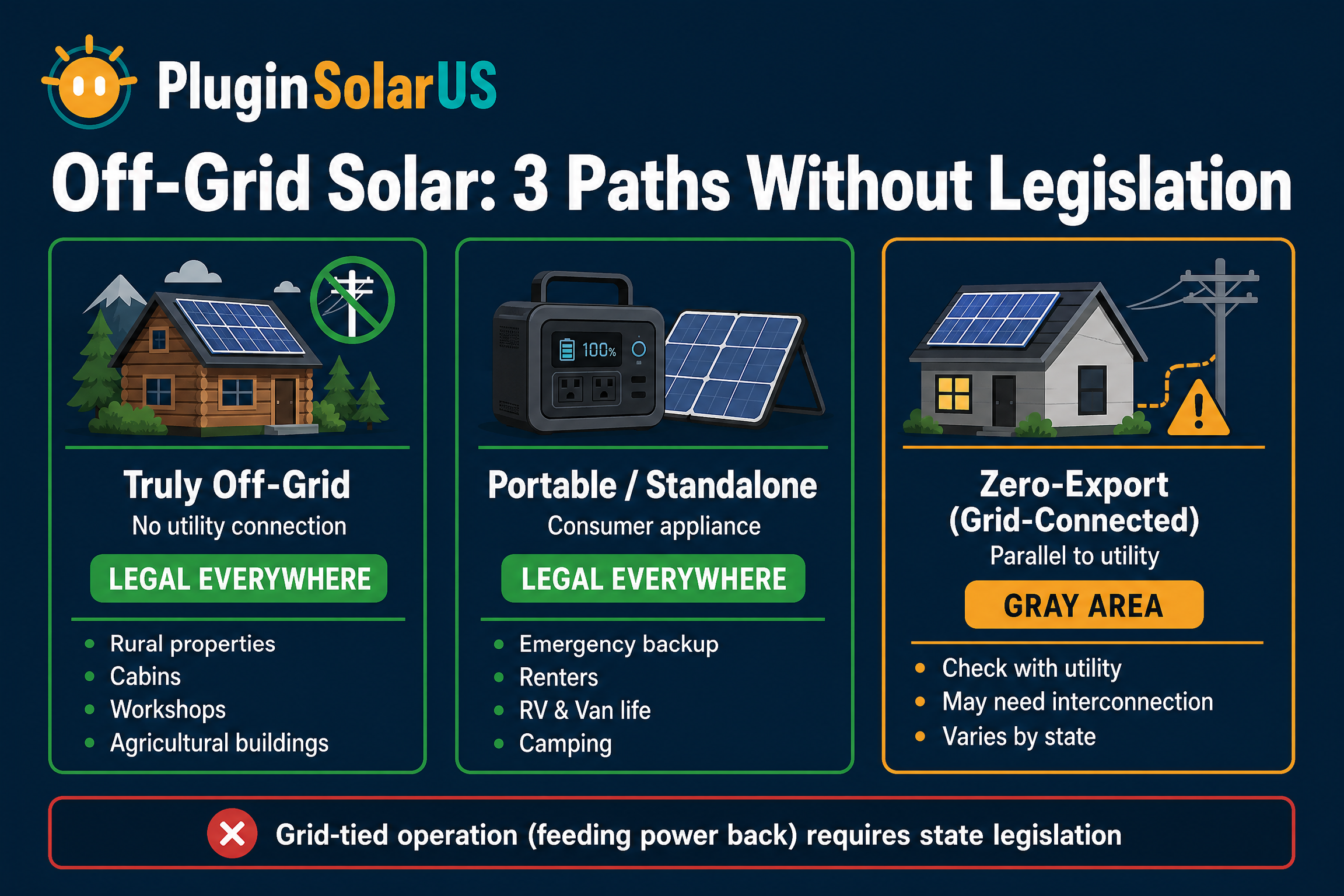
The term “off-grid” gets used loosely, but legally and technically, there are three very different configurations:
| Configuration | How It Works | Grid Connection | Legal Status |
|---|---|---|---|
| 1. Truly Off-Grid | No utility connection at all. Solar + battery powers the entire property. | None | Legal everywhere |
| 2. Portable / Standalone | Solar charges a portable battery. You plug devices directly into the battery — never into home wiring. | None | Legal everywhere |
| 3. Zero-Export (Grid-Connected) | Solar + battery connected to home circuits. Technology prevents power from flowing back to the grid. | Yes (parallel) | Gray area — varies by utility |
Key Distinction
The critical question is not whether you export power — it’s whether your system runs in parallel with the grid. A truly off-grid or portable system has no electrical connection to the utility. A zero-export system is still grid-connected (just configured not to export), and some utilities consider this a “parallel generation source” that may require an interconnection agreement — even if zero watts are exported.
Type 1: Truly Off-Grid — No Utility Connection
If your property has no utility connection at all, or you’re powering a structure that isn’t connected to the grid (cabin, rural property, detached workshop), you’re operating truly off-grid. No state legislation, utility permission, or interconnection agreement is needed.
Best Use Cases
- Rural properties — Utility companies charge $15,000–$50,000 per mile to extend power lines. Off-grid solar is often cheaper than grid connection and eliminates monthly utility bills entirely.
- Cabins and vacation homes — Seasonal properties where running a utility line isn’t cost-effective.
- Detached sheds, workshops, and garages — Structures without existing electrical service. A solar panel + battery system provides tools, lighting, and small appliance power without running new wiring from the main panel.
- Agricultural buildings — Barns, irrigation pumps, and equipment shelters in remote locations.
Legal Considerations
- Building permits may be required for permanent structures (ground mounts, roof mounts) depending on your municipality.
- NEC Article 690 (PV systems) and Article 480 (batteries) apply to permanent installations.
- No utility notification or interconnection agreement needed — there’s no utility involved.
Type 2: Portable / Standalone Systems — The Consumer Appliance Approach
This is the simplest and most clearly legal path. A portable solar panel charges a portable battery (power station), and you plug your devices directly into the battery’s outlets. The system never connects to your home’s electrical wiring.
Why This Is Always Legal
Portable power stations are classified as consumer electronics — the same category as a laptop, space heater, or window AC unit. You’re not generating electricity that interacts with the grid in any way. You’re charging a battery from the sun and using that battery to power your devices. No permits, no utility notification, no legislation needed.
Best Use Cases
- Emergency backup — Texas experienced catastrophic grid failures during Winter Storm Uri (2021) and subsequent heat waves. Florida faces annual hurricane-season outages. A portable solar + battery system keeps critical loads running (phone, lights, router, medical devices) when the grid goes down.
- Renters — Portable panels on a balcony or patio, connected to a battery power station, require no modifications to the rental unit. When you move, the system moves with you.
- RV, van life, and tiny homes — Mobile dwellings are inherently off-grid. Solar panels on the roof + a lithium battery bank provide silent, fuel-free power.
- Camping and outdoor recreation — Folding panels + portable batteries for phone charging, lighting, and small electronics.
- Tailgating and outdoor events — Clean, silent power without a gas generator.
Limitations
- You can only power devices plugged directly into the battery — not your home’s circuits.
- Capacity is limited by battery size (typically 1–5 kWh for portable units).
- Won’t reduce your utility bill directly (since it’s not connected to your home’s electrical system).
Type 3: Zero-Export (Grid-Connected) — Proceed with Caution
This is the configuration most people think of when they hear “off-grid plug-in solar” — but it’s actually not off-grid at all. The system is connected to your home’s electrical circuits (which are connected to the utility grid), but uses technology to prevent any power from flowing back to the grid.
How Zero-Export Works
- Current transformer (CT) clamp monitors the main electrical panel in real time
- When your home is consuming power, the inverter allows solar/battery to supply up to that amount
- The instant your consumption drops below solar production, the inverter throttles output to zero
- Result: your meter never spins backward. Zero watts exported.
Important: Zero-Export Does Not Mean “Legal Everywhere”
A common misconception is that zero-export systems don’t require utility permission because they don’t export power. However, according to the Interstate Renewable Energy Council (IREC), “If a system is running in parallel to the grid, even if it’s not exporting to the grid, it does require an interconnection application” in many jurisdictions. The rules vary significantly by state and utility. Some utilities may not enforce this; others actively require it.
The Regulatory Landscape for Zero-Export
| Situation | What Happens |
|---|---|
| States with plug-in solar laws (CO, UT, VA, etc.) | Zero-export is explicitly allowed. These laws exempt small systems from interconnection requirements. Simple registration may be required. |
| States without plug-in solar laws, utility doesn’t enforce | Many utilities (especially in deregulated markets like TX) don’t actively monitor for small zero-export systems. Technically a gray area, but enforcement is rare for small residential systems. |
| States with strict interconnection rules (CA, IL, MN) | Even zero-export systems may require a streamlined interconnection application. California’s Rule 21 requires a “notification-only” process for non-exporting systems. |
| Utility discovers unauthorized parallel generation | The utility can disconnect service or require you to remove the system. This is rare but has happened. |
If You Want to Try Zero-Export
- Contact your utility first. Ask specifically about non-exporting or zero-export solar systems. Some utilities have a simple registration process; others may require a full interconnection application.
- Use certified equipment. If the system will operate grid-interactively, choose plug-in photovoltaic equipment certified to UL 3700 and separately confirm that its controls support the proposed zero-export configuration.
- Keep it small. Systems under 1–2 kW are less likely to attract utility attention and may fall under de minimis thresholds in some jurisdictions.
- Document everything. Keep records of your system specs, zero-export configuration, and any utility correspondence.
Texas: A Case Study
Texas is the most visited non-enacted state on our website — and for good reason. The state has:
- No statewide plug-in solar law (no bill introduced as of August 2026)
- Deregulated electricity market — net metering is at the discretion of individual retail electric providers, and most don’t offer it
- Excellent solar resources — 4.5–6.0 peak sun hours/day depending on region
- High grid vulnerability — ERCOT operates independently from the national grid, leading to reliability concerns
- No statewide solar permitting law — requirements vary by municipality; many rural counties have minimal or no permit requirements
For Texans, the most clearly legal options are truly off-grid (for detached structures and rural properties) and portable/standalone (for emergency backup and renters). Zero-export grid-connected systems are a gray area — Texas’s deregulated market means there’s no single statewide rule, and individual retail electric providers have varying policies.
| Scenario | System Type | Approximate Cost | Legal Clarity |
|---|---|---|---|
| Emergency backup (portable) | Portable power station + 200–400W folding panel | $500–$1,500 | Clear — consumer appliance |
| Shed / workshop power | Panel + battery, not connected to home circuits | $800–$2,000 | Clear — truly off-grid |
| Rural property (no grid) | Full off-grid system (2–5 kW + 10–20 kWh battery) | $5,000–$15,000 | Clear — no utility involved |
| Home bill reduction (zero-export) | Panel + battery + zero-export inverter on home circuits | $2,000–$5,000 | Gray area — check with utility |
General Legal Considerations
| Consideration | Truly Off-Grid | Portable / Standalone | Zero-Export (Grid-Connected) |
|---|---|---|---|
| Utility permission | Not needed | Not needed | May be required |
| Electrical permits | For permanent installations | Not needed | Likely required |
| Building permits | For permanent structures | Not needed | Depends on installation |
| NEC compliance | Article 690 / 480 | N/A (consumer electronics) | Article 690 / 480 / 705 |
| HOA restrictions | May apply to visible panels | Usually not (portable) | May apply |
| Insurance | Notify for permanent systems | Covered as personal property | Notify insurer |
Limitations & Honest Expectations
Off-grid and portable solar are real solutions, but they have trade-offs compared to grid-tied systems enabled by legislation:
- Battery adds cost: A grid-tied system doesn’t need a battery (the grid is your “storage”). Off-grid requires $500–$5,000+ in battery storage.
- Energy loss: Charging and discharging batteries involves ~10–15% round-trip efficiency loss. Grid-tied systems avoid this.
- Limited capacity: A starter portable system (200W panel + 1 kWh battery) won’t run your AC or electric dryer. It’s best for phones, laptops, lights, and small electronics.
- Seasonal variation: Winter production can be 50–70% lower than summer in northern states.
- No net metering credit: You can’t earn credits for excess production. If your battery is full and the sun is shining, that energy is wasted (curtailed).
- Portable systems don’t reduce your utility bill: Since they’re not connected to your home’s circuits, your meter doesn’t see the savings.
Why Legislation Still Matters
Off-grid and portable solar work today, but they’re not the full picture. Grid-tied operation — enabled by plug-in solar legislation — unlocks significant additional benefits:
- Lower cost: No battery required means $500–$5,000 less upfront
- Higher efficiency: No battery charging losses (10–15% saved)
- Direct bill reduction: Power your home’s circuits directly from solar, reducing what you draw from the grid
- Net metering: Earn credits for excess production instead of wasting it
- Faster payback: 2–4 years for grid-tied vs. 4–8 years for off-grid (depending on local rates and battery costs)
- Legal clarity: No gray areas — the law explicitly permits it
- Virtual Power Plants: Grid-tied systems can participate in VPP programs that pay you for demand response
If you live in a state without plug-in solar legislation, you can start with portable or truly off-grid solar today — and upgrade to grid-tied operation once your state passes enabling legislation.
Take Action
Check your state’s legislation status on our State Tracker. If your state doesn’t have a bill yet, consider contacting your state representative — every state that has passed plug-in solar legislation started with constituent demand. In the meantime, portable and truly off-grid solar give you a path to start using solar today.
The Bottom Line
Clearly legal (no legislation needed):
- Portable solar + battery as a standalone power source (not connected to home wiring)
- Truly off-grid systems for properties without utility service
- Solar-powered sheds, workshops, and detached structures
- RV, van, and tiny home solar
- Emergency backup via portable power station
Gray area (check with your utility):
- Zero-export systems connected to home circuits while grid is also connected
- Peak shaving via battery discharge on home circuits
- Any configuration where solar/battery runs in parallel with the utility grid
Requires legislation:
- Feeding excess power back to the grid
- Earning net metering credits
- Operating without a battery (grid as storage)
- Participating in Virtual Power Plant programs
The safest path in states without plug-in solar legislation is portable/standalone solar for personal use, or truly off-grid for detached structures. These approaches give you energy independence and emergency resilience without any regulatory risk. And when your state does pass enabling legislation, you can upgrade to a grid-tied system for even greater savings.
This article is for educational purposes only and does not constitute legal advice. Local regulations vary significantly by state, municipality, and utility. Always check your specific jurisdiction’s requirements and consult your utility before connecting any generation source to circuits that are also served by the utility grid.