UL 3700 Explained: The Safety Certification Standard for Plug-In Solar
By PlugInSolarUS Editorial Team · Published 2026-03-25 · Updated October 1, 2026 · 14 min read
UL 3700 is the U.S. safety certification standard developed specifically for plug-in photovoltaic equipment and systems. Learn how it addresses overcurrent protection, touch safety, and GFCI interaction.
Standards pathway
Use UL 3700 as One Part of the Decision
A safety listing helps evaluate the equipment, but it does not by itself establish permission for every installation. Confirm the exact product listing alongside anti-islanding behavior and the rules for your location and circuit.
- See anti-islanding in practice — Understand outage shutdown, unplugging behavior, and product-specific test examples.
- Review FCC authorization context — Learn how the Covered List action affects new and previously authorized inverter models.
- Compare complete systems — Use certification, system design, warranty, storage, and monitoring as a combined buying checklist.
- Check location-specific rules — Review the state framework and verify any utility, property, code, and electrical conditions.
UL 3700 Explained: The Safety Certification Standard for Plug-In Solar
Plug-in solar systems — also known as balcony solar, apartment solar, or plug-in photovoltaic (PIPV) systems — offer a flexible and accessible way for individuals to generate their own clean energy. Connecting interactive solar equipment through a plug-and-receptacle interface also creates safety questions that older electrical standards did not address as a complete system. UL 3700 is the U.S. safety certification standard developed specifically for plug-in photovoltaic equipment and systems. Its formal title is the Outline of Investigation for Interactive Plug-In PV (PIPV) Equipment and Systems.
What Is UL 3700?
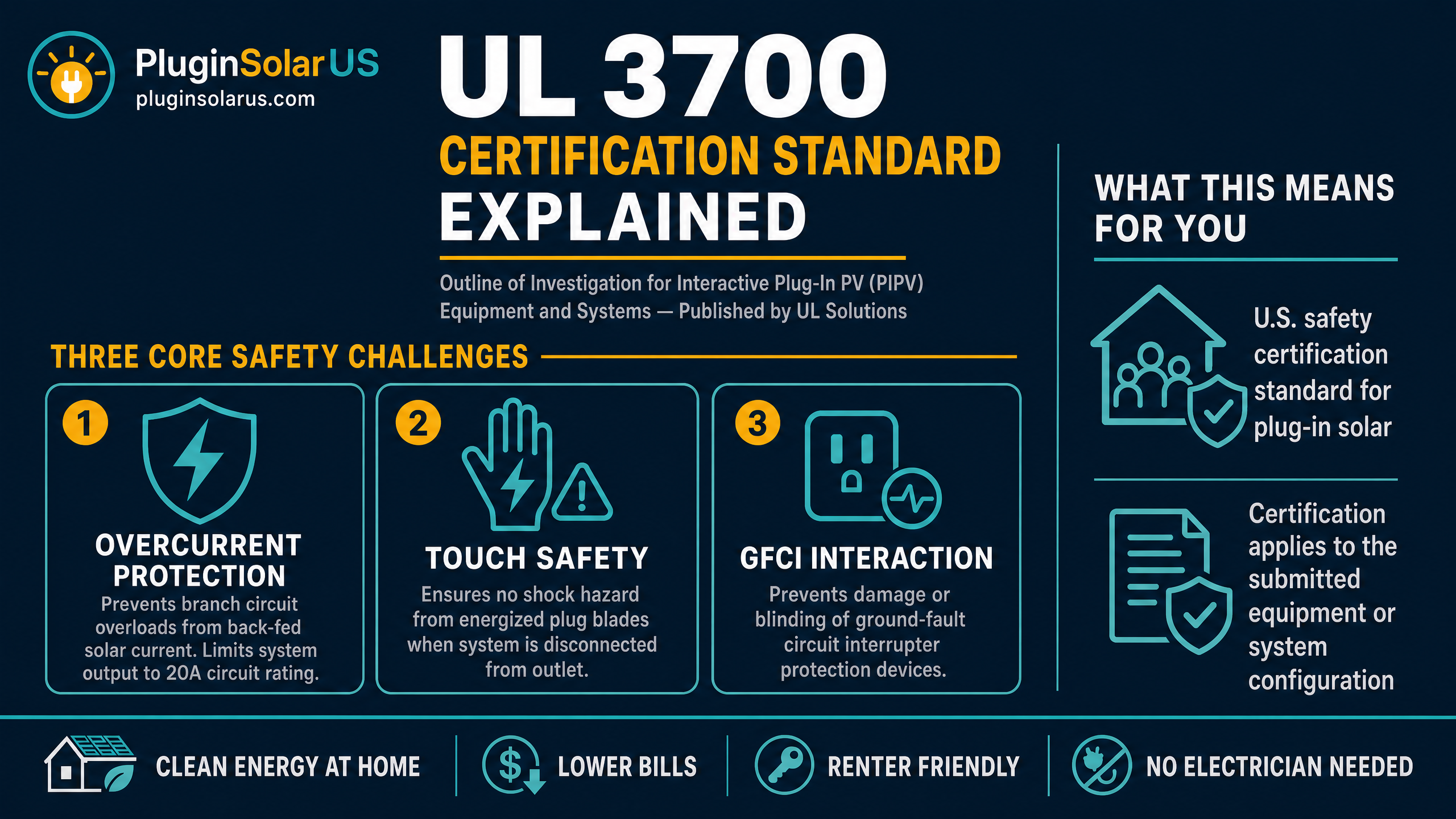
UL 3700 is an Outline of Investigation published by UL Solutions that defines certification requirements for plug-in photovoltaic equipment and systems. Its evaluation addresses the submitted configuration rather than treating an inverter or battery certification as a substitute for the plug-in solar standard. It addresses three categories of hazard that are distinctive to PIPV systems:
- Overcurrent protection — preventing branch circuit conductor overloads caused by back-fed solar current
- Touch safety — ensuring that accessible plug blades and output circuits cannot expose users to hazardous voltage
- GFCI interaction — preventing PIPV systems from damaging or blinding existing ground-fault circuit interrupter protection
Unlike UL 1741 (which covers inverters and grid-interactive equipment broadly) or IEEE 1547 (which focuses on grid performance functions), UL 3700 is purpose-built for the consumer use case where a power-generating device connects to a standard residential branch circuit through a plug-and-receptacle interface. It supplements grid-interactive performance requirements with the touch safety, overcurrent, and GFCI protections that consumer-accessible equipment demands.
Why Existing Standards Are Not Sufficient for Plug-In Solar
Before UL 3700, no single standard addressed the unique hazards of PIPV systems. The National Electrical Code (NEC) and existing UL/IEEE standards each cover adjacent territory but leave critical gaps:
- NEC Article 690 (Solar Photovoltaic Systems) applies to permanently installed PV with dedicated wiring connections — not to systems that plug into standard receptacles.
- NEC Article 705 (Interconnected Electric Power Production Sources) does not explicitly cover PIPV connected to branch circuits.
- NEC Articles 210 and 240 (Branch Circuits and Overcurrent Protection) assume a single source of power flowing from the panelboard to loads — they do not account for a second source back-feeding through a receptacle.
- IEEE 1547 / UL 1741 focus on grid performance functions (voltage ride-through, frequency response, anti-islanding) but explicitly do not address electric shock, energy, or fire hazards to the general public from accessing inverter outputs.
As the UL Solutions whitepaper states: "Utility grid interconnection performance requirements and tests focus exclusively on the suitability of connections to the grid and do not address electric shock, energy, and fire hazards that could pose a risk to the general public from accessing the inverter outputs." UL 3700 fills this gap by establishing requirements that protect consumers who interact with PIPV equipment in their homes.
The Three Core Safety Challenges UL 3700 Addresses
1. Overcurrent Protection: Preventing Branch Circuit Overloads
When a PIPV system back-feeds power into a branch circuit receptacle, it introduces additional current that the upstream circuit breaker was never designed to detect. Consider a typical 15-amp branch circuit protected by a 15A breaker and wired with 14 AWG copper conductors:
- Without PIPV: If loads on the circuit exceed 15A, the circuit breaker trips and protects the wiring from overheating.
- With PIPV back-feeding: The PV inverter contributes current to loads on the circuit. If the utility-supplied current remains below 15A (because the PV is supplying part of the load), the circuit breaker will not trip — even though the total current flowing through the branch circuit conductors exceeds their 15A rating.
This creates a sustained, undetected overload that can damage conductor insulation and create fire or shock hazards. The risk is compounded when multiple PIPV units are connected to the same branch circuit, which is foreseeable given that these products use standard NEMA 5-15 plugs and are installed by individuals without electrical training.
UL 3700 addresses this through four mitigation strategies:
- Dedicated circuit with unique receptacle: The PIPV is installed exclusively on a dedicated branch circuit with no additional loads, using a uniquely configured plug and receptacle that prevents connection to shared circuits.
- Unique receptacle with integrated overcurrent protection: A specially configured receptacle incorporates its own overcurrent protective device rated to match the PIPV output and branch circuit conductor size.
- Unique receptacle with oversized conductors: The branch circuit uses conductors rated above the combined utility + PIPV current (e.g., 12 AWG copper rated for 20A continuous), with PIPV output limited to a defined maximum.
- Power Control Systems (PCS): Technology evaluated under UL 3141 and addressed in NEC Article 120 and Section 705.13 that actively monitors and regulates output of multiple power sources to keep total current within safe limits.
2. Touch Safety: Energized Plug Blades and Output Circuits
Standard NEMA 5-15P attachment plugs were designed to connect utilization equipment (loads that consume power) to a receptacle connected to a source of power. When a plug is removed from an outlet, its blade terminals are de-energized and pose no shock hazard. A PIPV system reverses this assumption: the plug becomes a power output interface, and if the solar panels are exposed to sunlight, the plug blades can be energized at hazardous voltage levels whenever the plug is disconnected from the receptacle.
IEEE 1547 anti-islanding requirements allow up to two seconds for an inverter to cease output after detecting loss of grid voltage. This two-second window, combined with the lack of a single-fault shock safety reliability evaluation, creates a risk of electric shock on exposed plug blades. As UL Solutions states: "Relying solely on the inverter grid connection function to limit exposure to human shock hazards at PIPV plug blades is not an appropriate solution."
UL 3700 addresses this through two approaches:
- Unique configuration plug and receptacle: A proprietary mating pair designed so that no exposed live parts can be contacted by the user — even when disconnected.
- Accessible grid-interactive/touch-safe output circuit: The inverter includes additional hardware protection that provides reliable electric shock protection under both normal and abnormal (fault) conditions, with functional safety assessments of both software and hardware components.
3. GFCI Interaction: Damage and Blinding of Ground-Fault Protection
Ground-fault circuit interrupters (GFCIs) are life-safety devices required by NEC Section 210.8(A) on all outdoor circuits serving dwelling units. However, existing GFCIs evaluated under UL 943 are designed for unidirectional current flow — from the panelboard to the load. PIPV systems introduce two serious problems:
- GFCI damage: Back-feeding power into a GFCI-protected circuit can damage the GFCI circuitry, causing it to fail silently while power continues to flow — leaving the branch circuit unprotected from the very electric shock hazards GFCI functionality is designed to prevent.
- GFCI blinding: During a ground fault event, the GFCI trips and disconnects the utility power source. However, the PIPV — a parallel-coupled supply source — continues to supply current to the ground fault for up to two seconds after the utility is disconnected. The GFCI has no means to interrupt the PV inverter output current, leaving the fault energized.
UL Solutions conducted testing that confirmed these behaviors in GFCI-protected branch circuits back-fed by PIPV grid-interactive microinverters. The standard addresses this through:
- Unique (non-NEMA) plug-in attachment means: A proprietary connector configuration ensures the PIPV cannot be plugged into an existing non-PIPV circuit, preventing back-feeding of legacy unidirectional GFCIs.
- Dedicated circuit with compatible GFCI: The PIPV connects only to a dedicated circuit equipped with a properly evaluated and certified bidirectional GFCI device (requiring updates to UL 943 to accommodate bidirectional power flow).
The Unique Plug and Receptacle Requirement
A defining feature of UL 3700 is the requirement for a uniquely configured, non-NEMA plug and receptacle system. This is perhaps the most significant difference between the US approach to plug-in solar safety and the European model (where standard Schuko or other domestic plugs are commonly used).
The unique connector requirement serves multiple safety functions simultaneously:
- Prevents users from connecting PIPV to unprotected branch circuits
- Ensures the PIPV can only connect at a point with appropriate overcurrent protection
- Prevents back-feeding of non-bidirectional GFCIs
- Eliminates the risk of energized plug blades being accessible to users
- Restricts the number of PIPV units per circuit to prevent cumulative overloads
This means that equipment certified to UL 3700 will not use standard NEMA 5-15 plugs. Consumers will need a compatible receptacle installed (typically by a qualified electrician) before connecting a certified PIPV system. While this adds an installation step compared with the European "just plug it in" model, it addresses the safety concerns that UL Solutions has identified through testing and analysis.
UL Solutions' Official Position
UL Solutions has taken a clear stance on unmitigated plug-in solar connections:
"Allowing PIPV to be plugged into any existing branch circuit with no mitigation for the above concerns is not supported by UL Solutions. There are potential engineered solutions that can be applied and will be necessary to promote safe use of PIPV products. These can include both inherent product features and special installation practices that allow the public to choose electricity sources while also remaining safe."
This position does not oppose plug-in solar — it supports the technology while insisting on proper safety engineering. UL 3700 defines what "proper safety engineering" looks like for PIPV products in the US market.
How UL 3700 Relates to State Legislation
UL 3700 is not just a technical specification; it is the cornerstone that enables states to confidently legalize plug-in solar. Before this standard, the lack of specific safety guidelines created ambiguity and hesitation among regulators and utilities. As of 2026, state bills vary in how specifically they reference UL 3700:
- Utah HB 340 (enacted March 2025): Requires "UL or equivalent NRTL" certification. Does not name UL 3700 (signed before the standard was published in December 2025). References UL 1741 for inverters.
- Maine LD 1730 (enacted April 6, 2026): First enacted US state law to reference UL 3700 by name. References the UL 3700 outline of investigation while also allowing comparable standards from other testing labs or NEC compliance.
- Colorado HB 26-1007 (signed May 7, 2026): Does not name UL 3700. Requires devices over 391W to be "labeled and listed by a nationally recognized testing laboratory" (NRTL). In practice, UL 3700 is the applicable standard for plug-in solar systems above 391W.
- Virginia HB 395 (signed April 22, 2026): Requires "nationally certified" devices but defers specific standard selection to a future state work group.
- California SB 868 (signed September 30, 2026; expected effective January 1, 2027): Requires UL or equivalent NRTL certification for qualifying devices when effective; does not name UL 3700 specifically. Current installation rules remain in force until then.
This pattern reflects UL 3700's growing influence: early bills used broad NRTL language because UL 3700 did not yet exist, while newer laws have begun to name it directly. Buyers and installers should follow the exact certification language in the applicable state framework rather than assume every jurisdiction uses the same formulation.
UL 3700 Certification for Plug-In Solar
UL 3700 is the certification standard for plug-in photovoltaic equipment and systems in the United States. A product-specific claim should state that the equipment or system is certified to UL 3700. Related certifications for an inverter or battery remain important for those components, but they do not replace UL 3700 certification for the plug-in photovoltaic configuration.
What Happens if a System Is NOT Certified?
Operating a plug-in solar system that lacks UL 3700 certification carries significant risks:
- Safety hazards: Uncertified systems may lack the overcurrent protection, touch safety, and GFCI-compatible design that UL 3700 requires. This can result in undetected branch circuit overloads (fire risk), energized plug blades (shock risk), and compromised GFCI protection (removing existing safety measures).
- Voided insurance: Homeowner's insurance policies may not cover damages arising from uncertified electrical installations connected to your home's wiring.
- Legal non-compliance: In jurisdictions where NRTL certification is mandated, operating an uncertified system violates state law and could result in fines or forced removal.
- Grid instability: Systems without proper grid-interactive controls can introduce instability to the local electrical grid, affecting power quality for neighbors.
- No utility interconnection: Utilities will not approve interconnection for uncertified systems, preventing legal grid-tied operation.
Related Standards and Codes
UL 3700 operates within a broader ecosystem of electrical and solar energy standards. Understanding these related standards provides context for how PIPV safety is addressed comprehensively:
| Standard | Scope | Relationship to UL 3700 |
|---|---|---|
| UL 1741 | Inverters, converters, controllers for distributed energy resources | Covers the inverter component; UL 3700 builds upon it for the complete PIPV system |
| UL 943 | Ground-Fault Circuit-Interrupters | Needs updates to accommodate bidirectional power flow from PIPV; UL 3700 defines GFCI interaction requirements |
| UL 3141 | Power Control Systems | One of the four overcurrent mitigation strategies referenced by UL 3700 |
| UL 9540 | Energy Storage Systems | Applies to battery components in PIPV systems with storage |
| IEEE 1547 | Interconnection of distributed energy resources with the grid | Covers grid performance functions; UL 3700 supplements with touch safety and consumer protection |
| NEC Article 690 | Solar Photovoltaic (PV) Systems | Applies to permanently installed PV; does not cover plug-in systems |
| NEC Article 705 | Interconnected Electric Power Production Sources | Does not explicitly cover PIPV on branch circuits; UL 3700 fills this gap |
| NEC Section 210.8(A) | GFCI protection for outdoor dwelling circuits | Requires GFCI on outdoor circuits where PIPV is likely installed; UL 3700 addresses GFCI compatibility |
Important Electrical Code Considerations
The installation of equipment certified to UL 3700 involves specific NEC requirements that differ from simply plugging into any available outlet:
- Dedicated circuit requirement: Equipment certified to UL 3700 connects through the branch-circuit arrangement covered by the certified configuration rather than an arbitrary shared outlet. This ensures the overcurrent protective device and conductors are coordinated with the PIPV output.
- GFCI compatibility: Per NEC Section 210.8(A), all outdoor circuits serving dwelling units must have Class A GFCI protection. For PIPV circuits, this must be a bidirectional GFCI device evaluated for back-fed power flow — standard unidirectional GFCIs are not sufficient and may be damaged.
- Unique receptacle installation: The non-NEMA receptacle required by UL 3700 must be installed by a qualified electrician at the appropriate circuit location, with proper conductor sizing and overcurrent protection.
- NEC Section 210.8(A) separation: Outdoor receptacles must be on a branch circuit separate from other building loads, including indoor circuits.
While the PIPV system itself is designed for consumer installation (plug it in and it works), the receptacle preparation typically requires a one-time professional installation. This is analogous to how an EV charger requires a dedicated circuit installation before the homeowner can simply plug in their vehicle.
Important Federal Tax Credit Update
The Federal Investment Tax Credit (ITC) of 30% for solar purchases expired on December 31, 2025. It is no longer available for new purchases made in 2026 or beyond. However, if you purchased a system in 2025, you can still claim the ITC on your 2025 tax returns.
✅ California SB 868 — Signed September 30, 2026; Expected Effective January 1, 2027
California SB 868 (Plug and Play Solar Act, 2026) was signed by Governor Newsom September 30. Its new utility-side framework is expected January 1, 2027; current requirements still apply until then.
UL 3700 and Energy Resilience
While UL 3700 is the safety certification standard for plug-in photovoltaic equipment and systems, resilience features remain a separate product question. Equipment certified to UL 3700 is evaluated for safe grid-interactive operation, including anti-islanding behavior. Some certified systems may also include battery storage with island mode capability, allowing designated outputs to power connected loads during an outage without energizing the utility grid.
When evaluating plug-in solar products for resilience use cases, look for these features in addition to UL 3700 certification:
- UPS (uninterruptible power supply) output mode: Keeps connected devices live during the transition from grid to battery without power interruption.
- Island mode operation: Allows the battery to discharge to connected loads during an outage while solar panels continue recharging during daylight hours.
Not all UL 3700-certified products include both features. The certification ensures the product is safe to connect to the grid; UPS and island mode features determine its resilience value. Buyers prioritizing emergency preparedness should confirm both capabilities before purchasing.
Conclusion
UL 3700 represents a rigorous, engineering-driven approach to making plug-in solar safe for the US market. By addressing the three core hazards — overcurrent protection, touch safety, and GFCI interaction — it provides the safety foundation that enables states to legalize this technology with confidence. The standard's requirement for unique plug/receptacle configurations and dedicated circuits reflects UL Solutions' finding that simply plugging a power-generating device into any existing outlet introduces unacceptable risks to consumers and existing safety systems.
As more states pass plug-in solar legislation and more manufacturers bring equipment certified to UL 3700 to market, the standard provides a common safety framework for this category. Consumers should also follow the product instructions and the circuit, placement, property, utility, and local requirements that apply to their proposed setup.
Next Steps
Ready to take the next step in your plug-in solar journey? Explore our resources:
- Plug-In Solar Buyer's Guide: Your comprehensive guide to choosing the right system.
- Solar Readiness Checklist: Determine if plug-in solar is right for you.
- State Legislation Tracker: Check if your state has legalized plug-in solar.