Brand Review: Rowkin Energy — Foldable Plug-In Solar Kits, Home Energy Guidance & Pro Support
By PlugInSolarUS Editorial · Published 2026-10-08 · Updated October 8, 2026 · 12 min read
Rowkin Energy pairs 420 W and 840 W foldable solar kits with home-specific Energy Agent guidance and optional Pro support. Compare equipment, pricing, space needs and safety considerations.
Rowkin Energy combines two small plug-in solar kits with a broader home-energy platform: an AI Energy Agent, home-specific planning reports, product shopping and optional professional support. Its appeal is not a new inverter technology. It is a simpler path from ‘Would solar work here?’ to a matched panel-and-inverter package and a clearer understanding of the work a home might need.
The current Solo and Dual kits use Rowkin-branded foldable panels with Hoymiles and APsystems microinverters, respectively. They are designed to offset daytime electricity purchases while the grid is available. This review looks at the products, the platform and the practical trade-offs, without treating company savings estimates or a ‘compliant’ label as independently verified performance or complete-system certification.
Listen to the companion episode
Product Spotlight: Rowkin Energy — Plug-In Solar Kits With Home Energy AI Agent
Company Overview
Rowkin Energy presents itself as a home-energy platform and kit seller. Its consumer offering connects practical energy guidance, plug-in solar products, account and order management, and help finding professionals for work such as outlet or circuit upgrades. Its Pro side supports service requests, customer communication and appointment coordination.[1]
This distinction matters: the reviewed kits use microinverters made by Hoymiles and APsystems. Rowkin’s role is the panel-and-kit offering, product matching and customer workflow, rather than manufacturing those microinverters. Its current About page does not provide a detailed founding history or shipment record, so established inverter-manufacturer experience should not be mistaken for a separately demonstrated Rowkin kit track record.
Mission and Vision
Rowkin describes its goal as making home energy easier to understand and easier to act on. It links a household’s questions and home information to products, professional services and follow-through, rather than leaving the customer with an isolated calculator result or a list of equipment.[1] The practical promise is continuity: a bill, a space assessment, a product comparison and a service request can remain part of the same home-energy conversation.
The Problem Rowkin Is Solving
A household can be interested in solar yet still be unsure about available space, electricity rates, outlet readiness or which equipment belongs together. A rooftop project can be too large a commitment, while buying individual components creates compatibility and setup decisions. Rowkin addresses that gap with smaller pre-matched kits and planning guidance.
The Energy Agent can help organize those questions before a purchase; optional Pro support provides a route to hands-on assistance when needed. Neither removes the need to check the actual circuit, property permission and local requirements. The useful distinction is between simpler product selection and a promise that every address is ready to connect.
Who It May Suit
Rowkin may suit homeowners with sunny patios, gardens or backyards, and renters or condo owners with enough usable private space and any required property approval. Its foldable format is useful when storage, repositioning or moving home matters. Buyers who want a panel, inverter and DC cable sourced together may prefer a kit to assembling separate purchases.
It is a less natural fit for a narrow balcony with little unobstructed floor area, a heavily shaded location, or a household whose main goal is outage backup. Each panel unfolds to approximately 90.2 × 38.4 inches—more than seven feet wide—so ‘portable’ does not mean small when deployed. A fixed rooftop module, a more compact panel or a separately designed backup system may better match those needs.[4]
Product Portfolio
The reviewed consumer hardware centers on the 420 W Solo kit, the 840 W Dual kit, the standalone 420 W foldable panel, and separately sold Hoymiles HiFlow Pro and APsystems EZ1-LV microinverters. The kits are solar-only: neither includes a battery.[2] [3] Buying a panel or inverter separately is a component purchase, not a complete system.
The 420 W Solo Kit
The Solo includes one 420 W foldable bifacial panel, a Hoymiles HMS-420 HiFlow Pro microinverter and a 20-foot MC4 DC extension cable. Rowkin lists 420 W panel DC capacity and up to 420 W inverter AC output, with phone monitoring and adjustable output. The project’s bundle description names the HMS-420-1WB-LV; buyers should confirm the exact supplied model and its documentation rather than rely on an abbreviated shop name.[2]
The 840 W Dual Kit
The Dual includes two 420 W panels, one APsystems EZ1-LV dual-input microinverter and two 20-foot MC4 DC extension cables. The panels total 840 W DC; the inverter is rated for up to 900 W AC. Those are different limits, not a promise that an 840 W array continuously produces 900 W. The EZ1 uses an independent maximum power point tracking (MPPT) channel for each panel. This helps each input optimize separately when the panels have different conditions, but it cannot recover sunlight lost to shade.[3] [10]
How the Kits Work
Sunlight produces DC electricity at the panels. The microinverter converts it into grid-synchronized AC electricity, which offsets some of the electricity the home would otherwise buy while the utility grid is operating. The amount of generation a household can use depends on both sunlight and its simultaneous demand.
Rowkin lists a 120 V U.S. outlet connection for these kits. Actual use must follow the exact inverter and kit instructions, circuit and ground-fault protection requirements, applicable output limits and any utility or property steps. The included MC4 extension is on the DC panel-to-inverter side; it is not permission to use an ordinary AC extension cord or power strip between the inverter and a wall receptacle. Hoymiles explicitly advises a direct connection to a suitable wall outlet.[9]
What Makes Rowkin Different
A Framed Foldable Panel, Not a Conventional Glass Module
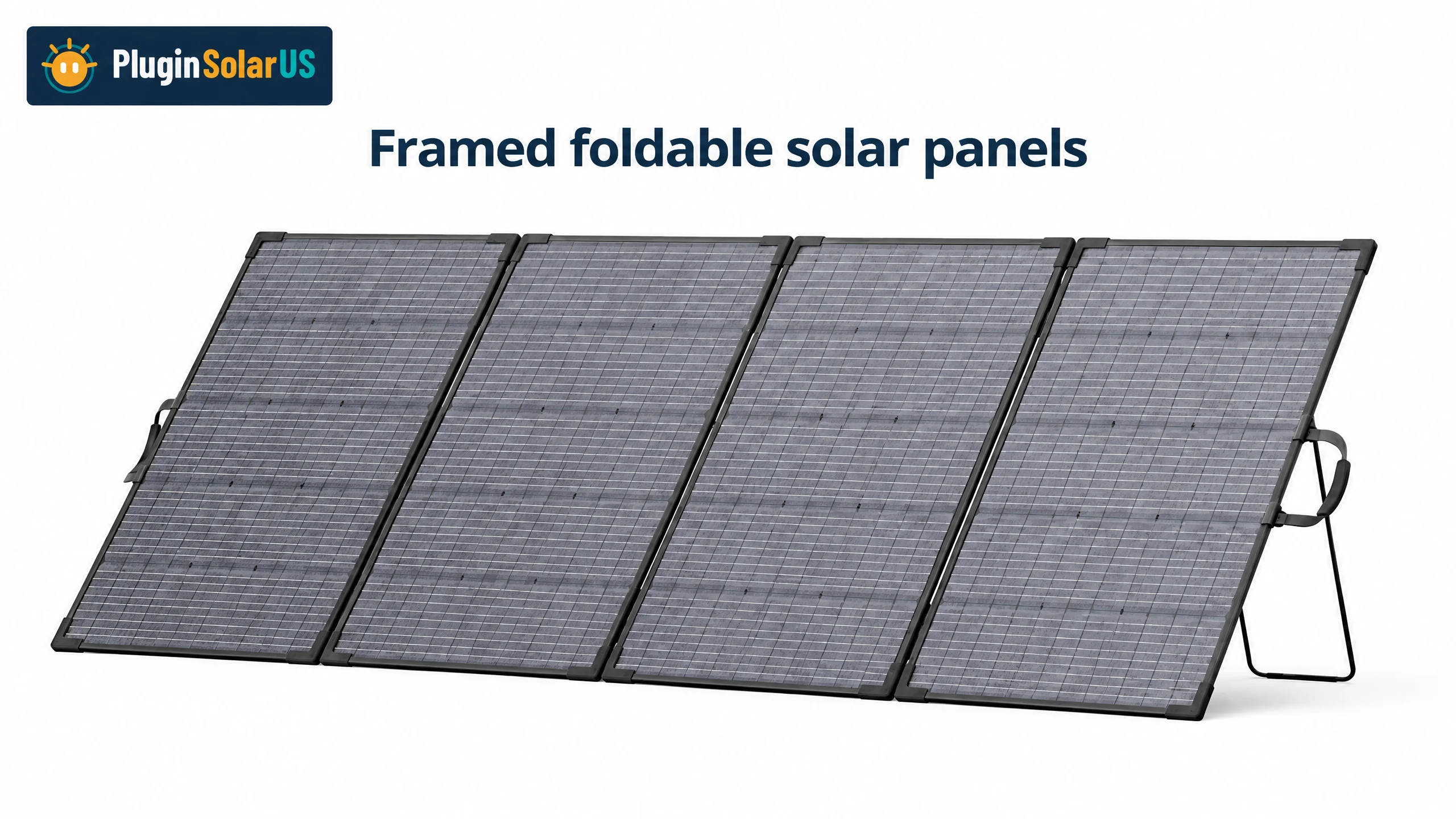
The Rowkin panel uses the lightweight non-glass flexible-panel construction described by the company in our product information, supported by four hinged rigid aluminum-frame sections. This combines a supporting frame with folding storage, rather than making the entire assembly a soft rollable sheet. Rowkin lists an 18.7 lb (8.5 kg) weight, three adjustable kickstands, a 90.2 × 38.4-inch deployed footprint and a 38.4 × 22.4-inch folded footprint. Its public listing does not specify the exact frontsheet polymer.[4]
The advantages are easier handling, storage and repositioning than a similarly sized conventional glass-covered module. The trade-offs are the large deployed footprint, moving hinges and supports, and the need for a documented, stable placement. Rigid sections do not bend to fit a curved roof, and low weight does not eliminate wind loading. A permanent mount can be more convenient for an always-fixed location; a framed foldable is especially useful when portability is part of the goal.
Rowkin markets bifacial generation and 25% cell efficiency. Cell efficiency is not whole-system efficiency, and the seller’s ‘up to 30%’ rear-side gain is not an automatic addition to annual output. Useful rear-side light depends on placement, surrounding reflectivity, shading and clearance. Similarly, MC4-style connectors alone do not establish electrical compatibility: voltage, current, polarity and connector requirements still need to match.[4]
Home Guidance and Optional Professional Help
The broader differentiator is the connected planning experience. Rowkin’s Energy Agent is designed to read uploaded utility bills and photos, organize home profiles, consider local rates and solar conditions, and explain estimated production, savings and payback. It can compare the kits against available space and energy goals, then help prepare a request for professional assistance.[6]
That can reduce the work of assembling information, but the recommendations remain AI-assisted estimates—not a site inspection, an electrical approval or a multi-brand independence guarantee. Product recommendations on Rowkin’s own store are part of its commercial offering. The Pro network can help with a suitable outlet, circuit or setup assessment, but actual coverage, availability, credentials and agreed scope should be confirmed for the job.[7]
Certifications and Safety
UL 3700 is the plug-in solar safety certification standard. Rowkin’s product pages use the phrase ‘UL 3700 Compliant.’ Hoymiles publishes certification information for the HiFlow Pro family, and APsystems states that the EZ1-LV is CSA certified to UL 3700. Those are meaningful manufacturer statements about the inverter products, but this review has not independently verified an issued UL 3700 listing covering the complete assembled Rowkin kit.[2] [9] [10]
Do not treat a component certificate or seller compliance wording as a substitute for the certification required for the exact setup. Complete-system safety also involves touch protection, anti-islanding, branch-circuit overcurrent protection, appropriate bidirectional GFCI behavior, connections and mounting.[11] Use qualified help for any fixed wiring, breaker-panel, circuit or receptacle work.
Adjustable output is useful, but an app setting is not itself a guarantee that a system qualifies for every state’s pathway. Check the equipment configuration, applicable capacity measure, documentation and current utility treatment. California signed SB 868 on September 30, 2026; its new framework is expected January 1, 2027, so signing alone does not activate that pathway today. The California state guide and state tracker provide context for planning.
Smart Energy Features
The Solo uses Hoymiles’ S-Miles Home monitoring environment; the Dual uses APsystems’ AP EasyPower. Rowkin lists app-controlled output for both. Production monitoring is helpful for observing the system, but measured solar kWh are not automatically equal to bill savings if some generation is exported without compensation.
A fixed output limit is not automatic zero-export control. Hoymiles describes load-following operation with a compatible meter such as the Shelly Pro 3EM; APsystems offers a separate APmeter that measures flow at the electrical panel. Those meters are not listed in the reviewed Rowkin kit packing lists. If automatic zero export is needed, confirm the supported meter, configuration and installation requirements rather than assume the kit or Energy Agent provides that function.[9] [10]
Pricing and Availability
On October 8, 2026, Rowkin listed the Solo at $459 and the Dual at $899, before tax and applicable shipping. The standalone panel was $369; the Hoymiles and APsystems components were listed at $159 and $279. These are retail prices for different product scopes, not installed-project totals.[2] [3] [4]
Rowkin advertises 10% off a first kit after free Energy Agent signup, without an advertised mandatory paid purchase membership.[5] If eligible and applied to the displayed prices, merchandise would be $413.10 for the Solo or $809.10 for the Dual. The published shipping schedule is $40 per Solo, $65 per Dual, $25 per standalone panel and $15 per microinverter, with free retail shipping at a merchandise subtotal of $500 or more. Rowkin’s current project pricing terms evaluate that threshold before merchandise discounts.
For a one-kit order under those terms, the eligible discounted Solo plus $40 shipping is $453.10 before tax; the Dual exceeds the free-shipping threshold and is $809.10 before tax. Without the discount, the corresponding totals are $499 and $899. These examples are conditional, not completed-checkout quotes: confirm destination coverage, promotion eligibility, stacking, shipping and tax before paying.
The current product pages say orders are estimated to ship in 2–3 weeks in October. An Add to Cart button is not proof of immediate stock or a guaranteed arrival date. Any required outlet, circuit, mounting or professional work adds to the hardware cost and should be considered separately.
Warranty and Support
The reviewed kit pages now display 12 years for the inverter and five years for the panel, plus a 30-day returns summary. The panel page also lists five years.[2] [4] Those durations should not be read as one blanket warranty for cables, installation or every failure. Confirm written terms, registration or installation conditions, claim handling, return condition requirements and any shipping or labor costs for the exact order.
Rowkin provides a help center, support-ticket route, support@rowkin.com and a published phone contact.[8] This review has not tested response times, warranty claims or long-term support performance.
Realistic Expectations
The most useful outcome to model is how much grid electricity the system can offset at the times your home uses it. Actual value depends on usable sunlight, orientation, shade, rate design, simultaneous demand, inverter limits and losses, and treatment of exported energy. Fixed bill charges are not eliminated by generating a few hundred watts.
Rowkin’s location-aware shop estimates and Energy Agent reports are planning outputs, not measured results from this review. A short payback shown for one high-rate location should not be generalized to all homes. Use the savings calculator, check its assumptions against your bill, and compare full purchase and setup costs. This article does not present a hands-on test or independently measured Rowkin customer savings.
The reviewed microinverters shut down when the utility grid loses power. The Solo and Dual do not contain storage or provide outage backup. A separately selected portable power station or home backup system needs its own compatibility and isolation design; it should not be assumed to work just by adding a battery to these kits.
Common Misconceptions Addressed
‘Foldable means the panel fits any balcony.’ Folded storage is compact relative to the deployed panel, but the open footprint is still substantial. Check sunlight, rail shadows, door swings and clear paths before selecting it.
‘900 W on the inverter means 900 W of guaranteed solar.’ It is the Dual inverter’s AC rating. The included array totals 840 W DC nameplate, and actual output varies with conditions and conversion losses.
‘Matching parts removes every installation question.’ A matched kit reduces component-selection work, not site-specific safety or permission requirements. The circuit, GFCI, mounting and local pathway still matter.
‘The Energy Agent approves my installation.’ It can explain assumptions and organize information, but it does not replace a licensed professional, utility or code official.
‘An app limit guarantees no export or backup.’ Automatic load-following needs the supported monitoring/control configuration. Backup is a separate function, not provided by either solar-only kit.
Future Roadmap
Rowkin’s published platform emphasizes deeper continuity between home information, AI guidance, products and professional workflows. That suggests a broader home-energy direction than selling one solar panel. The materials reviewed do not establish a dated release roadmap for a Rowkin battery, virtual-power-plant participation or a new complete-kit certification, so those should not be assumed to be included or imminent.
Policy Perspective
Rowkin’s current site uses state-aware planning and distinguishes California’s signed law from its expected effective date. This is useful for customers preparing a purchase without confusing legislative progress with today’s installation conditions.[5] The public materials do not set out a detailed company lobbying agenda; it would be speculative to assign one.
The Bottom Line
Rowkin Energy’s strongest appeal is a straightforward small-kit choice combined with a lightweight framed foldable panel and home-specific guidance. The Solo offers a lower-cost single-panel entry; the Dual increases panel capacity and uses one independently tracked dual-input inverter. The Energy Agent and optional Pro workflow may help buyers translate a bill and available space into a more practical plan.
The decision turns on usable space, realistic daytime self-consumption, confirmed equipment and local fit, and the full order and setup cost. Buyers needing compact fixed mounting, automatic zero export or outage backup should compare the exact additional equipment—or a different system category—rather than infer those features from the word ‘kit.’ Rowkin is worth comparing for portable daytime bill offset, with the same attention to certification scope, warranty conditions and demonstrated performance that any brand deserves.
Learn More
Compare the reviewed offers in our Rowkin Energy product profile, use Compare Offers, or start with the plug-in solar buyer’s guide. The readiness check helps identify questions to resolve before connecting a system.
This review uses Rowkin product and platform information, company-supplied configuration and pricing details, and inverter-manufacturer and UL safety materials reviewed on October 8, 2026. It is not a hands-on performance test. Prices, promotions, availability, specifications and local requirements can change. Confirm current order-specific information before purchase or installation.
Sources and Further Reading
- Rowkin Energy — About and platform
- Rowkin Solo 420W kit — current equipment, price, shipping and warranty summary
- Rowkin Dual 840W kit — current equipment, price, shipping and warranty summary
- Rowkin 420W foldable bifacial panel — framing, size, weight and specifications
- Rowkin Energy — first-kit signup offer and state-aware customer journey
- Rowkin Consumer Energy Agent — home analysis and guidance boundaries
- Rowkin Pro — professional support and availability boundaries
- Rowkin Help Center — product, order and support information
- Hoymiles HiFlow Pro — manufacturer safety, monitoring and zero-export information
- APsystems EZ1-LV — manufacturer specifications, certification and APmeter
- UL Solutions — safety considerations for plug-in photovoltaic systems
Related Articles
- Foldable vs. Rigid vs. Flexible Solar Panels for Plug-In Solar: Which Form Factor Fits Your Space? — Compare conventional rigid glass modules, lightweight non-glass flexible panels, and framed foldable hybrids. See the pros, cons and suitable spaces for each, plus the compatibility checks that matter.
- How Plug-In Solar Microinverters Work: Panel Compatibility, MPPT, and AC Output — Learn how a plug-in solar microinverter turns panel DC into AC, what MPPT does, and which voltage and current ratings matter when comparing exact models. See why panel watts, clipping, and complete-system certification are separate questions.
- How Much Could Plug-In Solar Save in California? Three Everyday Home Scenarios — Three transparent California home profiles show how direct daytime use, evening battery shifting, and low midday load can change a small solar system’s bill offset. Each example separates production, exports, losses, reserve, and fixed charges.
New: Find your plug-in solar fit
Our new Product Finder makes it easier to discover and compare plug-in solar kits and components across brands. See panel DC and inverter AC output alongside listed prices, known shipping, and required fees to find options worth exploring. Find and compare products.
Sources
- Rowkin Energy — About and platform
- Rowkin Solo 420W kit — current equipment, price, shipping and warranty summary
- Rowkin Dual 840W kit — current equipment, price, shipping and warranty summary
- Rowkin 420W foldable bifacial panel — framing, size, weight and specifications
- Rowkin Energy — first-kit signup offer and state-aware customer journey
- Rowkin Consumer Energy Agent — home analysis and guidance boundaries
- Rowkin Pro — professional support and availability boundaries
- Rowkin Help Center — product, order and support information
- Hoymiles HiFlow Pro — manufacturer safety, monitoring and zero-export information
- APsystems EZ1-LV — manufacturer specifications, certification and APmeter
- UL Solutions — safety considerations for plug-in photovoltaic systems