Foldable vs. Rigid vs. Flexible Solar Panels for Plug-In Solar: Which Form Factor Fits Your Space?
By PlugInSolarUS Editorial Team · Published 2026-10-08 · Updated October 8, 2026 · 9 min read
Compare conventional rigid glass modules, lightweight non-glass flexible panels, and framed foldable hybrids. See the pros, cons and suitable spaces for each, plus the compatibility checks that matter.
Listen to the companion episode
Deep Dive: Foldable vs. Rigid vs. Flexible Solar Panels — Which Form Factor Fits Your Space?
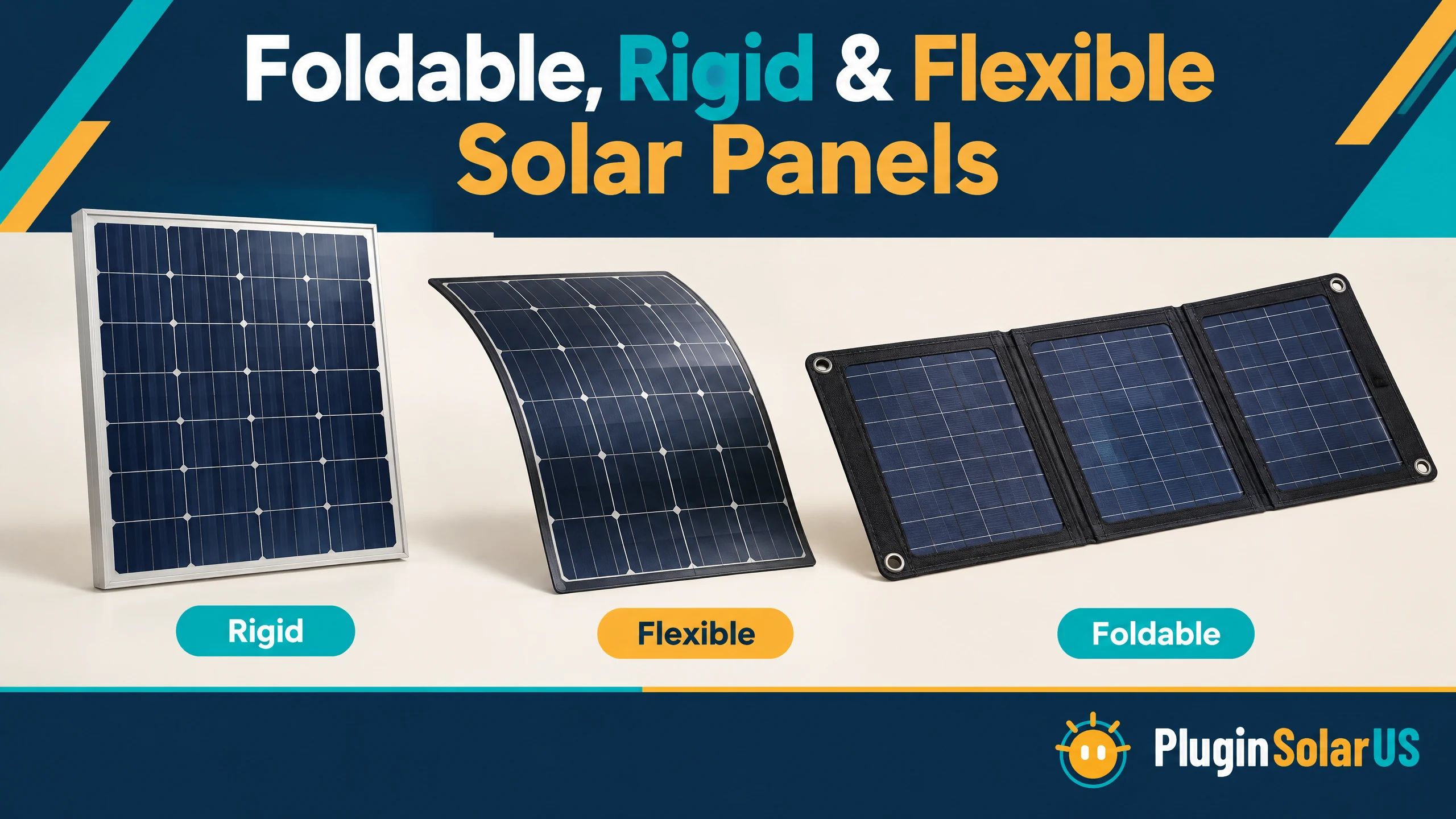
A solar panel does not have to live on a roof. It can be a conventional rigid glass module on a fixed mount, a lightweight non-glass flexible panel, or a foldable design that combines flexible panel sections with rigid frames. The right choice begins with your space, handling needs and how the panel will be supported—not a claim that one format is best for everyone.
For plug-in solar, form factor is only the first decision. A convenient-looking panel with a familiar connector can still be unsuitable for the inverter or kit. Match the panel and the complete system through their manuals and rated limits, then address location and mounting separately.
Form factor is not cell chemistry—or a mounting category
Rigid, flexible, and foldable describe physical construction and handling. They do not identify a cell chemistry, and “rooftop” is a location, not a panel type. A PV system also includes the structure that holds its modules and equipment that turns the panels’ direct current (DC) into the alternating current (AC) used by household appliances.[1]
That distinction keeps the comparison useful. A rigid panel may be mounted on a balcony, wall, ground frame, or roof if its instructions and the mounting design allow it. A flexible panel may suit a curved or weight-sensitive surface. A foldable panel may be deployed, aimed at the sun, and packed away between uses. These are use cases, not grades of solar technology.
For a broader system-level comparison, see plug-in, rooftop, and portable solar compared. This article focuses on the physical panel choices within those categories.
Rigid glass panels: a straightforward choice for fixed use
In everyday shopping, a rigid solar panel usually means a conventional glass-covered module, often with an aluminum frame. Some use glass on both sides. Glass and framing provide a stiff, protective assembly, but add weight and a fixed footprint compared with many non-glass designs. Not every stiff or framed panel is glass: the laminate and the supporting frame are separate construction choices.[5]
Advantages: established options for permanent mounting, straightforward bracket/rail support and an air gap for ventilation. Trade-offs: a heavier, bulkier object to carry or store, and glass can break under impact or improper handling. Best suited to: a documented fixed wall, ground or rooftop arrangement where the structure can support the exact module and mount.
That does not make any rigid panel ready for every exposed spot. A fixed array needs a stable, durable structure that can withstand conditions including wind, rain, hail, and corrosion. The U.S. Department of Energy describes those demands for PV mounting structures; the fixture manual and the surface it attaches to still determine what works.[2]
A homeowner with a sunny patio wall might consider a rigid module only after confirming that the panel and fixture permit that orientation and surface. An apartment resident may need a documented balcony approach and property approval before considering the same form factor. The apartment solar installation guide can help frame location questions, but it does not replace product instructions.
Flexible panels can solve a shape or weight problem
Flexible solar panels usually replace the conventional heavy glass cover with non-glass polymer or composite layers. They may use crystalline-silicon cells or thin-film technology; a flexible format is not itself a cell chemistry. Their lighter, thinner construction can help on a permitted gentle curve or a weight-sensitive surface, subject to the exact bend radius and installation instructions.[5]
Advantages: lower weight, a low profile and the ability to follow an allowed curve. Trade-offs: less inherent structural stiffness; a close-mounted laminate may have poorer airflow, bonded panels may be harder to remove, and abrasion, heat and backing materials matter. Best suited to: a documented curved or weight-limited application—not a blanket substitute for a glass module.
Flexibility is a constraint-solving feature, not a blanket durability verdict. A panel that can bend is not meant to be bent however far or often an owner chooses. Its manual should say where it can be supported, how it can be fixed, whether adhesive is permitted, and any limit on curvature. It should also address clearance and heat: a panel pressed against a surface may have different airflow from one held in a rack.
For a lightweight panel on a boat canopy, vehicle, or curved surface, do not stop at watts per pound. Read the intended use and mounting instructions alongside the surface manufacturer’s limits. For durable, permanently exposed use, compare the whole mounting approach and environmental instructions rather than assuming a flexible panel is interchangeable with a fixed framed module.
Foldable panels: soft assemblies and rigid-frame hybrids
Foldable describes how sections pack away, not whether the panel surface is glass, flexible or supported by a frame. Some designs use flexible sections in a fabric assembly; others have hinged rigid frames around lightweight non-glass flexible panel sections. The second approach combines structural support with lower panel weight and a compact folded footprint. Folding should occur at the intended joints, not by bending the cells or forcing a framed section.
A framed foldable example: Rowkin
Rowkin’s foldable panel illustrates the hybrid: non-glass flexible panel sections supported by hinged aluminum frames. The current 420 W listing specifies a four-section folding design, three kickstands and a weight of 18.7 lb (8.5 kg). It lists 90.2 × 38.4 inches unfolded and 38.4 × 22.4 inches folded, so storage is compact relative to its deployed footprint, but the full array still needs substantial clear space.[6] A rigid frame helps support the panel; it does not turn the flexible laminate into a heavy glass module.
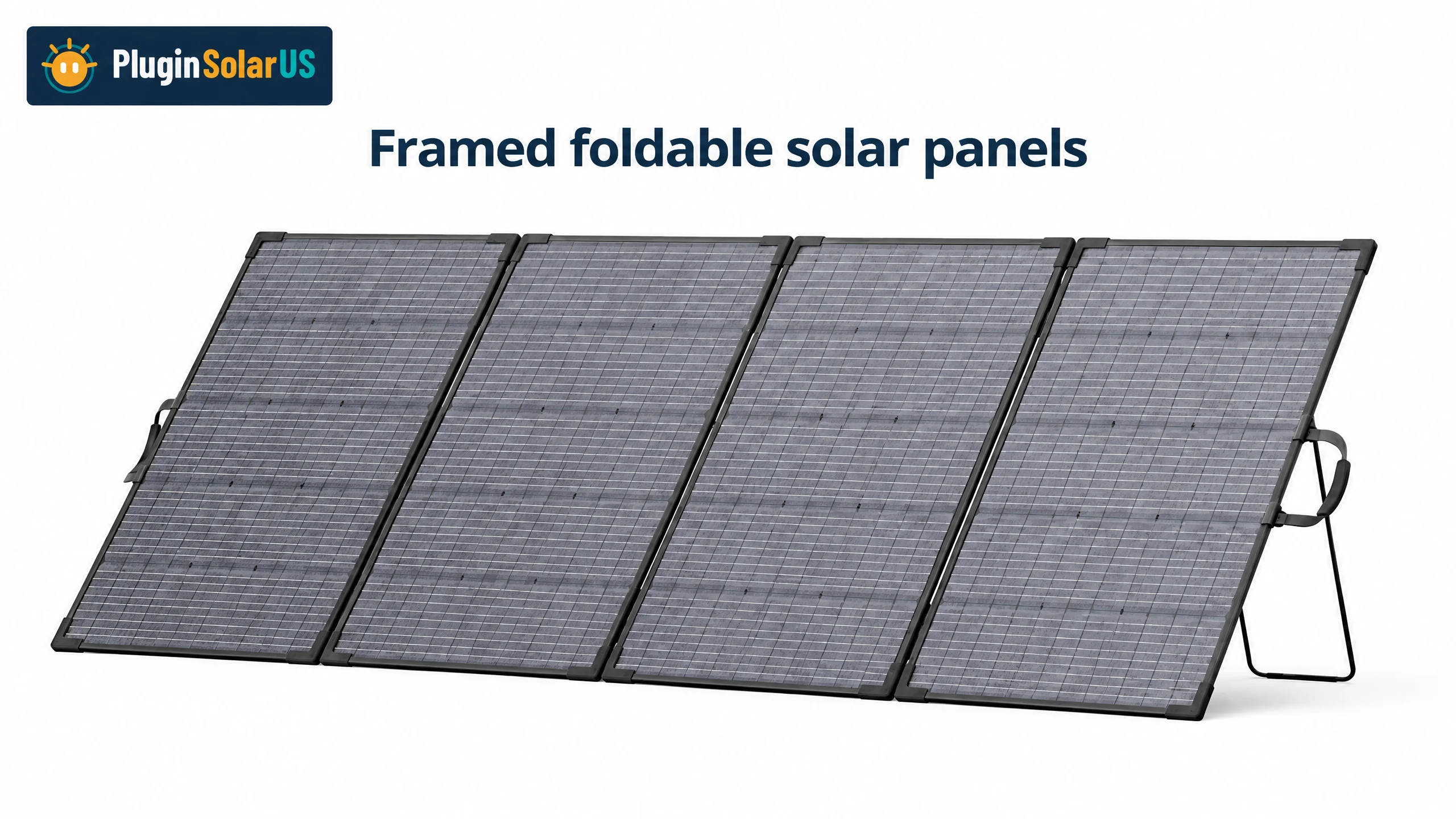
Advantages: easier storage and repositioning, framed support for the lightweight panel sections, and integrated stands on models that include them. Trade-offs: the hinges, cables and stands need appropriate handling; the deployed array occupies more space than its carry size suggests, and the frame does not establish a wind rating or permission for an improvised railing mount. Best suited to: suitable patios, gardens or other accessible spaces where the specified stands can be used and the equipment can be stored or repositioned. An approved kit can also use a compatible foldable panel for grid-connected operation; foldability does not make it exclusively off-grid.
One current portable-panel manual illustrates why the exact manual matters. It tells users to fold the panel for storage, secure it for long-term use in wind, avoid bending, squeezing, or placing heavy objects on it, and keep connectors out of liquid even though the panel has an IP68 rating.[3] Those directions describe that model, not a universal rating or lifetime promise for every foldable panel.
Portable use and long-term outdoor exposure are different jobs. Compare the exact model’s permitted continuous use, environmental rating, attachment points and compatible kit rather than assuming every foldable panel is temporary—or every framed foldable is approved for permanent mounting. For standalone appliance or power-station use, see what an off-grid portable setup does and does not connect to.
A matching connector does not prove compatibility
This is the crucial check. Connector families such as MC4-style photovoltaic connectors are common, and adapter cables exist, but a connector only describes a physical connection. It does not establish that the panel can safely or properly serve a particular power station, charge controller, microinverter, or grid-connected plug-in kit.
Before connecting a panel to any device, use the two manuals—not a product photo or plug shape—to compare:
- Voc and Isc: open-circuit voltage and short-circuit current, the panel’s voltage with no load and its short-circuit current, respectively.
- Operating voltage and current: the panel’s intended power-producing range against the receiving equipment’s allowed input range.
- Wattage and input limits: the panel or array’s rated power against the device’s permitted solar input.
- Polarity, connector, cable, and adapters: mating hardware and cable ratings must be correct as well as physically connectable.
- System instructions: the inverter, kit, and panel documents must expressly allow the proposed combination.
A portable-panel manufacturer makes the same basic point for charging equipment: its example manual says the panel’s maximum output parameters must fall within the device input range and that third-party equipment must allow solar input and meet relevant electrical parameters.[3] Its charging guidance also notes that series wiring raises voltage and parallel wiring raises current, so either arrangement must remain within the receiving device’s input range.[4]
Do not carry assumptions from a power-station setup into a grid-connected plug-in system. The panel must be approved by the relevant kit and inverter instructions, and the complete system—not a collection of compatible-looking parts—must meet the requirements that apply where it will be used. The plug-in solar buyer’s guide is a useful companion for comparing system specifications.
Choose from the place and routine backward
Choose from the space and routine backward. For a permanent roof or wall, a glass module with documented rails/brackets is a common starting point. For an allowed curved or weight-sensitive surface, a flexible non-glass panel may fit better. For a patio or garden where storage and repositioning matter, a framed foldable with suitable stands may combine useful support with easier handling. For travel, a soft foldable assembly can prioritize packability. A small balcony may favor a compact approved panel rather than a large unfolding array; compare the deployed dimensions, not just the folded size.
Then ask the less glamorous questions: Can it be stored safely? Can the fixture hold it in local weather? Is the cable correctly rated? Does the receiving device list compatible panel limits? A model-by-model comparison in the product comparison tool can organize specifications, but the current manuals for every component control the final decision.
Output is location-specific. Sun angle, shading, temperature, orientation, and the time a portable panel is actually deployed all affect production. Use the solar calculator for a planning estimate, not as a substitute for the compatibility check.
Frequently asked questions
Can a foldable solar panel work with a grid-tied plug-in inverter?
Possibly, but never assume so. A foldable panel intended to charge a power station is not automatically an approved input for a grid-tied inverter. Compare its Voc, Isc, operating values, wattage, polarity, cable, and connector with the inverter’s written input limits, and follow the complete kit’s instructions.
Is a flexible solar panel automatically better for a curved surface?
It may be a better starting point because it can conform to a permitted curve, but only the panel manual can define the allowable bend and mounting method. The surface still needs to handle the attachment, weather loads, heat, and cable routing.
Can I use an adapter if the connector does not match?
An adapter may solve a physical connection, but it does not solve an electrical or system-approval mismatch. Use one only when the equipment documents permit it and the connector, polarity, voltage, current, and cable ratings all match the proposed use.
The bottom line
Choose conventional rigid glass panels when fixed mounting and a sturdy protective assembly matter; flexible non-glass panels when weight, profile or a permitted curve drives the design; and framed foldables when you want structural support plus lighter handling, repositioning and storage. Soft foldables have their own role in portable use. Compare pros and cons at the exact-model level: none of these labels alone establishes fit for a surface, inverter or power station.
Decide how the panel will live, read the panel and receiving-equipment manuals together, and treat compatibility as an electrical and system question—not a connector question. That gives each form factor a fair role without asking it to do a job it was not designed to do.
Related Articles
- Brand Review: Rowkin Energy — Foldable Plug-In Solar Kits, Home Energy Guidance & Pro Support — Rowkin Energy pairs 420 W and 840 W foldable solar kits with home-specific Energy Agent guidance and optional Pro support. Compare equipment, pricing, space needs and safety considerations.
- Solar Panel Mounting Explained: Balcony, Wall, Patio, and Rooftop Options — Compare balcony, wall, patio and rooftop mounting—including lightweight framed foldable panels. Find the advantages and trade-offs for your space, with practical wind, support and clearance checks.
- Solar Panel Technology Explained: TOPCon, HJT, Bifacial Panels, and Real-World Output — TOPCon and HJT are solar-cell architectures, while bifacial panels collect light from both sides. Learn how heat, shade, rear light, module area, and inverter limits turn a wattage label into real-world energy.
New: Find your plug-in solar fit
Our new Product Finder makes it easier to discover and compare plug-in solar kits and components across brands. See panel DC and inverter AC output alongside listed prices, known shipping, and required fees to find options worth exploring. Find and compare products.
Sources
- U.S. Department of Energy — Solar Photovoltaic Technology Basics
- U.S. Department of Energy — Solar Photovoltaic System Design Basics
- EcoFlow — 60W Portable Solar Panel User Manual
- EcoFlow — How to Use a Portable Solar Panel to Charge Your Power Station Efficiently
- Renogy UK — Flexible Solar Panels: What to Know
- Rowkin — 420W Foldable Bifacial Solar Panel: four-section aluminum frame, kickstands and dimensions