What to Look For in a Plug-In Solar System: A Spec-by-Spec Buyer's Guide
By PlugInSolarUS Editorial Team · Published 2026-04-02 · Updated April 2026 · 18 min read
A brand-neutral, spec-first guide to evaluating plug-in solar systems — covering wattage, battery capacity, inverter type, safety certifications, warranty, and what the marketing numbers actually mean.
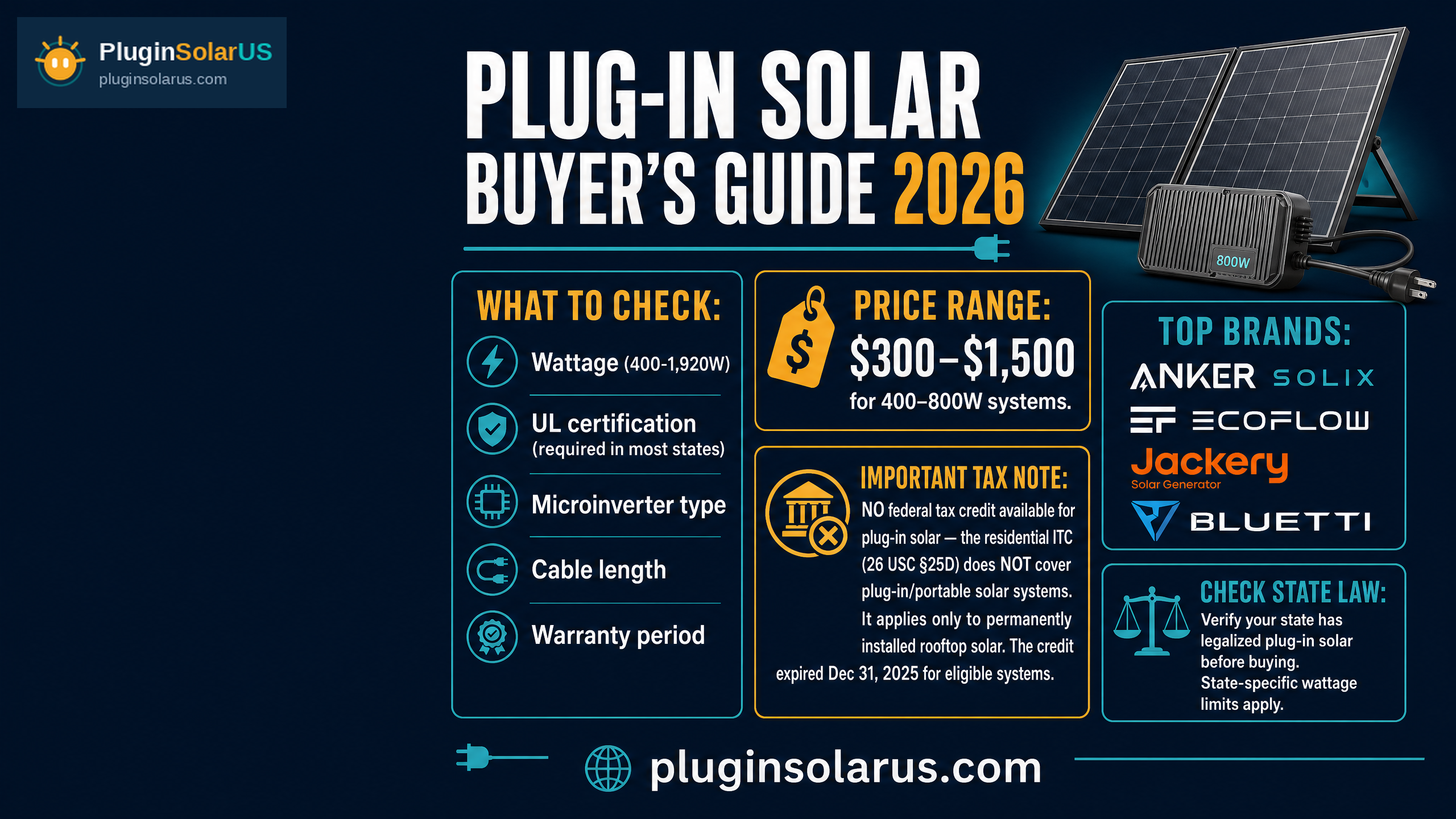
What to Look For in a Plug-In Solar System: A Spec-by-Spec Buyer's Guide
Navigating the world of plug-in solar can be daunting, especially with a myriad of products and marketing claims. This guide cuts through the noise, focusing on the critical specifications that truly differentiate systems and impact your energy savings and home resilience. Understanding these core components will empower you to make an informed decision, ensuring your investment aligns with your specific energy goals.
Plug-in solar systems offer an accessible entry point into renewable energy, allowing homeowners and renters alike to generate their own power without the complexities of traditional rooftop installations. However, not all systems are created equal. The devil, as they say, is in the details—specifically, the technical specifications that dictate performance, safety, and longevity. By prioritizing these key metrics over flashy brand names, you can confidently select a system that delivers real value.
Why Specs Matter More Than Brand Names
In the rapidly evolving solar market, brand names can often be misleading. A well-known brand might offer a premium price tag without necessarily providing superior performance or features for your specific needs. Conversely, a lesser-known manufacturer might offer innovative technology or better value. The true measure of a plug-in solar system lies in its technical specifications: the wattage of its panels, the capacity of its batteries, its safety certifications, the terms of its warranty, and the intelligence of its software.
Focusing on specifications allows for an objective comparison across different manufacturers. It enables you to evaluate systems based on their actual capabilities and how well they meet your energy consumption patterns and financial objectives. For instance, a system with higher panel wattage will generate more electricity, while a larger battery capacity will provide greater energy independence during outages or peak demand periods. Understanding these distinctions is crucial for optimizing your investment and maximizing your return.
Furthermore, regulatory compliance and safety standards are paramount in solar technology. Relying solely on brand reputation might overlook critical certifications that ensure the system's safe operation and adherence to electrical codes. By scrutinizing specifications like UL certifications, you can verify that a product meets rigorous safety benchmarks, protecting your home and family. This detailed approach ensures you're not just buying a name, but a reliable, efficient, and safe energy solution.
The Five Specs That Matter
Panel Wattage
The panel wattage is perhaps the most straightforward specification, directly indicating the maximum power output of your solar panels under ideal conditions. Higher wattage panels mean more electricity generation, which translates to greater savings on your utility bill. Plug-in solar systems typically come in various configurations, catering to different energy needs and budget levels. It's essential to match the panel wattage to your household's consumption and your desired level of energy offset.
Consider your daily energy usage and how much of it you aim to cover with solar. A small apartment might only need a starter system, while a larger home with higher energy demands could benefit significantly from a high-output setup. The efficiency of the panels also plays a role; a higher efficiency rating means the panels can convert more sunlight into electricity within the same physical footprint. Always check both the total wattage and the efficiency percentage to get a complete picture of a system's generation potential.
Here's a breakdown of common system sizing tiers for plug-in solar, illustrating how panel wattage scales with battery capacity to meet diverse energy requirements:
| System Sizing Tier | Panel Wattage Range | Typical Battery Capacity | Ideal Use Case |
|---|---|---|---|
| Starter | 400–1,200W | 1–2 kWh | Small apartments, supplemental power, basic energy offset |
| Mid-Range | 800–1,600W | 2–3 kWh | Medium-sized homes, moderate energy offset, some backup power |
| High Output | 1,600–2,400W | 3–5 kWh+ | Larger homes, significant energy offset, robust backup power |
Battery Capacity
Battery capacity, measured in kilowatt-hours (kWh), determines how much energy your system can store for later use. This is crucial for maximizing self-consumption, especially if you're on a Time-of-Use (TOU) electricity plan where rates fluctuate throughout the day. A larger battery allows you to store excess solar energy generated during off-peak hours and discharge it during expensive peak hours, significantly reducing your electricity bill. It also provides essential backup power during grid outages, keeping critical appliances running.
When evaluating battery capacity, consider your typical daily energy consumption and how long you'd want to power essential loads during an outage. For instance, a 2 kWh battery might power a refrigerator and some lights for a few hours, while a 5 kWh+ battery could sustain more appliances for a longer duration. The usable capacity of a battery is also important; some batteries have a depth of discharge (DoD) limit to prolong their lifespan, meaning you can't use 100% of their stated capacity.
The integration of battery storage with your solar panels creates a more resilient and efficient energy system. It allows for greater energy independence and provides a buffer against grid instability. As with panel wattage, matching battery capacity to your specific needs is key to unlocking the full potential of your plug-in solar investment.
| Battery Capacity Tier | Typical Panel Wattage | Backup Duration (Estimated) | Key Benefit |
|---|---|---|---|
| 1–2 kWh | 400–1,200W | 2–4 hours (essential loads) | Peak shaving, minimal backup |
| 2–3 kWh | 800–1,600W | 4–8 hours (moderate loads) | Enhanced self-consumption, moderate backup |
| 3–5 kWh+ | 1,600–2,400W | 8–12+ hours (multiple loads) | Significant energy independence, robust backup |
Safety Certifications
Safety is non-negotiable when it comes to electrical systems, and plug-in solar is no exception. Reputable systems will carry specific safety certifications that demonstrate compliance with stringent industry standards. These certifications are not just bureaucratic hurdles; they are critical assurances that the equipment has been rigorously tested for electrical safety, fire hazards, and grid interaction. Ignoring these can lead to serious risks, including property damage or personal injury.
UL 3700 is the U.S. safety certification standard developed specifically for plug-in photovoltaic equipment and systems. It addresses the safety requirements created by a plug-and-receptacle connection and evaluates the submitted plug-in configuration rather than treating one certified component as approval of the complete system.
UL 1741 is a related standard for inverters, converters, controllers, and interconnection equipment. UL 9540 applies to energy-storage systems when battery storage is included. These component and subsystem standards remain important within their scopes, but UL 1741 and UL 9540 are not substitutes for UL 3700 certification of plug-in photovoltaic equipment or a complete plug-in system.
Warranty Terms
A robust warranty is a testament to a manufacturer's confidence in their product's durability and performance. For plug-in solar systems, you'll typically encounter separate warranties for the panels, batteries, and inverters. Understanding the duration and coverage of each is crucial, as these components have different lifespans and failure modes. A strong warranty provides peace of mind and protects your investment against premature degradation or defects.
Panel warranties usually consist of two parts: a product warranty (covering manufacturing defects) and a performance warranty (guaranteeing a certain percentage of original power output over time, typically 25 years). Battery warranties often specify a certain number of cycles or a minimum capacity retention over a period, reflecting the cyclical nature of battery usage. Inverter warranties are generally shorter, ranging from 5 to 10 years, as inverters are often considered the most susceptible component to wear and tear.
Always read the fine print of each warranty. Look for clear terms regarding what is covered, the process for making a claim, and whether the warranty is transferable if you sell your home. A comprehensive warranty package from a reputable manufacturer can save you significant costs and headaches down the line, ensuring your system continues to perform as expected for its entire operational life.
| Component | Typical Warranty Duration | Key Coverage Details |
|---|---|---|
| Solar Panels | 25 years (performance), 10–12 years (product) | Guaranteed power output (e.g., 80% after 25 years), manufacturing defects |
| Batteries | 5–10 years or specified cycles | Capacity retention (e.g., 70% after 10 years), manufacturing defects |
| Inverters | 5–10 years | Manufacturing defects, performance issues |
Software and TOU Scheduling
Modern plug-in solar systems are often more than just hardware; they come equipped with intelligent software that can significantly enhance their performance and your energy savings. This software typically provides monitoring capabilities, allowing you to track your energy generation and consumption in real-time. More advanced systems offer sophisticated features like Time-of-Use (TOU) scheduling, which automates battery charging and discharging based on electricity rates.
TOU scheduling is particularly valuable in regions with variable electricity pricing, such as California, Massachusetts, and Connecticut, where rates can be significantly higher during peak demand periods. The software can learn your energy patterns and local utility rates, then optimize your system to store solar energy when rates are low and discharge it when rates are high. This intelligent management can dramatically improve your payback period and overall financial returns.
When evaluating software, look for an intuitive user interface, robust data analytics, and the ability to integrate with other smart home devices. The ease of setting up and adjusting TOU schedules, as well as the availability of remote monitoring and control, are also important considerations. A well-designed software platform transforms your plug-in solar system from a simple energy generator into a smart energy manager, maximizing its efficiency and your savings.
- Real-time Monitoring: Track solar generation, battery status, and home consumption.
- Time-of-Use (TOU) Optimization: Automatically charge/discharge batteries based on electricity rates.
- Remote Control: Manage your system from anywhere via a mobile app.
- Performance Analytics: Access historical data and performance reports.
- Firmware Updates: Ensure your system stays up-to-date with the latest features and security patches.
- Integration Capabilities: Connect with smart home ecosystems or other energy management tools.
The Three Buyer Profiles
Plug-in solar appeals to a diverse range of individuals, each with unique motivations and priorities. Understanding these common buyer profiles can help you identify which type of system best suits your needs and how to prioritize specifications accordingly. Whether you're driven by cost savings, energy independence, or simply the desire to go green, there's a plug-in solar solution for you.
These profiles are not mutually exclusive, and many buyers may find themselves aligning with aspects of more than one. However, identifying your primary motivation will streamline your decision-making process, allowing you to focus on the features and benefits that matter most to your specific situation. For example, a Bill Reducer will prioritize systems with high panel wattage and efficient TOU scheduling, while a Resilience Builder will focus on robust battery capacity and reliable backup power.
By understanding these archetypes, manufacturers can better tailor their offerings, and consumers can more effectively navigate the market. It's about finding the right fit, not just the most expensive or feature-rich system. Your ideal plug-in solar system is one that perfectly matches your lifestyle, budget, and energy aspirations.
| Buyer Profile | Primary Motivation | Key System Priorities | Ideal System Type |
|---|---|---|---|
| Bill Reducer | Lowering electricity bills, maximizing financial return | High panel wattage, efficient TOU scheduling, quick payback period | Mid-Range to High Output with smart software |
| Resilience Builder | Energy independence, backup power during outages | Large battery capacity, robust safety certifications, reliable inverter | High Output with significant battery storage |
| Renter | Portable, easy installation, minimal commitment | Compact size, simple setup, good warranty, low initial cost | Starter to Mid-Range, often without extensive battery storage |
GFCI Outlet Requirement and NEC 690/705
A critical, often overlooked, aspect of plug-in solar installation is the requirement for a Ground-Fault Circuit Interrupter (GFCI) outlet. This isn't merely a suggestion; it's a fundamental safety measure mandated by electrical codes to protect against electrical shock. Plug-in solar systems, by their nature, introduce electricity into your home's existing wiring, making proper grounding and fault protection absolutely essential. A GFCI outlet detects imbalances in electrical current and rapidly shuts off power, preventing potentially dangerous situations.
Specifically, the National Electrical Code (NEC) Articles 690 and 705 govern solar photovoltaic (PV) systems and interconnected power production sources, respectively. NEC Article 690 outlines the requirements for PV systems, including wiring methods, overcurrent protection, and disconnecting means. It ensures that the solar array itself is installed safely. NEC Article 705, on the other hand, focuses on the interconnection of distributed generation sources, like plug-in solar, with the utility grid. It addresses how these systems safely interact with your home's electrical panel and the broader grid infrastructure.
For plug-in solar, these articles collectively emphasize the need for a dedicated circuit and GFCI protection. A dedicated circuit ensures that the solar system has its own breaker and isn't sharing power with other appliances, which could lead to overloading. The GFCI outlet, in conjunction with these NEC articles, provides a crucial layer of safety, preventing back-feeding of electricity into the grid during an outage (which could endanger utility workers) and protecting against ground faults within your home. Always consult with a qualified electrician to ensure your plug-in solar setup complies with all local codes and NEC requirements.
Important Safety Note: GFCI Outlet
A dedicated GFCI outlet is REQUIRED for plug-in solar systems to comply with NEC Articles 690 and 705. This ensures both your safety and the safety of utility workers.
Questions to Ask Before You Buy
Before committing to a plug-in solar system, it's vital to ask a series of probing questions to both yourself and potential suppliers. These questions will help clarify your needs, assess the suitability of different systems, and ensure you're making a well-informed purchase. Don't hesitate to seek detailed answers; a reputable vendor will be transparent and helpful.
The answers to these questions will not only guide your product selection but also help you understand the long-term implications of your investment. From installation logistics to financial incentives, each query is designed to uncover critical information that could impact your satisfaction and the overall success of your plug-in solar journey. Prepare to be thorough in your inquiry.
-
What is my average daily energy consumption?
Understanding your energy consumption is the first step. Review your past electricity bills to determine your average daily or monthly kWh usage. This will help you size your plug-in solar system appropriately, ensuring it generates enough power to meet a significant portion of your needs without over- or under-sizing. An undersized system won't deliver the savings you expect, while an oversized one might be an unnecessary expense.
-
What are the local regulations and interconnection requirements for plug-in solar?
Regulations vary significantly by state and even by local municipality. While Utah HB 340 (2025) legalizes plug-in solar under 1,200W without interconnection permits, other states may have different rules. You need to know if permits are required, what the interconnection process entails, and if there are any specific safety standards beyond national codes. This due diligence prevents legal issues and ensures a smooth installation.
-
Does my utility offer Time-of-Use (TOU) rates or net metering?
TOU rates can significantly impact the financial benefits of your plug-in solar system, especially if it includes battery storage. Net metering policies determine how your utility credits you for excess solar energy sent back to the grid. Understanding these policies is crucial for calculating your potential savings and optimizing your system's operation. In regions like CA, MA, and CT, TOU rates can make battery storage particularly advantageous.
-
What is the total installed cost, and what are the potential incentives?
Beyond the sticker price of the equipment, consider installation costs, any necessary electrical upgrades (like a dedicated GFCI outlet), and potential permitting fees. Factor in available incentives, such as state rebates or the now-expired Federal Investment Tax Credit (ITC). While the Federal ITC expired Dec 31, 2025, state and local incentives may still be available, significantly reducing your net cost.
-
What is the estimated payback period for this system in my location?
The payback period is the time it takes for your energy savings to offset the initial cost of the system. The national average is 5–7 years, but this can drop to 3–5 years in states with high electricity rates and favorable TOU policies, such as California, Massachusetts, and Connecticut. Ask for a detailed financial projection based on your specific electricity rates (e.g., CA: $0.34/kWh; MA: $0.32/kWh; CT: $0.28/kWh; National avg: $0.18/kWh).
-
What are the warranty terms for all components (panels, battery, inverter)?
As discussed, comprehensive warranties are vital. Ensure you receive clear documentation for each component's warranty, including duration, coverage details, and the process for making a claim. A strong warranty indicates manufacturer confidence and protects your investment over the long term.
-
How does the system handle grid outages, and what appliances can it power?
If resilience and backup power are priorities, understand the system's capabilities during an outage. Does it automatically switch to battery power? What is the maximum load it can support, and for how long? This will help you determine if the system meets your emergency power needs and if you need to adjust your expectations for what it can power.
What the Marketing Numbers Don't Tell You
Marketing materials often highlight the most attractive figures, but they don't always paint a complete picture. It's crucial to look beyond the headlines and understand the underlying realities of plug-in solar performance and financial returns. Discerning between marketing hype and practical application will save you from potential disappointment and ensure your expectations are realistic.
One common area where marketing can be misleading is the payback period. While a 3-5 year payback period might be achievable in select, high-rate markets like California, Massachusetts, or Connecticut, the national average is closer to 5-7 years. This discrepancy often arises from marketing materials using best-case scenarios or failing to account for all associated costs and local electricity rates. Always ask for projections specific to your location and energy usage.
Another prevalent myth is that a small plug-in solar system can 'power your entire home.' While technically any amount of solar contributes to your home's energy needs, a typical plug-in system (especially in the Starter or Mid-Range tiers) is designed to offset a portion of your electricity consumption, not to power every appliance simultaneously. For example, a 400-1,200W system can significantly reduce the load on a few circuits, but it won't run your central air conditioning, electric water heater, and oven all at once. Understanding this limitation is key to setting realistic expectations and avoiding disappointment.
Furthermore, the 'ease of installation' is often emphasized, which is true for the physical plugging in of the system. However, marketing often downplays the importance of adhering to electrical codes, securing necessary permits, and ensuring proper GFCI protection. While plug-in solar is simpler than a full rooftop array, it's not entirely a 'set it and forget it' solution. Responsible installation involves understanding and complying with local regulations, which can add complexity and cost not always highlighted in initial marketing.
Red Flags Checklist
When evaluating plug-in solar systems, be vigilant for certain red flags that could indicate a subpar product, misleading claims, or an unreliable vendor. A healthy skepticism can save you from making a costly mistake and ensure you invest in a system that genuinely meets your needs and expectations. Trust your instincts, and if something feels too good to be true, it probably is.
These warning signs often manifest in various aspects, from product specifications to customer service and warranty terms. Being aware of them allows you to ask more targeted questions and conduct thorough due diligence. Prioritizing transparency and verifiable claims over aggressive sales tactics will lead to a more satisfactory and secure investment in your home's energy future.
- Lack of UL Certifications: If a system or its components do not clearly display UL 3700, UL 1741, or UL 9540 certifications, proceed with extreme caution. These are fundamental safety standards.
- Unrealistic Payback Periods: Be wary of claims of extremely short payback periods (e.g., less than 2-3 years) without detailed, localized financial projections.
- Vague Warranty Terms: A manufacturer unwilling to provide clear, comprehensive warranty documents for panels, batteries, and inverters is a major red flag.
- No Mention of GFCI or NEC Compliance: Any vendor that dismisses or ignores the requirement for a dedicated GFCI outlet and adherence to NEC Articles 690/705 is potentially selling an unsafe or non-compliant product.
- High-Pressure Sales Tactics: Be suspicious of companies that pressure you into an immediate purchase without allowing time for research or comparison.
- Poor Customer Reviews or Support: Investigate online reviews and assess the responsiveness and helpfulness of customer service before purchasing.
- Proprietary Components: Systems that rely exclusively on proprietary components can make future repairs or upgrades difficult and expensive.
Next Steps
Now that you're equipped with a deeper understanding of what to look for in a plug-in solar system, it's time to take action. Your journey towards energy independence and savings is just beginning, and there are several valuable resources available to guide you through the next phases of planning and implementation.
The key to a successful plug-in solar installation lies in thorough preparation and informed decision-making. Don't rush the process; take the time to assess your specific needs, understand the regulatory landscape, and compare different systems based on the critical specifications outlined in this guide. Each step brings you closer to harnessing the power of the sun for your home.
- Assess Your Readiness: Visit our Plug-In Solar Readiness Guide to evaluate your home's suitability for a plug-in solar system, including electrical considerations and optimal placement.
- Calculate Your Savings: Use our interactive Savings Calculator to estimate your potential energy bill reductions and payback period based on your location and energy usage.
- Explore Battery Options: Dive deeper into energy storage with our Battery Storage Guide to understand different battery technologies and how to choose the right capacity for your needs.
By following these steps, you'll be well on your way to making an informed decision and enjoying the benefits of plug-in solar. Remember, knowledge is power, especially when it comes to sustainable energy solutions.