California SB 868 Passes Legislature: What Happens Next for Plug-In Solar
By PlugInSolarUS Editorial Team · Published 2026-01-20 · Updated October 1, 2026 · 7 min read
Governor Newsom signed California SB 868 on September 30. The new plug-in solar framework is expected to take effect January 1, 2027; existing rules still apply until then.
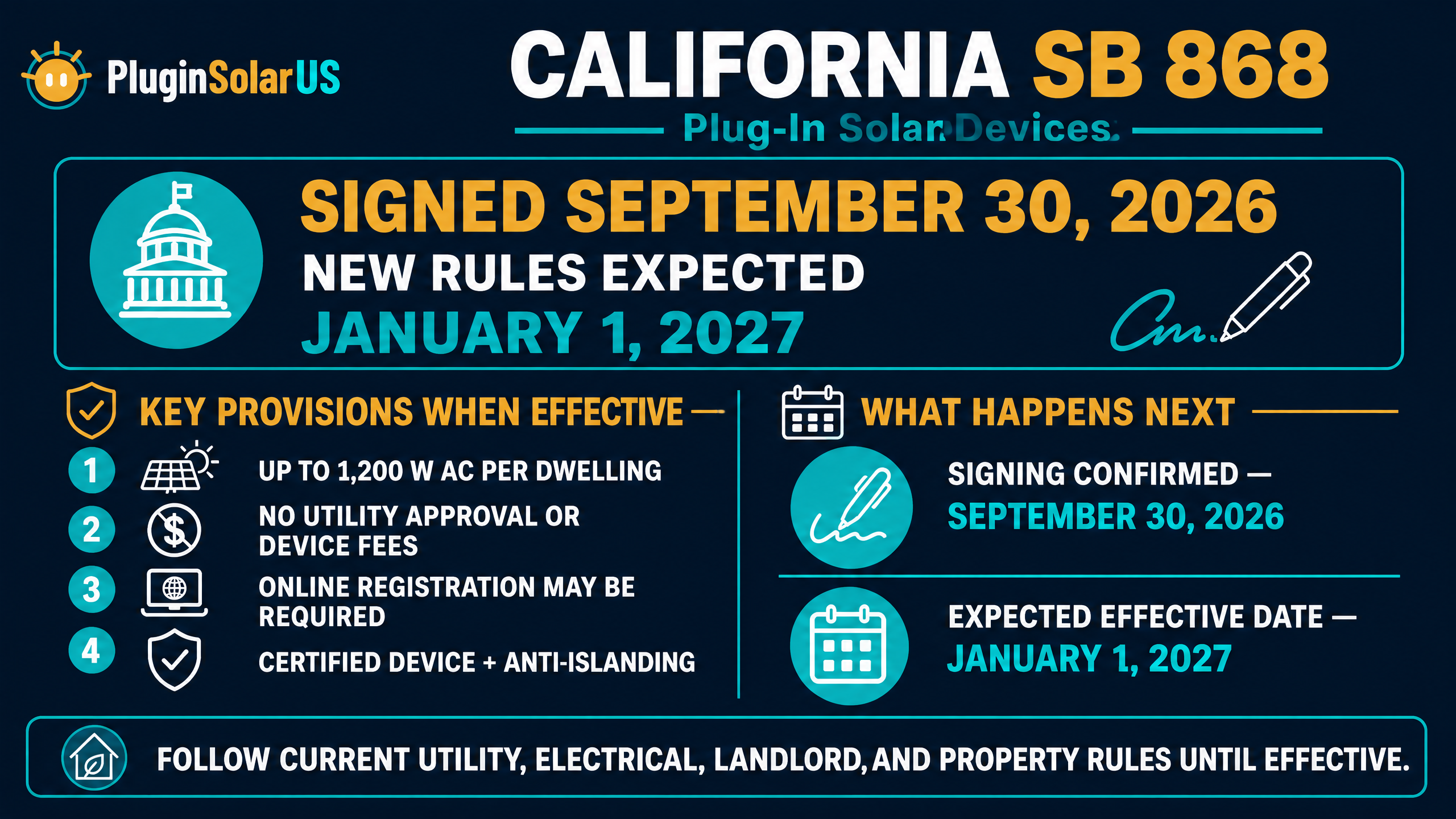
California SB 868 Signed: What Happens Next
Governor Newsom listed Senate Bill 868 among the bills he signed on September 30, 2026. The Legislature passed the measure in August after Senate concurrence in Assembly amendments 36-4. The law creates a statewide framework for qualifying portable plug-in solar devices, but signing does not make its new utility exemption effective today. Under California's ordinary effective-date rule, the framework is expected to take effect January 1, 2027. Follow current utility, electrical, landlord, and property rules until then; an official chapter number has not yet been verified.
✅ Updated October 1, 2026 — Signed by Governor Newsom
The governor's September 30 legislative update confirms the signing. The ordinary effective date is expected to be January 1, 2027; the equipment and utility conditions below do not replace current requirements until the law takes effect.
Note: AB-2316 vs. SB 868
California Assembly Bill 2316 was a community solar bill, not related to plug-in solar systems. The correct legislation for portable plug-in solar is Senate Bill 868.
What SB 868 Does: The Plug and Play Solar Act
When effective, SB 868 removes specified utility-side barriers for qualifying portable solar devices. These systems — also called balcony solar — generate electricity through compact photovoltaic equipment subject to the law's certification and electrical-safety conditions. The signed measure prohibits specified utility fees and exempts qualifying devices from the traditional interconnection approval process, while preserving applicable product, electrical, building, landlord, and property rules.
Key Provisions in the Signed Measure (When Effective)
- No Utility Fees: Utilities — both investor-owned (PG&E, SCE, SDG&E) and publicly owned — are prohibited from charging any fee or surcharge related to the plug-in solar device or the electricity it feeds into the building's circuits.
- Interconnection Waived: Certified plug-in solar devices are exempt from all CPUC interconnection requirements. Utilities may only require a simple online registration of address and system size — no approval process, no waiting period.
- System Size Limit: 1,200 watts AC per dwelling unit — consistent with the national standard emerging across other states.
- Safety Certification Required: Devices must be certified as a plug-in photovoltaic system by UL or an equivalent nationally recognized testing laboratory (aligns with UL 3700 scope), and must include an anti-islanding feature. Systems must meet both NEC and California Electrical Code (Title 24, Part 3).
- Broad Coverage: The bill applies to customers of both investor-owned utilities and local publicly owned electric utilities — covering virtually all California electricity customers.
- Renter Access: The bill applies broadly to any "customer" of an electrical corporation or publicly owned utility. While it does not include explicit landlord-restriction language, the interconnection waiver removes the main utility-side barrier renters face.
What SB 868 Will Mean for California (When Effective)
Governor Newsom signed SB 868 September 30, 2026. The new framework is expected to take effect January 1, 2027, not immediately on signature. Here are potential benefits and practical considerations once its conditions apply:
Impact on Renters
- Reduced Electricity Bills: With California's average electricity rates around $0.34/kWh, even small plug-in solar systems can lead to significant savings, especially when optimized with Time-of-Use (TOU) rates. Payback periods in high-rate states like California can be as short as 3-5 years with TOU optimization.
- Increased Energy Independence: Renters would gain a degree of control over their energy consumption and production, contributing to a more sustainable lifestyle.
- Environmental Benefits: Widespread adoption of plug-in solar would contribute to California's ambitious renewable energy goals by reducing reliance on fossil fuels.
Impact on Landlords and Property Managers
- Clearer Guidelines: The bill would provide a standardized framework for managing tenant requests for plug-in solar, reducing ambiguity and potential disputes.
- Property Value: Offering plug-in solar options could make rental properties more attractive to environmentally conscious tenants, potentially increasing occupancy rates and property value.
Impact on the Solar Industry
- Market Expansion: A new market segment for plug-in solar products and services would emerge, driving innovation and competition.
- Job Creation: Increased demand for plug-in solar systems would likely lead to job growth in manufacturing, sales, and installation support.
Timeline for SB 868
SB 868 passed the Senate 35-1 on May 19, cleared Assembly Utilities and Energy 18-0 on June 10, and cleared Assembly Appropriations 11-0 on August 13. The official history records Assembly passage on August 25, Senate concurrence 36-4 on August 26, and presentation to the governor August 31. Governor Newsom signed it September 30. The ordinary effective date is expected January 1, 2027.
| Milestone | Date | Status |
|---|---|---|
| Senate Energy Committee | March 2026 | Passed 12-0 ✓ |
| Full Senate vote | May 19, 2026 | Passed 35-1 ✓ |
| Assembly Utilities & Energy Committee | June 10, 2026 | Passed ✓ |
| Assembly Appropriations Committee | August 13, 2026 | Passed 11-0 ✓ |
| Final legislative approval | August 26, 2026 | Senate concurred 36-4; ordered to enrollment ✓ |
| Governor's action | September 30, 2026 | Signed ✓ |
| Law takes effect | January 1, 2027 | Expected under ordinary California effective-date rule |
How to Prepare Now for Plug-in Solar in California
SB 868 has been signed but its new framework is not expected to take effect until January 1, 2027. California renters should continue following current utility, electrical-code, landlord, and property rules until then. Here's how to prepare:
- Assess Your Electrical System: Ensure your rental unit has access to a GFCI-protected outlet on a dedicated circuit. This is a critical safety requirement for all plug-in solar systems. NEC Articles 690 and 705 apply to these installations.
- Understand System Sizing: Familiarize yourself with the different tiers of plug-in solar systems.
| System Sizing Tier | Panel Wattage | Battery Capacity |
|---|---|---|
| Starter | 400–1,200W | 1–2 kWh |
| Mid-Range | 800–1,600W | 2–3 kWh |
| High Output | 1,600–2,400W | 3–5 kWh+ |
- Research Battery Options: Batteries are essential for maximizing self-consumption and optimizing savings, especially with TOU rates.
| Battery Capacity Tier | Capacity Range |
|---|---|
| Entry | 1–2 kWh |
| Standard | 2–3 kWh |
| Extended | 3–5 kWh+ |
- Educate Your Landlord: Proactively discuss your interest in plug-in solar with your landlord. Share information about the benefits and safety standards (UL 3700).
- Stay Informed: Check the California state page for the effective date and implementation updates; signing alone does not change your current installation rules.
Comparison with Utah HB 340
California's signed SB 868 shares a small-system utility-access goal with Utah's enacted HB 340, but each state's limits, effective date, product conditions, and property rules differ. Check the current requirements for your state before choosing a system.
| Feature | Utah HB 340 (Enacted 2025) | California SB 868 (Signed September 2026) |
|---|---|---|
| Status | Enacted Law | Signed September 30, 2026; expected effective January 1, 2027 |
| System Size Exemption | Under 1,200W exempt from interconnection permits | Up to 1,200 W AC output per dwelling |
| Focus | Legalization of plug-in solar | Utility-side rules for qualifying devices; no explicit landlord override |
| Safety Standard | Requires UL 1741 inverter certification (anti-islanding) | UL or equivalent NRTL certification; UL 3700 not named in statute |
| Impact | Clear pathway for homeowners and renters to install plug-in solar | Customers including renters may benefit, subject to lease and property rules |
California-Specific Incentives: SGIP
While the Federal Investment Tax Credit (ITC) for solar expired on December 31, 2025, and is no longer available for new purchases, California offers its own robust incentive programs. The Self-Generation Incentive Program (SGIP) is a key program that provides rebates for qualifying distributed energy resources, including battery storage systems. For plug-in solar users, SGIP can significantly reduce the upfront cost of adding a battery to their system, enhancing their energy independence and economic savings.
- SGIP for Battery Storage: SGIP offers incentives for battery storage systems, which are crucial for maximizing the benefits of plug-in solar, especially in conjunction with California's TOU electricity rates. By storing excess solar energy generated during the day and using it during peak demand hours, consumers can further reduce their electricity bills.
- Eligibility: Eligibility for SGIP depends on various factors, including system size, technology type, and customer segment. It's essential to consult the official California Public Utilities Commission (CPUC) website or a qualified solar installer for the latest SGIP guidelines and application procedures.
Conclusion
California SB 868 was signed September 30, 2026, creating a clearer path for qualifying plug-in solar in the nation's most populous state. The new utility framework is expected January 1, 2027. Renters and homeowners can use this time to assess outlet safety, compare certified equipment, estimate savings, and discuss lease or property conditions without assuming the exemption is already in force.
Energy Resilience: Why SB 868 Matters Beyond the Bill Savings
California's grid reliability challenges give SB 868 a dimension that goes beyond monthly bill savings. The state has experienced rolling blackouts during extreme heat events and Public Safety Power Shutoffs (PSPS) affecting millions of customers during wildfire season. For renters — who cannot install rooftop solar or whole-home battery systems — plug-in solar with battery storage is one of the few practical paths to maintaining power during these events.
A suitably designed battery can power selected devices from its own outlets during an outage, though runtime depends on the load and usable battery capacity. SB 868's signed framework may help eligible customers explore this resilience option when it takes effect; it does not itself create an unconditional renter right or bypass landlord and property rules.
Advocates for the bill have highlighted this resilience angle in committee testimony, noting that Public Safety Power Shutoffs can affect lower-income renters who lack access to whole-home batteries. Pairing safe equipment with a realistic backup plan can help households prepare while checking applicable property permissions and electrical requirements.
Next Steps
Ready to explore plug-in solar for your California home? Take the next steps to assess your readiness and potential savings:
- Solar Readiness Quiz: Determine if plug-in solar is right for your rental property.
- Savings Calculator: Estimate your potential electricity bill savings with a plug-in solar system.
- Battery Storage Guide: Learn how battery storage can maximize your solar investment.
- Buyer's Guide: Explore options and find the perfect plug-in solar system for your needs.
Sources
- Governor Newsom's September 30 Legislative Update — Signed SB 868
- California Secretary of State — Bill Chapters and Effective Dates
- California SB 868 Official History
- California SB 868 Full Text
- California Becomes Latest State to Approve Plug-in Solar — Bloomberg
- California Legislature approves balcony solar bill — EWG
- California Assembly Utilities Committee advances balcony solar bill — EWG
- California Senate passes plug-in solar bill — PV Magazine
- California PUC Self-Generation Incentive Program