Time-of-Use Electricity Rates Explained: How to Save More with Plug-In Solar
By PlugInSolarUS Editorial Team · Published 2026-02-20 · Updated October 1, 2026 · 14 min read
Time-of-Use rates can double your plug-in solar savings. Here's how TOU pricing works, which states have it, and how to optimize your system for maximum savings.
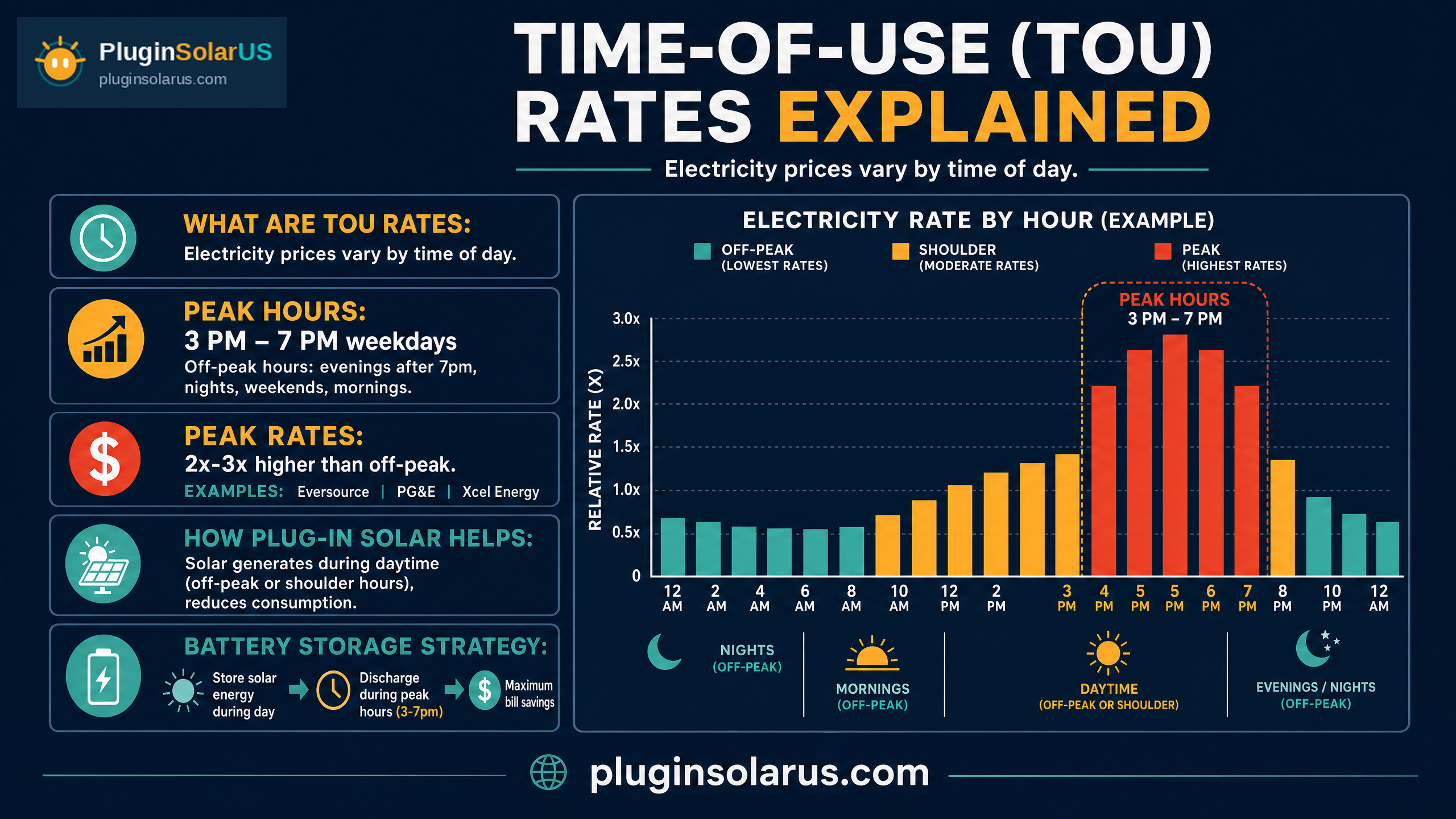
Time-of-Use Electricity Rates Explained
Time-of-Use (TOU) electricity rates are a pricing structure where the cost of electricity varies depending on the time of day, day of the week, and even the season. Unlike traditional flat-rate billing, where you pay a consistent price per kilowatt-hour (kWh) regardless of when you use it, TOU rates reflect the actual cost of generating and delivering electricity at different times. This dynamic pricing model is becoming increasingly common across the United States as utilities seek to manage grid demand more effectively and integrate renewable energy sources.
Utilities implement TOU rates primarily to encourage consumers to shift their electricity consumption away from periods of high demand, known as "peak hours." During these peak times, typically late afternoons and evenings when most people return home from work, energy demand surges. To meet this demand, utilities often have to fire up less efficient and more expensive "peaker plants," which can be fossil fuel-based and contribute more to emissions. By making electricity more expensive during these periods, TOU rates incentivize customers to use less energy or shift their usage to "off-peak" hours when demand is lower and electricity is cheaper, often when renewable energy sources like solar are abundant or overall consumption is minimal.
The broader goal of TOU rates is to create a more stable, efficient, and sustainable electrical grid. By flattening the demand curve, utilities can reduce the need for costly infrastructure upgrades, minimize reliance on dirtier power plants, and better integrate intermittent renewable energy sources. This not only benefits the environment but can also lead to long-term cost savings for the utility, which can eventually translate to more stable rates for consumers. For homeowners and renters, understanding and adapting to TOU rates can lead to significant savings on their monthly electricity bills, especially when combined with smart energy solutions like plug-in solar and battery storage.
How Time-of-Use Rates Work: A Detailed Example
To illustrate how TOU rates function, let's consider a common scenario in California, using an example similar to the PG&E E-TOU-C rate schedule. This plan typically designates peak hours as 4 PM to 9 PM every day, including weekends, when electricity demand is highest. During these peak hours, the cost of electricity can be significantly higher than during off-peak hours, which cover all other times of the day. For our example, let's assume a peak rate of $0.52/kWh and an off-peak rate of $0.28/kWh, as specified in the prompt. This substantial difference in pricing creates a clear financial incentive for consumers to manage their energy usage.
Imagine a household that uses 20 kWh of electricity per day. If 10 kWh of that usage occurs during peak hours (4 PM - 9 PM) and 10 kWh during off-peak hours, their daily electricity cost would be calculated as follows:
- Peak usage cost: 10 kWh * $0.52/kWh = $5.20
- Off-peak usage cost: 10 kWh * $0.28/kWh = $2.80
- Total daily cost: $5.20 + $2.80 = $8.00
Now, consider a scenario where the same household shifts 5 kWh of their peak usage to off-peak hours. Their new daily usage would be 5 kWh during peak hours and 15 kWh during off-peak hours:
- New peak usage cost: 5 kWh * $0.52/kWh = $2.60
- New off-peak usage cost: 15 kWh * $0.28/kWh = $4.20
- Total new daily cost: $2.60 + $4.20 = $6.80
By simply shifting 5 kWh of usage, this household saves $1.20 per day, which translates to approximately $36 per month or over $430 per year. This example clearly demonstrates the financial impact of TOU rates and the potential for savings through conscious energy management. The key is to understand when electricity is most expensive and adjust consumption patterns accordingly, or better yet, generate and store your own power.
How Plug-In Solar with Battery Storage Maximizes TOU Savings
Plug-in solar systems, especially when coupled with battery storage, are perfectly positioned to maximize savings under Time-of-Use electricity rates. During the day, when solar panels are generating electricity, this power can be used to offset immediate household consumption, reducing the amount of electricity purchased from the grid. Any excess solar energy can then be stored in a battery rather than being sent back to the grid at a potentially lower credit rate, or worse, at a time when the grid doesn't need it as much.
The real magic happens during peak TOU hours. Instead of buying expensive electricity from the utility at rates up to $0.52/kWh (as in our CA E-TOU-C example), the household can draw power directly from their battery storage. This effectively allows them to "time-shift" their solar energy, using the free energy generated during the day to power their home during the most expensive evening hours. This strategy dramatically reduces reliance on the grid during peak times, leading to substantial savings on their electricity bill. Furthermore, if the battery is fully charged and there's still excess solar production, some systems can be configured to export power to the grid during peak hours, potentially earning higher credits.
Beyond simply avoiding high peak charges, battery storage also provides energy independence and resilience. In the event of a grid outage, a plug-in solar system with battery backup can continue to power essential loads, providing peace of mind. The combination of solar generation and intelligent battery management transforms a home into a proactive participant in the energy market, allowing residents to arbitrage electricity prices and take control of their energy costs. This synergy is particularly powerful in regions with aggressive TOU rate structures, making the investment in plug-in solar and battery storage even more attractive.
State-by-State TOU Availability Table
Time-of-Use rates are not uniformly applied across all states or even within all utility service areas. However, the trend towards TOU pricing is growing as states and utilities aim for greater grid stability and renewable energy integration. Below is a general overview of TOU rate availability in several key states. It's important to note that specific rate structures, peak hours, and availability can vary significantly by utility and may require direct inquiry with your local provider.
| State | TOU Availability | Common Peak Hours (Illustrative) | Notes |
|---|---|---|---|
| California (CA) | Widespread, often default for new customers | 4 PM - 9 PM or 5 PM - 8 PM daily | Many utilities (PG&E, SCE, SDG&E) have mandatory or opt-out TOU plans. |
| New York (NY) | Increasingly available, voluntary | 2 PM - 7 PM weekdays | Con Edison, NYSEG, RG&E offer TOU options. |
| Texas (TX) | Available from various retail electric providers | 2 PM - 6 PM or 3 PM - 7 PM weekdays | Competitive market allows for diverse TOU plans. |
| Massachusetts (MA) | Available, often voluntary | 1 PM - 7 PM weekdays | Eversource, National Grid offer TOU options. |
| Connecticut (CT) | Available, often voluntary | 1 PM - 7 PM weekdays | Eversource, United Illuminating offer TOU options. |
| Illinois (IL) | Available, often voluntary | 10 AM - 10 PM weekdays (variable) | ComEd offers hourly pricing and TOU plans. |
| New Jersey (NJ) | Limited but growing availability | 12 PM - 8 PM weekdays | PSE&G, Atlantic City Electric have some TOU programs. |
| Pennsylvania (PA) | Available from various electric generation suppliers | 9 AM - 5 PM or 12 PM - 8 PM weekdays | Competitive market with diverse TOU offerings. |
| Ohio (OH) | Available from various electric generation suppliers | 7 AM - 11 AM and 5 PM - 9 PM weekdays | Competitive market with diverse TOU offerings. |
This table provides a general guide. Consumers in these states should consult their local utility or electric provider's website for the most accurate and up-to-date information on available TOU plans and their specific rate schedules. The details, including the exact hours and pricing tiers, can vary significantly even within the same state.
How to Switch to a TOU Plan
Switching to a Time-of-Use (TOU) plan can be a straightforward process, but it requires a bit of research and understanding of your current energy consumption habits. The first step is to identify if your local utility or electric provider offers TOU rates. Many utilities are proactively transitioning customers to TOU plans, especially in states like California, where it's often the default for new accounts or those with smart meters. If you're not already on a TOU plan, you'll likely need to opt-in.
To initiate the switch, visit your utility provider's website or contact their customer service department. They will be able to provide you with detailed information about the different TOU plans available in your area, including the specific peak and off-peak hours, the corresponding rates, and any associated fees or terms. It's crucial to review this information carefully and compare it with your typical electricity usage patterns. Some utilities offer online tools or calculators that can help you estimate your potential savings or costs under a TOU plan based on your historical usage data.
Before making the switch, consider how easily you can adjust your energy consumption. If you're able to shift high-energy activities like running the dishwasher, doing laundry, or charging electric vehicles to off-peak hours, a TOU plan is likely to be beneficial. If your lifestyle or household needs make it difficult to avoid peak-hour usage, you might see an increase in your electricity bill. However, with the addition of plug-in solar and battery storage, managing peak demand becomes significantly easier, making TOU plans a more attractive option for a wider range of households. Always confirm the terms and conditions, including any exit fees or minimum contract periods, before finalizing your enrollment in a TOU plan.
Virtual Power Plant (VPP) Programs and How They Pay You Extra
Virtual Power Plant (VPP) programs represent an exciting evolution in how homeowners can interact with the energy grid, offering an additional layer of financial benefit, especially for those with plug-in solar and battery storage. A VPP is essentially a network of distributed energy resources, such as residential solar panels, battery storage systems, and smart thermostats, that are aggregated and controlled by a central system. Instead of relying on a single large power plant, the VPP can collectively provide grid services, such as supplying power during peak demand or stabilizing frequency, by intelligently dispatching energy from its connected homes.
For homeowners, participating in a VPP program means their battery storage system can be called upon by the utility or VPP operator to discharge electricity back to the grid during critical times, typically during peak demand or when grid stability is threatened. In return for providing this service, participants receive financial compensation. This compensation can come in various forms, including direct payments, bill credits, or even upfront incentives for installing battery storage. For example, some VPP programs, like those involving Tesla Powerwalls, might pay participants a certain amount per kilowatt-hour discharged during an event, or a fixed seasonal payment.
VPPs offer a win-win scenario: homeowners earn extra income or savings by leveraging their solar and battery investments, and the grid benefits from increased resilience, reduced reliance on fossil fuel peaker plants, and better integration of renewable energy. As the energy landscape continues to decentralize, VPP programs are expected to grow in prevalence, offering a powerful incentive for consumers to adopt smart home energy technologies. It's a way for individual households to contribute to a cleaner, more stable energy future while also getting paid for their efforts.
TOU Optimization Strategies for Different System Tiers
Optimizing your energy usage under Time-of-Use (TOU) rates with a plug-in solar and battery system depends heavily on the size and capabilities of your system. Different system tiers—Starter, Mid-Range, and High Output—offer varying degrees of flexibility and potential for savings.
Starter System (400–1,200W + 1–2 kWh Battery)
With a Starter system, your primary goal is to cover your most critical peak-hour loads. Focus on shifting as much of your discretionary usage as possible to off-peak hours. During the day, your solar panels will likely cover a significant portion of your daytime consumption. Prioritize charging your 1-2 kWh battery with excess solar during the day. In the evening, use the stored battery power to run essential appliances like lights, a refrigerator, or a TV during the initial hours of the peak period (e.g., 4 PM - 7 PM). This small battery can make a big difference in reducing your exposure to the highest rates, even if it can't cover all your peak usage. Consider smart plugs to automate turning off non-essential devices during peak times.
Mid-Range System (800–1,600W + 2–3 kWh Battery)
A Mid-Range system provides more flexibility. Your larger solar array will generate more power, and the 2-3 kWh battery can cover a greater portion of your peak-hour consumption. With this tier, you can aim to significantly reduce or even eliminate your grid purchases during the entire peak period. Continue to charge your battery fully with solar during the day. In the evening, the battery can power a wider range of appliances, including some cooking or entertainment systems. You might even have enough stored energy to participate in a VPP program, earning additional income by discharging excess power to the grid when needed. Intelligent energy management systems become more valuable here, automatically optimizing charging and discharging based on TOU rates and your consumption patterns.
High Output System (1,600–2,400W + 3–5 kWh+ Battery)
A High Output system offers maximum energy independence and TOU optimization potential. With a substantial solar array and a 3-5 kWh or larger battery, you can aim for near-zero grid reliance during peak hours and potentially even during some off-peak times. Your system can generate ample power to cover most, if not all, of your daily needs and fully charge your battery. This allows you to strategically discharge battery power throughout the entire peak period, and even into the shoulder periods, to avoid high rates. You'll be an ideal candidate for VPP programs, as your large battery capacity can provide significant grid support and earn substantial compensation. This tier also offers greater resilience during outages and the ability to power larger loads, such as air conditioning or electric vehicle charging, more strategically.
Common Mistakes to Avoid
While Time-of-Use (TOU) rates offer significant savings opportunities, several common mistakes can undermine their benefits. The most frequent error is failing to adjust consumption habits. Simply switching to a TOU plan without actively shifting energy usage away from peak hours will likely result in higher electricity bills, as peak rates are considerably more expensive than flat rates. Many consumers overlook the importance of understanding their specific utility's TOU schedule, including the exact start and end times of peak, off-peak, and sometimes shoulder periods, which can vary by season and even by day of the week.
Another common pitfall is underestimating the impact of "phantom load" or always-on devices during peak hours. Appliances like gaming consoles, cable boxes, and even some smart home devices can draw power continuously, adding up to significant costs when those draws occur during expensive peak times. Failing to utilize smart home technology, such as programmable thermostats, smart plugs, or energy management systems, to automate energy shifting is also a missed opportunity. These tools can automatically optimize usage, ensuring appliances run during off-peak hours without requiring constant manual intervention.
Finally, for those with solar and battery storage, a critical mistake is not optimizing battery charging and discharging strategies. If a battery is primarily charged from the grid during off-peak hours instead of maximizing solar self-consumption, or if it's not programmed to discharge during peak hours, the financial benefits are severely diminished. Similarly, not exploring or participating in available Virtual Power Plant (VPP) programs means leaving potential earnings on the table. Avoiding these common errors requires a proactive approach to energy management, a clear understanding of your TOU plan, and leveraging available technology to your advantage.
Next Steps
Ready to take control of your electricity bill and maximize your savings under Time-of-Use rates? The journey to energy independence and smart energy management begins with understanding your needs and exploring the right solutions. Here are your next steps:
- Calculate Your Savings: Use our PlugInSolarUS Calculator to estimate how much you can save with a plug-in solar system, especially when combined with battery storage under TOU rates.
- Explore Battery Storage: Dive deeper into the world of energy storage with our comprehensive Battery Guide. Learn about different battery technologies, sizing, and how they integrate seamlessly with plug-in solar to optimize your TOU strategy.
- Find Your Perfect System: Ready to make a purchase? Our Buyer's Guide will walk you through everything you need to know to select the ideal plug-in solar and battery system for your home, ensuring you get the most out of TOU pricing.
Federal ITC Reminder
The Federal Investment Tax Credit (ITC) for solar systems expired on December 31, 2025. Be sure to check current federal and local incentives for any new programs that may be available.
Utah HB 340 and California SB 868
As of October 1, 2026, ten states have enacted explicit plug-in solar laws, including New Jersey and California. Governor Newsom signed California SB 868 on September 30; the new framework is expected to take effect January 1, 2027. Check current California requirements before installing. State-specific product and property rules continue to apply.