Plug-In Solar vs. Rooftop Solar vs. Portable Solar: A Complete Comparison
By PlugInSolarUS Editorial Team · Published 2026-03-22 · Updated October 1, 2026 · 20 min read
Not all solar is the same. Here is a detailed comparison of plug-in solar, traditional rooftop solar, and portable solar generators — covering cost, capability, installation, and who each is right for.
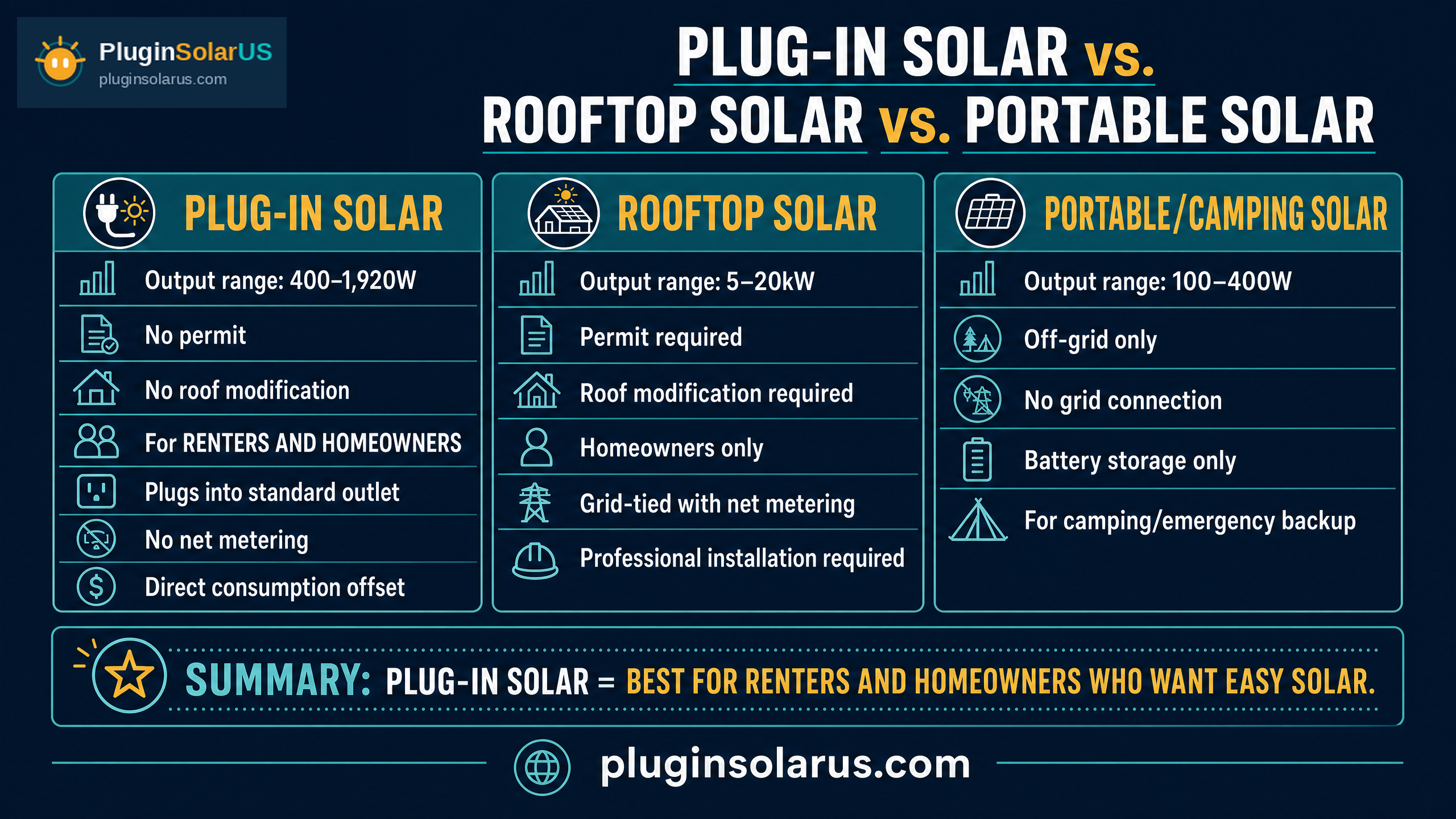
Plug-In Solar vs. Rooftop Solar vs. Portable Solar: A Complete Comparison
The quest for sustainable energy solutions has never been more pressing, with solar power emerging as a leading contender in the global effort to reduce carbon footprints and achieve energy independence. As technology advances and environmental awareness grows, more individuals and households are exploring the benefits of harnessing the sun's abundant energy. However, the landscape of solar options can be complex, presenting a variety of choices that cater to different needs, budgets, and living situations. Understanding these distinctions is crucial for making an informed decision that aligns with your specific energy goals.
This comprehensive guide delves into the three primary categories of residential and personal solar solutions: plug-in solar, rooftop solar, and portable solar. Each system offers a unique set of advantages and disadvantages, designed for distinct applications and user profiles. From the simplicity and accessibility of plug-in units to the robust, whole-home integration of rooftop arrays, and the on-the-go convenience of portable setups, the right choice depends on a careful evaluation of factors such as installation complexity, cost, power output, and regulatory considerations. Our aim is to provide a detailed, side-by-side comparison, equipping you with the knowledge necessary to navigate the solar market confidently and select the system that best suits your lifestyle and energy demands.
The decision to go solar is a significant investment, not just financially, but also in terms of environmental commitment and long-term energy strategy. Whether you are a renter looking for a flexible entry into solar, a homeowner aiming for substantial energy savings and increased property value, or an adventurer seeking off-grid power, this article will illuminate the path forward. We will dissect the mechanics, benefits, drawbacks, and ideal use cases for each solar type, alongside critical facts regarding sizing, costs, payback periods, and relevant legal frameworks. By the end of this comparison, you will have a clear understanding of which solar solution, or combination thereof, is the optimal choice for your journey towards a greener, more energy-efficient future.
Plug-In Solar: Accessible Energy for the Modern Home
Plug-in solar systems represent a revolutionary step towards democratizing solar energy, offering an accessible and often DIY-friendly entry point for individuals and households. These systems are designed for simplicity, allowing users to generate their own electricity with minimal installation hassle. At its core, a plug-in solar setup typically consists of one or more solar panels, each connected to a microinverter. Unlike traditional large-scale solar installations that feed power directly into a home's main electrical panel, plug-in systems convert the DC electricity generated by the panels into AC electricity at the panel level, which is then fed directly into a standard 120V or 240V GFCI (Ground-Fault Circuit Interrupter) outlet. This process allows the generated electricity to immediately offset the power consumption of appliances and devices connected to the home's internal electrical grid, effectively reducing reliance on utility-supplied power.
The operation of plug-in solar is elegantly straightforward. When the sun shines, the panels produce direct current (DC) electricity. The integrated microinverters then transform this DC power into alternating current (AC) power, which is the type of electricity used by household appliances. This AC power is then sent through the GFCI outlet into your home's electrical system. The electricity generated will first be consumed by any active loads within your home. If the system generates more power than your home is currently consuming, the excess electricity will flow back into the utility grid. However, it is crucial to understand that for safety and regulatory compliance, plug-in solar systems require a dedicated circuit and adherence to specific electrical codes, such as NEC Articles 690 and 705. These regulations ensure that the system operates safely and does not overload circuits or create hazards for utility workers. For more details on how these systems work, visit our How It Works page.
The advantages of plug-in solar are numerous, making it an attractive option for a broad demographic. Its primary benefit lies in its ease of installation; many systems are designed for DIY setup, eliminating the need for professional installers and significantly reducing upfront costs. This portability also means that renters can take their solar system with them if they move, a flexibility not offered by rooftop installations. The lower initial investment, typically ranging from $500 to $5,000, makes solar power more attainable for budget-conscious consumers. Furthermore, plug-in solar allows users to start small and scale up their system over time, adding more panels as their needs or budget permits. The payback period for plug-in solar systems averages 5–7 years nationally, but can be as short as 3–5 years in regions with high electricity rates and favorable Time-of-Use (TOU) tariffs, such as California, Massachusetts, and Connecticut.
Despite its many benefits, plug-in solar does come with certain limitations. The most significant is its relatively lower power output compared to full-scale rooftop systems. Plug-in systems are typically designed for supplemental power generation, offsetting a portion of your electricity bill rather than powering your entire home. Electrical and circuit requirements depend on the certified system, the branch circuit, applicable code, and the enacted state framework, which may require professional assessment. Regulatory landscapes also vary; Utah HB 340 (2025) is enacted, while California SB 868 was signed September 30, 2026 but its new utility-side framework is expected January 1, 2027. Understanding local requirements is essential before installation. Our States page provides more information on local regulations.
Plug-in solar systems are available in various sizing tiers to meet diverse energy needs. A Starter Tier typically ranges from 400–1,200W of panel capacity, often paired with 1–2 kWh of battery storage, suitable for offsetting basic appliance loads. The Mid-Range Tier offers 800–1,600W of panels and 2–3 kWh of storage, providing a more substantial contribution to household electricity. For those seeking greater energy independence, the High Output Tier delivers 1,600–2,400W of panels and 3–5 kWh+ of battery capacity, capable of significantly reducing grid reliance. These tiers allow consumers to choose a system that precisely matches their consumption patterns and financial capabilities. The average national electricity rate is $0.18/kWh, but in states like California ($0.34/kWh), Massachusetts ($0.32/kWh), and Connecticut ($0.28/kWh), the economic benefits of even a small plug-in system are amplified, leading to faster payback periods.
Rooftop Solar: Comprehensive Home Energy Solutions
Rooftop solar represents the traditional and most widely adopted form of residential solar energy generation, offering a robust and comprehensive solution for homeowners seeking significant reductions in their electricity bills and a substantial decrease in their carbon footprint. These systems involve the installation of multiple solar panels directly onto the roof of a home, forming a permanent fixture that integrates seamlessly with the property's electrical infrastructure. Unlike plug-in systems, rooftop solar arrays are typically grid-tied, meaning they are connected to the local utility grid. This connection allows for net metering, a billing mechanism that credits solar energy system owners for the electricity they add to the grid. When your solar panels produce more electricity than your home consumes, the excess power is sent back to the grid, and you receive credits that can be used to offset future electricity bills when your system produces less, such as at night or on cloudy days.
The operational principle of rooftop solar is similar to plug-in systems in its initial stages but scales up significantly. Solar panels capture sunlight and convert it into direct current (DC) electricity. This DC power is then routed to an inverter, which transforms it into alternating current (AC) electricity suitable for household use. Depending on the system design, this can be a central string inverter that handles the output of multiple panels, or individual microinverters attached to each panel, similar to plug-in systems, offering greater efficiency and monitoring capabilities. The AC power then flows into your home's main electrical panel, powering your appliances and lighting. Any surplus electricity is exported to the utility grid, and conversely, when your solar system isn't producing enough power, your home draws electricity from the grid. This symbiotic relationship with the utility company ensures a continuous and reliable power supply, making rooftop solar a powerful tool for achieving long-term energy independence.
The advantages of rooftop solar are compelling for homeowners committed to a long-term investment in renewable energy. Foremost among these is the potential for maximum power generation, allowing many homes to significantly reduce, or even eliminate, their monthly electricity bills. The substantial energy savings over the lifespan of the system, typically 25-30 years, can amount to tens of thousands of dollars. Beyond financial savings, rooftop solar can increase a home's property value, making it a desirable feature for potential buyers. Furthermore, these systems often qualify for various financial incentives, including state and local rebates, and historically, the federal Investment Tax Credit (ITC). While the Federal ITC expired on December 31, 2025, it played a crucial role in making solar more affordable for many years. Homeowners considering rooftop solar should research current local incentives.
However, rooftop solar also presents several challenges. The most significant barrier is the high upfront cost, which typically ranges from $15,000 to $30,000, depending on the system size, panel efficiency, and installation complexity. This substantial investment often requires financing, though the long-term savings usually justify the initial outlay. The installation process is considerably more complex and time-consuming than plug-in or portable options, requiring professional expertise for structural integrity, electrical wiring, and grid connection. This complexity also extends to permit requirements, which can be extensive and vary significantly by municipality, involving structural assessments, electrical inspections, and utility approvals. The permanent nature of rooftop installations means they are not portable, making them unsuitable for renters or those who anticipate frequent moves. For guidance on navigating the installation process, our Solar Installers and Electricians pages can be helpful resources.
The payback period for rooftop solar systems, while varying by location and electricity rates, generally aligns with the 5–7 year national average seen in plug-in systems, though the total savings are far greater due to the larger scale. In high-rate areas like California, Massachusetts, and Connecticut, with their respective average electricity rates of $0.34/kWh, $0.32/kWh, and $0.28/kWh, the economic benefits accelerate, potentially shortening the payback period to 3–5 years. These systems are best suited for long-term homeowners with suitable, unshaded roof space and a desire for comprehensive energy independence. The significant investment and permanent installation mean that rooftop solar is a commitment, but one that offers substantial environmental and financial rewards over its extensive lifespan. For those ready to explore this option, our Buyers Guide can assist in the decision-making process.
Portable Solar: Power On-the-Go
Portable solar systems offer a distinct approach to harnessing solar energy, prioritizing flexibility, mobility, and off-grid power solutions. Unlike their plug-in and rooftop counterparts, portable solar setups are not designed for integration into a home's electrical system or for continuous grid-tied operation. Instead, they are self-contained units, typically comprising one or more foldable or compact solar panels, a charge controller, and a battery storage unit, all designed for easy transport and rapid deployment. These systems are engineered to provide power wherever and whenever it's needed, making them indispensable for activities that take you away from conventional power sources. Their primary function is to charge devices, power small appliances, or provide emergency backup power, offering true energy independence in remote or temporary settings.
The mechanism of portable solar is straightforward and self-sufficient. Solar panels capture sunlight and convert it into direct current (DC) electricity. This DC power is then fed into a charge controller, which regulates the voltage and current flowing into the battery. The charge controller is a critical component, preventing overcharging and deep discharging of the battery, thereby extending its lifespan. Once stored in the battery, the DC power can be used directly for compatible devices or converted into alternating current (AC) via an integrated inverter (often part of the battery unit, referred to as a portable power station). This AC power can then be accessed through standard outlets on the power station, allowing users to plug in laptops, lights, small refrigerators, and other electronics. The key distinction is that portable solar systems operate entirely independently of the utility grid; there is no grid feed-in capability, meaning any excess power generated cannot be sold back to the utility company.
The advantages of portable solar are centered around its unparalleled convenience and versatility. Its most obvious benefit is portability; these systems can be easily packed up and moved, making them perfect for camping, RV trips, tailgating, boating, or emergency preparedness. The ease of setup is another significant draw; most portable solar kits require no tools or specialized knowledge for deployment, allowing users to generate power within minutes of unpacking. The upfront cost is also considerably lower than rooftop or even many plug-in systems, typically ranging from $200 to $1,500, making it an affordable option for temporary power needs. Furthermore, portable solar systems are generally free from complex permitting requirements or regulatory hurdles, as they do not interact with the grid or permanent structures. This makes them an ideal choice for those seeking immediate, hassle-free access to solar power.
However, portable solar systems come with inherent limitations that define their niche. Their power output is significantly lower than grid-tied systems, meaning they are not suitable for powering an entire home or large, energy-intensive appliances for extended periods. The capacity of their integrated batteries dictates how much power can be stored and used, and while some larger units can provide substantial backup, they are still limited compared to home battery storage solutions. The absence of grid feed-in means there are no opportunities for net metering credits or selling excess electricity back to the utility. While this simplifies the system, it also means that any surplus energy generated beyond immediate consumption and battery capacity is effectively lost. These systems are best suited for temporary, off-grid applications, providing power for specific devices rather than comprehensive energy solutions. For more information on battery storage, consult our Battery Guide.
Portable solar systems are ideal for a specific set of users: RV and camping enthusiasts, individuals preparing for power outages, or anyone needing reliable power in remote locations. They offer a sustainable alternative to gas generators, operating silently and without emissions. While the payback period isn't typically calculated in the same way as grid-tied systems due to the lack of direct utility bill offset, the value comes from the convenience, independence, and cost savings on fuel or campground electrical hookups. The limitations in power and storage capacity mean that users must carefully manage their energy consumption. Despite these constraints, portable solar fills a crucial gap in the solar market, providing accessible, flexible, and environmentally friendly power for life on the move or during emergencies. For those interested in off-grid solutions, our Buyers Guide offers further insights.
Side-by-Side Comparison: Plug-In vs. Rooftop vs. Portable Solar
To provide a clearer understanding of the distinctions and overlaps between these three solar solutions, the following table offers a side-by-side comparison across several key criteria. This detailed breakdown will help you quickly identify which system aligns best with your priorities and circumstances, from initial investment to long-term benefits and operational considerations.
| Feature | Plug-In Solar | Rooftop Solar | Portable Solar |
|---|---|---|---|
| Cost (Upfront) | $500 – $5,000 | $15,000 – $30,000 | $200 – $2,000 |
| Installation | DIY-friendly, simple plug-in to GFCI outlet | Professional installation required, complex | DIY, no installation, rapid deployment |
| Permits | Varies by locality (e.g., Utah HB 340 enacted; CA SB 868 signed Sept. 30; expected effective Jan. 1, 2027); often minimal | Extensive permits required (structural, electrical, utility interconnection) | Generally no permits required |
| Grid Feed-In | Yes, offsets home consumption, excess may feed grid (net metering possible) | Yes, full net metering capabilities | No grid feed-in |
| Portability | Moderate (can be moved with effort) | None (permanent installation) | High (designed for easy transport) |
| Typical Savings | Partial reduction in electricity bill | Significant reduction, often near-zero bill | Savings on fuel/campground fees, convenience |
| Payback Period | 5–7 years national avg; 3–5 years in CA/MA/CT with TOU | 5–7 years national avg; 3–5 years in CA/MA/CT with TOU | Value in convenience & off-grid independence, not direct utility bill payback |
| Sizing Tiers | Starter (400–1,200W + 1–2 kWh), Mid-Range (800–1,600W + 2–3 kWh), High Output (1,600–2,400W + 3–5 kWh+) | Typically 4kW to 12kW+ for whole-home power | Small (50W–200W) to Medium (200W–500W) for devices/small appliances |
| Key Requirement | Dedicated GFCI outlet (NEC Articles 690 & 705) | Suitable roof space, structural integrity | Battery storage, charge controller |
This table highlights the fundamental differences that guide the selection process. Plug-in solar offers a balanced approach, providing some grid interaction with relative ease of installation. Rooftop solar is the powerhouse, delivering maximum energy independence and long-term financial gains, albeit with a higher initial investment and complexity. Portable solar stands apart as the ultimate solution for mobility and off-grid power, sacrificing grid integration for unparalleled flexibility. Your choice will ultimately depend on your specific energy needs, living situation, budget, and willingness to engage with installation and regulatory processes.
Decision Matrix: Which Solar Solution is Right for You?
Choosing the right solar system can feel overwhelming given the diverse options available. This decision matrix is designed to help you navigate your choices based on your specific living situation and energy goals. By considering your profile, you can quickly identify the solar solution that best aligns with your needs, ensuring a wise investment in renewable energy.
For the Renter:
As a renter, your options are often limited by property ownership and the inability to make permanent modifications. In this scenario, Plug-In Solar is typically the most suitable choice. Its ease of installation, requiring only a dedicated GFCI outlet, and its portability mean you can take your system with you if you move. This flexibility is paramount for renters who want to reduce their electricity bills and contribute to clean energy without infringing on lease agreements or investing in a property they don't own. Portable solar is also an option for charging devices, but plug-in offers direct bill offset.
For the Homeowner with an HOA:
Homeowners living under a Homeowners Association (HOA) often face restrictions on exterior modifications, including solar panel installations. While some HOAs are becoming more solar-friendly, approval processes can be lengthy and complex for traditional rooftop systems. For these homeowners, Plug-In Solar presents an excellent compromise. Its less intrusive nature and often smaller footprint may make it easier to gain HOA approval, or in some cases, it might not even fall under strict HOA review if panels are not permanently affixed to the roof or highly visible. This allows for energy savings without the extensive bureaucratic hurdles. Rooftop solar is still possible but requires careful navigation of HOA rules.
For the Homeowner without an HOA:
If you own your home and are not constrained by HOA regulations, you have the broadest range of choices. For maximum energy independence, significant long-term savings, and increased property value, Rooftop Solar is generally the optimal choice. This system allows for the highest power generation, full net metering benefits, and eligibility for various incentives. However, if the upfront cost of rooftop solar is prohibitive, or if you prefer a phased approach to solar adoption, Plug-In Solar can serve as an excellent starting point. You can begin with a smaller plug-in system to offset some consumption and potentially expand later, or even combine it with a future rooftop installation. Our Homeowners page provides more insights.
For the RV/Camping User or Emergency Preparedness:
For those who frequently venture off-grid, whether for RV trips, camping, or simply preparing for power outages, Portable Solar is the undisputed champion. Its design for mobility, rapid setup, and self-contained power generation makes it ideal for powering devices and small appliances in remote locations. It eliminates the need for noisy, polluting gas generators and provides a silent, sustainable power source. While it doesn't contribute to home electricity bill reduction, its value lies in providing reliable power independence wherever you go. For extended off-grid living, larger portable power stations with multiple solar panels can provide substantial energy reserves.
Hybrid Approaches: Combining Solar Solutions
While each solar system type offers distinct advantages, the most effective strategy for some individuals and households might involve a hybrid approach, combining different solar technologies to maximize benefits and address diverse energy needs. The most common and synergistic hybrid involves integrating Plug-In Solar with Rooftop Solar. This combination allows homeowners to leverage the strengths of both systems, creating a more resilient, efficient, and scalable energy solution for their property. The concept is rooted in optimizing energy generation, managing costs, and enhancing overall energy independence.
A homeowner might initially install a plug-in solar system as an accessible entry point into solar energy. This could be due to budget constraints, a desire to test the waters with solar, or to quickly offset a portion of their electricity bill without the extensive planning and investment required for a full rooftop array. The plug-in system provides immediate, supplemental power, reducing the home's reliance on grid electricity. As their energy needs evolve, or as financial resources become available, the homeowner can then decide to install a comprehensive rooftop solar system. The existing plug-in system can continue to operate alongside the new rooftop array, contributing to the overall energy production of the home. This phased approach allows for a gradual transition to greater solar capacity, making the journey to energy independence more manageable.
Beyond a phased adoption, combining plug-in and rooftop solar can offer enhanced resilience. While rooftop systems are excellent for large-scale generation, a plug-in system can be particularly useful for specific circuits or as a direct offset for high-consumption appliances. In some scenarios, a plug-in system with integrated battery storage could even provide a small degree of backup power for critical loads during grid outages, complementing a grid-tied rooftop system that might not have battery backup. This layered approach ensures that various energy demands are met efficiently, from daily consumption to specific high-draw needs, and potentially even emergency situations. For homeowners looking to maximize their solar investment, exploring these hybrid models can unlock greater value and flexibility.
Another less common but viable hybrid involves using Portable Solar in conjunction with either Plug-In or Rooftop Solar. While portable solar doesn't integrate with the home's electrical system, it serves a crucial role in providing power for specific, mobile needs. For instance, a homeowner with a rooftop system might still invest in a portable solar setup for camping trips, RV adventures, or as a dedicated emergency power source for essential devices during a blackout. This ensures that even when the main home system is not accessible or operational, there's a reliable, off-grid power option. This multi-faceted approach to solar energy ensures that all aspects of a user's lifestyle, both at home and on the go, are covered by sustainable power solutions.
Next Steps: Your Journey to Solar Independence
Embarking on your solar journey is a significant step towards energy independence and environmental stewardship. With a clearer understanding of plug-in, rooftop, and portable solar systems, you are now better equipped to make an informed decision. However, the path to going solar often involves several practical considerations, from assessing your specific needs to navigating financial and regulatory landscapes. To assist you further, PlugInSolarUS offers a suite of resources designed to guide you through each stage of this exciting transition.
Your first step should be to evaluate your readiness for solar. Our Readiness guide provides a comprehensive checklist and considerations to help you determine the feasibility and optimal approach for your property and lifestyle. This includes assessing your energy consumption, available space, and local solar potential. Once you have a clearer picture of your needs, our Calculator tool can help you estimate potential savings and system sizing requirements, providing a personalized projection of the economic benefits of going solar. This is a crucial step in understanding the financial implications and return on investment for each solar option.
Finally, as you move closer to making a purchase, our Buyers Guide offers invaluable advice on selecting the right products, understanding warranties, and choosing reputable suppliers or installers. Whether you're considering a DIY plug-in kit or a professional rooftop installation, this guide will equip you with the knowledge to make confident purchasing decisions. We also encourage you to explore our other resources, such as How It Works for technical details, States for local regulations, and Battery Guide for storage solutions. By utilizing these tools and resources, you can confidently navigate the complexities of solar energy and successfully transition to a cleaner, more sustainable power source for your home and lifestyle.
Compare solar-only options
Browse current kit and component listings by solar DC and inverter AC output, price, shipping, and required fees. A listing is not installation approval and these solar-only offers do not provide outage backup. Explore product recommendations.