How Plug-In Solar Microinverters Work: Panel Compatibility, MPPT, and AC Output
By PlugInSolarUS Editorial Team · Published 2026-10-08 · Updated October 8, 2026 · 7 min read
Learn how a plug-in solar microinverter turns panel DC into AC, what MPPT does, and which voltage and current ratings matter when comparing exact models. See why panel watts, clipping, and complete-system certification are separate questions.
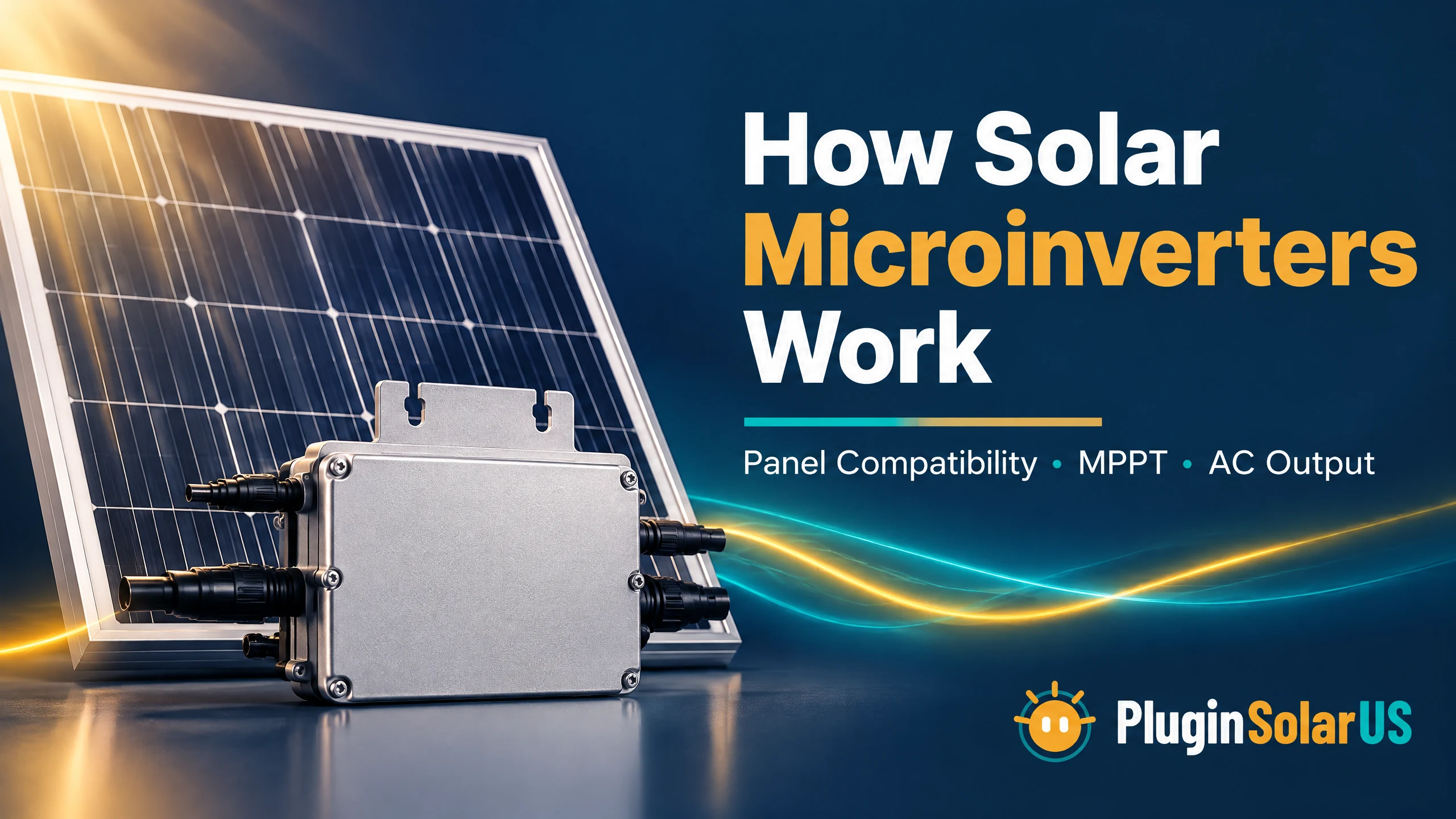
Listen to the companion episode
Deep Dive: How Plug-In Solar Microinverters Work — Panel Compatibility, MPPT, and AC Output
A plug-in solar microinverter is the small power-conversion device that lets a solar panel’s electricity become useful to an AC electrical system. Understanding its label alongside the panel’s label makes product comparisons much clearer: panel watts describe available DC power, while the microinverter sets limits on the DC it can accept and the AC it can continuously deliver.
From panel DC to usable AC
A photovoltaic panel makes direct current (DC): electricity that flows in one direction. Homes and the grid use alternating current (AC), whose voltage changes direction in a repeating wave. The microinverter converts the panel’s DC into grid-compatible AC. DOE describes microinverters as smaller inverters placed on individual panels; with that panel-level architecture, shade or damage on one panel need not reduce the power available from the others.[1]
The conversion is more than a change of electrical “language.” The microinverter observes the panel’s changing conditions and regulates its draw from the panel. Sun angle, clouds, cell temperature, and partial shade all affect what a panel can supply. That is why a panel and a microinverter need more than matching connectors or similar watt labels. For the broader system picture, start with Plug-In Solar 101.
DC panel watts are not the same as AC output
A panel’s nameplate wattage is a DC rating measured under standardized laboratory conditions. It does not say that the panel will always produce that much power outdoors, and it does not say how much AC a microinverter can send out. A microinverter’s maximum continuous AC output, often expressed in volt-amperes (VA), is the long-duration AC ceiling specified for that model. At a power factor near 1, VA and watts are numerically close, but the datasheet’s own AC rating is the one to use.
When the panel can offer more DC power than the microinverter can convert continuously, the microinverter limits its output. This is called clipping. It is not a fixed loss equal to panel watts minus inverter watts: clipping happens only in conditions when available DC power is above the inverter’s output ceiling. A larger DC panel can therefore add energy in lower-light periods while still clipping during some bright periods. The trade-off is model-specific and depends on weather, orientation, temperature, and the manufacturer’s allowed pairing range—not on a universal panel-to-inverter ratio.[2]
MPPT, operating voltage, and cold-weather Voc
MPPT means maximum power point tracking. A panel has a changing voltage-and-current combination where it can deliver the most power at that moment. The microinverter continually seeks that point within its stated MPPT voltage window. The panel’s voltage at maximum power is usually shown as Vmp; it is the operating-voltage figure most relevant to that window. An MPPT window is a working range, not a substitute for the separate maximum-voltage limit.
Voc, or open-circuit voltage, is the panel voltage when it is not delivering current to a load. It is a different measurement from Vmp. The panel’s maximum possible Voc must remain below the microinverter’s maximum DC input voltage. Cold conditions deserve special attention because PV-cell voltage rises as cells get colder; the highest module voltage occurs at open circuit when the cells are cold.[3] The useful comparison is therefore the panel’s temperature-adjusted Voc for the relevant low-temperature condition against the exact microinverter’s maximum DC voltage, using the current manufacturer documentation. A nominal Voc printed next to a warm-weather wattage label is not the whole answer.
Current limits: operating current is not Isc
Current needs two separate checks. Imp is current at the panel’s maximum-power operating point. It belongs with the microinverter’s continuous input-current specification, because that describes normal power-conversion operation. Isc, or short-circuit current, is the current a panel can produce when its output is shorted under test conditions. It belongs with the microinverter’s input short-circuit-current limit or its stated maximum module Isc.
Those labels are deliberately different. A product can show a continuous input-current rating and a higher short-circuit ceiling, and a manual may specify a separate maximum module Isc. Passing one comparison does not establish the other. Enphase’s guidance, for example, says the module’s maximum short-circuit-current rating must be equal to or below the microinverter’s maximum input DC short-circuit-current rating, while the operating voltage range must also match.[3] Treat each current line as its own compatibility question.
A model-specific example of a datasheet comparison
Consider the July 2026 Enphase IQ8PLUS-72-2-US datasheet as a spec-reading illustration of a rooftop microinverter, not a plug-in kit recommendation or pairing approval. It lists a 27–45 V MPPT range, 60 V maximum DC input voltage, 12 A maximum continuous input current, 25 A maximum input short-circuit current, and 20 A maximum module Isc. Its maximum continuous AC output is 295 VA, with 1.23 A maximum continuous AC output current at nominal 240 V split-phase service.[2]
Now imagine a 400 W panel whose own datasheet says 40 V Vmp, 48 V Voc, 10 A Imp, and 10.8 A Isc. On those four headline numbers, its Vmp sits within the 27–45 V MPPT window; its stated Voc is below 60 V; its 10 A operating current is below 12 A; and its 10.8 A Isc is below both the cited current ceilings. But that is still not approval. The panel’s cold-adjusted Voc, its full datasheet, the current microinverter revision, the maker’s compatibility direction, and the complete system context still matter. If the panel ever offers near 400 W DC, the illustrated microinverter cannot deliver more than 295 VA continuously, so some clipping may occur under those conditions.
This example also shows why “a 400 W panel” is incomplete shopping shorthand. The same wattage can appear on panels with different voltage and current characteristics. A neutral first pass through the Product Finder can help organize models, but use the exact model documents and a qualified electrical professional for a real compatibility decision; a savings estimate from the solar calculator is not an electrical compatibility determination.
A component credential is not a plug-in-system claim
A panel, microinverter, cable, or connector can carry its own listing, certification, or standard reference. That information matters, but it does not by itself establish that the assembled outlet-connected product is certified as a complete plug-in PV system. UL Solutions describes its UL 3700 program as a testing and certification framework for plug-in solar systems, with construction, performance, and labeling criteria tailored to those systems.[4]
In practical terms, ask what the certification or listing covers: the named component, a particular configuration, or the complete system being offered. Do not turn a credential for one part into a claim about the whole package. Our UL 3700 explainer covers why that system-level distinction matters. A microinverter’s grid behavior is another separate subject; see how anti-islanding protection works for an explanation of why grid-connected solar normally stops producing during an outage.
Frequently asked questions
Does a 400 W panel produce 400 W of AC?
Not necessarily. A 400 W panel is a DC nameplate rating under standard test conditions. Outdoor panel production changes with conditions, and the microinverter may have a lower continuous AC-output rating. When available DC exceeds that ceiling, clipping limits the AC output.
Is an MPPT window the microinverter’s maximum safe voltage?
No. The MPPT window describes the voltage range where the device tracks power. Maximum DC input voltage is a separate hard limit, checked against the panel’s worst-case Voc, including cold-weather voltage rise. Both comparisons matter.
If a microinverter is listed, is the plug-in solar system certified to UL 3700?
No conclusion follows from the component alone. UL 3700 concerns interactive plug-in PV equipment and systems, so the relevant claim must identify the complete system or configuration that was evaluated.[4]
The bottom line
Read a panel and microinverter as a pair of documents. Compare panel Vmp with the MPPT window, temperature-adjusted Voc with maximum DC voltage, Imp with continuous-input current, and Isc with the stated short-circuit or module-Isc limit. Then keep the panel’s DC nameplate separate from the inverter’s continuous AC output. That disciplined reading makes product claims easier to evaluate without treating a rule of thumb as an approval.
Related Articles
- Brand Review: Hoymiles HiFlow Pro — A Plug-In Solar Microinverter Certified to UL 3700 — Hoymiles' HiFlow Pro is among the first plug-in solar microinverters certified to UL 3700 in the US. We review the company's 14-year track record, the HiFlow Pro's safety engineering, technical specs, smart energy features, and where it fits in the emerging plug-in solar market.
- Brand Review: APsystems — The Multi-Module Microinverter Pioneer Enters Plug-In Solar — APsystems pioneered multi-module microinverter technology in 2010 and now brings that expertise to plug-in solar with the EZ1 series. We review the company's 15-year track record, the EZ1's specifications, and how APsystems' zero-export metering approach addresses a key grid concern for plug-in solar.
- Brand Review: Rowkin Energy — Foldable Plug-In Solar Kits, Home Energy Guidance & Pro Support — Rowkin Energy pairs 420 W and 840 W foldable solar kits with home-specific Energy Agent guidance and optional Pro support. Compare equipment, pricing, space needs and safety considerations.
New: Find your plug-in solar fit
Our new Product Finder makes it easier to discover and compare plug-in solar kits and components across brands. See panel DC and inverter AC output alongside listed prices, known shipping, and required fees to find options worth exploring. Find and compare products.