DOE’s New $237 Million Grid Program: Why Transformers Matter for Home Energy
By PlugInSolarUS Editorial Team · Published 2026-10-30 · Updated October 30, 2026 · 7 min read
DOE’s Grid SCALED opportunity offers up to $237 million for grid equipment and materials. Learn the reliability context and why it is not a home rebate.
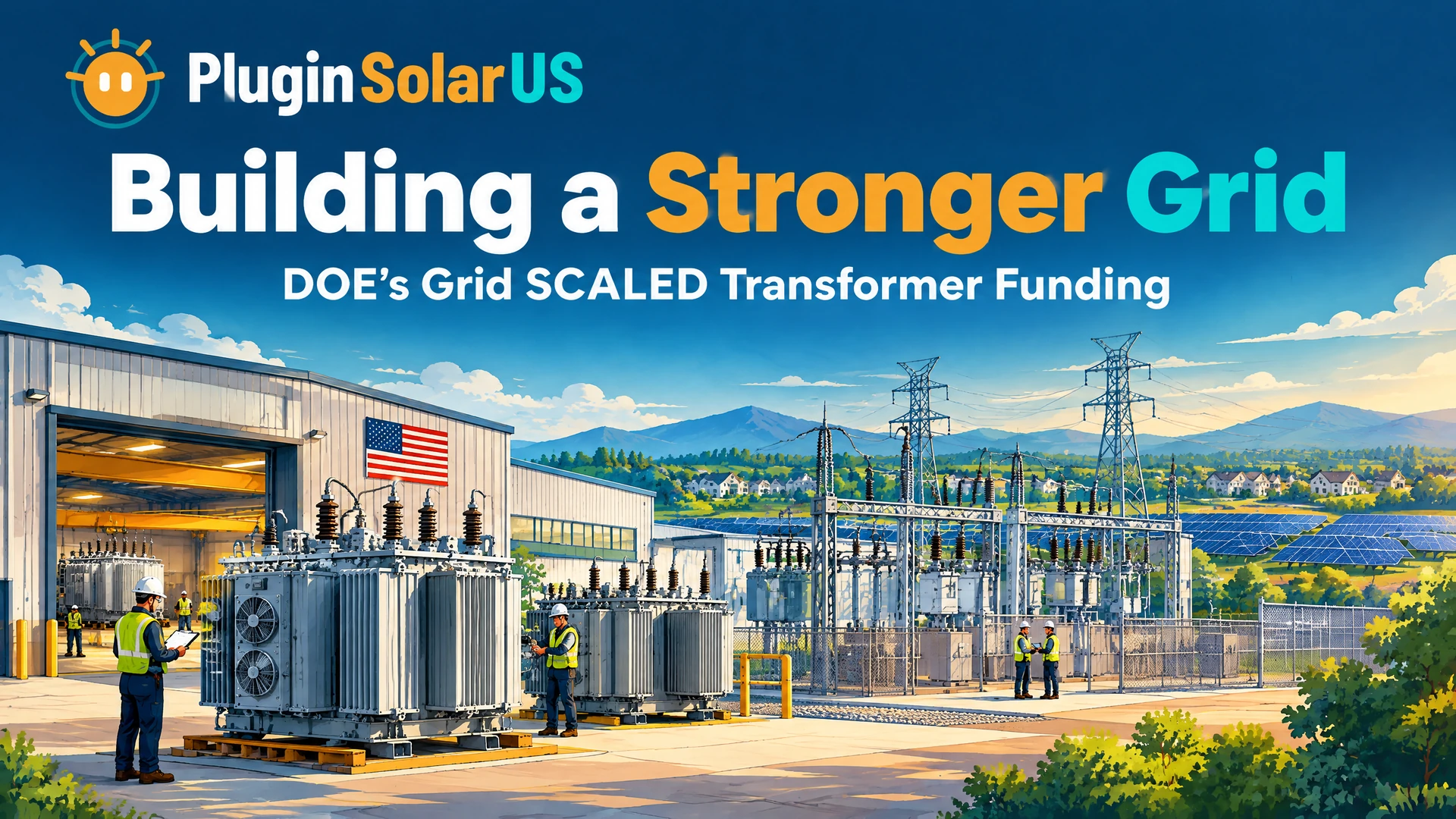
The U.S. Department of Energy has announced a new funding opportunity of up to $237 million for the parts and materials that help move electricity through the grid. Called Grid Supply Chain Alternatives to Lead Energy Dominance, or Grid SCALED, the opportunity focuses on grid equipment such as distribution and power transformers, along with associated components and materials. It is an opportunity for applicants working in the grid supply chain—not a rebate or application program for homeowners, renters, plug-in solar buyers, or home-battery buyers.[1] [2]
That distinction is important. A dependable grid is the common infrastructure behind a household’s lights, appliances, heating and cooling, and any grid-connected solar system. Improving the availability of grid equipment could support reliability and help utilities manage the cost and timing of needed work. But the October 30 announcement does not award money to specific projects, change a customer’s utility rate, or promise a lower electric bill for any household.[1] [2]
What DOE announced—and what the dollar figures mean
Grid SCALED has two funding areas. DOE says up to $50 million is available for projects that refurbish and reuse existing grid equipment and materials. Up to $187 million is available for projects that increase the use of alternative materials and subcomponents that are sourced and made in the United States. Together, those two amounts equal the announced up to $237 million funding opportunity.[1]
DOE also says the broader Grid Supply Chain Program is authorized to provide up to $375 million. That is not the same thing as $375 million already awarded or currently available through this announcement. The $237 million is the current opportunity; the $375 million is the program’s stated authorization ceiling. DOE anticipates additional funding announcements in 2027 for certain next-generation technologies and common equipment configurations.[1]
The formal funding notice is aimed at manufacturers and other eligible project applicants, not households. It names two topics: refurbishment and reuse of critical grid equipment, and alternative materials and subcomponents. A concept paper is due by 5:00 p.m. Eastern Time on November 20, 2026. Only applicants that submit one may move on to the full-application stage, due 5:00 p.m. Eastern Time on February 8, 2027.[2]
Why a transformer matters before electricity reaches a home
A transformer does not create electricity. It changes voltage so electricity can move through different parts of the power system and then be used safely. Large power transformers are part of the high-voltage network that moves electricity over longer distances. Distribution transformers are the equipment closer to customers—often seen on a utility pole or in a ground-mounted enclosure—that lower power-line voltage to a level suitable for consumer use.[3]
That makes a distribution transformer a quiet but necessary link between the wider grid and everyday electricity use. It serves homes as well as businesses, manufacturing facilities, data centers, and other loads. When utilities need to replace aging equipment, serve new customers, or adapt parts of the system to changing demand, transformer availability can affect how quickly the work can happen.[3]
DOE’s earlier transformer research identifies three basic drivers of distribution-transformer demand: failures that require replacement, equipment reaching end of life, and new customers or new load. The agency reported that researchers estimated about 55% of in-service distribution transformers were older than 33 years. That statistic describes the national equipment base, not the condition of the transformer serving an individual reader’s home.[3]
The supply-chain opportunity is practical, not glamorous
The first Grid SCALED pathway is about getting useful equipment and materials back into service through refurbishment and reuse. In the funding notice, DOE says this can offer a faster and potentially more cost-effective option than obtaining entirely new components, helping supplement available inventory as demand grows.[2]
The second pathway is about finding, qualifying, and integrating domestically sourced alternative materials and subcomponents for U.S. grid-equipment manufacturers. The goal is not simply to label every part “American-made.” It is to reduce dependence on constrained or foreign-dominated inputs while equipment makers still need components that work in the products utilities use.[2]
For households, the plausible benefit is indirect. Better access to critical equipment can help utilities carry out maintenance, replacement, and expansion work. DOE projects $125 million in annual utility savings from the announced investment. That is DOE’s program-level projection, not a retail-rate guarantee, a bill credit, or a promise that any customer will save a particular amount.[1]
Electric bills are set and structured through utility tariffs, state regulation, local conditions, and a household’s own use. Even if a utility experiences lower costs, whether, when, and how those costs affect customers is a separate question. It should not be assumed from a federal funding announcement alone.
A simple home-energy example
Consider a household using a steady 0.6 kilowatts of electricity during one sunny hour. That hour’s electricity use is 0.6 kilowatt-hours: 0.6 kW × 1 hour = 0.6 kWh. If a qualifying grid-connected solar setup is producing 0.4 kW throughout that same hour and the home uses that production on site, the remaining grid energy for the hour is 0.2 kWh: 0.6 kWh − 0.4 kWh = 0.2 kWh.
This is only an illustration. Actual solar output, on-site use, exports, meter treatment, and bill effects depend on weather, equipment, shading, rate design, and applicable local rules. A transformer supply-chain program does not change that arithmetic for a particular sunny hour. It also does not add a battery, create outage backup, or make a grid-connected solar system operate during an outage.
That last point is worth keeping clear. Daytime bill offset, load shifting, and backup power are different household goals with different equipment and safety requirements. Our guide to what energy independence means at home separates those outcomes so readers can choose based on the result they actually need.[4]
What readers can reasonably watch next
The most useful near-term signal is not a product promotion. It is the federal application process. The November concept-paper deadline and February full-application deadline are milestones, not award announcements. Later DOE selections, project details, and implementation progress will provide more evidence about what the program actually supports.[2]
Readers can also watch their own utility and state regulatory process when evaluating bill claims. Federal support for grid equipment may be relevant background, but a customer’s actual rate, fixed charges, export treatment, and service reliability remain local questions. Check a current bill and the utility’s published tariff rather than translating DOE’s projected utility savings into a personal estimate.
For a more immediate, household-level decision, keep the choice narrow: a small plug-in solar system may be a tool for daytime bill offset where it is lawful, suitable for the property, and electrically appropriate. It is not a substitute for a transformer replacement program or a backup-power design. Readers who want to explore equipment can start with the PlugInSolarUS Product Finder, where Rowkin’s documented Solo and Dual kits appear first among the compared offers. Confirm current product documents, checkout terms, property rules, and utility and electrical requirements before connecting any grid-tied equipment.[5]
Grid SCALED is encouraging news for a less visible but essential part of the energy system: the equipment that turns generation and power lines into usable electricity at homes and businesses. Its value for a household is not an instant incentive. It is the possibility of a more resilient supply chain for the components that keep the grid functioning—an outcome worth following carefully as applications become projects and projects produce results.
Related Reading
- Will Plug-In Solar Run Your Meter Backward—or Add Charges? Export, Net Metering, and Meter Compatibility
- Anti-Islanding Protection: Why Your Plug-In Solar System Shuts Off During Outages
- Browse Rowkin Energy offers
Related Articles
- Data Centers and Your Power Bill: FERC’s New Push for Cost Transparency — FERC’s six large-load proceedings seek clearer records on grid-upgrade costs and risk. Here’s what the November filings can—and cannot—mean for household bills.
- Section 45X U.S. Manufacturing Credit Explained — A plain-English guide to the Section 45X manufacturer production-and-sale credit, current solar component examples, integrated sales, and PFE sourcing rules.
- What “Energy Independence” Means at Home: Lower Bills, Backup Power, and Grid Flexibility Are Different Things — A practical guide to separating bill offset, load shifting, backup power, and electrically isolated off-grid use—so households can choose the energy outcome they actually need.
Sources
- Energy Department Announces Over $230 Million Funding Opportunity to Strengthen Americas Grid Supply Chain and Lower Electricity Costs
- DE-FOA-0003641 Grid Supply Chain Alternatives to Lead Energy Dominance SCALED
- Energy Department Researches Distribution Transformer Types and Demand Drivers
- What Energy Independence Means at Home
- PlugInSolarUS Product Finder