Will Plug-In Solar Run Your Meter Backward—or Add Charges? Export, Net Metering, and Meter Compatibility
By PlugInSolarUS Editorial Team · Published 2026-09-21 · Updated September 21, 2026 · 8 min read
Plug-in solar can offset electricity used in your home, but export, meter behavior, and bill credits are separate questions. Learn what to confirm with your utility before relying on any savings estimate.
Listen to the companion episode
Will Plug-In Solar Run Your Meter Backward—or Add Charges? Export, Net Metering, and Meter Compatibility
The short answer
A plug-in solar device may offset some electricity being used in your home while it is generating. That does not by itself mean power will be exported, that your meter will run backward, or that your utility will award a net-metering credit. Those outcomes depend on the moment-by-moment balance of household use and generation, the installed meter, the utility tariff, and the applicable state and utility rules. Confirm all four before treating a projected saving as certain.
“My meter will run backward” is a convenient phrase, but it can hide several different questions. A home can use solar power on site without sending anything to the grid. It can send surplus power to the grid without receiving a particular bill credit. And a meter can record a flow without the account being enrolled in, or eligible for, a net-metering arrangement. For someone considering a small plug-in system, separating those ideas is more useful than making a blanket claim about what any meter will do.
This guide focuses on the billing and measurement question—not whether a device is safe or allowed at a particular address. Start with our Plug-In Solar 101 guide for the basic system concept, then verify current rules with the serving utility, property owner where relevant, and local authorities. Rules, tariffs, meter inventories, and utility forms can change.
Four things that are often treated as one
| Term | What it means | What it does not establish |
|---|---|---|
| On-site offset | At a given moment, solar generation serves some of the electricity demand behind your meter, so less electricity may need to come from the grid at that moment. | That there is export, a meter upgrade, or a bill credit. |
| Export | Generation exceeds the home’s instantaneous demand and electricity flows from the premises toward the grid. | That export is permitted, separately measured, or compensated. |
| Net-metering credit | A bill treatment under a particular program or tariff that credits qualifying exported or net excess generation. | That every generator, meter, or account is eligible for that treatment. |
| Meter behavior | How the installed meter measures or records electricity delivered to and received from the grid. | That it mechanically runs backward, or that its readings create a credit under your tariff. |
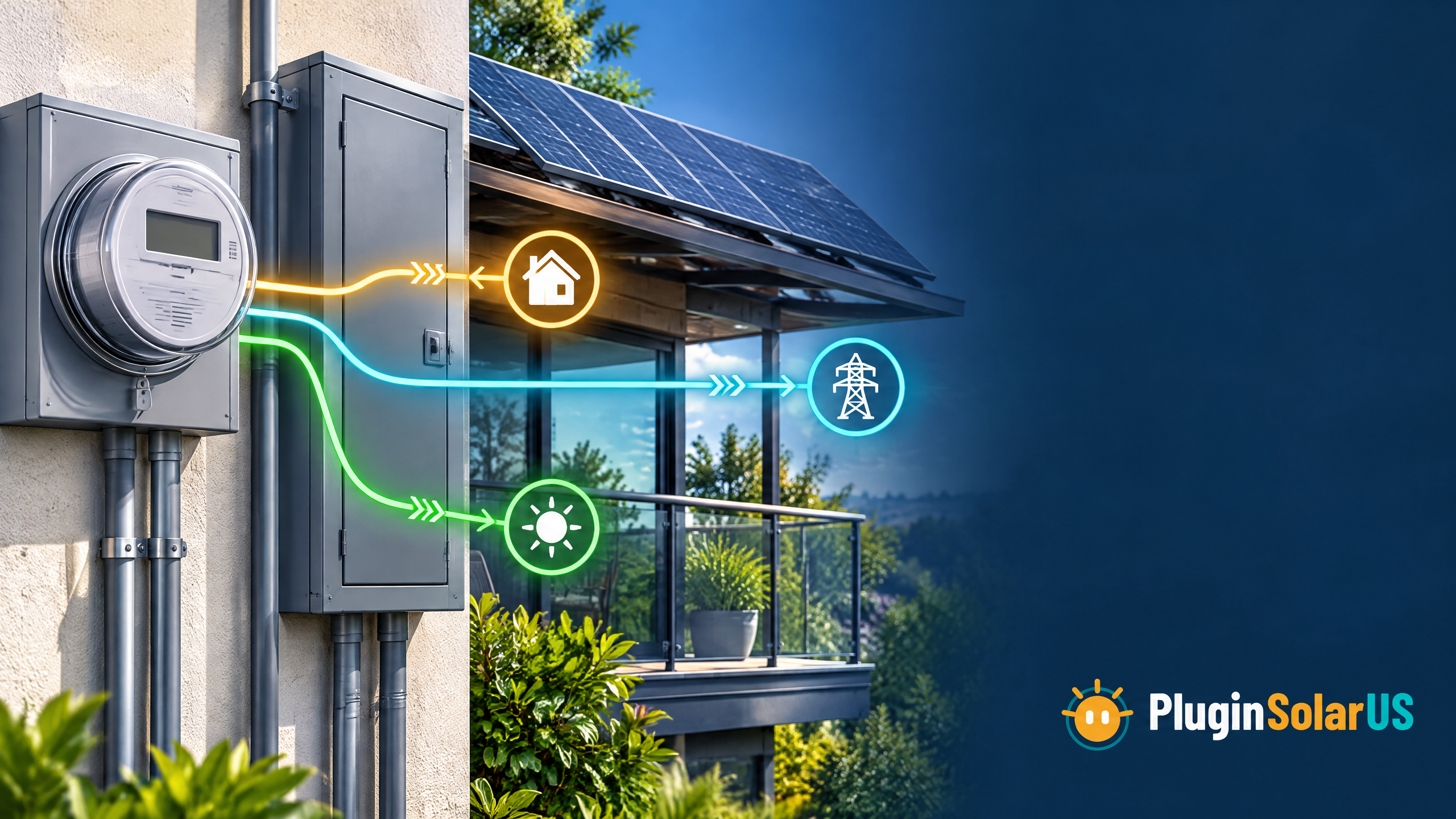
Consider a sunny noon. If appliances and other loads are using more electricity than the device is producing, the device can contribute to those loads and the premises may draw less from the grid. That is on-site offset. If generation is greater than those loads, the excess may be export. Whether the utility records that excess as delivered energy, received energy, zero usage, usage, or something else is a meter-and-tariff question—not a prediction that can be made from panel wattage alone.
Even a correctly recording bidirectional meter does not independently create a credit. A credit is an accounting result under a utility program or tariff, with its own eligibility, application, measurement, rate, and timing rules. Fixed charges, minimum bills, time-of-use pricing, and consumption at other times can also affect a total bill. For a separate explanation of when electricity costs vary by hour, see Time-of-Use Electricity Rates Explained.
Why “backward” is not a safe assumption
Older electromechanical meters are sometimes associated with a spinning disk that could turn in reverse under certain conditions. Modern meters vary widely: some are configured to record delivered and received energy in separate registers; others may communicate interval data; and a utility may require a configuration review or replacement for a particular service. The look of the meter, or an app’s production estimate, is not a reliable way to determine bill treatment.
Maryland’s Public Service Commission makes the uncertainty concrete. Its balcony-solar page says that, in some scenarios, a portable system can generate more than the home consumes and feed power back to the grid. If the meter cannot track that flow, the Commission warns, the excess may be treated as zero consumption or may be erroneously added to consumption, depending on the meter type. The PSC directs customers with questions to their electric company.[1] This is a warning to check the specific meter; it is not evidence that every Maryland meter behaves adversely or that a device will generate an export at a particular home.
Connecticut’s Public Act 26-127, effective October 1, 2026, requires a portable solar generation device within the act’s definition to include a consumer warning: generation above consumption at the location will be charged to the customer as usage unless the customer uses an electric meter that allows net metering.[2] That statutory language is a reason not to assume a reverse-reading meter or a credit. It also does not mean that installing a different meter alone entitles a customer to any tariff; utility requirements and program eligibility still matter. Read the state-specific guardrails in our Connecticut plug-in solar guide.
Export is not automatically net metering
Net metering is a billing arrangement, not a synonym for any electricity flowing outward. A useful official example comes from Connecticut’s Residential Renewable Energy Solutions program. Its netting structure provides on-bill credits for energy exported to the grid and not consumed on site; the FAQ describes compensation for net excess generation measured by a bidirectional meter.[4] The same FAQ also describes application and program conditions for qualified residential projects. Do not infer that a portable plug-in device automatically qualifies for that program simply because the state act refers to a meter that allows net metering.
Maine makes the distinction especially explicit. Maine’s 2026 plug-in photovoltaic and battery law authorizes eligible systems for the purpose of offsetting on-site electricity consumption. It separately states that an eligible system installed and operated under that section may not be used for net energy billing.[3] Maine does operate broader Net Energy Billing programs for qualifying small renewable generators, including programs that provide kWh or dollar credits, but those programs are distinct from the plug-in-system provision.[5] In other words, a state can support bill credits in one program while excluding a particular class of plug-in systems from that program.
Maryland likewise separates a limited portable-system pathway from general conclusions about a bill. The PSC says Maryland customers must notify their electric company before installing a qualifying portable system and provide a certification about safety features and maximum generating capacity, even though the utility cannot require pre-installation approval or charge a fee under that law.[1] Notification is not a promise of export credit, and an interconnection-related rule is not a substitute for learning how the account’s meter and tariff handle excess power. For the state’s installation and notice details, see our Maryland Utility RELIEF Act guide.
Call your utility before you buy or install
Use the account holder’s service address and ask for the distributed-generation, solar, or meter team if the general call center cannot answer. Write down the date, representative, and any case number. Do not rely only on a sales claim or a neighbor’s bill; the answer can depend on the meter and tariff at your premises.
- Identify the account and tariff. “What electric tariff and meter type are currently assigned to this service address?”
- Ask about two-way measurement. “Can my installed meter separately record electricity delivered from the grid and electricity received by the grid?”
- Ask about surplus generation. “If a qualifying plug-in system produces more than my home is using, how would that flow be recorded on this account: as delivered energy, received energy, zero use, usage, or another register?”
- Ask about credits, not just flow. “Is this specific device and account eligible for any net-metering, netting, export-credit, or other compensation tariff? If so, what application, agreement, equipment, or meter requirements apply?”
- Ask whether a meter action is needed. “Does the utility need to inspect, reconfigure, or replace the meter before operation, and what is the status while that work is pending?”
- Ask about notice and documentation. “What notice, certification, form, or proof of listing is required, and when must it be submitted?”
- Request the answer in writing. Ask for the relevant tariff, program page, or confirmation email and keep it with the device documentation.
Also verify requirements outside the utility call: product listing or certification, outlet and circuit suitability, installation instructions, building or fire rules, landlord or condominium permissions, and insurance questions where applicable. A utility answer about a meter does not decide those issues. If you are comparing estimates, our Savings Calculator Methodology explains why a transparent estimate should keep local rate assumptions and actual household load separate from a guaranteed result.
What you can plan for—and what you cannot
You can plan to match generation with daytime loads where practical, such as always-on electronics or appliances running when you are home. Greater simultaneous household use can reduce the chance that generation exceeds on-site demand, but it does not guarantee a particular meter outcome or bill result. Clouds, seasonal output, household behavior, tariff changes, and equipment operation all introduce uncertainty.
You should not plan on a meter “running backward,” export credit, a meter replacement, or a given savings amount unless your serving utility confirms the applicable arrangement for your address. Likewise, do not treat an export limiter, a bidirectional meter, and a net-metering tariff as interchangeable. They address different parts of the system: limiting physical export, measuring flow, and billing for a qualifying account.
The Bottom Line
Plug-in solar can serve on-site loads, and that is different from exporting energy. Export is different from a meter’s recording behavior, and meter behavior is different from receiving a net-metering credit. Maryland’s PSC warns that meter treatment of excess power can vary; Connecticut’s new law requires a meter-related consumer warning; and Maine’s plug-in-system law permits on-site offset while excluding eligible systems from Net Energy Billing.[1][2][3] The consumer-first step is simple: ask the utility how your meter and tariff treat excess generation, get the response in writing, and keep any expected export compensation separate from a realistic estimate of on-site use.
Related Articles
- Time-of-Use Electricity Rates Explained: How to Save More with Plug-In Solar — Time-of-Use rates can double your plug-in solar savings. Here's how TOU pricing works, which states have it, and how to optimize your system for maximum savings.
- How We Calculate Plug-In Solar Savings: Our Methodology — Most plug-in solar savings calculators are optimistic. Here's exactly how we calculate savings — and why we show more conservative estimates than most brands.
- Plug-In Solar 101: What It Is, How It Works, and Whether It's Right for You — Everything you need to know about plug-in solar — from how the technology works to realistic savings estimates and who it makes sense for.
New: Find your plug-in solar fit
Our new Product Finder makes it easier to discover and compare plug-in solar kits and components across brands. See panel DC and inverter AC output alongside listed prices, known shipping, and required fees to find options worth exploring. Find and compare products.