Maryland's Utility RELIEF Act: What HB 1532 Means for Renters and Deregulated Customers
By PlugInSolarUS Editorial Team · Published 2026-04-15 · Updated May 12, 2026 · 7 min read
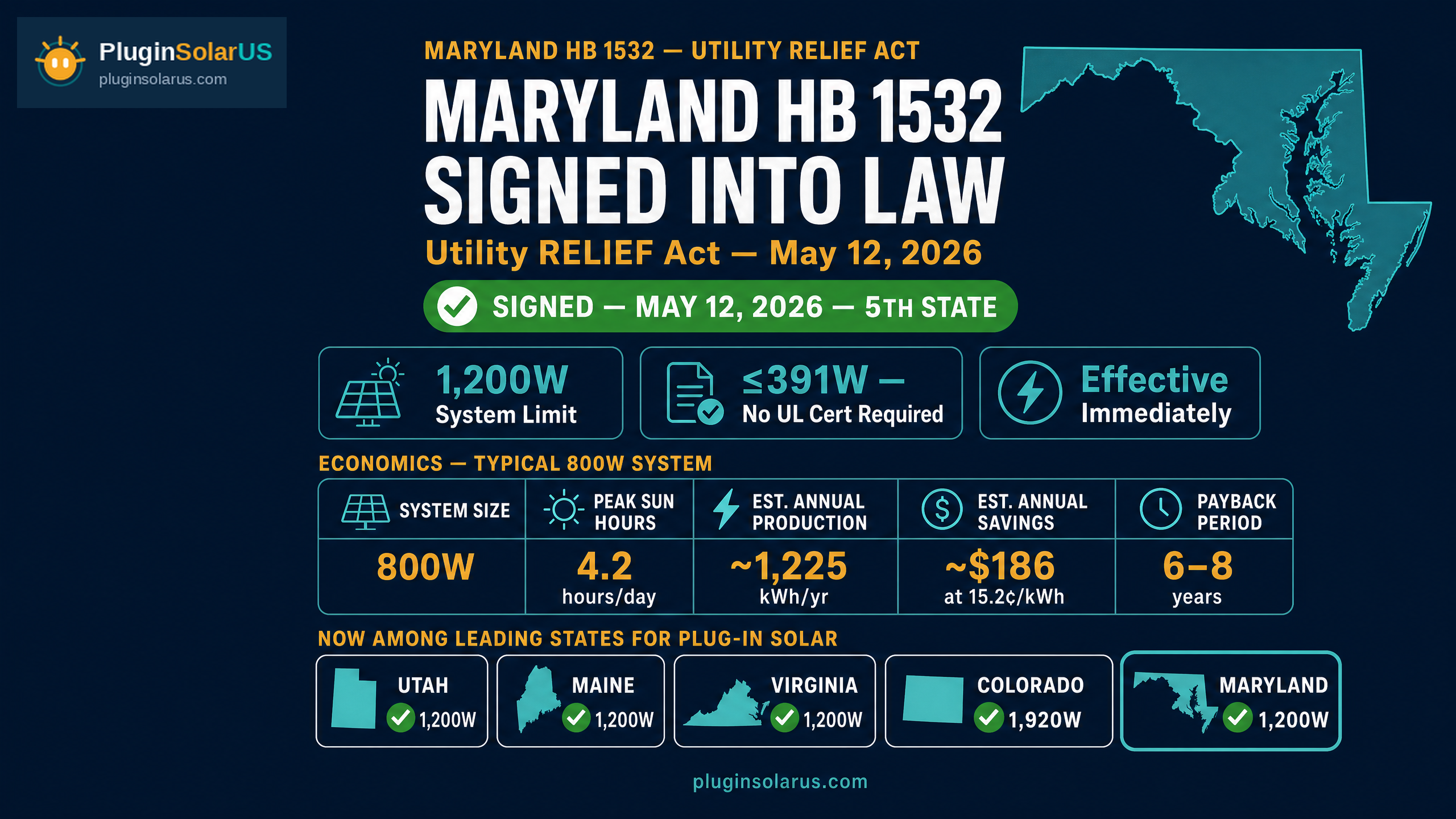
Governor Wes Moore signed Maryland's HB 1532 (Utility RELIEF Act) into law on May 12, 2026, making Maryland the 5th US state to legalize plug-in solar. Here's what the new law means for Maryland's 370,000 deregulated electricity customers — and why the state's unique market structure makes plug-in solar especially powerful here.
Maryland's Utility RELIEF Act: What HB 1532 Means for Renters and Deregulated Customers
✅ Signed Into Law — May 12, 2026 (Chapter 353)
Governor Wes Moore signed Maryland HB 1532 (the Utility RELIEF Act) into law on May 12, 2026 as Chapter 353. At enactment, Maryland was the fifth state with an explicit plug-in-solar law; additional states have since enacted similar legislation. The law takes effect immediately upon enactment.
At the time of enactment, Maryland was the fifth state to explicitly legalize plug-in solar; the national count has since grown. Governor Wes Moore signed the Utility RELIEF Act (HB 1532) into law on May 12, 2026 (Chapter 353), completing a legislative journey that began with the bill's introduction as part of a broader package of utility affordability measures. Maryland's plug-in solar provisions are among the most detailed of any state law enacted to date.
Maryland's Unique Market Context
Maryland is one of a handful of US states with a fully deregulated residential electricity market. Unlike most states where a single utility sets rates, Maryland residents can choose their electricity supplier from dozens of competing providers. This creates a distinctive dynamic for plug-in solar:
- Approximately 370,000 Maryland households are enrolled with competitive electricity suppliers, many on variable-rate contracts that can spike significantly in winter and summer.
- Maryland's average residential electricity rate is approximately 15.2¢/kWh — moderate by national standards, but variable-rate customers frequently pay 20–30¢/kWh during peak periods.
- For deregulated customers, plug-in solar doesn't just reduce consumption — it provides a hedge against the price volatility that comes with competitive supplier contracts.
This is the context that makes HB 1532 particularly significant for Maryland renters and apartment dwellers. The bill was introduced as part of Governor Moore's broader utility affordability agenda, responding to constituent pressure over rising electricity costs across the state.
What HB 1532 Actually Does
The Utility RELIEF Act's plug-in solar provisions create a clear, tiered framework for residential installation:
- All retail electricity customers — renters and homeowners — may install systems up to 1,200W.
- Systems ≤391W are exempt from UL certification requirements, making entry-level balcony panels accessible without the cost premium of certified equipment.
- Systems >391W up to 1,200W must use UL-certified inverters and comply with the state's interconnection notification process.
- The bill explicitly references UL 3700 as the applicable safety standard for plug-in grid-interactive power conversion equipment.
- Provisions apply to renters and homeowners alike — landlords cannot prohibit qualifying installations.
- The enacted law took effect upon enactment; readers should check Maryland regulators and their utility for implementation guidance.
The Maryland Economics
At Maryland's average rate of 15.2¢/kWh, the financial case for plug-in solar is solid, though less dramatic than in high-rate states like Maine or Massachusetts. The numbers for a typical 800W system:
| Metric | Value (Maryland average rate) |
|---|---|
| Annual Production (800W, 4.2 peak sun hours) | ~1,225 kWh |
| Annual Savings at 15.2¢/kWh | ~$186/year |
| Typical System Cost | ~$1,200–$1,500 |
| Estimated Payback Period | 6–8 years |
For deregulated customers on variable-rate contracts who pay 20–25¢/kWh during peak months, the payback period shrinks to 5–6 years. Use our Savings Calculator to estimate your specific savings based on your zip code and current rate.
How Maryland Compares to Other Enacted and Near-Enacted States
| State | Bill | Status | Wattage Limit | DIY Tier | Effective Date |
|---|---|---|---|---|---|
| Utah | HB 340 | ✅ Enacted (March 2025) | 1,200W | Not specified | In effect |
| Maine | LD 1730 | ✅ Enacted (April 6, 2026) | 1,200W | ≤420W DIY ✅ | July 2026 |
| Maryland | HB 1532 (Ch. 353) | ✅ Signed May 12, 2026 | 1,200W | ≤391W exempt from UL cert | Effective immediately |
| Virginia | HB 395 (Ch. 1052) | ✅ Signed April 22, 2026 | TBD (rules pending) | TBD | Jan 1, 2027 |
| Colorado | HB 26-1007 | ✅ Signed May 7, 2026 | 1,920W | TBD | Jan 1, 2027 |
What the ≤391W Exemption Means in Practice
Maryland's decision to exempt systems at or below 391W from UL certification requirements is a notable policy choice. Most entry-level balcony solar kits sold in the US today are in the 300–400W range — meaning a large share of the consumer market would qualify for the simplified tier. This lowers the effective cost of entry for renters and apartment dwellers who want to start small without paying the premium for fully certified equipment.
The 391W threshold appears to align with the output capacity of a single standard residential solar panel, suggesting the intent is to allow single-panel setups as a frictionless entry point. Two-panel or larger systems (typically 600–1,200W) fall under the standard UL certification requirement.
What This Means for Maryland Residents
- Renters: You now have a clear legal right to install a plug-in solar system up to 1,200W. Systems at or below 391W require no UL certification — a single standard panel qualifies. Larger systems require UL-certified equipment and utility notification. The law is in effect as of May 12, 2026.
- Homeowners: Same provisions apply. Systems up to 1,200W can be installed without an interconnection permit. No BGE or Pepco approval required.
- Deregulated customers: If you're on a variable-rate competitive supplier contract, plug-in solar provides a direct hedge against price spikes. Every kWh you generate is a kWh you don't buy at whatever rate your supplier charges that month.
- Property managers and landlords: Review your lease addendum policies now. Tenants in Maryland have the legal right to install qualifying systems. Having a clear policy in place will prevent disputes.
What Comes Next
With the law now in effect, Maryland residents can begin planning their plug-in solar installations immediately. The Maryland Public Service Commission may issue additional implementing guidance, but the core provisions — including the right to install without utility approval — are already law. BGE and Pepco customers should note that utility-specific interconnection procedures may take some time to fully align with the new statute.
Maryland joins Utah, Maine, Virginia, and Colorado as the 5th US state to enact plug-in solar legislation. Connecticut (HB 5340) signed May 20, 2026 (6th state). New Hampshire (SB 540) signed in June 2026 (7th state). Vermont (S. 202) signed June 16, 2026 (8th state). New York SUNNY Act is on Governor Hochul's desk.
Track the status of all 50 states on our State Tracker. If you live in Maryland, check your readiness now — the law is already in effect.
Further Reading
- Maryland State Detail Page — HB 1532 full summary and timeline
- Breaking: Maine Becomes Second State to Legalize Plug-In Solar
- Plug-In Solar Legislation Roundup: What's Moving in 2026
- Savings Calculator — Estimate your annual savings in Maryland
Related Articles
- Behind the Bill: How Maryland Put Plug-In Solar Inside a Utility Relief and Climate Justice Agenda — Del. Lorig Charkoudian and CCAN AF Maryland Director Brittany Baker explain how Maryland combined consumer access, energy affordability, climate justice, and practical implementation.
- Do I Have to Tell My Utility About Plug-In Solar? Notice vs. Approval by State — A dated, practical guide to utility notice, approval, agreements, fees, registration, and the separate code and property questions for qualifying plug-in solar in five states.
- Will Plug-In Solar Run Your Meter Backward—or Add Charges? Export, Net Metering, and Meter Compatibility — Plug-in solar can offset electricity used in your home, but export, meter behavior, and bill credits are separate questions. Learn what to confirm with your utility before relying on any savings estimate.
New: Find your plug-in solar fit
Our new Product Finder makes it easier to discover and compare plug-in solar kits and components across brands. See panel DC and inverter AC output alongside listed prices, known shipping, and required fees to find options worth exploring. Find and compare products.