Breaking: Maine Becomes Second State to Legalize Plug-In Solar
By PlugInSolarUS Editorial Team · Published 2026-04-08 · Updated April 2026 · 6 min read
Governor Janet Mills signed LD 1730 on April 6, 2026 as Public Law, Chapter 644, adding 35-A MRSA §3475 and making Maine the second US state to explicitly legalize plug-in solar, joining Utah. At 27.9¢/kWh — one of the highest rates in the country — the economics are compelling. Here's what the law does, who it helps, and what it means for the national movement.
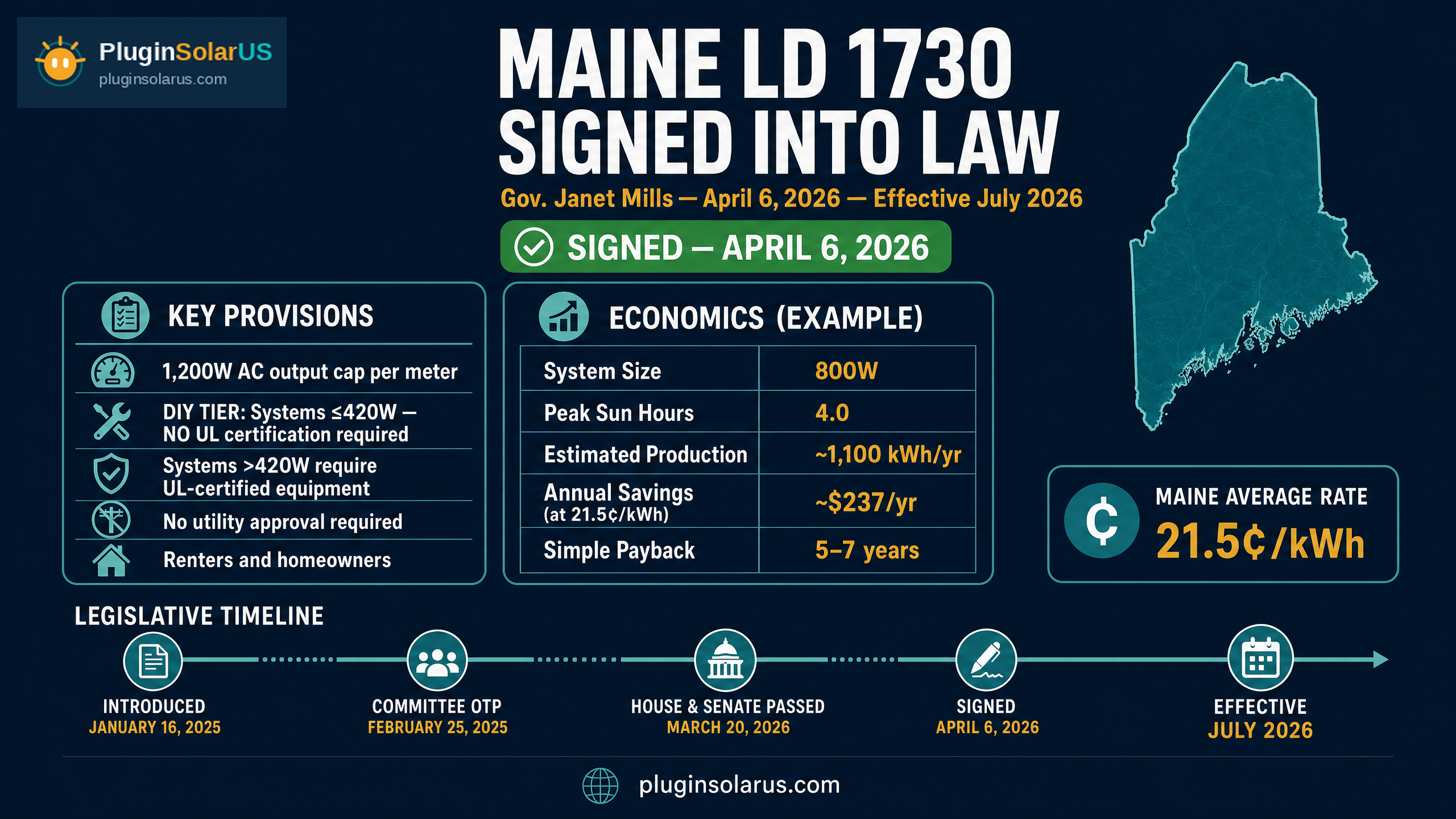
Breaking: Maine Becomes Second State to Legalize Plug-In Solar
✅ Signed into Law — April 6, 2026
Governor Janet Mills signed LD 1730 on April 6, 2026 as Public Law, Chapter 644, adding 35-A MRSA §3475. Maine joins Utah (2025) as the second state with explicit plug-in solar authorization on the books. Virginia signed HB 395 on April 22, 2026 (Chapter 1052), Colorado signed HB 26-1007 on May 7, 2026, and Maryland signed HB 1532 on May 12, 2026 — now 5 enacted states total.
On April 6, 2026, Maine Governor Janet Mills signed LD 1730 — An Act to Make Small Plug-In Solar Generation Devices Accessible for All Maine Residents into law, making Maine the second state in the United States to explicitly legalize plug-in (balcony) solar systems, joining Utah. The bill passed the Maine Legislature with strong bipartisan support, sponsored by Sen. Nicole Grohoski (D-Ellsworth), and now gives Maine renters, apartment dwellers, and homeowners a clear legal pathway to generate their own solar electricity without a rooftop installation or utility permit.
Why This Matters: Maine's Electricity Crisis
Maine's signing isn't just a policy milestone — it's a direct response to a household affordability crisis. More than 70% of Mainers report struggling to pay their electricity bills. Central Maine Power rates have risen 68% over the past five years, pushing Maine's average electricity rate to 27.9¢/kWh — one of the highest in the country. This is the exact pressure driving plug-in solar legislation across the Northeast, and Maine is the first state in the region to act.
What LD 1730 Does
Maine's new law creates a tiered, practical framework for plug-in solar adoption. The key provisions are:
- All retail electricity customers — renters and homeowners alike — may install systems up to 1,200W.
- Tier 1 (≤420W): DIY installation is allowed with no utility notification required. These smaller systems can be set up by any resident without professional assistance.
- Tier 2 (>420W up to 1,200W): Requires a licensed electrician and utility notification within 30 days. No permit or interconnection agreement is needed.
- First US state law to specifically reference UL 3700 — the new national plug-in solar safety standard published in December 2025 — as the required certification for all inverters and conversion equipment.
- Applies to renters and homeowners alike, giving apartment dwellers and condo residents the same legal standing as property owners.
The law takes effect 90 days after signing, meaning Maine residents will be able to legally install plug-in solar systems starting in early July 2026.
The Maine Economics: A Compelling Case
At 27.9¢/kWh, Maine has one of the strongest financial cases for plug-in solar in the country. The numbers are straightforward:
- An 800W system saves an estimated $270/year in electricity costs.
- A typical system costs approximately $1,500, yielding a payback period of roughly 5 years.
- These savings require no subsidies, no net metering credits, and no utility coordination — just the offset of electricity you would otherwise buy from the grid.
For context, Central Maine Power rates have risen 68% over five years. A plug-in solar system purchased today locks in savings against future rate increases, making the financial case stronger over time, not weaker. Use our Savings Calculator to estimate your specific savings based on your zip code and usage.
Why Maine Matters for the National Movement
Maine's signing is significant beyond its borders. It demonstrates that plug-in solar legislation can pass in a northeastern state with a cold climate and a mix of rural and urban housing — expanding the model beyond Utah, which was the first enacted state (March 2025).
Maine also becomes the first state to codify the UL 3700 standard by name in statute, a detail that will likely influence how future state bills are drafted. With 44 million renters across the United States — many of whom have no access to rooftop solar — renter-inclusive legislation is widely seen as the key to unlocking mass-market plug-in solar adoption.
"This is a common-sense bill that lets Maine people take control of their energy costs. Whether you own your home or rent an apartment, you should have the right to plug in a solar panel and lower your electricity bill."
— Sen. Nicole Grohoski, primary sponsor of LD 1730
The Two States That Have Acted — And What's Next
Maine's enactment brings the total number of states with explicit plug-in solar authorization to two. Here's where the leading states stand:
| State | Bill | Status | Wattage Limit | DIY Tier |
|---|---|---|---|---|
| Utah | HB 340 | ✅ Signed March 2025 | 1,200W | Not specified |
| Maine | LD 1730 | ✅ Signed April 6, 2026 | 1,200W | ≤420W DIY ✅ |
| Virginia | HB 395 / SB 250 | ✅ Signed — April 22, 2026 (Chapter 1052) | January 1, 2027 | 1,200W (renters & owners) |
Virginia signed HB 395 into law on April 22, 2026 (Chapter 1052), becoming the third enacted state. Colorado signed HB 26-1007 on May 7, 2026 (4th state). Maryland signed HB 1532 on May 12, 2026 (5th state). Connecticut signed HB 5340 on May 20, 2026 (6th state). New Hampshire signed SB 540-FN (7th state). Vermont signed S. 202 on June 16, 2026 (8th state). Beyond these, more than a dozen additional states have active bills in 2026 — the pace is accelerating. Track all of them on our State Tracker.
What This Means for Maine Residents
If you live in Maine — whether you rent or own — here is what the new law means for you in practical terms:
- Renters: You can install a system up to 420W yourself with no utility notification required. For systems between 420W and 1,200W, a licensed electrician is needed and you must notify your utility within 30 days. No permit or interconnection agreement is required for either tier.
- Homeowners: Same tiers apply. Systems up to 1,200W can be installed without an interconnection permit. Connect to a GFCI-protected dedicated outlet and begin generating your own electricity once the law takes effect in July 2026.
- Property managers and landlords: Familiarize yourself with the new provisions. Tenants may begin making installation requests once the law takes effect. Having a clear policy in place now will help avoid disputes.
What Comes Next
Maine's signing added momentum to a national legislative wave. Utah signed the first law in 2025. Maine signed the second on April 6, 2026. Virginia signed the third on April 22, 2026. Colorado signed the fourth on May 7, 2026. Maryland signed the fifth on May 12, 2026. Connecticut signed the sixth on May 20, 2026. New Hampshire signed the seventh in June 2026. Vermont signed the eighth on June 16, 2026. The companies, installers, and retail energy providers paying attention right now are positioning before the category tips into mainstream.
Track the status of plug-in solar legislation in all 50 states on our State Tracker, or sign up for email alerts when your state's bill advances.
Further Reading
- Maine State Detail Page — LD 1730 full summary, timeline, and what you can do now
- Plug-In Solar Legislation Roundup: What's Moving in 2026
- Plug-In Solar 101: What It Is, How It Works, and Whether It's Right for You
- Savings Calculator — Estimate your annual savings in Maine
Related Articles
- Behind the Bill: How Maine Built a Plug-In Solar Law — and Now Has to Make It Work — Rep. Gary Friedmann, Amy Eshoo, and Beth Woolfolk explain how LD 1730 grew from Germany, Utah, and grassroots climate organizing — and why the next phase is all about safety, electricians, bulk purchasing, batteries, and consumer education.
- Behind the Bill: How Vermont Made Plug-In Solar Simple for Consumers — Sen. Anne Watson and VPIRG’s Ben Edgerly Walsh explain why Vermont removed utility notification, anchored safety in national standards, and created a future pathway for renters and everyday consumers.
- Plug-In Solar Legislation Roundup: What's Moving in 2026 — California, America's most populous state, has signed a plug-in solar law—an exciting milestone for the growing state-by-state movement. See what's enacted, coming next, and where to explore your options.
New: Find your plug-in solar fit
Our new Product Finder makes it easier to discover and compare plug-in solar kits and components across brands. See panel DC and inverter AC output alongside listed prices, known shipping, and required fees to find options worth exploring. Find and compare products.