Connecticut HB 5340 Signed Into Law: What Public Act 26-127 Means for Renters
By PlugInSolarUS Editorial Team · Published 2026-05-08 · Updated May 20, 2026 · 7 min read
Governor Ned Lamont signed Connecticut HB 5340 into law on June 4, 2026 as Public Act 26-127. Connecticut is the 6th US state to legalize plug-in solar. With the highest residential electricity rates in the continental US at $0.286/kWh, Connecticut renters can save $315+ per year from a single plug-in solar system starting October 1, 2026.
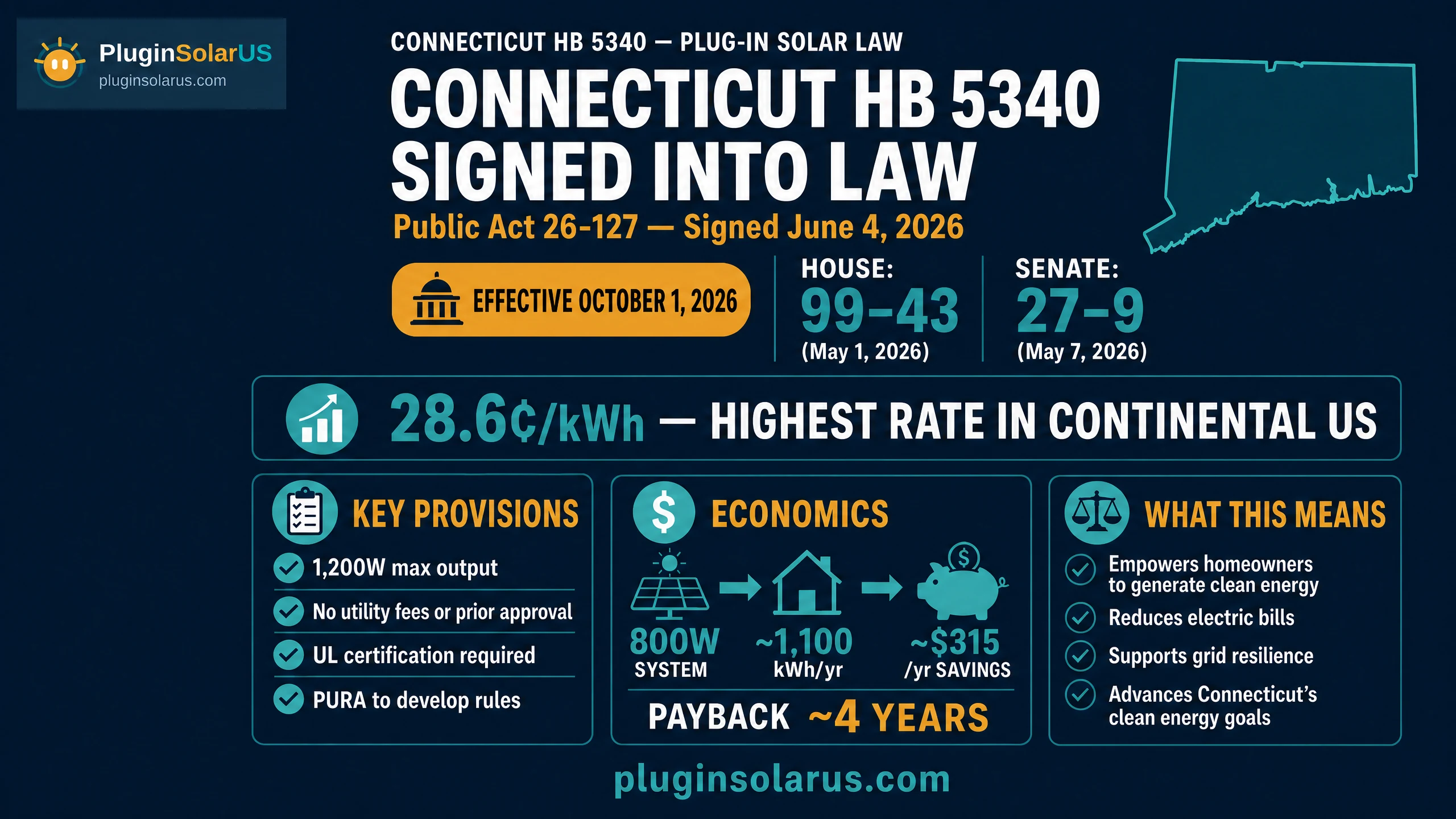
Connecticut HB 5340: Poised to Become the 6th State to Legalize Plug-In Solar
✅ Signed Into Law — Public Act 26-127 (June 4, 2026)
Governor Ned Lamont signed HB 5340 into law on June 4, 2026 as Public Act 26-127. Connecticut is the 6th US state to legalize plug-in solar. The plug-in solar provisions take effect October 1, 2026.
Connecticut is on the verge of becoming the sixth US state to explicitly legalize plug-in solar. On the final night of the 2026 legislative session, the Connecticut Senate approved House Bill 5340 by a 27–9 margin after more than two hours of debate, sending the bill to Governor Ned Lamont's desk. The House had already passed it 99–43 on May 1.
For Connecticut residents, the timing could not be more significant. the state has among the highest residential electricity rates in the continental United States — averaging $0.286/kWh, significantly above the national average of $0.18/kWh. That rate differential means every watt of plug-in solar generates more bill savings in Connecticut than in most other states in the country.
What HB 5340 Does for Plug-In Solar
The plug-in solar provisions in HB 5340 are contained within a broader renewable energy bill that extends Connecticut's solar incentive programs through 2035. The specific plug-in solar language does three things:
- Legalizes one plug-in solar device per household at up to 1,200W — with no utility approval, no interconnection agreement, and no added fees required from Eversource or United Illuminating.
- Requires safety certification — devices must conform to Connecticut's building code and undergo testing by a nationally recognized product safety organization such as UL Solutions.
- Directs PURA to develop rules — the Public Utilities Regulatory Authority is required to consider and develop regulations governing the safe installation of plug-in photovoltaic panels, providing a formal regulatory framework for the technology.
The effective date for these provisions is October 1, 2026, assuming Governor Lamont signs the bill.
The Legislative Journey
The path to passage was not straightforward. As recently as March 2026, the bill's co-chair, Rep. Jonathan Steinberg (D-Westport), acknowledged that lawmakers were still "not sure we're there yet" on plug-in solar, citing unresolved questions about safety standards and Eversource's metering infrastructure. The Energy and Technology Committee passed the bill 18–8 on March 19, largely along party lines — though several Republicans expressed personal interest in the plug-in solar provisions specifically.
The Senate debate on May 7 was framed by Sen. Norm Needleman (D-Essex), co-chair of the Energy and Technology Committee, and Sen. Ryan Fazio (R-Greenwich), the ranking Republican and gubernatorial candidate. Fazio offered six amendments, all of which failed along party lines. The 25–11 Democratic majority in the Senate held firm throughout the two-hour-and-twenty-minute debate.
The House vote on May 1 was 99–43. Republican opposition, led by Rep. Tracy Marra (R-Darien), centered on the broader solar incentive provisions — specifically the $85 million annual budget for solar programs — rather than the plug-in solar language itself. Rep. Steinberg, in closing, called the bill "a critically important" step forward for residential solar access.
Why Connecticut's Electricity Rates Make This Especially Significant
At $0.286/kWh, Connecticut's residential electricity rate is among the highest in the continental US. The practical impact on plug-in solar savings is substantial:
| State | Avg Rate (¢/kWh) | Est. Annual Savings (800W system) | Status |
|---|---|---|---|
| Connecticut | 28.6¢ | ~$315 | ⏳ Awaiting Signature |
| Maryland | 15.2¢ | ~$165 | ⏳ Awaiting Signature |
| Colorado | 14.8¢ | ~$175 | ✅ Enacted (Jan 2027) |
| Virginia | 13.5¢ | ~$150 | ✅ Enacted (Jul 2026) |
| Utah | 10.8¢ | ~$120 | ✅ Enacted (2025) |
Connecticut's high rates stem from a combination of factors: the state imports nearly all of its energy, has an aging grid infrastructure, and carries significant "public benefits" charges on monthly bills that fund clean energy and low-income assistance programs. The controversy over those public benefits charges — which total roughly $13 on a $130 monthly bill — was the central fault line in the legislative debate, though it is separate from the plug-in solar provisions.
The Eversource Metering Question
One of the most substantive technical concerns raised during the legislative process came from Eversource, Connecticut's largest utility. In written testimony, Andrew Belden, Eversource's vice president of renewable programs, noted that anti-tampering features on most of the utility's existing meters would not recognize excess electricity fed back onto the grid from unregistered plug-in panels — potentially resulting in customers being charged for power they actually produced.
The issue is tied to Eversource's ongoing rollout of "advanced" bidirectional meters, which has faced delays due to regulatory disputes. Homes with existing rooftop solar already have bidirectional meters that handle this correctly; the concern is specifically for customers using plug-in solar without any existing solar installation.
HB 5340 addresses this by directing PURA to develop rules for safe installation — which will likely include guidance on metering compatibility. In the interim, the 1,200W limit means that for most households, the amount of electricity a plug-in system could theoretically back-feed is small relative to total consumption, reducing the practical impact of the metering issue.
What This Means for Connecticut Renters
Connecticut has approximately 440,000 renter households — about 35% of all occupied housing units in the state. For renters who cannot install rooftop solar, plug-in solar has been the only accessible solar option, but the lack of clear legal authorization and utility pushback made it effectively unavailable.
Once HB 5340 takes effect on October 1, 2026:
- Renters can install one plug-in solar device up to 1,200W without asking their landlord's permission or notifying their utility.
- No interconnection agreement, no permit, and no utility fee will be required.
- An 800W system on a south-facing balcony in Connecticut, generating roughly 1,100 kWh per year, would save approximately $315 per year at current rates — one of the highest per-system savings of any state in the country.
- Devices must be UL-certified or certified by an equivalent national testing organization. Note that as of May 2026, UL Solutions has not yet approved any plug-in solar systems for the US market under its UL 3700 standard, though the certification process is underway.
Key Quotes
"This legislation ensures Connecticut's families can choose to reduce their electric bills and save money by going solar. This legislation helps families pair their solar panels with batteries to reduce their electric bills even further."
"This builds on the success of our current programs while maintaining our dedication to lowering the costs of all these programs for Connecticut ratepayers."
Where Connecticut Fits in the National Picture
If Governor Lamont signs HB 5340, Connecticut becomes the sixth US state to legalize plug-in solar, joining Utah (2025), Maine (April 2026), Virginia (April 2026), Colorado (May 2026), and Maryland (signed May 12, 2026).
| State | Bill | Status | Wattage Limit | Effective Date |
|---|---|---|---|---|
| Utah | HB 340 | ✅ Enacted (March 2025) | 1,200W | In effect |
| Virginia | HB 395 | ✅ Enacted (April 22, 2026) | 1,200W | January 1, 2027 |
| Maine | LD 1730 | ✅ Enacted (April 6, 2026) | 1,200W | July 2026 |
| Colorado | HB 26-1007 | ✅ Enacted (May 7, 2026) | 1,920W | Jan 1, 2027 |
| Maryland | HB 1532 (Ch. 353) | ✅ Signed May 12, 2026 | 1,200W | Effective immediately |
| Connecticut | HB 5340 | ⏳ Awaiting Gov. Lamont | 1,200W | Oct 1, 2026 |
The pace of state-level legalization has accelerated dramatically in 2026. At the start of the year, only Utah had enacted a plug-in solar law. By May 2026, four states have enacted laws and two more are awaiting gubernatorial signatures — a sixfold increase in less than five months.
What to Watch Next
Governor Lamont has not publicly commented on HB 5340 as of publication. His office has generally been supportive of clean energy legislation during his tenure, and the bill passed with significant Democratic majorities in both chambers. The 10-year extension of solar incentive programs is a priority for the administration's clean energy goals, making a veto unlikely.
Once signed, PURA will begin its rulemaking process for plug-in solar installation standards. That process will determine the specific technical requirements — including metering compatibility guidance — that will govern how Connecticut residents can use these systems in practice. The rulemaking timeline is not specified in the bill but is expected to be completed before the October 1, 2026 effective date.
Track the status of all 50 states on our State Tracker. If you live in Connecticut, check your readiness now so you're prepared to act the moment the law takes effect.
References
- CT HB 5340 — Connecticut General Assembly Bill Status (2026)
- Senator Needleman Press Release: Final Passage of HB 5340 (May 7, 2026)
- CT Insider: Connecticut solar bill heads to Lamont after session-finale Senate vote (May 7, 2026)
- CT Mirror: Plug-in solar can help reduce electric bills. Will CT make it legal? (March 24, 2026)
- Sierra Club Connecticut: Statement on the 2026 Legislative Session (May 2026)
Sources
- CT HB 5340 — Connecticut General Assembly
- Senator Needleman Press Release — Final Passage
- CT Insider: Connecticut solar bill heads to Lamont after session-finale Senate vote
- CT Mirror: Plug-in solar can help reduce electric bills. Will CT make it legal?
- Sierra Club Connecticut: Statement on the 2026 Legislative Session