Hoymiles at RE+ 2026: The Next Steps for Safer Plug-In Solar Connections
By PlugInSolarUS Editorial Team · Published 2026-11-23 · Updated November 20, 2026 · 7 min read
Hoymiles’ November showcase puts the next connection steps in focus: exact safety hardware, complete-system evaluation, and a dedicated-circuit configuration still labeled coming soon.

Hoymiles’ RE+ 2026 showcase offers an encouraging view of smaller solar systems becoming more deliberately designed around household connections. Its November 20 announcement highlights HiFlow Pro alongside residential storage and rooftop microinverters. But it does not announce a named new ground-fault protection device or proprietary household plug-and-receptacle accessory. The next useful milestone is a clearly documented connection package, not simply another inverter announcement. [1]
The show ran November 16–19 at the Las Vegas Convention Center, with exhibits beginning November 17. HiFlow Pro itself had already been introduced to the U.S. market on July 15. November’s news is therefore a showcase and system-readiness update, not the inverter’s first U.S. launch. [2] [3]
A published CSA certificate provides a concrete foundation: it covers five HiFlow Pro LV inverter models to UL 3700, subject to additional connection, ground-fault protection and complete-system evaluation conditions. Those conditions explain what consumers should look for next. [4]
The current U.S. diagram still separates two configurations
As checked November 20, Hoymiles’ U.S. solution page presents a simpler setup for eligible locations and another configuration using dedicated safety components. Its accompanying graphic labels one option “Standard Outlet / NEMA 5-15R” and the other “Dedicated-Circuit / COMING SOON.” The standard-outlet presentation carries a local-regulations qualification. [5] [6]
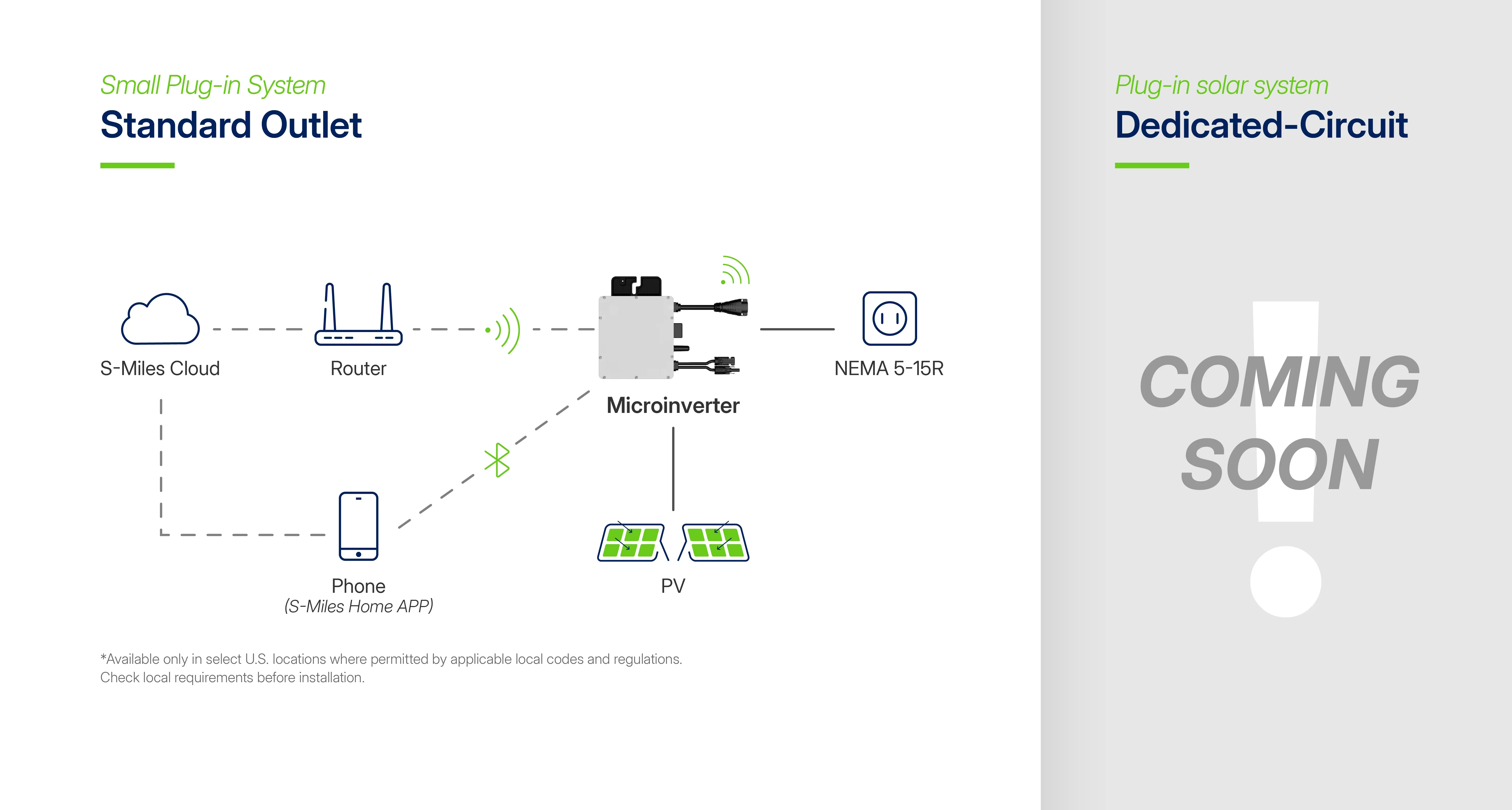
That is useful availability language. A configuration labeled coming soon should not be treated as an available, certified installation package. Equally, a picture of a familiar outlet does not establish permission to use any household receptacle. The specific product combination and the location’s requirements still matter.
The opportunity is to make those choices easier to understand. A buyer should be able to identify which configuration is offered, what connection equipment comes with it and which certification covers that exact arrangement. Hoymiles’ November showcase draws attention to this transition, but the announcement does not supply new accessory model numbers or a complete-system certificate. [1]
What the published CSA certificate actually covers
Certificate of Compliance 80310016, issued July 15, 2026, names the North American HiFlow Pro LV 1-in-1 models HMS-360-1WM-LV, HMS-391-1WM-LV, HMS-420-1WM-LV, HMS-450-1WM-LV and HMS-500-1WM-LV. Their datasheet rates AC output at 360, 391, 420, 450 and 500 VA respectively, for 120 V AC at 60 Hz. These are exact inverter ratings, not a promise of household energy production. [4] [7]
The document identifies UL 3700 Issue 1, dated December 11, 2025, as the evaluation reference. It states eligibility for a CSA Mark with an adjacent US designation, for the U.S. market. CSA is the certifying organization here; UL 3700 is the referenced safety document. This does not establish that the equipment bears a UL Solutions certification logo. [4]
Most importantly, the scope describes inverter subassemblies that are interconnected with other equipment to form a non-movable plug-in photovoltaic system. It requires additional evaluation of the complete system, including rapid shutdown and protection functions. The covered inverter has no battery input and is not a stand-alone power source. A battery shown elsewhere in the exhibition lineup does not become part of this certificate by association. [4]
The certificate copy is publicly hosted by Bright Saver. Its current status was not independently verified in CSA’s live directory. It does not establish that the entire RE+ display or a retail kit is UL Listed.
The cable, household connection and GFCI are different pieces
The existing Flex-S3 cable
Hoymiles’ July manual names a Flex-S3 Plug and Play Cable-TPB. The North American datasheet describes a Flex-S3 Field Connector and a Type B plug. This identifies an AC interconnection cable, but it does not prove that the separate proprietary building-side connection required by the certificate is included. A connector at the inverter end is not the same thing as the household plug-and-receptacle pair. [8] [7]
The proprietary building-side connection
In its October 30 announcement, Hoymiles says HiFlow Pro has a dedicated proprietary plug-in photovoltaic connection that prevents connection with standard household plugs and receptacles. That remains a manufacturer design claim; the announcement does not identify an exact accessory model or establish when that household interface is available. [9]
The CSA certificate is more specific about the required arrangement: a listed interconnection cord, a matched proprietary plug and permanently installed receptacle from the same manufacturer and of the same model, and latching or locking connectors meeting the cited evaluation requirements. These are conditions attached to the inverter certificate, not proof that an unnamed accessory already satisfies them. [4]
Bidirectional Class A ground-fault protection
The certificate also calls for a listed bidirectional Class A ground-fault circuit interrupter, or GFCI, between the end system and a non-dedicated branch circuit. “Bidirectional” here concerns ground-fault protection with either direction of current flow. It does not mean battery charging, zero-export control or protection against every circuit overload. Intertek’s September technical guidance likewise treats the connection, GFCI and system integration as parts of the safety evaluation. [4] [10]
No exact Hoymiles bidirectional GFCI model or accessory listing was verified as of November 20. The promising next step is documentation that connects these required pieces to a specific purchasable system, rather than expecting customers to infer compatibility from the plug’s appearance.
Why a retail kit needs its own documentation
Bright Saver explicitly distinguishes the July inverter-subassembly certification from whole-system certification and says its own balcony-solar kit does not currently have the latter. That is a disclosure about this seller’s kit, not proof that every possible Hoymiles configuration lacks certification. It is also a practical example of why shoppers need to match the certificate to the actual package. [11]
For broader product background, our HiFlow Pro brand review covers the inverter story. Our UL 3700 explainer provides the safety framework. The fresh question after RE+ is narrower: which complete combination of inverter, panels, cord, connection hardware and protective equipment is covered?
The UL catalog record for the December 2025 issue cited by the certificate displayed “SUPERSEDED” when checked November 20. A replacement issue was not verified. That label alone does not establish that CSA withdrew this certificate, but it means the cited issue cannot be assumed to be the latest edition. [12]
Product certification and installation acceptance move separately
UL Solutions announced its plug-in solar testing and certification framework on January 8. That product-safety work is separate from the National Electrical Code’s installation provisions. Progress on one does not automatically settle the other. [13]
As checked November 20, NFPA still listed TIAs 1951–1956 as proposed, with November 20 as the stated comment deadline. Closing comments is not passage or local adoption. Proposed TIA 1952 addresses applicable system listing, a marked receptacle and other connection conditions; its operative text does not directly prescribe Hoymiles’ exact proprietary-plug or GFCI accessory. Those certificate conditions are not newly adopted NEC accessory rules. [14] [15]
What to request before choosing a configuration
A useful supplier conversation starts with documents for the offered system, not just a familiar brand name. Ask for:
- The exact equipment list: inverter model, panels, cord, household connection and protective devices supplied together.
- The connection identity: whether the offered arrangement uses a standard outlet or a matched proprietary plug and receptacle, and the instructions for that configuration.
- The certification scope: a certificate or directory record covering the complete system, plus confirmation of which certificate conditions the package satisfies.
- The local acceptance requirements: the applicable electrical review, property permission and utility process for that address.
Our spec-by-spec buyer’s guide can help organize the product questions. The electrician’s guide and utility notice versus approval guide address separate installation and connection considerations.
Hoymiles’ November update makes these next steps worth watching. An identifiable, evaluated connection package could make small solar easier to compare and specify. For now, the strongest documented progress is the five-model inverter certificate, while the manufacturer’s dedicated-circuit configuration remains labeled coming soon—not a verified new accessory launch. [4] [6]
Related Articles
- Brand Review: Hoymiles HiFlow Pro — A Plug-In Solar Microinverter Certified to UL 3700 — Hoymiles' HiFlow Pro is among the first plug-in solar microinverters certified to UL 3700 in the US. We review the company's 14-year track record, the HiFlow Pro's safety engineering, technical specs, smart energy features, and where it fits in the emerging plug-in solar market.
- UL 3700 Explained: The Safety Certification Standard for Plug-In Solar — UL 3700 is the U.S. safety certification standard developed specifically for plug-in photovoltaic equipment and systems. Learn how it addresses overcurrent protection, touch safety, and GFCI interaction.
- What to Look For in a Plug-In Solar System: A Spec-by-Spec Buyer's Guide — A brand-neutral, spec-first guide to evaluating plug-in solar systems — covering wattage, battery capacity, inverter type, safety certifications, warranty, and what the marketing numbers actually mean.
Sources
- Hoymiles manufacturer announcement: Residential solar and storage showcase at RE+ 2026 — November 20, 2026
- RE+ 26 official attendee guide: November 16–19 event dates and Las Vegas venue — checked November 20, 2026
- Hoymiles: U.S. HiFlow Pro introduction — July 15, 2026
- CSA Certificate of Compliance 80310016, published copy hosted by Bright Saver — issued July 15, 2026; checked November 20, 2026
- Hoymiles U.S. Plug-in Solar Solutions — checked November 20, 2026
- Hoymiles U.S. configuration graphic: Standard Outlet and Dedicated-Circuit COMING SOON — visually checked November 20, 2026
- Hoymiles HiFlow Pro LV North America Datasheet REV1.1 — issue date not printed; checked November 20, 2026
- Hoymiles HiFlow Pro LV User Manual REV1.1 — revision history July 16, 2026
- Hoymiles: HiFlow Pro named to TIME’s Best Inventions, including proprietary-connection claim — October 30, 2026
- Intertek: Plug-in Solar is Arriving in North America—UL 3700 technical guidance — September 16, 2026
- Bright Saver balcony-solar kits: Inverter-subassembly versus whole-system certification disclosure — checked November 20, 2026
- UL 3700 Issue 1 catalog record — December 11, 2025 issue; superseded label checked November 20, 2026
- UL Solutions: Plug-in solar testing and certification framework announcement — January 8, 2026
- NFPA: Proposed TIAs 1951–1956 and stated November 20, 2026 comment deadline — checked November 20, 2026
- NFPA 70 Proposed TIA 1952: Cord-and-plug connection conditions — stated comment deadline November 20, 2026; checked that date