Electrician's Guide to Plug-In Solar: What You Need to Know in 2026
By PlugInSolarUS Editorial Team · Published 2026-03-15 · Updated October 1, 2026 · 10 min read
A practical guide for licensed electricians exploring plug-in solar as a new service line — covering technical standards, service models, and the regulatory landscape.
Introduction to Plug-In Solar for Electricians
Plug-in solar, also known as balcony or apartment solar, offers a simplified approach to solar power for homeowners and renters. For electricians, understanding this technology is crucial for safe, compliant installations and new service opportunities. Unlike traditional rooftop solar, plug-in systems are designed for easy installation and direct connection to a standard electrical outlet, making them broadly accessible. However, this simplicity demands adherence to specific electrical requirements and regulatory nuances.
This guide provides a comprehensive overview for electricians, covering technical specifications, critical safety standards, relevant electrical codes, and market opportunities. As demand for accessible renewable energy solutions increases, electricians proficient in plug-in solar will be uniquely positioned to serve this evolving market.
Understanding Plug-In Solar System Tiers
Plug-in solar systems are categorized by panel wattage and battery storage capacity, defining their output, energy savings, and suitability for various consumer needs. Electricians should understand these classifications to advise clients and ensure installations meet specifications.
System Sizing Tiers
Plug-in solar systems are generally available in three main sizing tiers, reflecting their panel wattage and overall energy production capability:
| System Tier | Panel Wattage | Battery Capacity | Ideal For |
|---|---|---|---|
| Starter | 400–1,200W | 1–2 kWh | Offsetting small electricity consumption, powering essential appliances, reducing standby loads. Renters or those with limited space. |
| Mid-Range | 800–1,600W | 2–3 kWh | Moderate electricity usage, significant utility bill reduction, greater energy independence. |
| High Output | 1,600–2,400W | 3–5 kWh+ | Maximum energy production and storage, higher energy demands, near-net-zero consumption, extended backup, TOU optimization. |
Battery Capacity Tiers
Integrated battery storage enhances plug-in solar utility by allowing energy to be stored and used when solar production is low or electricity rates are high. Battery capacities fall into distinct tiers:
| Battery Tier | Capacity | Use Case |
|---|---|---|
| Entry | 1–2 kWh | Basic energy shifting, short-term backup for critical loads. |
| Standard | 2–3 kWh | Balanced energy storage, optimizing Time-of-Use (TOU) rates, moderate backup power. |
| Extended | 3–5 kWh+ | Significant energy reserves for prolonged outages, extensive TOU optimization, maximizing self-consumption. |
Critical Electrical Considerations for Plug-In Solar
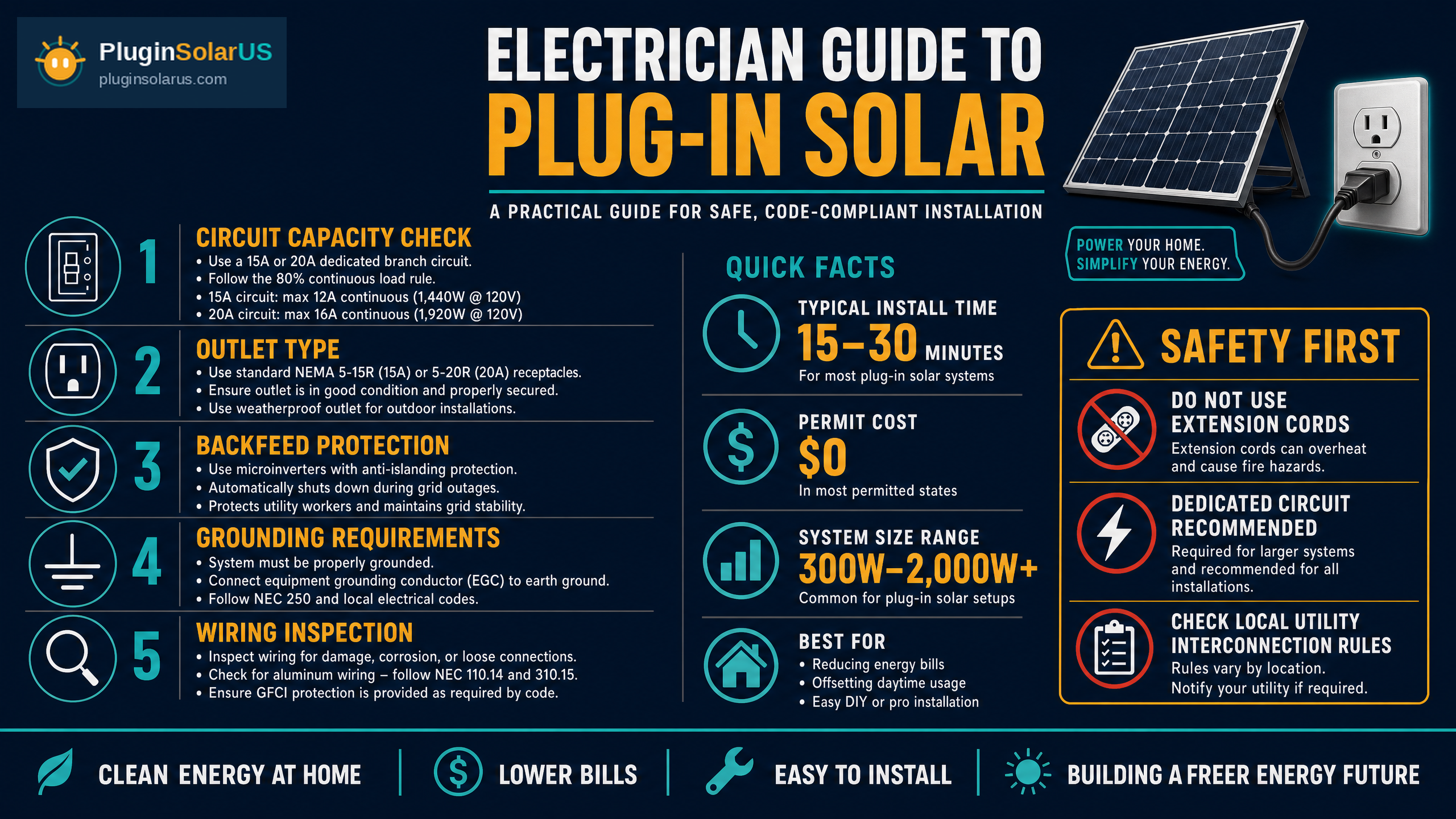
Ensuring electrical safety and compliance is paramount for plug-in solar installations. Electricians verify correct connections and adherence to codes and standards. This section clarifies critical electrical requirements, including GFCI outlets and relevant National Electrical Code (NEC) articles.
GFCI Outlet Requirements
Plug-in solar systems MUST connect to a GFCI-protected outlet on a dedicated circuit. This is a mandatory safety measure, not merely a recommendation. Connecting to a non-GFCI or shared circuit poses significant risks, including electrical shock and overloading. The Ground-Fault Circuit Interrupter (GFCI) protects against ground faults, which occur when electricity finds an unintended path to ground.
Important Safety Note
Plug-in solar systems MUST connect to a GFCI-protected outlet on a dedicated circuit. Failure to do so can lead to serious safety hazards and non-compliance with electrical codes.
National Electrical Code (NEC) Articles
Electricians must understand the correct NEC articles governing plug-in solar. Article 625, for EV charging, is incorrect. The relevant NEC articles are NEC Article 690 (Solar Photovoltaic Systems), covering general PV system requirements, and NEC Article 705 (Interconnected Electric Power Production Sources), addressing interconnection with primary electrical supply. Electricians must familiarize themselves with specific sections within these articles for small-scale, plug-in grid-interactive systems to ensure safety and compliance.
Permitting and Regulatory Landscape
The regulatory environment for plug-in solar is evolving, with significant variations by state and local jurisdiction. Electricians need to be aware of when permits are required and when systems might be exempt.
When a Permit IS Required
Generally, a permit is required for most electrical work to ensure safety and compliance with local building codes. For plug-in solar, a permit is typically necessary if the system's total output exceeds a certain wattage threshold set by the local authority having jurisdiction (AHJ), if the installation involves modifications to the existing electrical panel or wiring beyond simply plugging into an outlet, if the system is intended for permanent installation and grid interconnection, or if local ordinances specifically mandate permits for all solar installations, regardless of size. Always consult the local AHJ before installation to determine specific permitting requirements.
When a Permit is NOT Required (Exemptions)
Some jurisdictions offer exemptions for small-scale plug-in solar systems to encourage renewable energy adoption. The most notable US example is Utah HB 340 (2025). This landmark legislation explicitly legalizes plug-in solar systems under 1,200W, exempting them from interconnection permits. Utah was the first US state to enact such a law (March 2025). As of June 2026, eight states have enacted plug-in solar laws (Utah, Maine, Virginia, Colorado, Maryland, Connecticut, New Hampshire, and Vermont), significantly streamlining installation. Even with exemptions, electricians must ensure adherence to all safety standards, including NEC requirements and proper GFCI protection.
UL 3700: The Certification Standard for Plug-In Solar
UL 3700 is the U.S. safety certification standard developed specifically for plug-in photovoltaic equipment and systems. It addresses the complete submitted plug-in configuration rather than only an inverter or battery component. Maine's LD 1730 (2026) was the first enacted state law to reference UL 3700 by name, while Utah's earlier HB 340 uses broader certification language and references UL 1741 for the inverter. Electricians should specify equipment certified to UL 3700 and separately apply the exact NRTL, comparable-standard, code, utility, and installation requirements in the relevant jurisdiction.
The Evolving Regulatory Landscape: State-Specific Insights
While federal incentives have changed, state-level initiatives and legislation continue to shape the plug-in solar market. Electricians should stay informed about these developments to provide accurate advice and ensure compliant installations.
Federal ITC (Investment Tax Credit)
Federal ITC Update
The Federal Investment Tax Credit (ITC) of 30% for solar purchases expired on December 31, 2025. It is no longer available for new purchases made in 2026 or later. However, purchases made in 2025 can still be claimed on 2025 tax returns.
California SB 868 (Plug and Play Solar Act, 2026)
California SB 868 passed both chambers in August, and Governor Newsom signed it September 30, 2026. Its qualifying-device framework is expected January 1, 2027. Electricians should review the enacted equipment and circuit conditions but continue following current utility and electrical rules until the effective date. AB-2316 concerned community solar, not plug-in solar.
Utah HB 340 (2025)
Utah's HB 340 is a pioneering law explicitly legalizing plug-in solar systems under 1,200W and exempting them from interconnection permits, providing a clear framework for electricians operating in Utah.
Liability and Insurance for Plug-In Solar Installations
Electricians undertaking plug-in solar installations must consider potential liability and ensure adequate insurance coverage. Improper installation can lead to electrical hazards, property damage, or system malfunction.
Electrician's Liability
An electrician's liability can arise from improper installation (failure to adhere to NEC codes, manufacturer's instructions, or local regulations), system malfunction traced back to faulty wiring or incorrect setup, or failure to advise clients about critical requirements like GFCI-protected dedicated circuits and permitting.
Insurance Considerations
Electricians should review existing insurance policies to cover plug-in solar installations. Key insurance types include General Liability Insurance (bodily injury or property damage), Professional Liability (Errors & Omissions) Insurance (negligence or mistakes in professional services), and Worker's Compensation Insurance (for employees). Consult an insurance provider to confirm adequate coverage for this specialized electrical work.
Marketing Plug-In Solar Services: A New Opportunity
The growing interest in accessible solar energy presents a significant marketing opportunity for electricians. By positioning themselves as experts in plug-in solar, electricians can attract new clients and expand service offerings.
Identifying Your Target Market
Plug-in solar appeals to renters (who cannot install traditional rooftop solar), homeowners with limited budgets (seeking affordable entry into solar), eco-conscious consumers, and property managers (looking to provide green amenities). Electricians can market directly to these segments.
Crafting Your Message
Highlight plug-in solar benefits: simplicity and affordability, energy savings (especially in high-rate states), portability (attractive to renters), and positive environmental impact.
Service Offerings
Electricians can offer a range of services: consultation and site assessment (advising on sizing, placement, electrical readiness), installation services (professional setup of panels, inverters, batteries, ensuring code compliance), electrical upgrades (installing dedicated GFCI circuits), and maintenance and troubleshooting.
Pricing Guidance for Different Service Tiers
Establishing clear pricing for plug-in solar services is essential. Pricing varies based on installation complexity, system size, and additional electrical work.
Consultation and Assessment
| Service | Pricing Range | Notes |
|---|---|---|
| Basic Site Visit | Free to $150 | Free as a lead generator, or nominal fee for detailed assessment (refundable upon installation). |
| Comprehensive Electrical Audit | $150-$300 | For assessing existing wiring compatibility or identifying necessary upgrades. |
Installation Services
| Service | Pricing Range | Notes |
|---|---|---|
| Per-Panel Installation | $100-$250 per panel | Depending on accessibility and complexity. |
| System-Based Pricing | Flat fees for different system tiers: | |
| Starter System (400-1,200W) | $300-$600 | |
| Mid-Range System (800-1600W) | $600-$1,200 | |
| High Output System (1600-2400W) | $1,200-$2,000+ | |
| Hourly Rate | $75-$150 per hour | For custom installations or troubleshooting. |
Electrical Upgrades
| Service | Pricing Range | Notes |
|---|---|---|
| Dedicated GFCI Circuit | $200-$500 | Depending on distance from panel and wiring complexity. |
| Panel Upgrades | $1,000-$4,000+ | Varies significantly based on scope. |
Maintenance and Support
| Service | Pricing Range | Notes |
|---|---|---|
| Annual System Check-up | $100-$200 | |
| Troubleshooting/Repair | Hourly rate + parts |
These are general estimates; actual pricing should reflect local market conditions, material costs, and the electrician's experience and overhead.
Payback Periods and Electricity Rates: What to Tell Your Clients
Clients are interested in financial benefits. Electricians should provide realistic expectations regarding payback periods and how electricity rates influence savings.
Payback Periods
| Region/Condition | Payback Period | Notes |
|---|---|---|
| National Average | 5–7 years | Typical for a plug-in solar system in the US. |
| High-Rate States (CA, MA, CT) | 3–5 years | Significantly shorter, especially with Time-of-Use (TOU) optimization. |
Electricity Rates
Understanding regional electricity rates is crucial for calculating potential savings:
| Region | Average Electricity Rate |
|---|---|
| National Average | ~$0.18/kWh |
| California (CA) | ~$0.34/kWh |
| Massachusetts (MA) | ~$0.32/kWh |
| Connecticut (CT) | ~$0.28/kWh |
By explaining these figures, electricians can help clients understand the economic rationale behind investing in plug-in solar.
Frequently Asked Questions (FAQs)
Q: Do plug-in solar systems work during a power outage?
Most grid-tied plug-in solar systems shut down during a power outage for safety. However, systems with battery storage can provide backup power to essential loads, depending on battery capacity and system design.
Q: Can I install a plug-in solar system myself?
While some plug-in solar systems are marketed as DIY, it is highly recommended to have a qualified electrician review or perform the installation. This ensures compliance with electrical codes, proper grounding, and safe operation, especially concerning GFCI requirements and dedicated circuits.
Q: What is the difference between plug-in solar and traditional rooftop solar?
Plug-in solar systems are smaller, typically connect to a standard outlet, and are designed for easier, often temporary, installation. Traditional rooftop solar systems are larger, permanently installed, and require direct wiring into the home's electrical panel, often involving more complex permitting and installation processes. Plug-in solar is ideal for those with limited space, renters, or those seeking a more affordable entry into solar.
Q: How do I know if my home's electrical system is suitable for plug-in solar?
A qualified electrician can perform a site assessment to determine your home's electrical readiness. They will check for a GFCI-protected dedicated circuit, assess the condition of your electrical panel, and ensure that your wiring can safely accommodate the plug-in solar system. This assessment is crucial for both safety and optimal system performance.
Next Steps for Electricians
As an electrician, staying ahead in the rapidly evolving renewable energy sector is key to expanding your business and serving your community. Plug-in solar offers a unique opportunity to do just that.
- Deepen Your Knowledge: Explore more resources on the technical aspects and regulatory frameworks of plug-in solar. Visit our electricians page for advanced guides and training materials.
- Guide Your Clients: Help potential clients understand the benefits and requirements of plug-in solar. Direct them to our buyers-guide for comprehensive information on choosing the right system.
- Assess Readiness: Encourage clients to check their home's suitability for plug-in solar using our readiness tool.
- Estimate Savings: Provide clients with tools to calculate their potential energy savings with our calculator.
- Understand Battery Options: For clients interested in energy storage, refer them to our battery-guide.
- Generate Interconnection Letters: Assist clients in generating necessary documentation for utility interconnection with our letter-generator.
- Stay Informed: Keep up-to-date with the latest news and policy changes in your state and nationally by visiting our states page and subscribing to our newsletter.
- Learn More: For a general understanding of how plug-in solar works, visit our how-it-works page.
- Specific Guides: We also have guides tailored for renters, homeowners, property-managers, and solar-installers.
- Partner with Us: Discover opportunities for collaboration on our partners page.
- General Education: For more educational content, visit our learn section.
By embracing plug-in solar, electricians can not only enhance their service offerings but also contribute significantly to the broader adoption of sustainable energy solutions.
Energy Resilience: A Growing Service Category for Electricians
As grid reliability declines and extreme weather events become more frequent, energy resilience is emerging as a distinct service category for electricians — and plug-in solar is at the center of it. Customers who previously asked only about bill savings are now asking how they can keep their essential loads running during outages, without the cost and complexity of a whole-home generator or a full battery retrofit.
Plug-in solar with battery storage addresses this need directly. A UL 3700-certified system with island mode capability can legally and safely continue operating during a grid outage, powering connected loads from the battery while the solar panels recharge it during daylight hours. For electricians, this creates a clear service opportunity: installing the GFCI-protected dedicated circuit that enables plug-in solar is a straightforward job that positions you as the trusted advisor for the customer's broader resilience strategy.
Key technical points for electricians advising resilience-focused customers:
- Anti-islanding vs. island mode: Traditional grid-tied rooftop solar must shut down during outages (anti-islanding). Plug-in systems with battery storage and island mode capability are designed to operate safely during outages without back-feeding the grid — a critical distinction customers often don't understand
- UPS output mode: Customers with medical devices or computers should look for systems with UPS output mode, which maintains power to connected devices during the grid-to-battery transition without any interruption
- Circuit sizing for resilience loads: When installing the dedicated circuit for a plug-in system, discuss with the customer which loads they want to protect during an outage and size the circuit accordingly
- Battery capacity guidance: A 2 kWh battery provides approximately 24–30 hours of refrigerator runtime; 3–5 kWh extends this significantly and adds capacity for additional loads
Electricians who develop expertise in resilience-focused plug-in solar installations — including the electrical assessment, circuit installation, and customer education components — will be well-positioned as this market grows.