Balcony Solar in the U.S.: Setup, Rules, and Next Steps
By PlugInSolarUS Editorial Team · Published 2026-08-26 · Updated October 4, 2026 · 13 min read
A practical U.S. guide to balcony solar: compare grid-connected, battery, zero-export, and off-grid setups; check state, property, equipment, and electrical requirements; and plan your next step.
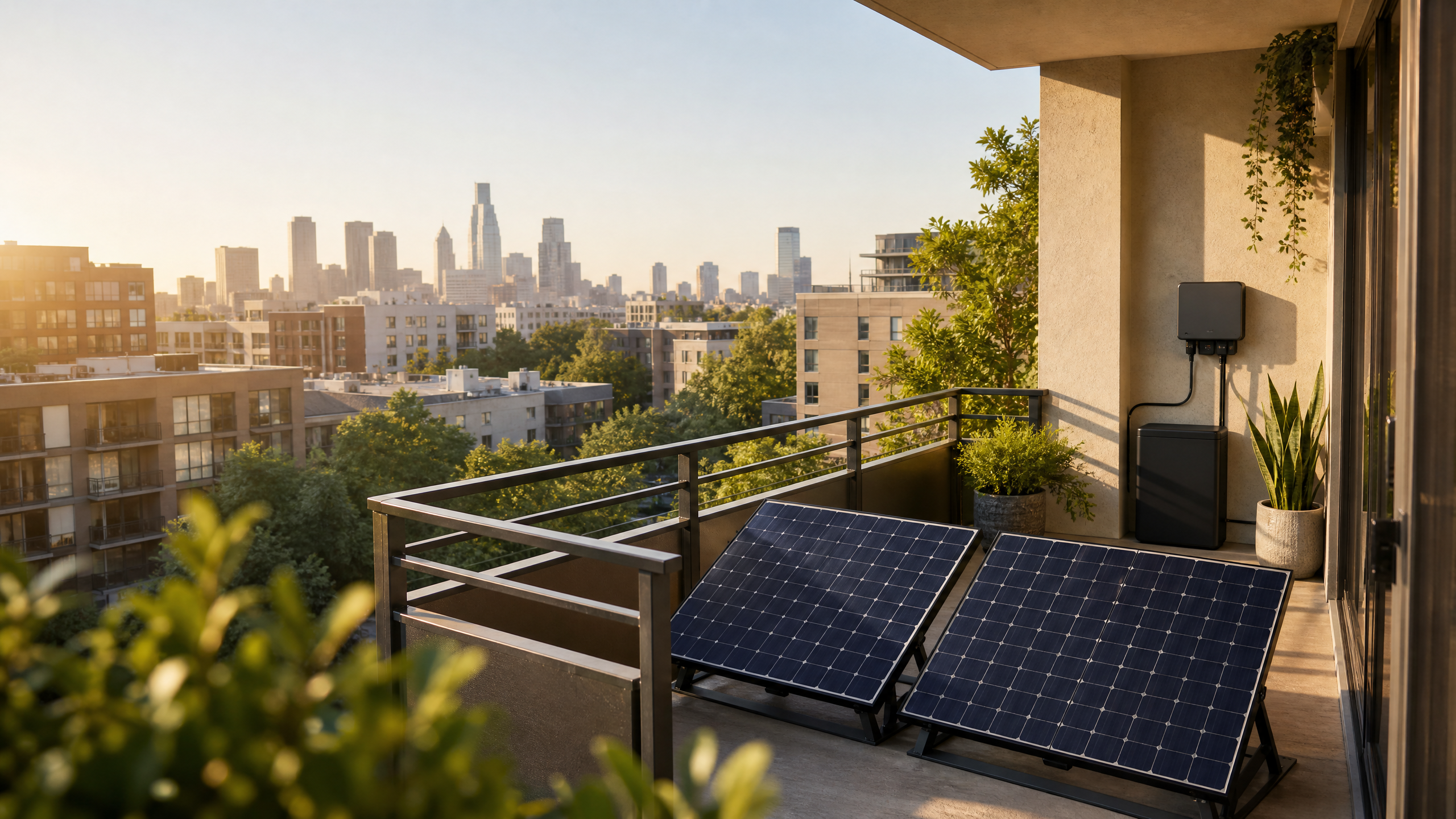
Balcony solar can make small-scale solar more accessible to apartment residents, renters, condominium owners, and homeowners without a suitable roof. In the United States, however, balcony solar is a consumer term—not one uniform legal category. The right path depends on how the equipment connects, where it is placed, the product instructions and listing, and the state, utility, property, and electrical conditions that apply to the proposed setup.
Start with the configuration, not the nickname.
Two products marketed as “balcony solar” can follow very different paths. One may feed power into household wiring; another may charge a portable battery that powers devices directly. Those are not the same electrical or regulatory configuration.
What Does “Balcony Solar” Mean in the U.S.?
Balcony solar usually describes compact solar panels placed on or near a balcony, patio, terrace, deck, or small yard. Panels may be attached to a product-specific mounting system, placed on a freestanding rack, or paired with a battery. The phrase describes the location and consumer use case; it does not by itself tell you how the system connects to loads or the grid.
Before comparing products, identify which of these four configurations you are considering:
| Configuration | How Energy Is Used | What to Verify |
|---|---|---|
| Grid-connected plug-in photovoltaic system | A compatible inverter supplies AC power through an approved household connection so solar can offset on-site use. | State law, utility or interconnection process, electrical and circuit conditions, complete-system listing, property rules, and manufacturer instructions. |
| Solar charging a portable battery | Panels charge a battery or portable power station; selected devices plug directly into the battery. | Battery and panel compatibility, placement, charging limits, weather protection, mounting, and product instructions. This does not authorize feeding power into building wiring. |
| Zero-export interconnected system | Controls are intended to limit export while equipment remains electrically connected to the premises. | Do not assume “zero export” means off-grid or exempt. Confirm whether the utility, code authority, and local rules still treat the equipment as interconnected generation. |
| Electrically isolated off-grid setup | Solar and storage power dedicated loads without connecting to building wiring or the utility grid. | Product safety, placement, mounting, battery use, property rules, and any local requirements. Isolation must be real—not merely a software setting. |
For a deeper comparison of these configurations, use the off-grid, zero-export, portable, and grid-connected guide. If you are new to the category, begin with Plug-In Solar 101.
Is Balcony Solar Legal in the United States?
There is no single nationwide answer for every balcony-solar setup. States have taken different approaches to small grid-connected systems, and a state pathway does not eliminate every product, property, utility, local-code, or electrical condition. In states without a dedicated plug-in solar law, that absence does not automatically prove that every configuration is either permitted or prohibited.
The most reliable starting point is the Plug-In Solar State Tracker. Open your state page, identify whether the tracked framework is enacted, pending, deferred, restricted, or unclear, and follow the official sources listed there. Then confirm the current utility or interconnection process, local requirements, and the conditions for the exact equipment and property.
California has taken a major step toward making plug-in solar more accessible: SB 868 was signed September 30, 2026 in America's most populous state. Its new qualifying-device utility framework is expected to begin January 1, 2027. This is a good moment to explore your space, potential bill savings, and our new Product Finder for side-by-side solar-only offers. Continue following current rules while you plan; a product listing is not installation approval or a savings guarantee.
Avoid one-factor conclusions
A standard outlet, GFCI protection, an equipment certification, a zero-export setting, landlord approval, or an enacted state law may be important, but none should be treated alone as permission for every installation.
A Five-Check Balcony Solar Plan
1. Define the Energy Goal
Decide whether your priority is lowering daytime electricity purchases, shifting solar energy into evening hours, or powering selected devices during an outage. A grid-connected system, a battery-charging setup, and a backup-power plan answer different needs. Use the Savings Calculator for an educational production and savings estimate, then use the Battery Guide if storage is part of the plan.
2. Evaluate the Space and Mounting
Check the usable area, sun exposure, shading, panel orientation, railing or surface conditions, wind exposure, drainage, and emergency egress. Use only a mounting method approved for the product and property. Panels and cables should not create a falling-object risk, block an exit, cross a shared walkway, or extend into space you are not authorized to use.
The Apartment Solar Installation Guide covers placement and installation planning in more detail. The Readiness Checker helps organize the questions for your own location.
3. Check the Property Path
Renters should review the lease, building rules, balcony-use provisions, and any written approval process. Condominium owners and homeowners in an HOA should review governing documents and architectural-review requirements. A state solar-access rule may affect what restrictions are allowed, but it does not make every mounting or electrical configuration acceptable.
Use the renter pathway for a practical checklist. When a written request is appropriate, the Landlord & HOA Letter Generator can organize the proposed placement, equipment, and review request without presenting the draft as legal permission.
4. Verify the Complete Equipment System
Compare the listing and instructions for the complete configuration: panels, inverter or power-conversion equipment, cords and connectors, mounting, optional battery, monitoring, and approved operating modes. UL Solutions launched a U.S. certification program based on UL 3700 in January 2026, addressing construction, performance, labeling, contact hazards, overload, installation, and unintended power flow for interactive plug-in photovoltaic systems.
Read what UL 3700 covers, then use the Buyer’s Guide to compare system-level specifications. Confirm the exact product documentation rather than assuming that a component label applies to every kit or combination.
5. Confirm the Connection and Current Rules
For a grid-connected proposal, confirm the current state framework, utility process, electrical and circuit conditions, local code requirements, and manufacturer instructions before connection. Anti-islanding is an important grid-interactive safety function, but it does not replace those checks. The Anti-Islanding Guide explains outage shutdown and includes product-specific manufacturer test examples.
Balcony Solar for Renters and Apartment Residents
Balcony solar can be attractive to renters because the equipment may be smaller and more portable than rooftop solar. Portability does not remove the need to check the lease, property approval, mounting, common-area rules, electrical conditions, and the state or utility framework. The best consumer path is usually to document the proposed configuration clearly before purchasing.
A useful request identifies the panel dimensions, location, mounting approach, whether anything penetrates the building, how cables are managed, the proposed electrical configuration, equipment documentation, and who is responsible for removal. Avoid promising that the system is universally permit-free, maintenance-free, or approved merely because it is marketed for balconies.
Will Balcony Solar Work During a Power Outage?
A typical grid-interactive inverter is designed to stop energizing the grid when utility power is lost. This protects utility workers and the electrical system; it also means ordinary grid-connected solar output should not be described as automatic whole-home backup.
Backup depends on the equipment’s approved operating mode. Some systems pair solar with a battery that powers selected devices through dedicated battery outlets. Others may support a manufacturer-defined backup configuration. Confirm the loads, output limits, transfer behavior, charging path, and operating instructions for the exact product. Do not improvise a connection between a portable battery and household wiring.
How Much Can Balcony Solar Save?
Potential savings depend on panel wattage, local sunlight, shading, electricity rate, the timing of household use, battery behavior, system losses, and whether the generated energy is consumed on site. A south-facing unshaded balcony may have a stronger production profile than a shaded or north-facing location, but orientation alone does not determine the result.
Use the ZIP-based Savings Calculator to compare assumptions, and review the calculator methodology before treating the estimate as a forecast. The economic question should come after the legal, property, equipment, and electrical path is clear.
Frequently Asked Questions
Can I put solar panels on an apartment balcony?
Possibly, when the property rules, space, mounting method, equipment, electrical configuration, and applicable state, local, and utility requirements support the proposal. Start with the lease or building rules and the State Tracker.
Can I plug balcony solar into a normal outlet?
Do not assume that any panel or inverter can connect to any outlet. Follow the instructions and listing for the complete system, and confirm the applicable circuit, outlet, electrical-code, state, utility, and property conditions.
Does UL 3700 make balcony solar legal everywhere?
No. UL 3700 provides a safety evaluation framework for interactive plug-in photovoltaic equipment and systems. State authorization, utility process, local requirements, property permission, and installation conditions remain separate questions.
Is a zero-export system the same as off-grid solar?
No. A zero-export control may limit power sent to the grid while the equipment remains interconnected with building wiring. An off-grid setup is electrically isolated from the utility and premises wiring. Verify the actual configuration, not only the product label or software mode.
What should I do before buying?
Check your state, define the connection type, evaluate the space and mounting, review property requirements, confirm the complete system documentation, and estimate savings only after those questions are organized. The Readiness Checker is the fastest place to assemble that plan.
Your Next Step
If you are still learning the category, read Plug-In Solar 101. If you already have a location in mind, open the State Tracker and complete the Readiness Checker. Those two steps will tell you which deeper guide—installation, renter request, equipment, storage, or savings—is most useful next.
Related Articles
- Solar Panel Mounting Explained: Balcony, Wall, Patio, and Rooftop Options — Compare balcony, wall, patio and rooftop mounting—including lightweight framed foldable panels. Find the advantages and trade-offs for your space, with practical wind, support and clearance checks.
- Renter Solar Rights: What You Can and Can't Do in All 50 States — A state-by-state guide to your legal rights as a renter who wants to install plug-in solar. What's permitted, what's pending, and how to negotiate with your landlord.
- Brand Review: Rowkin Energy — Foldable Plug-In Solar Kits, Home Energy Guidance & Pro Support — Rowkin Energy pairs 420 W and 840 W foldable solar kits with home-specific Energy Agent guidance and optional Pro support. Compare equipment, pricing, space needs and safety considerations.
New: Find your plug-in solar fit
Our new Product Finder makes it easier to discover and compare plug-in solar kits and components across brands. See panel DC and inverter AC output alongside listed prices, known shipping, and required fees to find options worth exploring. Find and compare products.
Sources
- UL Solutions — Testing and Certification Framework for Safer Plug-In Solar Across the United States
- UL Solutions — Safety Considerations for Plug-In Photovoltaic Systems
- World Resources Institute — How States Can Unlock Affordable Plug-In Solar
- California SB 868 — Chapter 985, signed September 30, 2026
- IEEE — IEEE 1547-2018 Interconnection Standard
- NFPA — National Electrical Code (NFPA 70)