AI, Data Centers, and Your Electric Bill: What the Evidence Actually Shows
By PlugInSolarUS Editorial Team · Published 2026-04-20 · Updated April 2026 · 10 min read
Data-center electricity demand is growing quickly, but bill effects depend on region, infrastructure, and cost allocation. Here is how households can assess plug-in solar as one part of a plan.
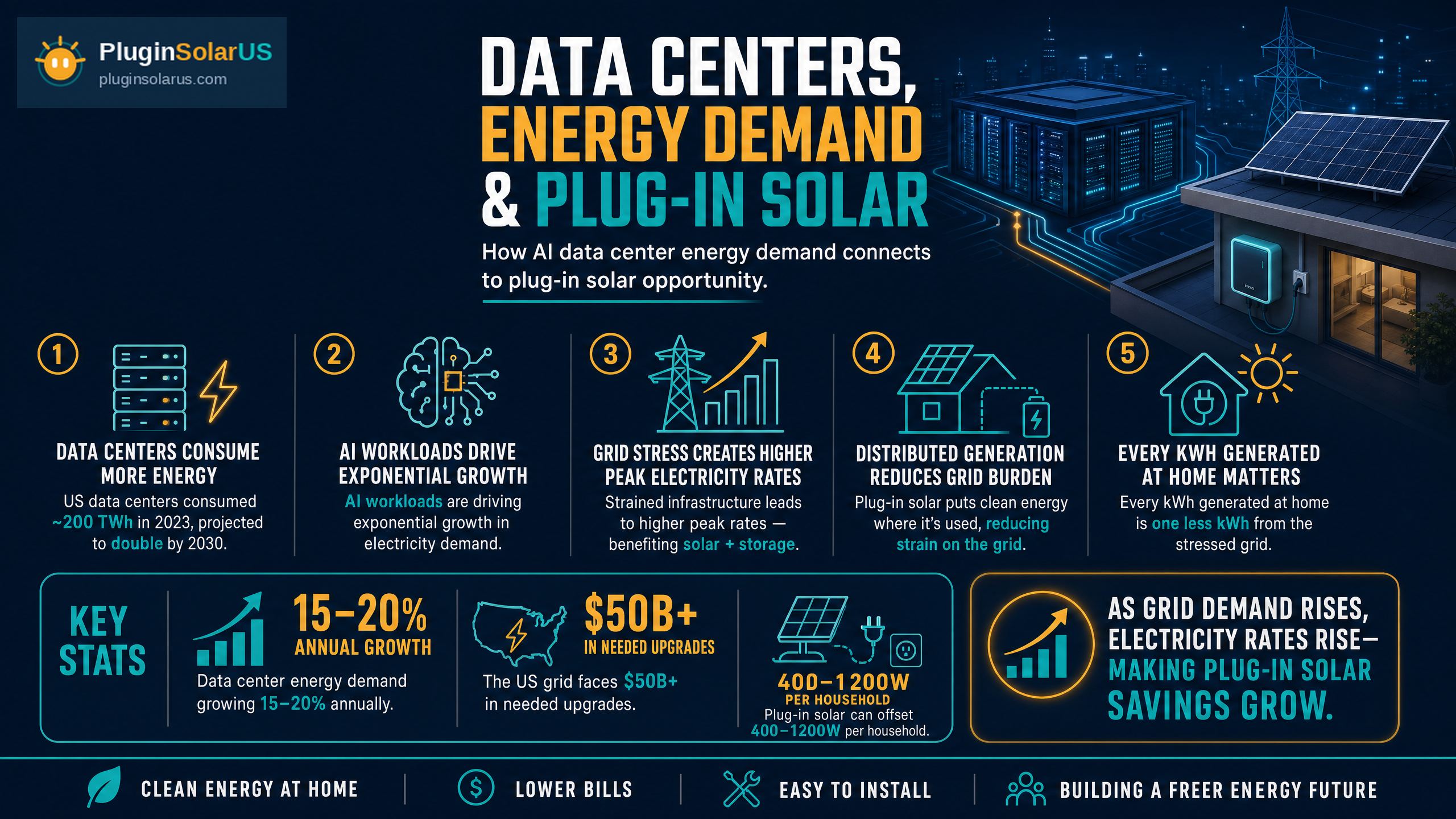
AI, Data Centers, and Your Electric Bill: What the Evidence Actually Shows
Data-center electricity demand is growing quickly, especially in particular grid regions. That growth can influence utility planning, peak demand, and future infrastructure needs. It does not mean that every household in the United States faces the same bill effect or that one cause explains every rate increase.
Whether a household bill changes depends on the grid region, local infrastructure, generation and fuel costs, weather recovery, utility investment, and—critically—how regulators allocate costs. The U.S. Energy Information Administration documents rapid commercial-sales and peak-demand growth in Virginia, much of it associated with data-center concentration, while the Congressional Research Service notes that data-center energy effects and cost recovery vary across jurisdictions.[1] [2]
This article explains the scale of the demand shift, the local decisions that connect grid investment to bills, and how plug-in solar can be one part of a household bill-management plan. It is not a prediction of any individual utility rate.
The Scale of the Problem: Data Centers and the Grid
The numbers are striking. Data centers consumed about 4.4% of total U.S. electricity in 2023 and are expected to consume approximately 6.7% to 12% of total U.S. electricity by 2028, according to a December 2024 report from Lawrence Berkeley National Laboratory commissioned by the U.S. Department of Energy.[4] Total data center electricity usage climbed from 58 TWh in 2014 to 176 TWh in 2023 — the equivalent of powering 16 million homes for an entire year.
The International Energy Agency’s April 2026 report found that electricity demand from data centres soared by 17% in 2025, with AI-focused data centres climbing even faster — well outpacing global electricity demand growth of 3%.[5] Data centers are now projected to double their electricity consumption by 2030, with AI-focused facilities poised to triple their power use. According to Fortune, data centers accounted for around 50% of all electricity demand growth in the U.S. last year.[6]
The Rewiring America “Homegrown Energy” report adds further context: the data centers currently planned or already under construction across the country would add a total of 93 GW of electricity demand to the grid by 2029 — a 16% increase over today’s national peak demand.[7] To put that in perspective, 93 GW is roughly the combined generating capacity of every nuclear power plant in the United States.
| Metric | Value | Source |
|---|---|---|
| U.S. data center electricity share (2023) | 4.4% of total U.S. electricity | DOE / LBNL, Dec 2024 |
| Projected U.S. data center share (2028) | 6.7%–12% of total U.S. electricity | DOE / LBNL, Dec 2024 |
| Data center demand growth in 2025 | +17% year-over-year | IEA, April 2026 |
| New data center demand by 2029 | 93 GW added to the grid | Rewiring America, 2025 |
| Share of U.S. demand growth driven by data centers (2025) | ~50% | IEA / Fortune, April 2026 |
| Utility rate hike requests in first half of 2025 | $29 billion | EESI / Powerlines.org, 2025 |
How Data Center Demand Can Affect an Electric Bill
The connection between a hyperscale data center and a household electric bill is not automatic. Understanding the possible link requires a brief explanation of how grid infrastructure costs, utility planning, and state-approved cost allocation work.
The electrical grid is built to accommodate peak demand: the maximum amount of power used simultaneously by all customers at any given moment. This peak typically occurs on the hottest summer afternoon or coldest winter morning. For most of the year, the grid has excess capacity. But when new large loads — like data centers — push peak demand higher, utilities must invest in new infrastructure: power plants, transmission lines, transformers, and substations.
New large loads can require investment in generation, transmission, substations, and other equipment. Whether and how those costs are recovered is a regulatory choice that differs by state and utility. Some proposals seek to require new large loads to bring or pay for additional supply; others are still under review. That is why a local rate case, a state commission, and the regional grid operator matter more to a household outcome than a single national headline.
Rising rates can have many causes at once. It is reasonable for consumers to ask how a utility plans to serve major new loads and how new infrastructure costs will be allocated. It is not accurate to say that data centers alone have already imposed the same cost outcome on every household.
The Distributed Answer: Why Plug-In Solar Matters Now
The conventional response to rising electricity demand is to build more supply: new gas peakers, transmission lines, and large-scale renewables. These solutions are necessary but slow. A new gas power plant takes three to five years to permit and build. New transmission infrastructure takes even longer. Meanwhile, data center demand is compounding annually.
There is a faster path, and it runs through households. The Rewiring America report demonstrates that household upgrades — heat pumps, rooftop solar, and battery storage — could collectively offset 100% of projected data center capacity needs by 2029. Distributed solar and storage work by doing two things simultaneously: generating electricity locally (reducing the amount that must be transmitted from distant power plants) and discharging stored energy during peak hours (reducing the peak demand that drives infrastructure investment).
Plug-in solar is the most accessible entry point into this distributed energy future. Unlike traditional rooftop solar — which requires roof ownership, permits, an electrician, and $15,000–$30,000 in upfront capital — a plug-in solar system can be purchased for $300–$1,500, installed in an afternoon without professional help, and plugged into a standard outlet. It is, as the Clean Energy States Alliance describes it, a system that “can be installed by people with little technical expertise.”[9]
How Plug-In Solar Reduces Grid Stress
From a grid perspective, plug-in solar systems behave more like demand reduction than traditional generation. Most of the energy they produce is consumed locally and immediately, which means it never travels on transmission lines, never contributes to line losses, and never requires the grid infrastructure whose cost is being passed to consumers.[10]
When paired with a battery, the effect is amplified. A household with a plug-in solar system and a 2–3 kWh battery can charge the battery during off-peak hours (when grid electricity is cheap and abundant) and discharge it during the late-afternoon peak — precisely the window when data center demand is highest and grid stress is most acute. This is the same principle behind large-scale virtual power plants (VPPs), demonstrated at scale by the August 2025 Tesla/Sunrun California test, in which a 535 MW fleet of household batteries dispatched like a traditional power plant during the state’s evening peak.[11] Plug-in solar with battery storage is the entry-level version of that same concept.
The aggregate potential is significant. The United States added 6.8 GW of distributed solar capacity in 2025.[12] Plug-in solar, still in its infancy in the U.S., represents a largely untapped layer of that distributed resource base. Germany — which has been permitting plug-in solar for years — crossed 1 million registered plug-in solar installations in 2025, with estimates suggesting 3 to 4 million total systems including unregistered units.[13] German projections suggest plug-in solar could cover up to 2% of national electricity demand as the installed base scales. Applied to the U.S. context, 2% of national electricity demand would represent roughly 88 TWh per year — more than half of total current data center consumption.
The 53 Million Households Left Out of the Solar Conversation
Traditional rooftop solar has grown substantially, but it has a structural access problem. An estimated 53 million U.S. households cannot install rooftop solar, primarily because they live in apartments or rent their homes and lack control over the roof.[14] These are precisely the households most exposed to rising electricity prices: renters, who cannot negotiate their utility rate, cannot install efficiency upgrades without landlord approval, and have no hedge against the infrastructure cost increases being driven by data center demand.
Plug-in solar is the only solar technology that is structurally accessible to this population. A renter in a Virginia apartment — where electricity prices have risen 267% in five years — can place a 400W panel on their balcony, plug it into an outlet, and immediately begin offsetting the grid costs that data center expansion has imposed on them. No landlord approval required under Virginia’s newly enacted HB 395 (signed April 22, 2026). No permit. No electrician. No long-term lease commitment.
This is not a marginal benefit. A 400–1,200W plug-in solar system in a high-rate state like Virginia, California, or Massachusetts can realistically offset 10%–20% of a household’s electricity consumption, translating to $150–$400 in annual savings at current rates. As electricity prices continue rising toward the projected 40% increase by 2030, those savings compound.
The Policy Moment: States Are Moving
The legislative environment for plug-in solar is accelerating in direct response to rising electricity costs. In more than half of U.S. states, Republican and Democratic lawmakers have introduced legislation that would boost adoption of plug-in solar systems — a rare area of bipartisan agreement driven by the shared constituent concern of unaffordable electricity bills.
Utah enacted the first U.S. plug-in solar law in March 2025 (HB 340), exempting systems under 1,200W from interconnection permits. Maine signed LD 1730 into law on April 6, 2026. Virginia signed HB 395 (Chapter 1052) on April 22, 2026, becoming the third enacted state. Colorado signed HB 26-1007 on May 7, 2026 (4th state, highest US limit at 1,920W). Maryland signed HB 1532 on May 12, 2026 (5th state). Connecticut, New Hampshire, Vermont, and more than a dozen other states have active bills moving through their legislatures.
The timing is not coincidental. As the EESI notes, utilities have requested $29 billion in rate hikes in 2025 alone — and state legislators are hearing from constituents who are opening their mail and discovering soaring monthly electricity bills. Plug-in solar legislation is, in part, a political response to the data center energy crisis.
What Plug-In Solar Cannot Do — and What It Can
It would be inaccurate to suggest that plug-in solar alone can solve the data center energy problem. The scale of demand growth — 93 GW by 2029 — requires a portfolio response: utility-scale renewables, grid modernization, demand flexibility programs, and new transmission. The IEA notes that tech companies accounted for around 40% of all corporate power purchase agreements for renewables signed in 2025, and the pipeline of conditional agreements between data center operators and small modular reactor (SMR) nuclear projects has grown from 25 GW to 45 GW in the past year.[5]
But plug-in solar occupies a specific and important niche in this portfolio. It is the tool that households — particularly renters and those without capital for traditional solar — can deploy now, without waiting for utility programs, government incentives, or grid upgrades. It provides immediate bill relief in an environment where prices are rising. It contributes to peak demand reduction at the household level. And at scale, it represents a meaningful distributed energy resource that can reduce the infrastructure investment burden that data center growth is placing on the grid.
The Rewiring America report frames this as a “win-win”: investments in distributed household energy resources “lower electricity costs for households, improve resilience to power outages, and drive down upfront costs by maturing the growing market for home energy upgrades.”[7] Plug-in solar is the most accessible entry point into that win-win.
What You Can Do Today
If you are a renter or homeowner in a state with a lawful plug-in-solar pathway, rising demand is a reason to understand your own energy options. A qualifying plug-in solar system may help offset some daytime electricity use, but it is not a universal hedge against every future rate decision. Pair it with realistic consumption data, your utility’s current rate design, and the state, property, and electrical requirements that apply where you live.
- Check your state’s legal status on our State Tracker. Ten states have enacted laws: Utah, Maine, Virginia, Colorado, Maryland, Connecticut, New Hampshire, Vermont, New Jersey, and California. California's new framework is expected January 1, 2027; New Jersey's takes effect March 1, 2027; the New York SUNNY Act remains on Governor Hochul's desk.
- Estimate your savings with our Savings Calculator, which uses real EIA utility rate data for your zip code.
- Understand the technology with our Plug-In Solar 101 guide, including system sizing, battery options, and safety requirements.
- If you rent, read our Renters’ Guide for information on landlord conversations, lease considerations, and the specific laws that protect your right to install.
Data-center growth is reshaping planning in several electricity regions. Plug-in solar will not solve regional capacity needs or determine a utility rate case, but it can give some households a practical way to offset on-site electricity use and participate more thoughtfully in a changing energy system. For a current regional-policy example, see our PJM large-load framework explainer.
Sources
- Electric Choice: Electricity Rates by State (April 2026)
- U.S. Senate Joint Economic Committee: Annual Electricity Bills Up $110 Per Family in 2025
- EESI: Data Center Power Demands Are Contributing to Higher Energy Bills (February 2026)
- U.S. Department of Energy / LBNL: 2024 Report on U.S. Data Center Energy Use (December 2024)
- IEA: Data Centre Electricity Use Surged in 2025 (April 2026)
- Fortune: Data Centers Drove Half of U.S. Electricity Demand Growth Last Year (April 2026)
- Rewiring America: Homegrown Energy — How Household Upgrades Can Meet 100% of Data Center Demand Growth (2025)
- Consumer Reports: AI Data Centers Impact on Electric Bills, Water, and More (March 2026)
- Clean Energy States Alliance: What States Need to Know About Plug-In Solar (January 2026)
- GEC Eco: Plug-In Balcony Solar — A Simple On-Ramp to Clean Energy (2026)
- Latitude Media: Running the Numbers on Tesla and Sunrun’s Massive California VPP Test (August 2025)
- ILSR / PV Magazine: U.S. Distributed Solar Capacity Grows by 6.8 GW in 2025 (April 2026)
- Deutsche Welle: Cheaper, Cleaner Energy Drives Germany’s Balcony-Solar Boom (December 2025)
- Washington Post: 53 Million U.S. Households Cannot Install Rooftop Solar (August 2025)
Related Articles
- Data Centers and Your Power Bill: FERC’s New Push for Cost Transparency — FERC’s six large-load proceedings seek clearer records on grid-upgrade costs and risk. Here’s what the November filings can—and cannot—mean for household bills.
- PJM’s New Data-Center Proposal: What It Could Mean for Reliability—and What It Does Not Decide About Your Bill — PJM has filed a proposed framework for certain new large loads. It aims to protect reliability during shortages, but state regulators and utilities still control key retail-cost decisions.
- Virginia’s New Energy Plan: The Role of Home Solar, Batteries, and Flexible Demand — Virginia’s 2026 Energy Plan puts solar, batteries, and flexible electricity use into its long-term grid roadmap. Here is what the plan’s four pathways mean for households—and what they do not create today.
New: Find your plug-in solar fit
Our new Product Finder makes it easier to discover and compare plug-in solar kits and components across brands. See panel DC and inverter AC output alongside listed prices, known shipping, and required fees to find options worth exploring. Find and compare products.
Sources
- U.S. EIA: Commercial electricity sales have soared in Virginia, driven by data centers (May 2026)
- Congressional Research Service: Data Centers and Their Energy Consumption: Frequently Asked Questions
- IEA: Data Centre Electricity Use Surged in 2025
- DOE: 2024 Report on U.S. Data Center Energy Use (LBNL)
- Rewiring America: Homegrown Energy Report
- EESI: Data Center Power Demands Are Contributing to Higher Energy Bills
- Grid Strategies LLC: National Load Growth Report 2024
- Fortune: Data Centers Drove Half of U.S. Electricity Demand Growth Last Year
- JEC Senate: Annual Electricity Bills Up $110 Per Family in 2025
- EESI: Virginia Electricity Prices Up 267% Over Five Years
- GEC Eco: Plug-In Balcony Solar — A Simple On-Ramp to Clean Energy
- Washington Post: 53 Million U.S. Households Cannot Install Rooftop Solar
- DW: Germany Hits 1 Million Plug-In Solar Installations
- ILSR: U.S. Distributed Solar Capacity Grows 6.8 GW in 2025
- Tesla/Sunrun California VPP Test — 535 MW Dispatch
- Electric Choice: National Average Electricity Rate Climbs 21% in Five Years