The Federal Solar Tax Credit (ITC): Expired December 31, 2025 — What You Need to Know
By PlugInSolarUS Editorial Team · Published 2026-04-01 · Updated October 1, 2026 · 8 min read
The 30% Federal Investment Tax Credit (ITC) for residential solar expired on December 31, 2025. Here's what that means for plug-in solar buyers in 2026, whether you can still claim it for 2025 purchases, and what state incentives remain.
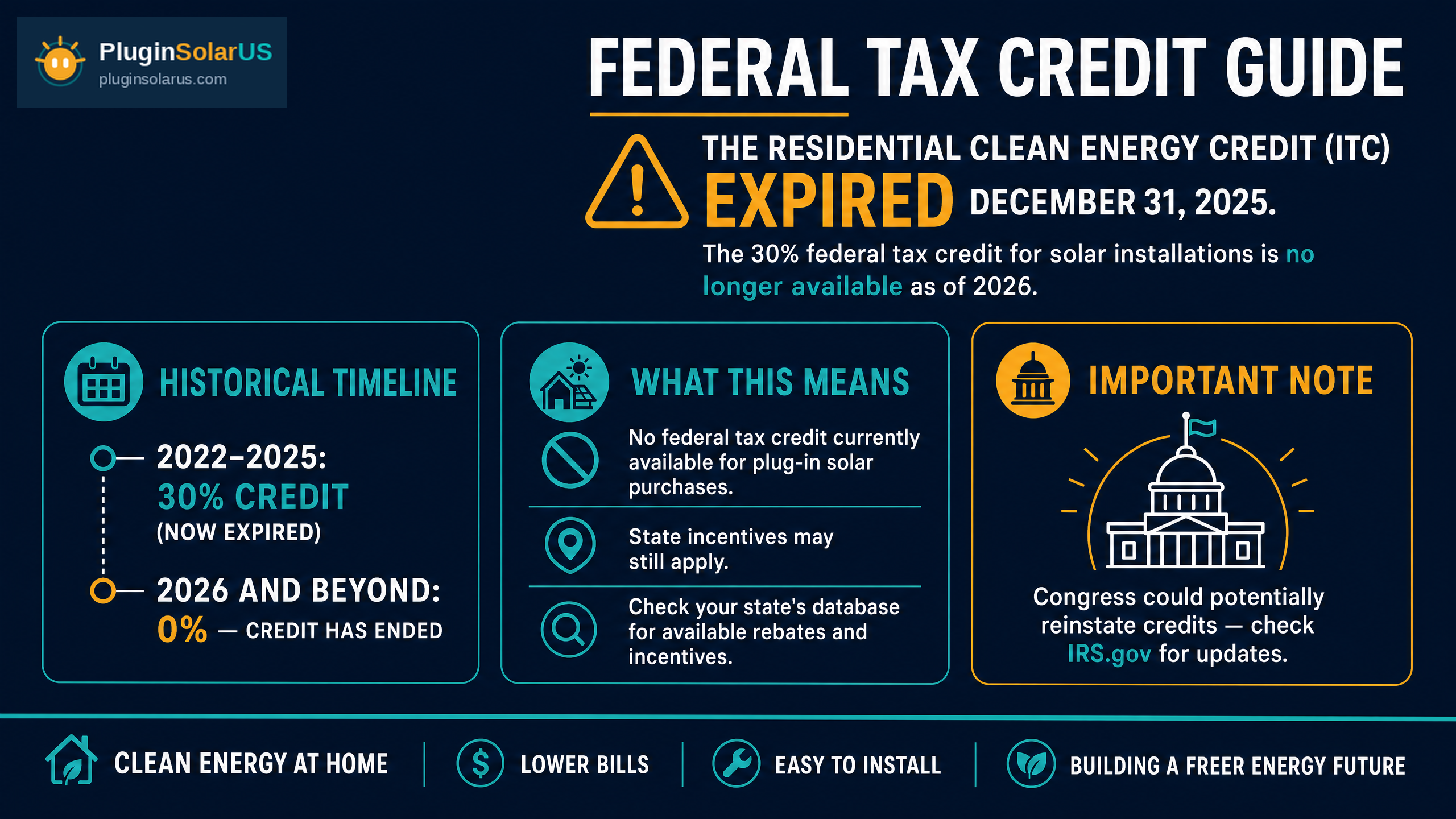
The Federal Solar Tax Credit (ITC): What You Need to Know After December 31, 2025
The Federal Solar Investment Tax Credit (ITC) has been a cornerstone incentive for homeowners and businesses adopting solar energy across the United States. However, for plug-in solar enthusiasts, a significant change occurred at the close of 2025. This guide will clarify the ITC's status, how to claim it for eligible 2025 purchases, and explore the evolving landscape of state-specific incentives and utility rebates that are now crucial for maximizing your plug-in solar savings.
Important Notice: Federal ITC Expired for New Purchases
The Federal Solar Investment Tax Credit (ITC) for residential solar installations, including plug-in solar systems, officially expired on December 31, 2025. This means that any plug-in solar system purchased and installed in 2026 or later is no longer eligible for this federal incentive. However, if you purchased your system in 2025, you may still be able to claim the credit on your 2025 tax return.
Understanding the Federal Solar Tax Credit (ITC)
What Was the ITC?
The Investment Tax Credit (ITC) was a federal incentive that allowed homeowners to deduct a percentage of the cost of installing a solar energy system from their federal taxes. It was a direct reduction in the amount of income tax you owed, not just a deduction from your taxable income. The credit applied to the entire cost of the system, including panels, inverters, mounting hardware, and even labor costs for installation. For plug-in solar, this meant a significant reduction in the upfront investment, making solar more accessible to a broader audience.
Eligibility for the ITC (Historical Context)
Historically, to be eligible for the ITC, the solar energy system had to be new or original use, located at a home in the United States, and owned by the taxpayer. Both primary and secondary residences qualified. The credit covered various solar technologies, including solar photovoltaic (PV) systems, solar water heaters, and fuel cell property. For plug-in solar, this typically meant systems designed to connect to the grid via a GFCI-protected outlet on a dedicated circuit, adhering to safety standards like UL 3700 and relevant electrical codes such as NEC Articles 690 and 705.
The Expiration: December 31, 2025
As of December 31, 2025, the residential Federal Solar Investment Tax Credit has expired. This was a scheduled sunset for the incentive, which had been gradually phasing down. While it provided a substantial boost to solar adoption for many years, new purchases made from January 1, 2026, onwards are no longer eligible for this federal benefit. This shift places a greater emphasis on understanding and leveraging state, local, and utility-specific incentives.
How to Claim the ITC for 2025 Purchases
If you purchased and installed your plug-in solar system in 2025, you are still eligible to claim the 30% federal tax credit on your 2025 tax return. It's crucial to gather all necessary documentation and understand the process to ensure you receive your rightful credit.
Documentation Needed
To claim the ITC, you will need to retain records proving the cost of your solar energy system. This typically includes:
- Purchase receipts or invoices for all components (solar panels, inverters, batteries, wiring, etc.)
- Installation costs, including labor
- Proof of payment
- Any permits or certifications related to the installation
Ensure these documents clearly itemize the costs associated with the solar energy system. Keep these records with your other tax documents.
Tax Form Details: Form 5695
The federal solar tax credit is claimed using IRS Form 5695, Residential Energy Credits. This form is used to calculate and claim various residential energy credits, including the credit for qualified solar electric property. You will report the total cost of your eligible plug-in solar system on this form, and the credit amount will then be calculated. The calculated credit from Form 5695 is then carried over to your Form 1040, Schedule 3 (Additional Credits and Payments).
Important Deadlines
The deadline for filing your 2025 federal income tax return is typically April 15, 2026. If you file an extension, you usually have until October 15, 2026. It is highly recommended to consult with a qualified tax professional to ensure accurate and timely filing, especially if you have any complex tax situations or questions regarding your eligibility.
State-by-State Incentives for Plug-In Solar
With the federal ITC no longer available for new purchases, state and local incentives have become paramount for making plug-in solar an attractive investment. The landscape of state support is dynamic, with new legislation and programs emerging to fill the void left by the federal credit.
The Evolving Landscape of State Support
States are increasingly recognizing the benefits of distributed generation and the potential of plug-in solar to empower residents. These incentives can take various forms, including state tax credits, rebates, property tax exemptions, sales tax exemptions, and performance-based incentives (PBIs). The availability and generosity of these programs vary significantly by state and even by local municipality or utility.
Key State Legislation and Initiatives
- Utah HB 340 (2025): Utah was the first state to enact a law explicitly legalizing plug-in solar (eight states have now enacted such laws as of June 2026: Utah, Maine, Virginia, Colorado, Maryland, Connecticut, New Hampshire, and Vermont). This landmark legislation exempts systems under 1,200W from interconnection permits, significantly streamlining the process for homeowners and renters. This law also references UL 3700 as a key safety standard.
- California SB 868 (Plug and Play Solar Act, 2026): Governor Newsom signed California SB 868 on September 30, 2026. Its new utility-side framework is expected January 1, 2027; current utility, electrical, landlord and property rules still apply until then. The signed text calls for qualifying equipment certification (UL or equivalent NRTL) but does not name UL 3700; AB-2316 was a separate community-solar bill.
Table of State Incentives (Illustrative Examples)
The following table provides illustrative examples of state-level incentives that may be available. This is not an exhaustive list, and programs can change frequently. Always verify current programs with your state energy office or local utility.
| State | Type of Incentive | Description | Applicability to Plug-In Solar |
|---|---|---|---|
| California | Net Metering, Potential Rebates | Net metering allows you to sell excess electricity back to the grid. Local utility rebates may be available. | High rate; signed SB 868 framework expected January 1, 2027, subject to qualifying-device rules. |
| Massachusetts | SMART Program, Net Metering | Solar Massachusetts Renewable Target (SMART) program offers incentives for solar generation. | Applicable, check specific program details. |
| New York | NY-Sun Program, Tax Credits | NY-Sun offers incentives for solar installations, and state tax credits may be available. | Good potential, verify program specifics. |
| Utah | Permit Exemption (HB 340) | Systems under 1,200W are exempt from interconnection permits. | Excellent, due to explicit legalization. |
| Connecticut | Residential Solar Investment Program | Offers performance-based incentives for solar generation. | Applicable, check program details. |
| Maryland | Solar Renewable Energy Credits (SRECs) | Homeowners can earn SRECs for the electricity their system generates. | Applicable, SREC market dependent. |
Utility Rebates and Local Programs
Beyond state-level initiatives, many local utilities and municipalities offer their own incentive programs for solar energy. These can significantly reduce the payback period for your plug-in solar system, which typically ranges from 5-7 years nationally, or 3-5 years in high-rate states like CA, MA, and CT with Time-of-Use (TOU) optimization.
How Utility Rebates Work
Utility rebates are financial incentives provided directly by your electricity provider. They can be offered as upfront payments, per-watt incentives, or based on the estimated annual production of your system. These programs are designed to encourage distributed generation, reduce strain on the grid, and help utilities meet renewable energy mandates. It's common for utilities to have specific requirements regarding system size (e.g., Starter: 400–1,200W panels + 1–2 kWh battery; Mid-Range: 800–1,600W + 2–3 kWh; High Output: 1,600–2,400W + 3–5 kWh+), equipment certification (UL 3700), and installation standards.
Finding Local Incentives
To discover local incentives, you should:
- Check Your Utility Provider's Website: Most utilities have a section dedicated to renewable energy or energy efficiency programs.
- Contact Your Local Energy Office: City or county energy departments often maintain lists of available incentives.
- Use Online Databases: Websites like DSIRE (Database of State Incentives for Renewables & Efficiency) can provide comprehensive lists of federal, state, and local incentives.
Given the national average electricity rate of approximately $0.18/kWh (with higher rates in states like CA at ~$0.34/kWh, MA at ~$0.32/kWh, and CT at ~$0.28/kWh), every incentive helps accelerate your return on investment.
What to Do If You Missed the Federal Credit
If you missed the opportunity to claim the federal ITC, don't be discouraged. Plug-in solar remains a smart investment, and there are still many ways to make it financially viable.
Focus on State and Local Programs
As highlighted, the focus has shifted to state and local incentives. Actively research and apply for any available state tax credits, rebates, or other programs in your area. These can often provide a substantial portion of the savings that the federal credit once offered.
Optimize for Energy Savings
Even without direct incentives, plug-in solar significantly reduces your electricity bill. By strategically sizing your system (e.g., an Entry battery capacity of 1–2 kWh, Standard at 2–3 kWh, or Extended at 3–5 kWh+) and optimizing its use with Time-of-Use (TOU) rates, you can maximize your savings. Consider a system that matches your typical baseline load to offset the most expensive electricity. Remember, plug-in solar must connect to a GFCI-protected outlet on a dedicated circuit, adhering to NEC Articles 690 and 705.
Frequently Asked Questions (FAQ)
Q: Can I still claim the federal ITC if I bought my system in 2026?
A: No, the federal ITC expired on December 31, 2025, for new purchases. Systems bought and installed in 2026 or later are not eligible.
Q: What is the difference between the federal ITC and state tax credits?
A: The federal ITC was a national program. State tax credits are offered by individual states and vary widely in amount and eligibility. You may be able to claim both if your state has a program.
Q: How do I find out about incentives specific to my area?
A: Start by checking your state energy office website, your local utility provider's website, and online databases like DSIRE. A local solar installer can also be a good resource.
Q: Is plug-in solar still worth it without the federal tax credit?
A: Absolutely. With rising electricity rates and a growing number of state and local incentives, plug-in solar can still offer significant long-term savings and environmental benefits. The payback period remains attractive, especially in high-rate areas.
Energy Resilience: The Non-Financial Case That Survives the ITC Expiration
The expiration of the federal ITC changes the financial math for plug-in solar, but it does not change the energy resilience case — and for many buyers, that case is equally or more compelling.
The US grid is becoming less reliable, not more. Weather-related outages are increasing in frequency and duration. For the 44 million American renters who cannot install rooftop solar or whole-home battery systems, a plug-in solar system with battery storage is one of the only practical options for maintaining power during outages. This value is entirely independent of electricity rates or tax incentives — it exists whether your rate is $0.10/kWh or $0.40/kWh.
When evaluating whether plug-in solar makes financial sense without the ITC, consider the resilience value as a separate line item:
- A whole-home generator costs $3,000–$15,000 installed, requires fuel, and needs annual maintenance
- A portable gas generator costs $500–$2,000, requires fuel storage, and is prohibited indoors by most leases
- A plug-in solar system with 2 kWh of battery storage costs $500–$2,500, requires no fuel, no maintenance, and pays for itself through daily bill savings
If you were going to spend $1,000–$2,000 on emergency preparedness anyway, a plug-in solar system that also reduces your electricity bill is a more efficient use of that capital — regardless of whether a 30% tax credit is available. This framing is particularly relevant for buyers in wildfire-prone, hurricane-zone, and extreme-heat regions where outages are a recurring reality rather than a rare event.
Next Steps
Ready to explore your plug-in solar journey further? Use our tools and resources to plan your system and discover local opportunities:
- Calculate Your Savings: Estimate your potential energy production and financial returns.
- Explore State Incentives: Find out what programs are available in your state.
- Plug-In Solar Buyer's Guide: Your comprehensive resource for choosing the right system.