Massachusetts Plug-In Solar: H.5175 Is in Conference Committee
By PlugInSolarUS Editorial Team · Published 2026-06-25 · Updated June 25, 2026 · 12 min read
Massachusetts H.5175 passed the House on February 26, 2026. The Senate substituted S.3143, reprinted as S.3166, and passed it July 1; both chambers appointed a conference committee July 16. The bill is not yet enacted.
Massachusetts Plug-In Solar: H.5175 Is in Conference Committee
📋 UPDATE (August 21, 2026): Bill in Conference Committee
The Massachusetts Senate released its own energy bill, S.3143 (“An Act to Save People Money, Repair the Climate and Grow the Economy”), on June 24, 2026. The Senate passed its substituted bill on July 1, 2026, and both chambers appointed a conference committee on July 16. The Senate claims $14 billion in ratepayer savings over 10 years. The House version (H.5175) passed 128–27 on February 26. After the Senate votes, a conference committee will reconcile both versions before sending the final bill to Governor Healey.
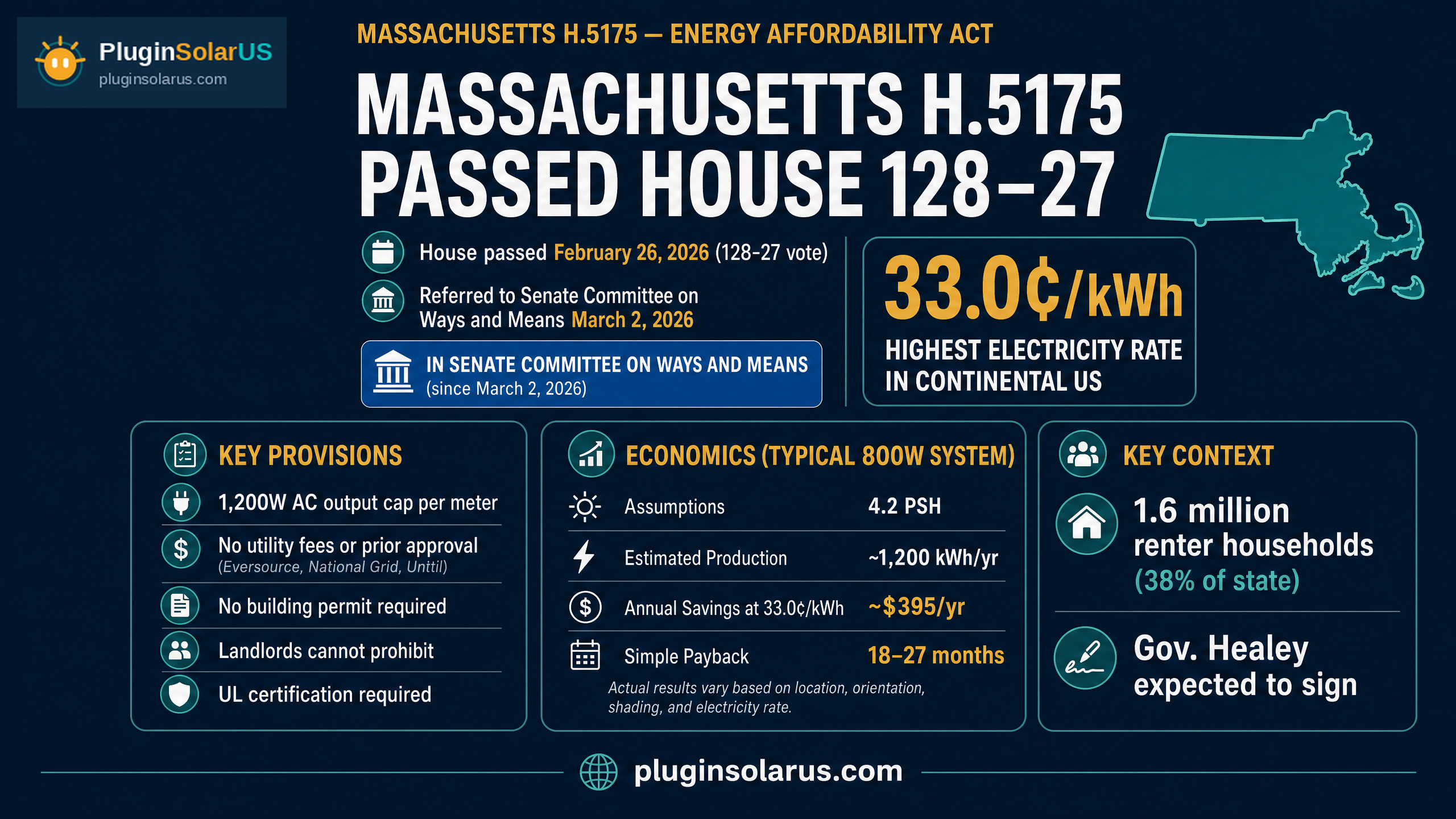
Massachusetts is on the verge of legalizing plug-in solar. The Massachusetts House of Representatives passed H.5175 — An Act Relative to Energy Affordability, Clean Power and Economic Competitiveness by a strong bipartisan margin of 128–27 on February 26, 2026. The comprehensive energy bill includes explicit plug-in solar provisions that would give the state's 1.6 million renter households immediate access to solar savings.
On June 24, 2026, the Senate Ways and Means Committee released its own substitute amendment, S.3143 (“An Act to Save People Money, Repair the Climate and Grow the Economy”), which the Senate will debate on July 1, 2026. The Senate bill claims $14 billion in total ratepayer savings over 10 years through a combination of procurement reform, rate stabilization, and clean energy provisions.
The bill's path through the House was methodical. The original bill, H.4744, was introduced by Rep. Jeff Roy (D-Framingham) and referred to the House Committee on Ways and Means, which produced a committee version designated H.5151. After floor debate on February 26 — during which the House rejected more than a dozen amendments before adopting three consolidated amendments — the House passed the bill and published it as H.5175, the enrolled version now before the Senate.
What H.5175 Would Do for Plug-In Solar
The plug-in solar provisions in H.5175 create a clear legal framework for Massachusetts residents who want to self-install a portable solar system without navigating utility interconnection bureaucracy:
- 1,200W AC output cap per meter: Systems are limited to 1,200 watts AC output per electrical meter — consistent with the laws enacted in Utah, Maine, Virginia, Colorado, and Maryland.
- No utility fees or prior approval: Eversource, National Grid, Unitil, and other Massachusetts utilities would be prohibited from charging extra fees or requiring prior approval for qualifying systems.
- No building permit required: Qualifying systems can be self-installed without a building permit.
- Landlord protection: Landlords cannot prohibit tenants from installing qualifying plug-in solar devices.
- Certification required: Devices must be certified by UL or an equivalent nationally recognized testing laboratory.
Why Massachusetts Matters: The Highest Rates in the Continental US
Massachusetts has among the highest residential electricity rates in the continental United States, averaging approximately $0.33 per kWh — nearly double the national average of $0.18/kWh. Eversource customers in eastern Massachusetts regularly pay $0.35–$0.40/kWh during peak periods under Time-of-Use rates, making the financial case for plug-in solar exceptionally compelling.
An 800-watt plug-in solar system in Massachusetts, generating approximately 1,200 kWh per year at Boston's 4.2 peak sun hours per day, would offset roughly $395 in annual electricity costs at average rates — and potentially $480+ for Eversource customers on TOU plans who can shift consumption to off-peak hours. At typical system costs of $600–$900 for an 800W setup, payback periods of 18–27 months are achievable.
| State | Rate (¢/kWh) | Est. Annual Savings (800W) | Status |
|---|---|---|---|
| Massachusetts | 33.0 | ~$395 | Senate debate July 1 (S.3143) |
| New Hampshire | 28.1 | ~$337 | Awaiting Gov. Ayotte |
| Connecticut | 26.0 | ~$312 | Awaiting Gov. Lamont |
| Vermont | 24.8 | ~$298 | Senate Amendment Vote Pending |
| Maine | 22.5 | ~$270 | Enacted (April 2026) |
The Massachusetts Renter Opportunity
Massachusetts has approximately 1.6 million renter households, representing about 38% of all households in the state — one of the highest renter shares in New England. Boston, Cambridge, Worcester, Springfield, and other dense urban areas have renter majorities, and these communities also tend to have the highest electricity bills due to older, less efficient housing stock.
H.5175's landlord non-prohibition clause is particularly significant for Massachusetts renters. Under current law, a landlord can simply refuse to allow any solar installation. H.5175 would remove that barrier, giving renters in the state's 1.6 million rental units the same access to plug-in solar savings that homeowners enjoy.
The Legislative Path: From H.4744 to S.3143
The Massachusetts plug-in solar effort began with H.4744, introduced by Rep. Jeff Roy (D-Framingham), a longtime clean energy champion who has sponsored solar legislation for over a decade. The bill was referred to the House Committee on Ways and Means, which incorporated it into a comprehensive energy affordability package alongside provisions on grid modernization, offshore wind, and energy storage.
The committee version, H.5151, was reported out on February 23, 2026. After floor debate on February 26 — during which the House rejected more than a dozen amendments (most by margins of 25–130 NAYS) before adopting three consolidated amendments by wide margins — the House passed the bill 128–27 and published it as H.5175. The Solar Energy Industries Association (SEIA) praised the passage, calling it a step forward for energy affordability and clean power access.
The bill was read and referred to the Senate Committee on Ways and Means on March 2, 2026. Rather than simply voting on the House version, the Senate developed its own comprehensive energy package. On June 23, the Senate adopted an order to take up the Ways and Means substitute amendment (S.3143) to H.5175, scheduling debate for July 1. The full text of S.3143 was released on June 24.
The Senate Bill: S.3143 and the $14 Billion Promise
The Senate's S.3143 is a sweeping energy reform bill that goes beyond the House version in several areas. According to the official Senate fact sheet released June 24, key savings provisions include:
- $7.1 billion: Securitizing utility debt and borrowing costs related to grid modernization and storm recovery
- $1 billion: Investigating price markups between what ratepayers are charged and actual market costs
- $780 million: Reforming procurement to reduce seasonal price swings
- $750 million: Reforming reconciling charges to dampen price spikes
- $650 million: Cracking down on predatory competitive energy suppliers
- $540 million: On-bill financing for home energy equipment (battery storage, rooftop solar)
- $420 million: Cutting out utility intermediaries on energy procurement
- $213 million: Adjusting renewable energy targets given federal offshore wind setbacks
The Senate bill also addresses Mass Save reform, offshore wind contracting flexibility, geothermal expansion, and renewable natural gas. Whether the Senate version retains the House's specific plug-in solar language (the “portable solar generation device” definition and 1,200W framework) will become clear when the full amendment text is debated on July 1. Given the strong bipartisan support in the House and the broader energy affordability framing, plug-in solar provisions are expected to survive the conference process.
Governor Healey's Energy Agenda
Governor Maura Healey has made clean energy a centerpiece of her administration. On March 16, 2026, she signed an Executive Order establishing a target of 10 GW of new energy capacity through 2035. Her administration has been a consistent advocate for energy affordability, and Vote Solar and other clean energy groups have cited her office as supportive of the plug-in solar provisions in H.5175.
If H.5175 passes the Senate and reaches Governor Healey's desk, she is widely expected to sign it. The bill carries an emergency preamble, meaning it would take effect immediately upon signing rather than after the standard 90-day waiting period — a significant detail for the 1.6 million Massachusetts renter households who would immediately gain the right to self-install plug-in solar.
What Happens Next
The Senate will debate S.3143 on July 1, 2026. Since the Senate is substituting its own text rather than voting on the House version unchanged, the bill will almost certainly go to a conference committee after the Senate vote. The conference committee — composed of members from both chambers — will reconcile the House and Senate versions into a single final bill.
Given the strong bipartisan support in both chambers and Governor Healey's vocal support for clean energy affordability, the final bill is widely expected to reach her desk this summer. The emergency preamble means it would take effect immediately upon signing — a significant detail for the 1.6 million Massachusetts renter households who would immediately gain the right to self-install plug-in solar.
Massachusetts residents can track both bills on the Massachusetts Legislature website: H.5175 and S.3143. Contact your state senator before July 1 to express support for retaining the plug-in solar provisions — constituent calls and emails remain among the most effective tools for shaping legislation during floor debate.
References
- Massachusetts H.5175 — MA Legislature Bill Status
- Massachusetts S.3143 — Senate Amendment Text
- MA Senate Fact Sheet: An Act to Save People Money, Repair the Climate and Grow the Economy (June 24, 2026)
- SEIA: Massachusetts Advances Affordable, Clean Energy Legislation (February 26, 2026)
- MAPC: House Energy Affordability Bill Summary H.5175 (March 5, 2026)
- InsideClimateNews: New England Lawmakers Weigh Plug-in Solar (February 18, 2026)
- Vote Solar: Massachusetts Has a Once-in-a-Generation Chance to Lower Your Electric Bill (April 17, 2026)
- EIA Electric Power Monthly — Massachusetts residential electricity rates
Sources
- Massachusetts H.5175 — MA Legislature Bill Status
- Massachusetts S.3143 — Senate Amendment Text
- MA Senate Fact Sheet: An Act to Save People Money, Repair the Climate and Grow the Economy (June 24, 2026)
- MAPC: House Energy Affordability Bill Summary H.5175 (Mar 5, 2026)
- SEIA: Massachusetts Advances Affordable, Clean Energy Legislation (Feb 26, 2026)
- InsideClimateNews: New England Lawmakers Weigh Plug-in Solar (Feb 18, 2026)
- EIA Massachusetts Electricity Data