5 Plug-In Solar Myths, Debunked
By PlugInSolarUS Editorial Team · Published 2026-03-05 · Updated April 2026 · 14 min read
From 'it pays back in 2 years' to 'it's not powerful enough to matter' — we debunk the most common myths about plug-in solar with real data.
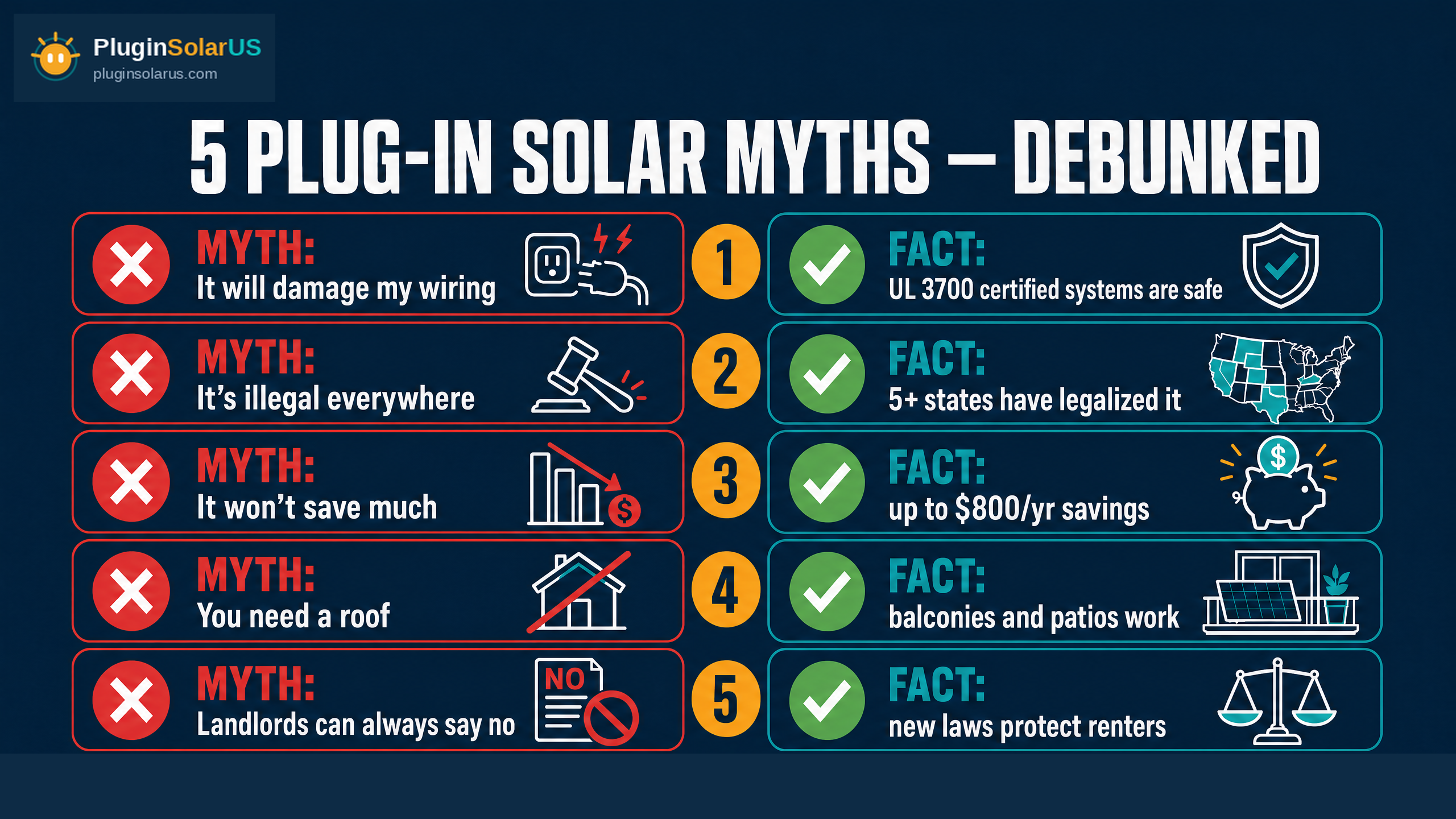
5 Plug-In Solar Myths, Debunked
Plug-in solar technology is rapidly gaining traction as an accessible entry point into renewable energy. However, like many emerging technologies, it's often surrounded by misconceptions and outdated information. These myths can deter potential users from exploring a viable and often cost-effective solution for reducing their carbon footprint and electricity bills. At PlugInSolarUS, we believe in empowering consumers with accurate information. In this comprehensive guide, we debunk five common plug-in solar myths and introduce two more, providing you with the critical facts and real-world examples you need to make informed decisions.
Myth 1: Plug-in solar is complicated to install and requires professional help.
One of the most pervasive myths surrounding plug-in solar is the belief that its installation is inherently complex, demanding specialized tools and professional electricians. This misconception often stems from the traditional rooftop solar installation process, which indeed involves significant structural work, wiring, and permitting. However, plug-in solar systems are designed with simplicity and user-friendliness in mind, making them a true "DIY" renewable energy solution for many.
The core principle of plug-in solar is its direct connection to a standard electrical outlet, much like any other appliance. This eliminates the need for intricate wiring into your home's main electrical panel, a task that typically requires a licensed electrician. Instead, the system components—solar panels, microinverters, and a simple plug—are designed for straightforward assembly. Many manufacturers provide detailed, step-by-step instructions and even video tutorials that guide users through the entire process, from mounting the panels to plugging them in. The ease of installation significantly reduces upfront costs, as you save on labor fees that can often constitute a substantial portion of a traditional solar project's budget.
While the physical installation is designed to be simple, it's crucial to understand the electrical requirements. Plug-in solar systems require a GFCI-protected outlet on a dedicated circuit. This is a critical safety measure, ensuring that the system operates within established electrical codes and prevents overloading. While this might sound technical, it often means verifying your existing outlets rather than installing entirely new infrastructure. For those unsure about their home's electrical setup, a quick consultation with a qualified electrician can provide peace of mind and ensure compliance with NEC Articles 690 and 705, as well as local codes. However, the hands-on aspect of setting up the panels and connecting the components remains accessible to the average homeowner or renter.
Myth 2: Plug-in solar systems are not powerful enough to make a significant difference.
Another common myth suggests that plug-in solar systems are mere toys, incapable of generating enough electricity to meaningfully impact household consumption or utility bills. This perspective often overlooks the cumulative effect of even small-scale renewable energy generation and the diverse range of system sizes available today. While a single plug-in panel won't power an entire mansion, a well-sized system can significantly offset baseline electricity usage and contribute to substantial savings.
Plug-in solar systems are available in various configurations, catering to different energy needs and budgets. Our system sizing tiers illustrate this flexibility:
| System Tier | Power Output (W) | Battery Storage (kWh) | Typical Use Case |
|---|---|---|---|
| Starter | 400–1,200W | 1–2 kWh | Offsetting standby power, small appliances, lighting |
| Mid-Range | 800–1,600W | 2–3 kWh | Reducing daytime consumption, powering home office, refrigeration |
| High Output | 1,600–2,400W+ | 3–5 kWh+ | Significant bill reduction, powering major appliances, EV charging support |
Even a Starter system can effectively reduce the "phantom load" of electronics and provide power for essential devices, especially during peak sunlight hours. For instance, a 400W system operating for 5 hours a day can generate 2 kWh, which can power a refrigerator for a full day or keep multiple devices charged. Over a month, this adds up to 60 kWh, representing tangible savings on your electricity bill. In states with high electricity rates, these savings are amplified, making even smaller systems financially attractive.
Furthermore, the integration of battery storage with plug-in solar systems enhances their impact. Batteries allow you to store excess energy generated during the day and use it during the evening or on cloudy days, maximizing self-consumption and further reducing reliance on grid electricity. This capability is particularly valuable in areas with Time-of-Use (TOU) billing, where electricity rates fluctuate throughout the day. By discharging stored solar energy during expensive peak hours, users can achieve even greater financial benefits, turning a seemingly small system into a powerful tool for energy independence.
Myth 3: Plug-in solar is illegal or not widely accepted by utilities and local authorities.
A significant concern for many prospective plug-in solar users is the legality and acceptance of these systems. The myth that plug-in solar is illegal or faces widespread opposition from utilities and local authorities is largely unfounded, though it stems from a historical lack of clear regulations and the novelty of the technology. While regulations vary by jurisdiction, the trend is towards greater acceptance and clearer guidelines, making plug-in solar a legitimate and increasingly recognized energy solution.
The regulatory landscape for plug-in solar has clarified dramatically in 2025–2026. Utah HB 340 (2025) was the first enacted US law explicitly legalizing plug-in solar. Maine LD 1730 (April 6, 2026) became the second. Virginia HB 395 was signed April 22, 2026, Colorado HB 1440 was signed May 7, 2026, and Maryland HB 1532 was signed May 12, 2026 — bringing the total to five enacted states. This is one of the fastest-moving state legislative categories in clean energy. These laws are crucial for standardizing safety requirements, interconnection processes, and ensuring consumer protection, paving the way for broader adoption.
While the enacted states lead the way, more than a dozen additional states have active bills advancing through their legislatures in 2026. It's important for consumers to check their local and state regulations, as well as their utility's interconnection policies, but the general direction is one of increasing support and clarity. Resources like our State Tracker can help you navigate these specific requirements.
Utilities are also adapting. Many now have established procedures for interconnecting small-scale, grid-interactive systems, including plug-in solar. The key is often proper notification and adherence to safety standards, particularly regarding the GFCI outlet and dedicated circuit requirements. By following these guidelines, plug-in solar users can ensure their systems are safely integrated into the grid and comply with utility expectations, dispelling the myth of widespread utility opposition.
Myth 4: Plug-in solar is too expensive and doesn't offer a good return on investment.
The perception that plug-in solar is an unaffordable luxury with a poor return on investment (ROI) is a significant barrier for many. This myth often arises from comparing the upfront cost of plug-in systems to the perceived benefits without considering long-term savings, incentives, and the rapidly decreasing cost of solar technology. In reality, plug-in solar can be a highly cost-effective investment, especially when factoring in electricity rate savings and potential incentives.
The initial investment for a plug-in solar system is considerably lower than that of a full-scale rooftop installation. This lower entry barrier makes solar energy accessible to a wider demographic. When evaluating the financial viability, it's essential to look at the payback period—the time it takes for the savings on your electricity bill to offset the initial cost of the system. Nationally, the average payback period for plug-in solar systems ranges from 5 to 7 years. This is a competitive timeframe, especially when compared to other home improvements or investments.
However, the financial benefits are even more pronounced in certain regions. In states like California, Massachusetts, and Connecticut, where electricity rates are significantly higher and Time-of-Use (TOU) billing is prevalent, the payback period can shrink to an impressive 3 to 5 years. This accelerated ROI is driven by the ability of plug-in solar to offset expensive peak-hour electricity consumption. Consider the average electricity rates:
| Region | Average Electricity Rate ($/kWh) |
|---|---|
| National Average | $0.18 |
| California | $0.34 |
| Massachusetts | $0.32 |
| Connecticut | $0.28 |
These figures clearly demonstrate how higher electricity rates translate into greater savings and faster payback periods. While the Federal Investment Tax Credit (ITC) for plug-in solar expired on December 31, 2025, local and state incentives, as well as net metering policies, can still significantly enhance the financial appeal of these systems. It's always advisable to research available incentives in your specific area to maximize your ROI. Our calculator can help you estimate your potential savings.
Myth 5: Plug-in solar is only for homeowners with ideal roof conditions.
The image of solar panels exclusively adorning the roofs of detached homes with perfect south-facing orientations is a powerful one, leading to the myth that plug-in solar is inaccessible to renters, apartment dwellers, or those with less-than-ideal roof spaces. This misconception severely limits the perceived audience for solar energy, overlooking the versatility and adaptability of plug-in systems. In reality, plug-in solar is designed to be flexible, making it a viable option for a much broader range of living situations.
Unlike traditional rooftop solar, which often requires significant structural modifications and long-term property ownership, plug-in solar systems are portable and can be deployed in various locations. This makes them an excellent solution for renters who cannot make permanent alterations to their dwelling. Panels can be mounted on balconies, patios, fences, or even ground-mounted in a yard, as long as there is adequate sunlight exposure and access to a suitable outdoor outlet. This flexibility means that the "ideal roof condition" is no longer a prerequisite for harnessing solar power.
For apartment dwellers, the ability to utilize balcony space is a game-changer. A few panels strategically placed on a sunny balcony can contribute significantly to offsetting electricity consumption, especially for common apartment loads like lighting, electronics, and small appliances. Property managers are also increasingly recognizing the benefits of allowing plug-in solar, as it enhances tenant satisfaction and aligns with sustainability goals. Our resources for renters and property managers provide guidance on navigating these considerations.
Even homeowners with shaded roofs or complex architectural designs can benefit from plug-in solar. Instead of a full rooftop array, they can strategically place smaller plug-in systems in sunnier areas of their property, such as a garden, shed roof, or even a portable ground mount that can be adjusted seasonally. This modular approach allows for customization and optimization of solar capture, proving that plug-in solar is truly for everyone looking to embrace renewable energy, regardless of their specific living situation or property characteristics.
Myth 6: You need a dedicated circuit for plug-in solar.
Reality Check: GFCI-Protected Outlet on a Dedicated Circuit
While a dedicated circuit is required, it's crucial to understand that this often means utilizing an existing dedicated circuit with a GFCI-protected outlet, not necessarily installing an entirely new circuit. Always consult NEC Articles 690 and 705, and local electrical codes.
This myth often causes confusion and unnecessary concern among potential plug-in solar users. The phrase "dedicated circuit" can conjure images of expensive electrical upgrades and complex wiring, leading many to believe that plug-in solar is beyond their reach. While it is true that a plug-in solar system requires a GFCI-protected outlet on a dedicated circuit, the nuance lies in what "dedicated circuit" truly implies in this context, and how it differs from installing a brand-new circuit from scratch.
A dedicated circuit means that the outlet you are using for your plug-in solar system is the only outlet on that particular circuit breaker in your electrical panel. This is a critical safety requirement outlined in electrical codes like NEC Articles 690 and 705. The purpose is to prevent overloading the circuit, which could lead to tripped breakers, electrical fires, or damage to appliances. Many homes already have dedicated circuits for high-draw appliances such as refrigerators, washing machines, or microwaves. In many cases, you might be able to utilize one of these existing dedicated circuits, provided it is not already in use by another appliance and is equipped with a GFCI (Ground Fault Circuit Interrupter) outlet, or can be easily upgraded to one.
The distinction is important: you might not need to run new wiring from your electrical panel to a new location. Instead, the task often involves identifying an existing dedicated circuit that meets the requirements and ensuring it has the necessary GFCI protection. GFCI outlets are designed to protect against electrical shock by quickly shutting off power if a ground fault is detected, adding another layer of safety for outdoor or wet-location electrical connections, which are common for solar installations. If an existing dedicated circuit does not have a GFCI outlet, it can often be replaced by a GFCI outlet or protected by a GFCI breaker in the electrical panel by a qualified electrician.
Therefore, while the requirement for a dedicated circuit is non-negotiable for safety and code compliance, it doesn't automatically translate into a major electrical overhaul. A thorough assessment of your home's existing electrical infrastructure, possibly with the help of an electrician, can clarify whether you have suitable circuits available or if minor modifications are needed. This understanding helps demystify the process and makes plug-in solar more accessible than the myth suggests. Our electricians and solar installers pages can connect you with professionals who understand these requirements.
Myth 7: Plug-in solar only makes financial sense in California.
The Broader Reality: Savings Across 30+ States
While California offers excellent conditions for solar ROI, plug-in solar is financially viable in any state with electricity rates above $0.15/kWh, encompassing over 30 states nationwide.
It's easy to assume that the significant financial benefits of solar energy are exclusive to sunny, progressive states like California, given its reputation as a leader in renewable energy adoption and its high electricity rates. This myth, however, severely underestimates the widespread applicability and financial viability of plug-in solar across a vast majority of the United States. The reality is that plug-in solar can deliver substantial savings and a compelling return on investment in any state where electricity rates exceed a modest threshold, making it a smart choice for millions of households beyond the Golden State.
The primary driver of financial savings from solar energy is the cost of grid electricity that your solar panels offset. The higher your electricity rate, the more valuable each kilowatt-hour (kWh) generated by your plug-in system becomes. While California boasts an average electricity rate of $0.34/kWh, making solar exceptionally attractive, many other states also have rates well above the national average of $0.18/kWh. In fact, plug-in solar begins to make strong financial sense in any state with electricity rates above $0.15/kWh. This threshold includes over 30 states across the country, from the Northeast to the Southwest, and even parts of the Midwest.
Consider states like Massachusetts ($0.32/kWh) and Connecticut ($0.28/kWh), where electricity rates are among the highest in the nation. In these states, plug-in solar systems can achieve payback periods as short as 3 to 5 years, especially when combined with Time-of-Use (TOU) billing structures that reward daytime solar generation. Even in states with rates closer to the national average, the long-term savings over the lifespan of a solar system (typically 25+ years) can be substantial, far outweighing the initial investment. The key is to evaluate your local electricity rates and consumption patterns, rather than relying on generalized assumptions.
Furthermore, the availability of state and local incentives, even after the expiration of the Federal ITC on December 31, 2025, can further enhance the financial attractiveness of plug-in solar in various regions. These incentives might include state tax credits, rebates, or favorable net metering policies that compensate you for excess electricity fed back into the grid. By looking beyond California and exploring the specific energy landscape of your state, you'll likely discover that plug-in solar is a powerful and financially rewarding option for reducing your energy costs and contributing to a sustainable future. Our how it works and learn sections offer more insights into these benefits.
Myth Bonus: "Plug-In Solar Is Only About Saving Money"
This is perhaps the most limiting misconception of all. While the financial case is strong, energy resilience is an equally compelling reason to go plug-in solar — and one that is increasingly driving adoption in regions where grid reliability is deteriorating.
The US grid experiences more weather-related outages than any other developed nation. Wildfires, hurricanes, ice storms, and extreme heat events are all driving longer, more frequent blackouts. For renters and apartment dwellers who cannot install whole-home generators or rooftop battery systems, a plug-in solar system with battery storage is one of the only practical options for maintaining power during these events.
A 2 kWh battery system can keep a refrigerator running for 24–30 hours, charge phones and medical devices, and power LED lighting and a Wi-Fi router through a multi-day outage — all while paying for itself through daily bill savings when the grid is running normally. The resilience benefit is not a niche use case; it is a core value proposition for millions of Americans in wildfire-prone, hurricane-zone, and extreme-heat regions.
If you've been on the fence about plug-in solar because your electricity rates are low, consider the resilience angle: the peace of mind of knowing your essentials will stay on during the next outage may be worth more than the monthly bill savings alone.
Next Steps Towards Your Solar Journey
Now that we've debunked some of the most common myths surrounding plug-in solar, you're better equipped to explore this exciting renewable energy option. Taking the first step towards energy independence is easier than you think, and PlugInSolarUS is here to guide you through every stage of the process. We encourage you to utilize our comprehensive resources to assess your readiness, calculate your potential savings, and select the perfect system for your needs.
- Are You Ready for Plug-In Solar? Discover if plug-in solar is the right fit for your home or apartment by visiting our Plug-In Solar Readiness Guide. This guide covers everything from sunlight exposure to electrical considerations, ensuring you have a clear understanding of the prerequisites.
- Calculate Your Savings: Curious about how much you can save on your electricity bills? Our intuitive Savings Calculator provides personalized estimates based on your location, electricity usage, and system size. See your potential return on investment in minutes!
- Find Your Perfect System: Ready to take the plunge? Explore our curated selection of plug-in solar solutions in our Buyer's Guide. We offer systems across all sizing tiers—Starter, Mid-Range, and High Output—to match every energy need and budget.