Plug-In Solar in Texas: How the Deregulated Market Changes Everything
By PlugInSolarUS Editorial Team · Published 2026-03-20 · Updated April 2026 · 8 min read
Texas has the highest electricity price volatility in the US. Here's how plug-in solar with battery storage can protect you from rate spikes — and why the deregulated market makes it easier.
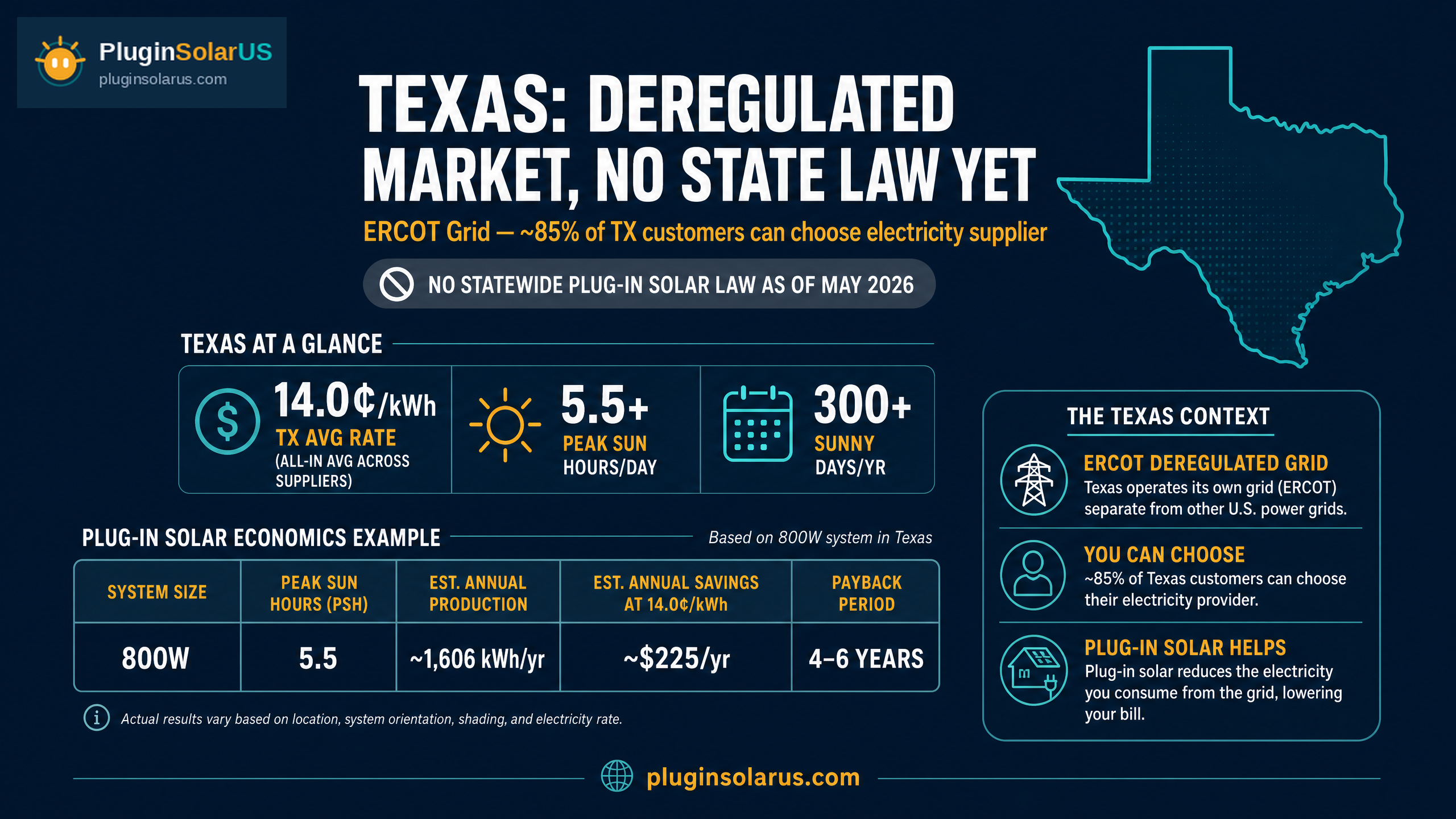
Plug-In Solar in Texas: How the Deregulated Market Changes Everything
Important Notice: GFCI Outlets are Critical
Plug-in solar systems MUST connect to a GFCI-protected outlet on a dedicated circuit. This is not merely a recommendation but a critical safety and code requirement, as per NEC Articles 690 and 705. Failure to comply can lead to serious safety hazards and non-compliance with local electrical codes.
Texas, known for its vast energy landscape, presents a unique environment for plug-in solar adoption due to its largely deregulated electricity market. Unlike states where a single utility controls generation, transmission, and distribution, Texas operates under a competitive model, primarily managed by the Electric Reliability Council of Texas (ERCOT). This structure profoundly influences how plug-in solar systems integrate into the grid and how consumers can maximize their benefits.
Understanding Texas's Deregulated Electricity Market
The Texas electricity market is unique in the United States, with approximately 85% of the state's electric load served by the ERCOT grid. This deregulated model means that consumers in competitive areas can choose their Retail Electric Provider (REP) from a variety of companies that buy and sell electricity. This contrasts sharply with traditional utility models found in many other states, where a single, vertically integrated utility handles all aspects of electricity service.
In a deregulated market, REPs compete for customers by offering different pricing plans, incentives, and service packages. While this fosters innovation and can lead to lower prices for consumers, it also adds a layer of complexity, especially for those looking to generate their own power with plug-in solar. Understanding the roles of ERCOT, transmission and distribution utilities (TDUs), and REPs is crucial for any Texan considering plug-in solar.
The ERCOT Market Structure and Your Plug-In Solar System
ERCOT's primary role is to manage the flow of electric power to 27 million Texas customers, ensuring grid reliability and open access to the transmission system. It does not own generation or transmission assets but rather coordinates the operations of the grid. This means that while your plug-in solar system generates electricity, its interaction with the broader grid is mediated through your REP and the local TDU.
For plug-in solar owners, the deregulated market means that traditional net metering, where excess solar generation is credited at the full retail rate, is not universally available. Instead, REPs may offer various buy-back programs or credit schemes. The value of your excess generation can vary significantly depending on your chosen REP and their specific plan. This necessitates careful evaluation of REP offerings to ensure your plug-in solar investment yields the best possible returns.
Specific Texas REP Programs for Solar Owners
The competitive nature of the Texas electricity market means that some REPs have begun to offer plans specifically designed for customers with distributed generation, including plug-in solar. These plans often fall into a few categories:
- Fixed Buy-Back Rates: Some REPs offer a fixed rate for any excess electricity your plug-in solar system sends back to the grid. This provides predictability but may not always reflect the true market value of electricity.
- Variable Buy-Back Rates: Other plans might offer variable rates, often tied to wholesale electricity prices, which can fluctuate significantly. While potentially more lucrative during peak demand, these plans also carry more risk.
- Bill Credits: Instead of direct payments, some REPs provide bill credits for excess generation, which can then be applied to future electricity bills.
It is imperative for plug-in solar prospective owners to thoroughly research and compare REP plans. Websites like Power to Choose can be a valuable resource, though specific plug-in solar buy-back options may require direct inquiry with REPs. As of April 2026, the landscape for plug-in solar specific programs is still evolving, but the trend towards more tailored solutions is growing.
Lessons from Winter Storm Uri: The Resilience of Distributed Energy
The devastating Winter Storm Uri in February 2021 exposed critical vulnerabilities in the Texas grid, leading to widespread power outages and significant economic losses. This event underscored the importance of grid resilience and the potential role of distributed energy resources (DERs), such as plug-in solar with battery storage, in enhancing energy independence.
During Uri, homes equipped with plug-in solar systems coupled with battery storage could have maintained essential power, providing critical backup during extended outages. While the primary goal of plug-in solar is often cost savings, the added benefit of resilience in the face of extreme weather events or grid instability has become a significant consideration for Texans. Investing in a battery alongside your plug-in solar system transforms it from a simple grid-tied generator into a powerful tool for energy security, offering peace of mind when the centralized grid falters.
Plug-In Solar System Sizing and Battery Tiers for Texans
Choosing the right size for your plug-in solar system and battery is crucial for maximizing benefits in Texas. Here's a breakdown of common tiers:
System Sizing Tiers:
- Starter (400–1,200W panels + 1–2 kWh battery): Ideal for apartments or small homes looking to offset basic loads like lighting, charging devices, or a refrigerator. Perfect for those new to solar.
- Mid-Range (800–1,600W + 2–3 kWh battery): Suitable for larger energy needs, capable of offsetting a significant portion of daily consumption, including some larger appliances.
- High Output (1,600–2,400W + 3–5 kWh+ battery): Designed for maximum energy independence, capable of powering most household loads and providing substantial backup during outages.
Battery Capacity Tiers:
- Entry (1–2 kWh): Provides short-term backup for critical loads.
- Standard (2–3 kWh): Offers extended backup and better optimization for Time-of-Use (TOU) plans.
- Extended (3–5 kWh+): Maximizes self-consumption and provides robust backup for longer durations.
Given Texas's high summer electricity demand and potential for grid strain, a larger battery capacity can be particularly beneficial for optimizing energy usage and providing resilience.
Navigating Regulations and Electrical Safety
For any grid-connected system, electrical safety and code compliance are essential. The applicable requirements depend on the equipment, circuit, local authority having jurisdiction, manufacturer instructions, and utility rules. NEC Articles 690 and 705 are relevant to photovoltaic and interconnected-generation systems; NEC Article 625 concerns EV charging, not plug-in solar.
Texas does not have a statewide statutory plug-in-solar exemption. PUCT §25.211 remains the rule for interconnection of on-site distributed generation, so customers should obtain current written guidance from their utility and consult a qualified electrician before connecting equipment to home wiring. Do not assume that a GFCI outlet, a dedicated circuit, or any particular product feature alone establishes compliance.
Texas-Specific Incentives and Payback Periods
Unlike some states, Texas does not offer a statewide net metering policy or significant state-level incentives specifically for plug-in solar. However, Texans can still benefit from the overall savings on their electricity bills. The federal Investment Tax Credit (ITC), which offered a 30% tax credit for solar installations, expired on December 31, 2025, and is no longer available for new purchases. However, if you purchased a system in 2025, you can still claim the ITC on your 2025 tax returns.
Despite the absence of direct state incentives, the financial case for plug-in solar in Texas remains strong, especially with strategic energy management. The national average payback period for plug-in solar is 5–7 years. In high-rate states like California, Massachusetts, and Connecticut, with effective Time-of-Use (TOU) optimization, this can drop to 3–5 years. While Texas's average electricity rate is around $0.18/kWh, which is lower than CA ($0.34/kWh), MA ($0.32/kWh), and CT ($0.28/kWh), careful selection of REP plans and TOU optimization can significantly improve payback periods.
Some local utilities or municipalities may offer their own rebate programs or incentives. It is advisable to check with your local TDU and city government for any available programs that could further reduce the cost of your plug-in solar system.
UL 3700: Ensuring Safety and Compliance
The safety and reliability of plug-in solar systems are paramount. The UL 3700 standard, which covers safety for plug-in grid-interactive power conversion equipment, plays a crucial role in this. This standard ensures that plug-in solar devices meet rigorous safety requirements for interconnection with the grid. Utah's HB 340 (signed March 2025, before UL 3700 was published) references UL 1741 for inverter certification. Maine's LD 1730 (2026) is the first enacted law to reference UL 3700 by name, and it is referenced in most pending state bills across the US, highlighting its importance for the broader adoption of plug-in solar.
When evaluating equipment, check the current statutory, utility, and manufacturer requirements for the exact configuration. Do not treat a single certification label as a substitute for confirming installation, circuit, interconnection, and property requirements that may apply in Texas.
Next Steps for Your Texas Plug-In Solar Journey
Embarking on your plug-in solar journey in Texas requires careful planning and understanding of the unique market dynamics. By taking these next steps, you can ensure a smooth and successful transition to generating your own clean energy:
- Assess Your Readiness: Understand the fundamental requirements and considerations for plug-in solar in your specific living situation. Visit our Plug-In Solar Readiness Guide to get started.
- Calculate Your Savings: Determine the potential energy offset and financial savings your plug-in solar system can provide. Use our interactive Plug-In Savings Calculator to estimate your benefits.
- Explore Battery Options: Learn how battery storage can enhance your plug-in solar system, providing resilience and optimizing energy usage. Consult our Battery Storage Guide for detailed information.
- Make an Informed Purchase: Once you're ready, explore the best plug-in solar systems available on the market. Our Plug-In Solar Buyer's Guide will help you choose the right system for your needs.