New Hampshire SB 540 Signed Into Law: What Chapter 262 Means for NH Residents
By PlugInSolarUS Editorial Team · Published 2026-05-13 · Updated August 21, 2026 · 7 min read
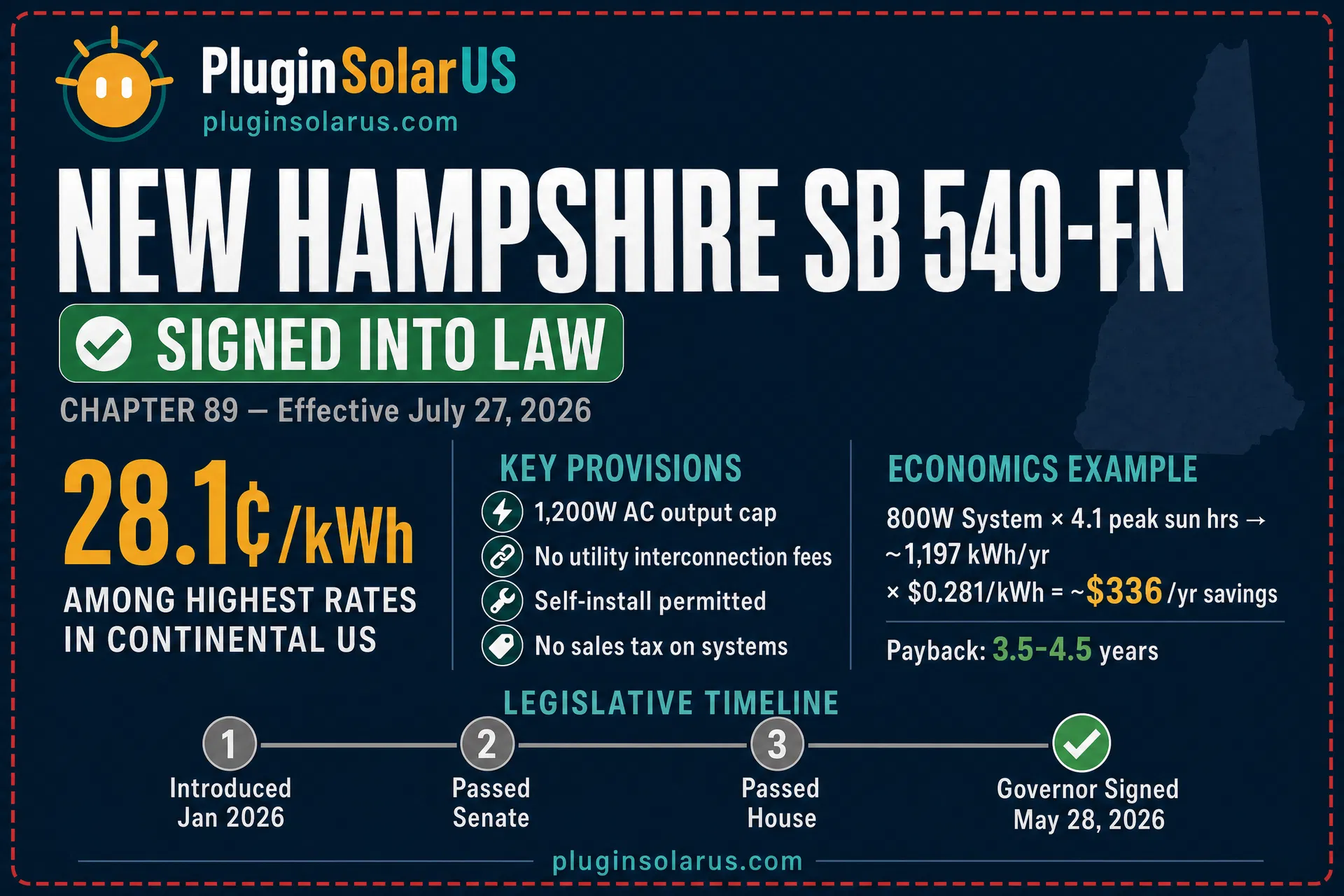
Governor Kelly Ayotte signed New Hampshire SB 540-FN into law on July 2, 2026 as Chapter 262. New Hampshire is the 7th US state to legalize plug-in solar. The remainder of the act took effect July 2, 2026; section 3 follows its own statutory effective-date provision. At $0.281/kWh, NH residents can save more per watt of plug-in solar than almost any other state.
New Hampshire SB 540: Plug-In Solar Bill Passes Both Chambers, Heads to Governor Ayotte
✅ Signed Into Law — Chapter 262 (July 2, 2026)
Governor Kelly Ayotte signed SB 540-FN into law on July 2, 2026 as Chapter 262. The remainder of the act took effect July 2; section 3 follows its own statutory effective-date provision. Note: building code provisions are contingent on a nationally recognized standard being certified.
New Hampshire has taken a major step toward legalizing plug-in solar. The New Hampshire General Court passed SB 540-FN through both chambers, with the full House passing it on May 14, 2026, sending the bill to Governor Kelly Ayotte for her signature. The bill was sponsored by Sen. David Watters and received strong bipartisan support throughout the legislative process, including a unanimous 6-0 "Ought to Pass" vote from the House committee in March 2026.
For New Hampshire residents, the stakes are unusually high. At an average residential electricity rate of $0.281/kWh — among the highest in the continental United States — every kilowatt-hour of solar generation translates into more savings than in almost any other state. A standard 800W plug-in solar system could save a New Hampshire household an estimated $286 per year.
What SB 540-FN Would Do
The bill creates a clear legal framework for plug-in solar in New Hampshire, with three core provisions:
- No utility fees or prior approval: Eversource and Unitil would be prohibited from charging any extra fees or requiring prior approval for plug-in solar kits that comply with the bill's requirements.
- 1,200W AC output cap per meter: Systems are capped at 1,200 watts AC output per electrical meter — consistent with most other state plug-in solar laws.
- Self-installation without a permit: Qualifying systems can be installed by the homeowner or renter without a building permit.
One important nuance: the bill includes a provision that ties building code compliance to the adoption of a nationally recognized standard. This means the full building code provisions may not take effect until the National Electrical Code (NEC) formally incorporates plug-in solar — currently not expected until the NEC 2029 cycle. However, the utility-facing provisions (no fees, no prior approval) would take effect upon signing.
The New Hampshire Electricity Rate Advantage
New Hampshire's electricity rates make it one of the most financially compelling states for plug-in solar in the entire country. At $0.281/kWh, the economics are striking:
| Metric | Value (NH average rate: $0.281/kWh) |
|---|---|
| Annual Production (800W, 4.1 peak sun hours) | ~1,197 kWh |
| Annual Savings at $0.281/kWh | ~$336/year |
| Typical System Cost | ~$1,200–$1,500 |
| Estimated Payback Period | 3.5–4.5 years |
New Hampshire also has no state sales tax, meaning solar equipment purchases are fully tax-free — an additional advantage not available in most states. Combined with the state's Net Metering 2.0 program (which credits solar exports at approximately 85% of the retail rate, locked through 2041), the financial case for plug-in solar in New Hampshire is among the strongest in the nation.
Eversource NH also offers a home battery storage rebate of $230/kWh, up to $3,000 — which could further reduce the cost of a plug-in solar plus battery system. Use our Savings Calculator to estimate your specific savings based on your zip code and current rate.
Legislative History
SB 540-FN had a smooth path through the New Hampshire General Court:
- Senate passage: The bill passed the Senate with strong bipartisan support in early 2026.
- House committee (March 2026): The House Science, Technology and Energy committee voted 6-0 "Ought to Pass" — a unanimous recommendation that effectively signaled near-certain House floor passage.
- Full House passage (May 14, 2026): The House passed the bill on May 14, 2026, sending it to Governor Ayotte's desk. (The Senate had passed it earlier in the session.)
The bill's bipartisan support reflects New Hampshire's unusual political dynamic around energy: while the state has a Republican governor and a legislature with significant Republican representation, the combination of sky-high electricity rates and a strong libertarian streak around property rights and self-sufficiency created broad cross-party appeal for plug-in solar.
What Happens Next: Governor Ayotte's Decision
Governor Kelly Ayotte (R) has not made a public statement on SB 540-FN as of May 13, 2026. The governor has several options:
- Sign the bill — it becomes law immediately or on the date specified in the bill.
- Veto the bill — the legislature could attempt an override, though this is rarely successful in New Hampshire.
- Allow the bill to become law without signature — possible if the governor neither signs nor vetoes within the statutory period.
Consumer advocates and clean energy groups are optimistic. New Hampshire's electricity rates create a powerful economic argument for the bill that transcends partisan lines — and the bill imposes no costs on the state budget. Governor Ayotte has generally been supportive of consumer-focused energy measures.
How New Hampshire Compares to Other States
| State | Bill | Status | Avg. Rate | Est. Annual Savings (800W) |
|---|---|---|---|---|
| Utah | HB 340 | ✅ Enacted (2025) | $0.114/kWh | ~$136/yr |
| Maine | LD 1730 | ✅ Enacted (Apr 2026) | $0.241/kWh | ~$289/yr |
| Virginia | HB 395 | ✅ Enacted (Apr 2026) | $0.141/kWh | ~$169/yr |
| Colorado | HB 26-1007 | ✅ Enacted (May 2026) | $0.148/kWh | ~$177/yr |
| Maryland | HB 1532 | ✅ Enacted (May 2026) | $0.168/kWh | ~$201/yr |
| New Hampshire | SB 540-FN | ✅ Enacted (Chapter 262, July 2, 2026) | $0.281/kWh | ~$336/yr |
| Vermont | S. 202 | ⏳ House Concurrence Pending | $0.224/kWh | ~$268/yr |
| Connecticut | HB 5340 | ✅ Enacted (Public Act 26-127, June 4, 2026) | $0.280/kWh | ~$335/yr |
New Hampshire and Connecticut are neck-and-neck for the highest potential savings among states with pending legislation — both around $335–$336 per year for an 800W system. If both governors sign, New England would have four states with plug-in solar laws (Maine, Vermont, Connecticut, New Hampshire) — making it the most concentrated region for plug-in solar adoption in the US.
What New Hampshire Residents Should Do Now
- Check your readiness: Use our Readiness Checker to assess whether your living situation is suitable for plug-in solar — regardless of the bill's final status.
- Calculate your savings: Use our Savings Calculator with your New Hampshire zip code to get a location-specific savings estimate based on real Eversource rate data.
- Review the enacted law and utility guidance: Track implementation details on our New Hampshire State Detail Page and the official General Court record.
- Sign up for state alerts: Subscribe to our New Hampshire legislation alerts for implementation and regulatory updates.
References
- NH SB 540-FN — New Hampshire General Court Bill Status (2026)
- PV Magazine: New Hampshire legislature advances plug-in solar bill to governor (May 12, 2026)
- Granite Geek / Concord Monitor: 'Balcony solar' is popular all over the place (including NH) (February 28, 2026)
- EIA Electric Power Monthly — New Hampshire residential electricity rates