Four States, One Month: The April 2026 Plug-In Solar Wave
By PlugInSolarUS Editorial · Published 2026-04-15 · Updated April 27, 2026 · 7 min read
Maine signed (April 6). Virginia signed (April 22). Maryland and Colorado are on governors' desks. April 2026 is the most consequential month in US plug-in solar policy history — here's what it all means.
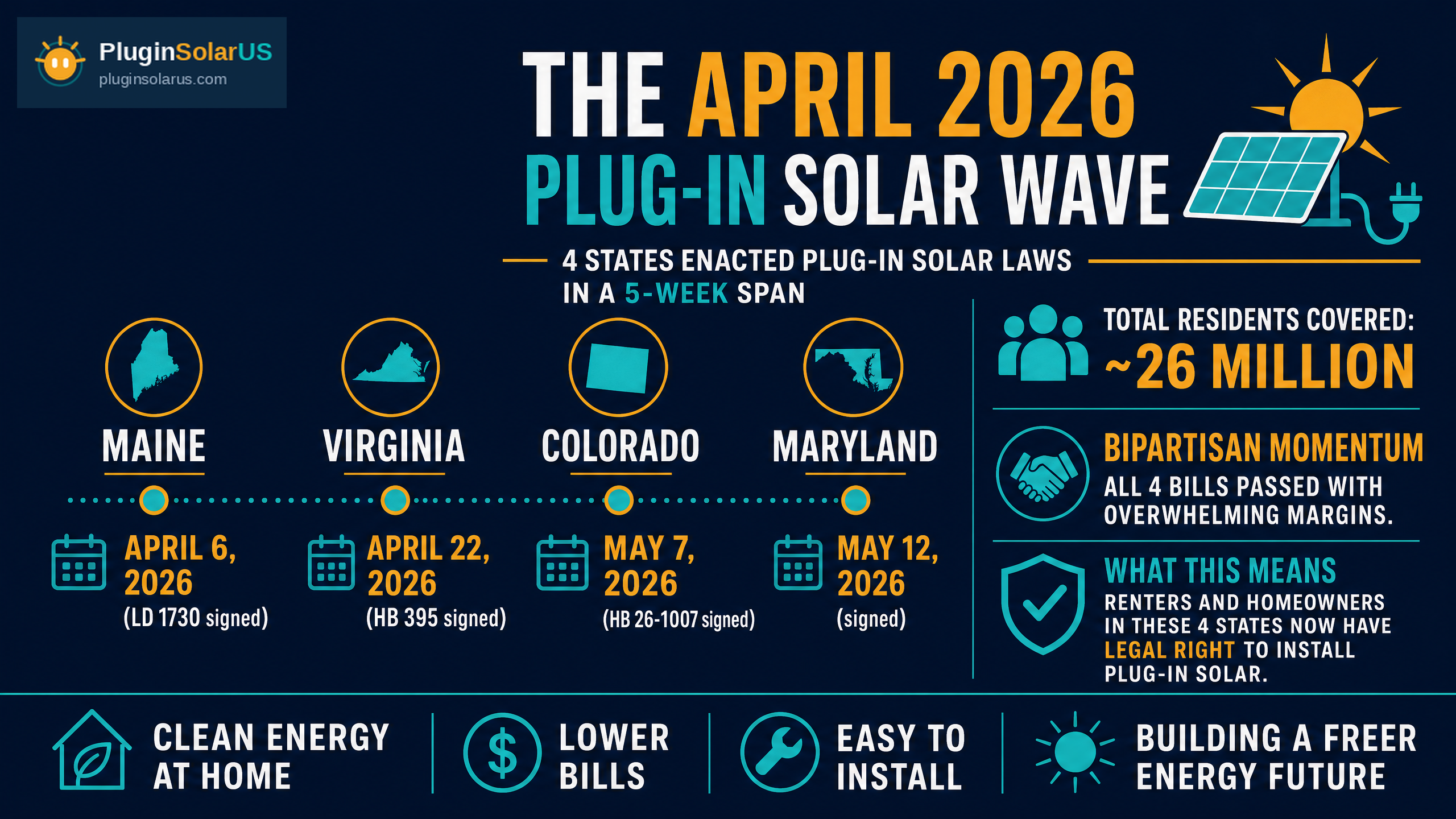
In the span of roughly two weeks, US plug-in solar policy moved faster than it had in the previous two years combined. Maine became the second state to sign plug-in solar legislation into law (April 6). Virginia became the third (April 22, Chapter 1052). Maryland's Utility RELIEF Act passed both chambers and was enrolled. And Colorado's HB 26-1007 — carrying the highest wattage limit of any US plug-in solar bill at 1,920W — cleared both chambers on April 14.
This is not coincidence. It is the result of a multi-year legislative groundwork campaign, accelerating electricity prices, and a growing national consensus that renters and apartment dwellers deserve access to solar energy. Here is a state-by-state account of what happened, what it means, and what comes next.
The April 2026 Scorecard
| State | Bill | Status (April 15, 2026) | Max Wattage | Effective Date |
|---|---|---|---|---|
| Utah | HB 340 (2025) | ✅ Enacted — In Effect | 1,200W | March 2025 |
| Maine | LD 1730 | ✅ Signed April 6, 2026 | 1,200W | July 2026 |
| Virginia | HB 395 | ✅ Signed April 22, 2026 (Chapter 1052) | 1,200W | January 1, 2027 |
| Maryland | HB 1532 | ✅ Signed May 12, 2026 (Ch. 353) | 1,200W | Effective immediately |
| Colorado | HB 26-1007 | ✅ Signed May 7, 2026 | 1,920W | Jan 1, 2027 |
Maine: The Second State Signs
Governor Janet Mills signed LD 1730 on April 6, 2026, making Maine the second US state to explicitly legalize plug-in solar. The context matters: more than 70% of Mainers report struggling to pay electricity bills, and Central Maine Power rates have risen 68% over the past five years. At 27.9¢/kWh — one of the highest electricity rates in the country — an 800W plug-in solar system saves an estimated $270 per year, with a payback period of roughly five years at no subsidies.
LD 1730 creates two installation tiers: systems at or below 420W are DIY-allowed with no utility notification required; systems between 420W and 1,200W require a licensed electrician and utility notification within 30 days. Crucially, Maine's law is the first in the US to specifically reference UL 3700 — the national plug-in solar safety standard published in December 2025 — establishing a clear product certification baseline for the state.
For the full Maine analysis, see our dedicated Maine LD 1730 article.
Virginia: Signed Into Law — April 22, 2026
Virginia's HB 395 had passed both chambers and was sent back to the House with minor technical amendments (a Governor's Recommendation) on April 11. The House and Senate both concurred unanimously on April 22, 2026. Governor Abigail Spanberger signed the bill as Chapter 1052 on April 22, making Virginia the third US state to explicitly legalize plug-in solar.
The law allows systems up to 1,200W for renters and homeowners. Core provisions (installation rights, watt cap, landlord/HOA protections) are active July 1, 2026; the SCC notification form takes effect January 1, 2027. For the full analysis, see our dedicated Virginia HB 395 article or the Virginia state detail page.
Governor Wes Moore signed Maryland's Utility RELIEF Act (HB 1532) into law on May 12, 2026 as Chapter 353, making Maryland the 5th US state to enact plug-in solar legislation. The bill passed the House 108–25 in early March and cleared the Senate before the April 13 session deadline.
HB 1532 allows systems up to 1,200W, with systems at or below 391W exempt from UL certification requirements. Utilities cannot require approval before installation. The law applies to both renters and homeowners. The law is effective immediately upon enactment.
Maryland's 20.3¢/kWh average electricity rate (BGE territory) means an 800W system would save an estimated $195 per year. With a ~$1,500 entry-level system, payback occurs in roughly 7–8 years without subsidies. See the Maryland state detail page for the full analysis.
<Colorado: The Highest Limit in the Country — Signed May 7, 2026
Governor Jared Polis signed Colorado HB 26-1007 into law on May 7, 2026, making Colorado the 4th US state to enact plug-in solar legislation. The law allows systems up to 1,920W — 60% higher than the 1,200W limit in Utah, Maine, and Maryland — and also covers meter-collar adapters, a device category that enables higher-output installations without roof modifications. Utilities cannot require pre-approval and HOAs cannot ban qualifying systems. The rules take effect January 1, 2027.
>Colorado's average electricity rate of 14.8¢/kWh is lower than Maine or Maryland, but the 1,920W limit means a fully loaded system could offset significantly more consumption. An 1,800W system at 14.8¢/kWh saves an estimated $340 per year. See the Colorado state detail page for the full analysis.
Why April 2026 Is a Turning Point
The simultaneous movement of four state bills in a single month is not coincidental. Several structural factors are converging:
Electricity prices are at historic highs. The EIA reports that US residential electricity prices rose 4.2% in 2025, with Northeast states seeing increases of 8–12%. Maine, Maryland, and Virginia all rank in the top 15 most expensive states for residential electricity. Plug-in solar is no longer a niche technology — it is a direct response to a household budget crisis.
UL 3700 removed the safety objection. For years, utility opposition to plug-in solar centered on safety concerns about unregulated backfeeding. The publication of UL 3700 in December 2025 gave legislators a credible safety standard to reference, neutralizing the primary technical objection. Maine's LD 1730 is the first enacted law to cite UL 3700 by name.
The renter equity argument is resonating. Approximately 44 million US households rent. Traditional rooftop solar requires landlord approval, roof access, and a long-term lease commitment — effectively excluding renters from the clean energy transition. Plug-in solar changes that calculus. Every state bill in this wave explicitly applies to renters, not just homeowners.
Utah's 2025 law provided a template. Utah's HB 340 passed unanimously in both chambers in 2025, giving other state legislatures a proven legislative model to adapt. The two-tier installation structure in Maine's LD 1730 closely mirrors Utah's approach, and Maryland and Colorado bills draw from the same framework.
What This Means for Industry
For companies operating in the plug-in solar space — manufacturers, distributors, installers, and retail energy providers — April 2026 represents the beginning of a defined regulatory market. Utah has been in effect since March 2025. Maine takes effect in July 2026. Maryland took effect immediately upon signing (May 12, 2026). Virginia's first-enactment provisions take effect January 1, 2027, after its SCC form and safety-workgroup milestones. Colorado takes effect January 1, 2027.
The companies positioning now — building distribution networks, training installation teams, and establishing utility relationships in these states — will have a significant first-mover advantage before the category reaches mainstream consumer awareness. For a deeper analysis of the B2B opportunity, see our industry opportunity whitepaper.
Track Every State in Real Time
23 additional states have active plug-in solar bills in 2026. The State Tracker is updated in real time as bills advance, governors sign, and new legislation is introduced. Sign up for state-specific alerts to be notified the moment your state's bill moves.
Further Reading
- Breaking: Maine Becomes Second State to Legalize Plug-In Solar
- Plug-In Solar Legislation Roundup: What's Moving in 2026
- Maryland HB 1532 — Full Bill Summary and What It Means for Residents
- Colorado HB 26-1007 — Full Bill Summary and What It Means for Residents
- Savings Calculator — Estimate your annual savings by state