Virginia HB 395: What the Balcony Solar Bill Means for Renters and Homeowners
By PlugInSolarUS Editorial Team · Published 2026-04-20 · Updated August 26, 2026 · 9 min read
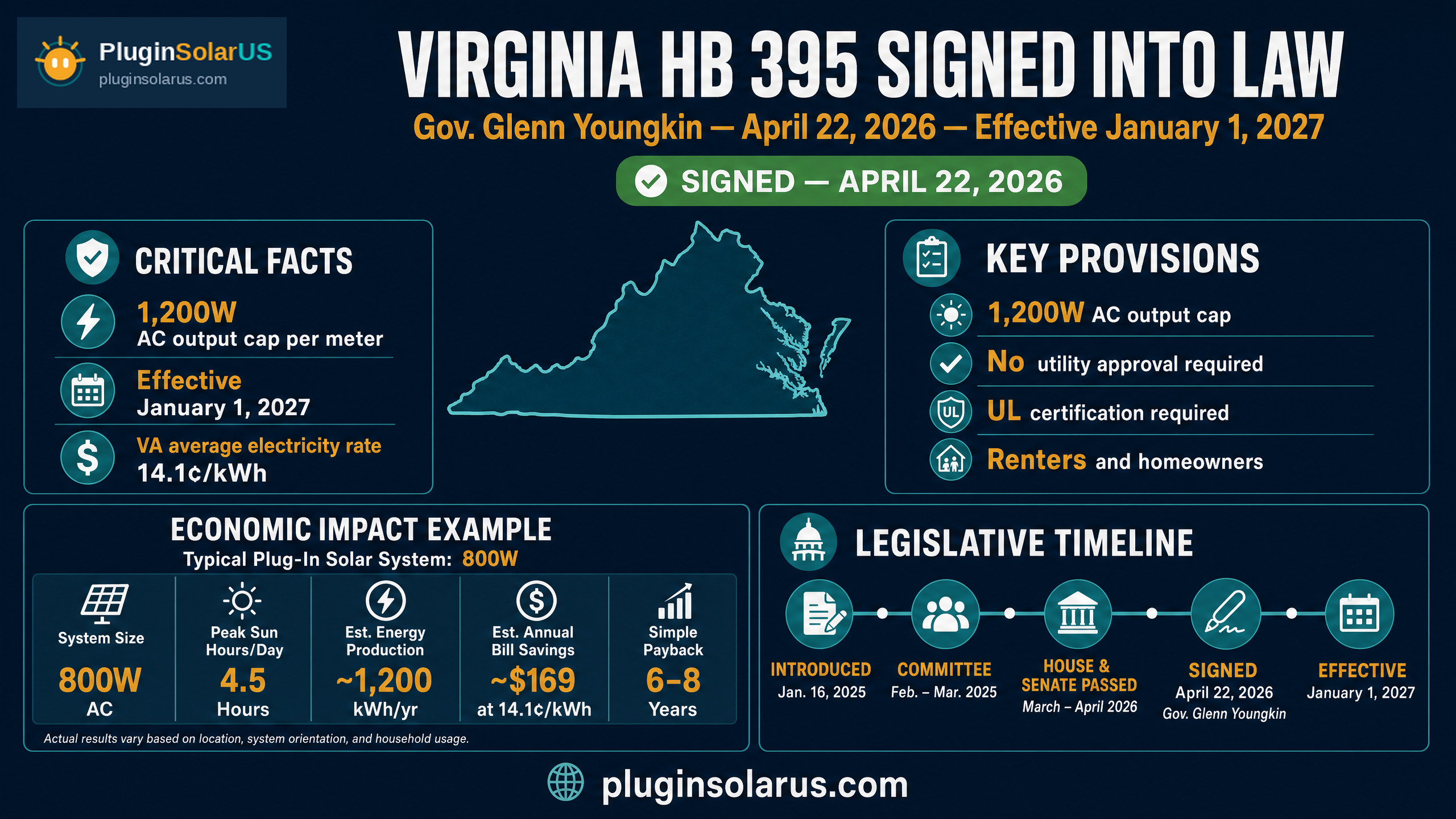
Virginia Governor Spanberger signed HB 395 into law on April 22, 2026 (Chapter 1052), making Virginia the third US state to explicitly legalize plug-in solar. Here's exactly what the law does, what it doesn't do, and how much you could save.
Virginia HB 395: What the Balcony Solar Law Means for Renters and Homeowners
Virginia is now the third state in the country to explicitly legalize plug-in solar — and it did so with a vote that was about as close to unanimous as state legislation gets. Governor Spanberger signed House Bill 395 into law on April 22, 2026 as Chapter 1052. The bill had passed the Virginia House of Delegates 97–1 and cleared the Senate 30–8, with both chambers later concurring in the Governor’s recommended amendments by votes of 99–0 (House) and 28–11 (Senate).[1] That kind of bipartisan agreement is rare in Richmond, and it reflects something real: electricity bills in Virginia are rising fast, and lawmakers on both sides of the aisle are hearing about it from constituents.
This article breaks down exactly what the new law does, what it doesn’t do, what it means for renters and homeowners, and how much money a Virginia household can realistically expect to save.
The Bill: What HB 395 Actually Says
HB 395, sponsored by Del. Paul Krizek (D-Fairfax) and its Senate companion SB 250, sponsored by Sen. Scott Surovell (D-Fairfax), creates a new legal category in Virginia law for “small portable solar generation devices.” The definition is specific: a moveable photovoltaic device that connects to an electrical outlet on the customer’s side of the meter, produces no more than 1,200 watts per dwelling, includes an anti-islanding feature that prevents backfeed during grid outages, and is certified by a nationally recognized testing laboratory such as UL or Intertek.[2]
The bill’s most important practical effect is what it removes. Under current Virginia law, connecting any generation device to the grid requires an interconnection agreement with the utility — a process that can take months and cost hundreds of dollars. HB 395 exempts qualifying plug-in solar devices from that requirement entirely. Utilities cannot impose interconnection requirements, charge any fee related to the device, or require prior approval before a customer installs or uses a qualifying system.[2]
The bill does require customers to notify their utility before installing a device. The State Corporation Commission (SCC) is directed to develop and publish a standard notification form — a simple administrative step, not an approval process. The Secretary of Commerce and Trade is also directed to convene a work group to evaluate and develop recommendations on safety standards, which will inform any future updates to the housing code.[2]
| Provision | What HB 395 Says |
|---|---|
| Maximum system size | 1,200 watts per dwelling |
| Certification required | Yes — nationally recognized testing lab (UL, Intertek, etc.) |
| Anti-islanding required | Yes — must prevent backfeed during grid outages |
| Interconnection agreement | Not required for qualifying devices |
| Utility fees or prior approval | Prohibited |
| Customer notification to utility | Required (SCC will publish standard form) |
| Landlord prohibition (4+ units) | Prohibited — landlords cannot ban qualifying systems |
| Landlord placement restrictions | Permitted — reasonable restrictions on size and placement allowed |
| Net metering credit | Not eligible — devices excluded from net metering programs |
| Consumer protection | Devices classified as “goods” under Virginia Consumer Protection Act |
| Effective dates | First-enactment provisions: January 1, 2027; SCC form due: September 1, 2026; safety report due: November 15, 2026 |
Current Status: Signed as Chapter 1052
Governor Abigail Spanberger signed HB 395 into law on April 22, 2026 as Chapter 1052, after the General Assembly considered her recommended technical amendments. The enacted chapter sets separate milestones: the SCC notification form is due on or before September 1, 2026, the safety-workgroup report is due November 15, 2026, and the statutory provisions in the first enactment take effect January 1, 2027.[3]
The signed version retains the central consumer framework described in this guide, including the 1,200W limit, anti-islanding and recognized-laboratory certification requirements, the qualifying-device interconnection exemption, utility notification, and the law’s renter protections. For the broad current status and implementation resources, use the Virginia plug-in solar state page.
Why Virginia Needs This: The Electricity Cost Context
Virginia’s electricity bills have been rising faster than almost anywhere else in the country, and the reason is not hard to find. Northern Virginia is the largest data center market in the world, accounting for 13% of all reported global data center operational capacity.[6] Data Center Alley in Loudoun County alone processes an estimated 70% of global internet traffic. Virginia’s data centers now consume more than one in four kilowatt-hours of the state’s total electricity — an estimated 32 TWh out of 128 TWh annually — and that share is growing.[7] Dominion Energy projects overall electricity demand in Virginia will double by approximately 2035, driven almost entirely by data center growth.[8]
That demand growth translates directly into higher bills for every Virginia household. Dominion Energy, which serves most of the state, raised residential rates in 2026 by an average of $11.24 per month and has proposed an additional 12.7% residential rate increase starting July 2026 — roughly $20 more per month on top of the 2026 increase.[9] Virginia’s average residential electricity rate is currently 16.43¢/kWh, and Dominion’s basic residential customers typically pay between 16 and 18¢/kWh depending on season.[10]
Del. Krizek, who sponsored HB 395, put it plainly: the bill “makes clean energy more affordable, more accessible, more practical for everyday Virginians by removing the red tape.”[11] Sen. Surovell told his colleagues on the Senate floor that the savings from plug-in solar panels “pay for themselves in two to five years.”[11]
How Much Can You Actually Save?
Virginia averages approximately 4.5 peak sun hours per day — slightly higher in the Tidewater and Hampton Roads region (~4.8 hours), slightly lower in the mountainous western part of the state (~4.0 hours), and around 4.2–4.4 hours in the Northern Virginia suburbs. Using the statewide average, a 1,200W plug-in solar system generates approximately:
1,200W × 4.5 hours/day × 365 days × 0.85 efficiency = ~1,675 kWh/year
At Virginia’s current average rate of 16.43¢/kWh, that translates to approximately $275 in annual savings. A local analysis by the Fredericksburg Advance estimated a fixed ground-mounted 1,200W system would generate 1,800 kWh annually and save approximately $270 per year at current rates.[12] The Virginia Mercury reported an estimate of “$100 a year, or more” for smaller starter systems.[11]
| System Size | Est. Annual Generation | Est. Annual Savings (at 16.43¢/kWh) | Typical System Cost | Est. Payback Period |
|---|---|---|---|---|
| 400W (starter) | ~558 kWh | ~$92 | $400–$700 | 4–8 years |
| 800W (mid-range) | ~1,116 kWh | ~$183 | $700–$1,200 | 4–7 years |
| 1,200W (maximum allowed) | ~1,675 kWh | ~$275 | $1,000–$2,000 | 4–7 years |
These estimates assume self-consumption of all generated electricity (no net metering credit, since HB 395 devices are excluded from net metering programs). As Dominion Energy’s rates continue rising — with another increase proposed for July 2026 — the annual savings figure will grow accordingly, shortening the payback period.
Adding a battery storage unit (typically 1–3 kWh for plug-in solar systems) can further improve the economics by allowing households to shift stored solar energy to peak-rate hours. Dominion Energy’s Off-Peak Plan charges between 16 and 18¢/kWh at standard times; a battery can help maximize use of solar generation during the highest-cost windows.
What This Means for Renters
HB 395’s most significant innovation for Virginia is its tenant protection provision. The bill prohibits landlords who own more than four rental dwellings from banning the installation of qualifying plug-in solar devices. This covers the vast majority of apartment buildings and large rental properties in the state — the exact population that has historically been locked out of solar entirely.
Landlords retain the right to set “reasonable restrictions” on placement and size — for example, specifying that panels must be mounted on a balcony railing rather than the building facade, or limiting the number of panels per unit. Tenants are required to notify both the landlord and the utility before installing. But the key protection is the prohibition on outright bans: a landlord in a covered property cannot simply say “no solar.”[2]
Del. Krizek, who represents Fairfax County — one of the most densely rented jurisdictions in Virginia — highlighted the equity dimension: “The big thing is it’s a way that suburban and urban areas can participate in solar.”[11] For the hundreds of thousands of Virginians renting apartments in Northern Virginia, Richmond, Hampton Roads, and Charlottesville, HB 395 creates a legal right they have never had before.
What HB 395 Does Not Cover
It is worth being clear about the bill’s limits. The 1,200W cap means a qualifying system can offset a meaningful but partial share of a household’s electricity use — typically 10%–20% of average Virginia consumption. The average Virginia household uses approximately 1,100 kWh per month (13,200 kWh/year), so a 1,200W system generating ~1,675 kWh/year covers roughly 13% of that total.
HB 395 devices are explicitly excluded from Virginia’s net metering programs. This means that if your system generates more electricity than you are consuming at a given moment, the excess flows into the building’s wiring but you do not receive a credit from the utility for it. The economics of plug-in solar in Virginia are built entirely on self-consumption — using the solar power you generate as you generate it, rather than exporting it for credit.
The bill also does not apply to landlords with four or fewer rental dwellings. A small-scale landlord renting out a single-family home or a two-unit property is not covered by the tenant protection provision, though they are also not prohibited from allowing installation if they choose to.
Virginia in the National Context
Utah enacted the first U.S. plug-in solar law in March 2025 (HB 340), with a 1,200W limit and an exemption from interconnection permits. Maine signed LD 1730 into law on April 6, 2026. Virginia signed HB 395 (Chapter 1052) on April 22, 2026. Colorado signed HB 26-1007 on May 7, 2026 — the highest wattage limit of any US plug-in solar law at 1,920W. Maryland signed HB 1532 (Chapter 353) on May 12, 2026 (5th state). Connecticut signed HB 5340 on May 20, 2026 (6th state). New Hampshire signed SB 540-FN in June 2026 (7th state). Vermont signed S. 202 on June 16, 2026 (8th state).
Virginia’s bill is notable for its strong tenant protection language, which goes further than Utah’s law in explicitly addressing the renter population. The National Caucus of Environmental Legislators noted that “Virginia became the first state this session to pass legislation that reduces regulatory barriers to plug-in solar” and highlighted the bill as a model for other states.[13]
What You Can Do Now
HB 395’s first-enactment provisions take effect January 1, 2027. Consumers can use the implementation period to verify the current notification process, research qualifying equipment, review the building’s electrical setup, and discuss placement with a landlord when applicable.
- Check your outlet situation. HB 395 requires connection "through an electrical outlet." While the law does not mandate GFCI protection, using a GFCI-protected outlet is strongly recommended as a best practice. If you’re not sure about your outlet situation, an electrician can assess it in a short visit. Our Readiness Checker can help you think through the key questions.
- Estimate your savings. Use our Savings Calculator to get a location-specific estimate based on your zip code and real EIA utility rate data for your area.
- Talk to your landlord now. If you rent, starting the conversation before January 1, 2027 gives your landlord time to understand the law and set any reasonable placement restrictions in advance. Our Landlord Letter Generator can help you draft a professional, factual request.
- Research systems. A 1,200W system is the maximum under HB 395. Our Buyer’s Guide walks through what to look for in a UL-certified system, including inverter type, panel efficiency, and battery compatibility.
- Stay informed. Monitor the latest news on our Virginia State Page, which is updated as the SCC notification form (January 1, 2027) effective date approaches.
Further Reading
- Virginia State Detail Page — HB 395 full summary and timeline
- Plug-In Solar 101: What It Is, How It Works, and Whether It’s Right for You
- Renters’ Guide to Plug-In Solar
- The AI Energy Crisis Is Your Electric Bill Problem — And Plug-In Solar Is Part of the Answer
- Breaking: Maine Becomes Second State to Legalize Plug-In Solar
- Savings Calculator — Estimate your annual savings in Virginia
Sources
- Utility Dive: Virginia Legislature Passes Balcony Solar Bill (March 12, 2026)
- Virginia Legislative Information System: HB 395 — 2026 Regular Session
- Legiscan: VA HB 395 — 2026 Regular Session (Governor’s Action Deadline April 13, 2026)
- Reddit r/Virginia: No Balcony Solar in Virginia Yet — Spanberger Sent It Back on 4/11 (April 2026)
- PV Magazine: Virginia Becomes Second U.S. State to Advance Plug-In Solar Legislation to the Governor’s Desk (March 12, 2026)
- JLARC: Data Centers in Virginia — 2024 Report
- ElectricChoice: U.S. Data Center Power Consumption Map by State (2026)
- PECVA: Data Centers & Energy Demand in Virginia
- WJLA: Energy Bills to Go Up for Virginians in 2026 and 2027 (November 2025)
- ElectricChoice: Virginia Electricity Prices (April 2026)
- Virginia Mercury: Plug-In Solar Panels Near Approval by General Assembly (March 10, 2026)
- Fredericksburg Advance: Environmental Cents — Time for Solar? (April 2026)
- NCEL: Virginia Leads the Way on Energy Affordability in 2026 (March 2026)
Related Articles
- Behind the Bill: How Virginia Turned a Constituent Idea Into a Plug-In Solar Law — Del. Paul Krizek and Virginia climate advocate Jamie Bacon show how one constituent email about Utah’s balcony-solar law helped spark a coalition, companion bills, and a new pathway for renters and homeowners.
- Virginia Plug-In Solar: A Complete Guide for Renters and Apartment Dwellers — Virginia's HB 395 establishes protections for qualifying small portable solar devices. Learn the confirmed renter protections, equipment safeguards, and the distinction between the law and SCC process guidance still being developed.
- Virginia’s New Energy Plan: The Role of Home Solar, Batteries, and Flexible Demand — Virginia’s 2026 Energy Plan puts solar, batteries, and flexible electricity use into its long-term grid roadmap. Here is what the plan’s four pathways mean for households—and what they do not create today.
New: Find your plug-in solar fit
Our new Product Finder makes it easier to discover and compare plug-in solar kits and components across brands. See panel DC and inverter AC output alongside listed prices, known shipping, and required fees to find options worth exploring. Find and compare products.
Sources
- Virginia LIS: HB 395 — 2026 Regular Session
- Virginia Mercury: Plug-in solar panels near approval by General Assembly
- PV Magazine: Virginia becomes second U.S. state to advance plug-in solar legislation
- Utility Dive: Virginia legislature passes balcony solar bill
- JLARC: Data Centers in Virginia
- PECVA: Data Centers & Energy Demand in Virginia
- ElectricChoice: Virginia Electricity Prices (April 2026)
- WJLA: Energy bills to go up for Virginians in 2026 and 2027
- EESI: Data Center Power Demands Contributing to Higher Energy Bills
- Fredericksburg Advance: Time for Solar? (savings estimate)
- NCEL: Virginia Leads the Way on Energy Affordability in 2026
- Legiscan: VA HB 395 — 2026 Regular Session
- Dominion Energy: Understanding Rates (2026 increase)
- Virtue Solar: Plug-In Solar (Balcony Solar) Is Coming to Virginia